
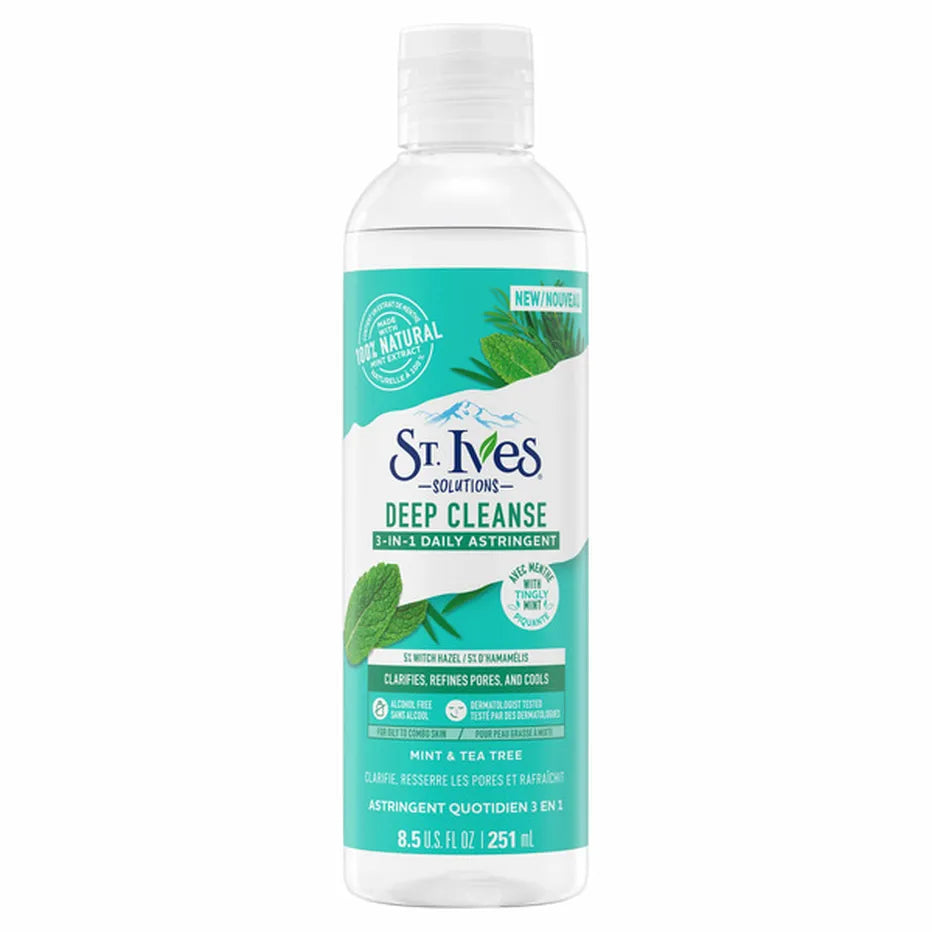

St. Ives
Deep Cleanse 3-in-1 Daily Astringent

Deep Cleanse 3-in-1 Daily Astringent
St. Ives
deep-cleanse-3-in-1-daily-astringent
Tone
9706830889253
Morning or Evening?
How often will you use this product?
Notes


Highlights
WHAT IS IT?
Astringent toner with 21 ingredients
FEATURES
Alcohol-free, Paraben-free, Oil-free, Non-comedogenic, Dermatologist-tested
BEST FOR
Oily to combination skin
CHECKS
Free of paraben
Who Is It For?
Adults Women And MenWhat Does It Help With?
Clarifies Skin Refines Pores Removes Excess OilBudget
AffordableHow To Use
Which routine should it be used in?
Instructions:
Key Information


What St. Ives Says
Product Description:
There's fresh. And there's tingly fresh. Introducing new St Ives 3-in-1 Daily Astringent – an alcohol-free face toner with 5% witch hazel and three types of skin-tingly mint. Clarify skin and refine pores with a blast of minty freshness you can feel, plus 0% alcohol to unclog pores and wash away excess oil, without drying skin. Perfect for oily to combo skin!
About the Brand:
Ingredients Overview
Ingredients List
Water (eau), leaf water, hexylene glycol, polysorbate 20, glycerin, salicylic acid, peg-6 caprylic/capric glycerides, fragrance (parfum), sodium hydroxide, phenoxyethanol, citric acid, tetrasodium edta, sodium benzoate, cetrimonium chloride, cetylpyridinium chloride, potassium sorbate, melaleuca alternifolia (tea tree) flower/leaf/stem extract, mentha viridis (spearmint) leaf extract, mentha piperita (peppermint) leaf extract, benzyl alcohol, benzyl benzoate, citronellol, coumarin, eugenol, hexyl cinnamal, limonene, linalool
Key Ingredients
Witch hazel, Tea tree extract, Spearmint leaf extract, Peppermint leaf extract
Ingredients Details
Fragrance Parfum
Common Name(s): Fragrance parfum
DESCRIPTION
What It Does: Delivers targeted skin-conditioning or bioactive benefits through a specific mechanism of action suited to the formulation's intended purpose.
Why It's Used: Specialty actives address specific skin concerns through targeted molecular mechanisms, providing efficacy beyond what base formulation ingredients alone can achieve.
How It Works: The bioactive compound interacts with specific molecular targets in skin cells or the extracellular matrix — enzymes, receptors, structural proteins, or signaling molecules — triggering beneficial biological responses.
Typically Found In: Serums,treatments,moisturizers,specialty products
TECHNICAL DETAILS
Primary Category: Specialty actives
Secondary Functions: Skin-conditioning,anti-aging
Application Areas:

Facial Skincare

Body Care
Hair Care
Beard Care
Color Cosmetics (Makeup)
Dietary/Oral Supplements
Typical Concentration Range: 0.01–5%
SOURCING & ETHICS
Vegan Status: Conditional - supplier confirmation required
Halal Status: Unverified - supplier confirmation required
Source Notes: Specialty active ingredient; check individual sourcing for vegan status. [audit 2026-07-29 rev2: the record's own source_notes does not assert a non-animal origin, or instructs the reader to verify with the supplier; "yes" asserts knowledge the record does not hold. determination requires shariah-panel sign-off.]
SKIN COMPATIBILITY
Irritancy Rating: 1899-12-31 00:00:00 -0800
Sensitivity Concerns: Fragrance sensitization possible; contains allergens that may require labeling under eu regulations.
Safe for Sensitive Skin: Yes
SAFETY & COMPATIBILITY
Safety Profile: Well-characterized cosmetic ingredient with established safety profile. generally non-irritating at typical use concentrations. suitable for leave-on and rinse-off cosmetics.
Works Well With: Niacinamide,hyaluronic acid,vitamin c,peptides
Avoid Combining With: Incompatible with oxidizing agents; check ph stability
SCIENTIFIC NOTE
Specialty actives typically work through enzyme inhibition (e.g., tyrosinase inhibition for brightening, mmp inhibition for anti-aging), receptor activation (e.g., retinoid receptors, ppar-γ for barrier genes), or transcription factor modulation (e.g., nrf2 for antioxidant gene upregulation). structure-activity relationships determine potency and selectivity.
Last Verified: 2025-01-15
Primary Sources: Cosing eu database; pcpc cosmetic ingredient safety reviews; ingredient-specific safety and efficacy literature
Glycerin
Common Name(s): Glycerol,glycerine,1,2,3-propanetriol
CAS Number: 56-81-5
DESCRIPTION
What It Does: Glycerin pulls water from the environment and deeper skin layers into the outer skin layer (epidermis), boosting moisture levels and keeping skin soft, smooth, and plump.
Why It's Used: It is used in virtually every moisturizer, serum, and cleanser because it is highly effective at hydrating skin, is well-tolerated by all skin types, and enhances the texture and spreadability of formulations.
How It Works: As a humectant, glycerin forms hydrogen bonds with water molecules, trapping them in the skin. it also reinforces the skin barrier by integrating into lipid structures between skin cells.
Typically Found In: Moisturizers,serums,cleansers,toners,sheet masks,sunscreens,body lotions,shampoos,conditioners
TECHNICAL DETAILS
Primary Category: Humectant
Secondary Functions: Skin barrier support,emollient,solvent
Application Areas:
Facial Skincare
Body Care
Hair Care
Beard Care
Color Cosmetics (Makeup)
Dietary/Oral Supplements
Typical Concentration Range: 1%–30% (typical: 3–10%)
SOURCING & ETHICS
Vegan Status: Conditional - feedstock declaration required
Halal Status: Unverified - feedstock declaration required (plant, animal and petrochemical routes all exist)
Source Notes: Derived from plant oils via hydrolysis or saponification; synthetic versions also available. palm-derived glycerin carries sustainability concerns. [audit 2026-07-29 rev2: origin-dependent: the same inci exists in plant, animal and petrochemical versions and the name does not discriminate. determination requires shariah-panel sign-off.]
SKIN COMPATIBILITY
Irritancy Rating: 1/5 – very low; non-irritating at all standard concentrations
Comedogenicity Rating: 0/5 – non-comedogenic
Sensitivity Concerns: Extremely rare allergic reactions; generally safe for all skin types including sensitive and baby skin
Safe for Sensitive Skin: Yes
SAFETY & COMPATIBILITY
Safety Profile: Widely recognized as safe. ewg hazard score: 1. no significant concerns for irritation, sensitization, or toxicity at typical concentrations (up to 50%).
Works Well With: Hyaluronic acid,ceramides,niacinamide,panthenol,urea,peptides,retinol,ahas/bhas
Avoid Combining With: No known incompatibilities at standard concentrations
SCIENTIFIC NOTE
Glycerin is an endogenous skin component found naturally in the stratum corneum. aquaporin-3 channels in keratinocytes facilitate glycerin transport, making it integral to natural skin hydration pathways.
Last Verified: 2026-03-12
Primary Sources: Cosing database,cir safety assessment,ewg skin deep,inci decoder
Hexylene Glycol
Common Name(s): Hexylene glycol,glycol co-solvent,humectant formulation aid
CAS Number: N/a
DESCRIPTION
What It Does: Provides humectant and co-solvent with mild antimicrobial in cosmetic formulations, improving active ingredient dissolution and product texture while delivering mild skin conditioning.
Why It's Used: Glycol solvents are essential for dissolving actives with limited water or oil solubility — the intermediate polarity of glycol ethers provides access to the wider solubility parameter space between pure water and oil phases.
How It Works: Hydroxyl and ether groups provide h-bonding for water miscibility; the organic chain provides compatibility with lipophilic actives. medium-chain glycols (c3–c6) provide the optimal balance of water compatibility, lipophilic active dissolution, and skin-compatible humectancy.
Typically Found In: Skin care formulations,co-solvent systems
TECHNICAL DETAILS
Primary Category: Functional ingredient – humectant
Secondary Functions: Tewl reduction,skin plumping
Application Areas:
Facial Skincare
Body Care
Hair Care
Beard Care
Color Cosmetics (Makeup)
Dietary/Oral Supplements
Typical Concentration Range: 1%–30%
SOURCING & ETHICS
Vegan Status: Conditional - supplier confirmation required
Halal Status: Unverified - supplier confirmation required
Source Notes: Synthetic or naturally derived. excellent aqueous solubility. [audit 2026-07-29 rev2: status downgraded on audit. determination requires shariah-panel sign-off.]
SKIN COMPATIBILITY
Irritancy Rating: 1/5 – very low
Comedogenicity Rating: 0/5 – non-comedogenic
Sensitivity Concerns: Non-irritating; suitable for all skin types.
Safe for Sensitive Skin: Yes
SAFETY & COMPATIBILITY
Safety Profile: Excellent safety profile. ewg score: 1.
Works Well With: Ceramides,emollients,occlusives,glycerin,hyaluronic acid
Avoid Combining With: No significant incompatibilities
SCIENTIFIC NOTE
Glycol ether co-solvents enhance sc penetration of co-applied actives by increasing their thermodynamic activity in the sc lipid phase — high thermodynamic activity (near saturation) drives diffusion by concentration gradient even when absolute concentration is low.
Last Verified: 2026-03-12
Primary Sources: Cosing database,hexylene glycol glycol solvent review
Peg-6 Caprylic/capric Glycerides
Common Name(s): Peg-6 caprylic/capric glycerides,peg-6 caprylic/capric glycerides ester,polyethylene glycol-6 caprylic/capric glycerides ester
DESCRIPTION
What It Does: Helps oil and water blend together in creams and lotions while conditioning and moisturizing skin.
Why It's Used: Selected for hlb ~7–9 o/w emulsification and skin conditioning; the caprylic/capric glycerides chain provides natural affinity with skin lipids.
How It Works: 6 eo units give hlb ~7–9; caprylic/capric glycerides tail provides oil-phase anchoring and skin conditioning; nonionic character enables broad ph compatibility and electrolyte tolerance.
Typically Found In: O/w emulsions,creams,lotions,skin conditioning products
TECHNICAL DETAILS
Primary Category: Functional ingredient – emulsifier
Secondary Functions: Skin conditioning,surfactant,moisturizing
Application Areas:
Facial Skincare
Body Care
Hair Care
Beard Care
Color Cosmetics (Makeup)
Dietary/Oral Supplements
Typical Concentration Range: 0.5%–5%
SOURCING & ETHICS
Vegan Status: Conditional - feedstock declaration required
Halal Status: Unverified - feedstock declaration required (plant, animal and petrochemical routes all exist)
Source Notes: Caprylic/capric acids from coconut; glycerol plant-derived; eo from petrochemical. [audit 2026-07-29 rev2: origin-dependent: the same inci exists in plant, animal and petrochemical versions and the name does not discriminate. determination requires shariah-panel sign-off.]
SKIN COMPATIBILITY
Irritancy Rating: 1/5 – very low
Comedogenicity Rating: 1/5 – low
Sensitivity Concerns: Generally well tolerated. peg-based; trace 1,4-dioxane concern for certified organic use.
Safe for Sensitive Skin: Yes
SAFETY & COMPATIBILITY
Safety Profile: Good safety profile. ewg score: 1–2.
Works Well With: Emollients,humectants,fatty alcohols,other peg emulsifiers
Avoid Combining With: No significant incompatibilities
SCIENTIFIC NOTE
Peg-6 esters of caprylic/capric glycerides provide hlb ~7–9, appropriate for o/w emulsification and/or solubilization depending on oil phase. c8/c10 glyceride peg-6; hlb ~7-9; balanced emulsification with mct-like skin feel.
Last Verified: 2026-03-27
Primary Sources: Cosing database,inci dictionary,specialchem formulations