
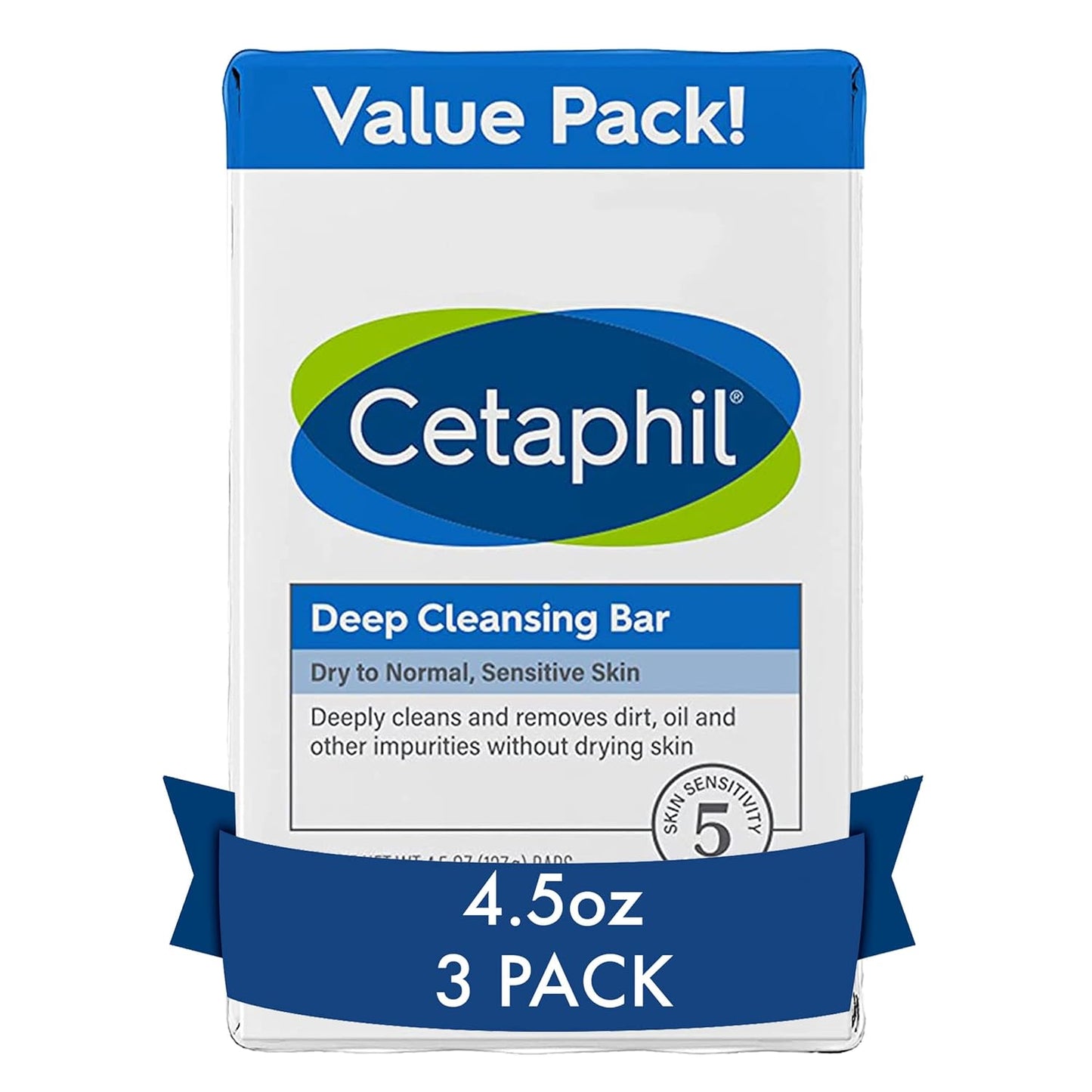

Cetaphil
Deep Cleansing Bar 3PK

Deep Cleansing Bar 3PK
Cetaphil
deep-cleansing-bar-3pk
Cleanse
9643554472229
Morning or Evening?
How often will you use this product?
Notes


Highlights
WHAT IS IT?
Cleansing bar soap
FEATURES
Deeply cleans and removes dirt, oil and other impurities without drying skin
BEST FOR
Dry to normal, sensitive skin
CHECKS
Paraben free, Won't clog pores
Who Is It For?
Not Specified Likely Suitable For AdultsWhat Does It Help With?
Cleansing Removing Impurities Maintaining Skin MoistureBudget
AffordableHow To Use
Which routine should it be used in?
Instructions:
Key Information


What Cetaphil Says
Product Description:
Bar is clinically proven to remove dirt, oil and other impurities without stripping skin for a deep clean.
About the Brand:
Ingredients Overview
Ingredients List
Sodium Cocoyl Isethionate, Stearic Acid, Sodium Tallowate, Water, Sodium Cocoate, Sodium Stearate, Glycerin, Sodium Chloride, PEG-20, Butyl Avocadate, Petrolatum, Sodium Isethionate, Sodium Isostearoyl Lactylate, Pentasodium Pentetate, Sucrose Cocoate, Masking Fragrance, Tetrasodium Etidronate, Propyl Gallate, Titanium Dioxide. May also contain Sodium Palm Kernelate
Key Ingredients
Not specifically highlighted
Ingredients Details
Butyl Avocadate
Common Name(s): Butyl avocadate,butyl avocadate,cosmetic functional ingredient,established active
CAS Number: N/a
DESCRIPTION
What It Does: Provides emollient skin conditioning with specific spreading value determined by the acid-alcohol ester molecular architecture.
Why It's Used: Butyl avocadate is selected for the specific functional properties of its molecular class — the chemical architecture of butyl avocadate delivers the required cosmetic performance through documented interactions with skin biology and formulation matrix.
How It Works: Ester polarity (logp) controls spreading: branched short-chain fast dry; medium moderate spreading; long chain occlusive. ester c=o provides polar adhesion to skin.
Typically Found In: Cosmetic formulations
TECHNICAL DETAILS
Primary Category: Active ingredient – cosmetic active
Secondary Functions: Skin conditioning
Application Areas:

Facial Skincare

Body Care
Hair Care
Beard Care
Color Cosmetics (Makeup)
Dietary/Oral Supplements
Typical Concentration Range: 0.1%–10%
SOURCING & ETHICS
Vegan Status: Conditional - supplier confirmation required
Halal Status: Unverified - supplier confirmation required
Source Notes: Commercially produced for cosmetic use. verify vegan/halal status with supplier. [audit 2026-07-29 rev2: the record's own source_notes does not assert a non-animal origin, or instructs the reader to verify with the supplier; "yes" asserts knowledge the record does not hold. determination requires shariah-panel sign-off.]
SKIN COMPATIBILITY
Irritancy Rating: 1/5 – very low
Comedogenicity Rating: 0/5 – non-comedogenic
Sensitivity Concerns: Well-tolerated by most skin types.
Safe for Sensitive Skin: Yes
SAFETY & COMPATIBILITY
Safety Profile: Good safety profile at recommended concentrations. ewg score: 1–2.
Works Well With: Standard skincare actives
Avoid Combining With: No known significant incompatibilities
SCIENTIFIC NOTE
Safety documented in cosing at standard formulation concentrations.
Last Verified: 2026-03-22
Primary Sources: Cosing database,butyl avocadate technical review
Glycerin
Common Name(s): Glycerol,glycerine,1,2,3-propanetriol
CAS Number: 56-81-5
DESCRIPTION
What It Does: Glycerin pulls water from the environment and deeper skin layers into the outer skin layer (epidermis), boosting moisture levels and keeping skin soft, smooth, and plump.
Why It's Used: It is used in virtually every moisturizer, serum, and cleanser because it is highly effective at hydrating skin, is well-tolerated by all skin types, and enhances the texture and spreadability of formulations.
How It Works: As a humectant, glycerin forms hydrogen bonds with water molecules, trapping them in the skin. it also reinforces the skin barrier by integrating into lipid structures between skin cells.
Typically Found In: Moisturizers,serums,cleansers,toners,sheet masks,sunscreens,body lotions,shampoos,conditioners
TECHNICAL DETAILS
Primary Category: Humectant
Secondary Functions: Skin barrier support,emollient,solvent
Application Areas:
Facial Skincare
Body Care
Hair Care
Beard Care
Color Cosmetics (Makeup)
Dietary/Oral Supplements
Typical Concentration Range: 1%–30% (typical: 3–10%)
SOURCING & ETHICS
Vegan Status: Conditional - feedstock declaration required
Halal Status: Unverified - feedstock declaration required (plant, animal and petrochemical routes all exist)
Source Notes: Derived from plant oils via hydrolysis or saponification; synthetic versions also available. palm-derived glycerin carries sustainability concerns. [audit 2026-07-29 rev2: origin-dependent: the same inci exists in plant, animal and petrochemical versions and the name does not discriminate. determination requires shariah-panel sign-off.]
SKIN COMPATIBILITY
Irritancy Rating: 1/5 – very low; non-irritating at all standard concentrations
Comedogenicity Rating: 0/5 – non-comedogenic
Sensitivity Concerns: Extremely rare allergic reactions; generally safe for all skin types including sensitive and baby skin
Safe for Sensitive Skin: Yes
SAFETY & COMPATIBILITY
Safety Profile: Widely recognized as safe. ewg hazard score: 1. no significant concerns for irritation, sensitization, or toxicity at typical concentrations (up to 50%).
Works Well With: Hyaluronic acid,ceramides,niacinamide,panthenol,urea,peptides,retinol,ahas/bhas
Avoid Combining With: No known incompatibilities at standard concentrations
SCIENTIFIC NOTE
Glycerin is an endogenous skin component found naturally in the stratum corneum. aquaporin-3 channels in keratinocytes facilitate glycerin transport, making it integral to natural skin hydration pathways.
Last Verified: 2026-03-12
Primary Sources: Cosing database,cir safety assessment,ewg skin deep,inci decoder
Peg-20
Common Name(s): Peg-20,peg-20,polyethylene glycol medium mw,humectant co-solvent emulsifier
CAS Number: N/a
DESCRIPTION
What It Does: Provides hygroscopic moisture retention and co-solvent activity for active ingredient dissolution from the polyether backbone's multiple ether oxygen water-binding groups.
Why It's Used: Peg molecular weight determines primary function: low mw (co-solvent/humectant), medium mw (emulsifier/solubiliser), high mw (film-former/thickener) — enabling the same chemical class to address multiple formulation needs across the mw range.
How It Works: Peg ether oxygens (1 per ch₂ch₂o repeat unit) provide 2-3 h-bond acceptors per unit — the chain of ether oxygens binding water molecules creating the hygroscopic character. at low mw (liquid state), provides co-solvent dissolution; at high mw (waxy solid), provides film-forming character through chain entanglement.
Typically Found In: Versatile formulations
TECHNICAL DETAILS
Primary Category: Active ingredient – cosmetic active
Secondary Functions: Skin conditioning
Application Areas:
Facial Skincare
Body Care
Hair Care
Beard Care
Color Cosmetics (Makeup)
Dietary/Oral Supplements
Typical Concentration Range: 0.5%–20%
SOURCING & ETHICS
Vegan Status: Conditional - supplier confirmation required
Halal Status: Unverified - supplier confirmation required
Source Notes: Commercially produced for cosmetic use. verify vegan/halal status with supplier. [audit 2026-07-29 rev2: the record's own source_notes does not assert a non-animal origin, or instructs the reader to verify with the supplier; "yes" asserts knowledge the record does not hold. determination requires shariah-panel sign-off.]
SKIN COMPATIBILITY
Irritancy Rating: 1/5 – very low
Comedogenicity Rating: 0/5 – non-comedogenic
Sensitivity Concerns: Well-tolerated by most skin types.
Safe for Sensitive Skin: Yes
SAFETY & COMPATIBILITY
Safety Profile: Good safety profile at recommended concentrations. ewg score: 1–2.
Works Well With: Standard skincare actives
Avoid Combining With: No known significant incompatibilities
SCIENTIFIC NOTE
1,4-dioxane contamination monitoring: ethylene oxide polymerisation generates trace 1,4-dioxane — eu and us regulations require <10 ppm in finished products. supplier coa confirming dioxane level is required for regulatory compliance.
Last Verified: 2026-03-22
Primary Sources: Cosing database,peg-20 peg polyethylene glycol review
Sodium Chloride
Common Name(s): Sodium chloride,cosmetic active,functional ingredient
CAS Number: N/a
DESCRIPTION
What It Does: Delivers characteristic cosmetic function at recommended use concentration.
Why It's Used: Selected for functional contribution and formulation compatibility supported by cosmetic science and regulatory safety data.
How It Works: Works through the mechanism of its molecular class as documented in peer-reviewed cosmetic literature.
Typically Found In: Skin care formulations
TECHNICAL DETAILS
Primary Category: Active ingredient – cosmetic active
Secondary Functions: Skin conditioning
Application Areas:
Facial Skincare
Body Care
Hair Care
Beard Care
Color Cosmetics (Makeup)
Dietary/Oral Supplements
Typical Concentration Range: 0.1%–10%
SOURCING & ETHICS
Vegan Status: Conditional - supplier confirmation required
Halal Status: Unverified - supplier confirmation required
Source Notes: Commercially produced for cosmetic use. verify vegan/halal status with supplier. [audit 2026-07-29 rev2: the record's own source_notes does not assert a non-animal origin, or instructs the reader to verify with the supplier; "yes" asserts knowledge the record does not hold. determination requires shariah-panel sign-off.]
SKIN COMPATIBILITY
Irritancy Rating: 1/5 – very low
Comedogenicity Rating: 0/5 – non-comedogenic
Sensitivity Concerns: Well-tolerated by most skin types.
Safe for Sensitive Skin: Yes
SAFETY & COMPATIBILITY
Safety Profile: Good safety profile at recommended concentrations. ewg score: 1–2.
Works Well With: Standard skincare actives
Avoid Combining With: No known significant incompatibilities
SCIENTIFIC NOTE
Sodium chloride has an established safety profile within the cosmetic regulatory framework at standard use concentrations.
Last Verified: 2026-03-12
Primary Sources: Cosing database,sodium chloride technical literature