
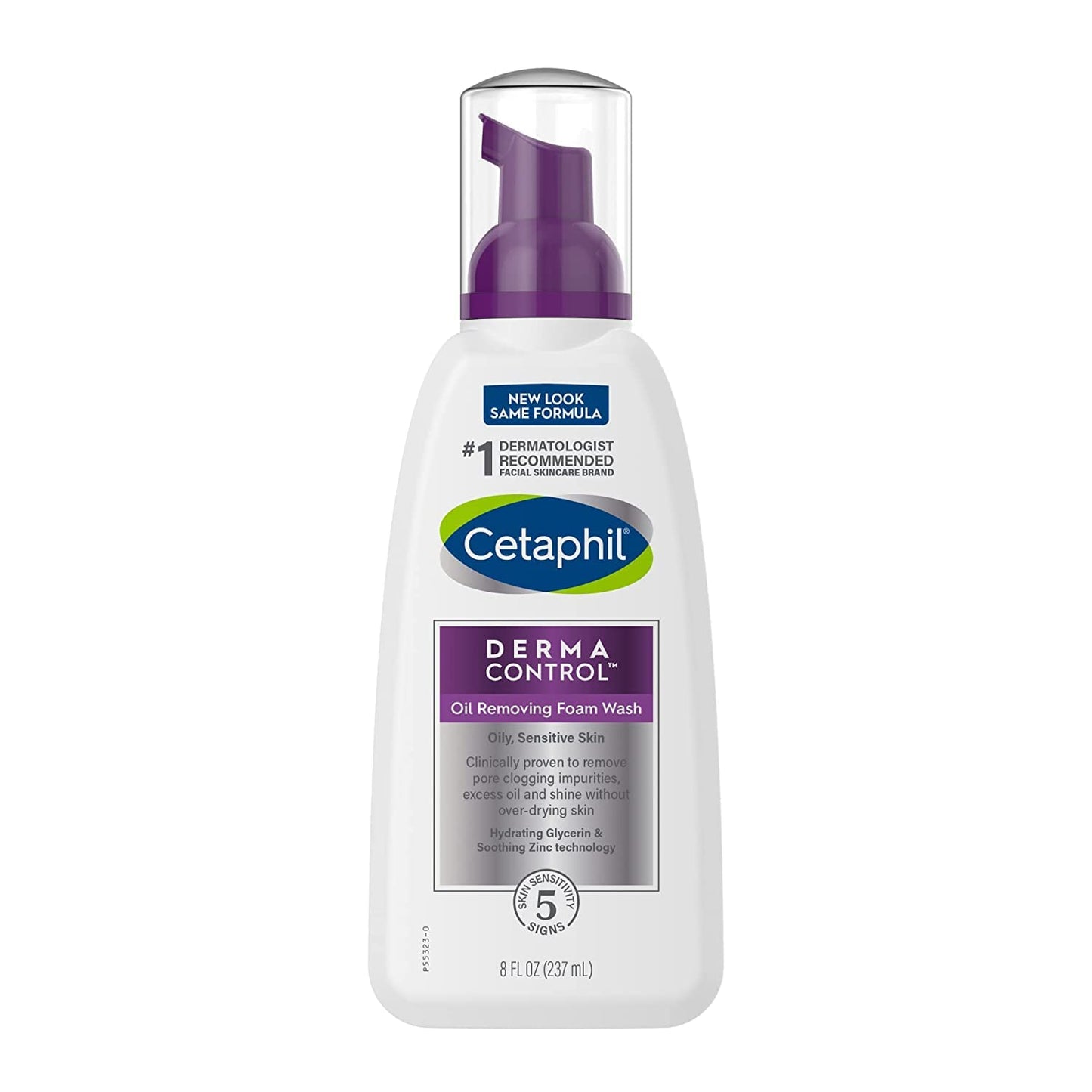

Cetaphil
DermaControl Oil Removing Foam Wash

DermaControl Oil Removing Foam Wash
Cetaphil
dermacontrol-oil-removing-foam-wash
Cleanse
9643553816869
Morning or Evening?
How often will you use this product?
Notes


Highlights
WHAT IS IT?
Foam cleanser with 17 ingredients
FEATURES
Clinically proven to effectively remove excess oil, without stripping or drying skin
BEST FOR
Oily, sensitive skin
CHECKS
Paraben-free, Oil-free, Won't clog pores
Who Is It For?
Above 18 Men And WomenWhat Does It Help With?
Excess Oil Pore-clogging Impurities Makeup RemovalBudget
AffordableHow To Use
Which routine should it be used in?
Instructions:
Key Information


What Cetaphil Says
Product Description:
Deep cleansing formula, dispensed through an instant foaming pump, gently removes pore clogging impurities, makeup and excess oil without over-drying skin.
About the Brand:
Ingredients Overview
Ingredients List
Water, Zinc Coceth Sulfate, Glycerin, PEG-75, Dipotassium Glycyrrhizate, Zinc Gluconate, PEG-200 Hydrogenated Glyceryl Palmate, PEG-40 Hydrogenated Castor Oil, PEG-7 Glyceryl Cocoate, Sodium Benzoate, Masking Fragrance, Disodium EDTA.
Key Ingredients
Zinc Coceth Sulfate, Glycerin, Zinc Gluconate
Ingredients Details
Dipotassium Glycyrrhizate
Common Name(s): Dpg,dipotassium glycyrrhizinate,glycyrrhizic acid potassium salt
CAS Number: 68797-35-3
DESCRIPTION
What It Does: Provides glycyrrhizic acid anti-inflammatory and cortisol-potentiating soothing activity.
Why It's Used: The anti-inflammatory licorice active — dipotassium glycyrrhizate provides stronger anti-inflammatory activity than glabridin-containing licorice extract, making it the preferred licorice active for anti-inflammatory formulations.
How It Works: Glycyrrhizic acid inhibits 11-beta-hsd (11-beta-hydroxysteroid dehydrogenase) which inactivates cortisol to cortisone. local cortisol levels increase providing anti-inflammatory activity analogous to mild topical corticosteroid. also inhibits phospholipase a2 and prostaglandin synthesis directly.
Typically Found In: Sensitive skin serums,anti-inflammatory products,anti-itch formulas
TECHNICAL DETAILS
Primary Category: Active ingredient – anti-inflammatory licorice
Secondary Functions: Redness reduction,anti-inflammatory,calming
Application Areas:

Facial Skincare
Body Care

Hair Care
Beard Care
Color Cosmetics (Makeup)
Dietary/Oral Supplements
Typical Concentration Range: 0.1%–1%
SOURCING & ETHICS
Vegan Status: Yes – from glycyrrhiza glabra root
Halal Status: Yes
Source Notes: Plant-derived extract or synthetic.
SKIN COMPATIBILITY
Irritancy Rating: 1/5 – very low
Comedogenicity Rating: 0/5 – non-comedogenic
Sensitivity Concerns: Non-irritating; ideal for reactive and sensitive skin.
Safe for Sensitive Skin: Yes – particularly recommended for sensitive skin
SAFETY & COMPATIBILITY
Safety Profile: Excellent safety profile. ewg score: 1.
Works Well With: Ceramides,panthenol,allantoin,hyaluronic acid,centella asiatica
Avoid Combining With: No significant incompatibilities
SCIENTIFIC NOTE
Dipotassium glycyrrhizate's 11-beta-hsd inhibition provides a corticosteroid-potentiating mechanism: by preventing cortisol deactivation to cortisone, it effectively amplifies the anti-inflammatory activity of the skin's own naturally produced glucocorticoid without introducing exogenous steroids — providing a 'natural steroid potentiation' that explains why licorice preparations have been used as a topical anti-inflammatory for millennia.
Last Verified: Cosing database,armanini et al. glycyrrhizate review
Primary Sources: 2026-03-12
Glycerin
Common Name(s): Glycerol,glycerine,1,2,3-propanetriol
CAS Number: 56-81-5
DESCRIPTION
What It Does: Glycerin pulls water from the environment and deeper skin layers into the outer skin layer (epidermis), boosting moisture levels and keeping skin soft, smooth, and plump.
Why It's Used: It is used in virtually every moisturizer, serum, and cleanser because it is highly effective at hydrating skin, is well-tolerated by all skin types, and enhances the texture and spreadability of formulations.
How It Works: As a humectant, glycerin forms hydrogen bonds with water molecules, trapping them in the skin. it also reinforces the skin barrier by integrating into lipid structures between skin cells.
Typically Found In: Moisturizers,serums,cleansers,toners,sheet masks,sunscreens,body lotions,shampoos,conditioners
TECHNICAL DETAILS
Primary Category: Humectant
Secondary Functions: Skin barrier support,emollient,solvent
Application Areas:
Facial Skincare
Body Care
Hair Care
Beard Care
Color Cosmetics (Makeup)
Dietary/Oral Supplements
Typical Concentration Range: 1%–30% (typical: 3–10%)
SOURCING & ETHICS
Vegan Status: Yes – plant-derived (coconut, soy, palm) or synthetic
Halal Status: Yes – when plant-derived or synthetic; verify source with supplier
Source Notes: Derived from plant oils via hydrolysis or saponification; synthetic versions also available. palm-derived glycerin carries sustainability concerns.
SKIN COMPATIBILITY
Irritancy Rating: 1/5 – very low; non-irritating at all standard concentrations
Comedogenicity Rating: 0/5 – non-comedogenic
Sensitivity Concerns: Extremely rare allergic reactions; generally safe for all skin types including sensitive and baby skin
Safe for Sensitive Skin: Yes
SAFETY & COMPATIBILITY
Safety Profile: Widely recognized as safe. ewg hazard score: 1. no significant concerns for irritation, sensitization, or toxicity at typical concentrations (up to 50%).
Works Well With: Hyaluronic acid,ceramides,niacinamide,panthenol,urea,peptides,retinol,ahas/bhas
Avoid Combining With: No known incompatibilities at standard concentrations
SCIENTIFIC NOTE
Glycerin is an endogenous skin component found naturally in the stratum corneum. aquaporin-3 channels in keratinocytes facilitate glycerin transport, making it integral to natural skin hydration pathways.
Last Verified: Cosing database,cir safety assessment,ewg skin deep,inci decoder
Primary Sources: 2026-03-12
Peg-200 Hydrogenated Glyceryl Palmate
Common Name(s): Peg-based nonionic emulsifier,ethoxylate surfactant,o/w solubiliser
CAS Number: N/a
DESCRIPTION
What It Does: Stabilises o/w emulsions by reducing interfacial tension, solubilises oils and fragrances in aqueous systems, and wets oil-phase components for improved formulation homogeneity.
Why It's Used: Peg emulsifiers are selected for their precise hlb, broad ph stability (unlike soap emulsifiers that lose function at acidic ph), and compatibility with both anionic and cationic co-ingredients in the formulation system.
How It Works: Peg chain length determines hlb: longer peg = higher hlb = more hydrophilic = better o/w emulsification. at the o/w interface, the peg chain extends into the water phase forming a hydrated steric barrier that prevents droplet coalescence. nonionic character provides ph-independent function across the full cosmetic ph range.
Typically Found In: Emulsions,fragrance solubilisation
TECHNICAL DETAILS
Primary Category: Active ingredient – cosmetic active
Secondary Functions: Skin conditioning
Application Areas:
Facial Skincare
Body Care
Hair Care
Beard Care
Color Cosmetics (Makeup)
Dietary/Oral Supplements
Typical Concentration Range: 1%–10%
SOURCING & ETHICS
Vegan Status: Yes
Halal Status: Yes
Source Notes: Commercially produced for cosmetic use. verify vegan/halal status with supplier.
SKIN COMPATIBILITY
Irritancy Rating: 1/5 – very low
Comedogenicity Rating: 0/5 – non-comedogenic
Sensitivity Concerns: Well-tolerated by most skin types.
Safe for Sensitive Skin: Yes
SAFETY & COMPATIBILITY
Safety Profile: Good safety profile at recommended concentrations. ewg score: 1–2.
Works Well With: Standard skincare actives
Avoid Combining With: No known significant incompatibilities
SCIENTIFIC NOTE
Mixed peg emulsifier systems (e.g., peg-100 stearate + glyceryl stearate) form more cohesive interfacial films than single emulsifiers — the geometric complementarity of the co-emulsifier pair providing better mechanical emulsion stability than either component alone.
Last Verified: Cosing database,peg-200 hydrogenated glyceryl palma peg emulsifier review
Primary Sources: 2026-03-12
Peg-40 Hydrogenated Castor Oil
Common Name(s): Peg-based nonionic emulsifier,ethoxylate surfactant,o/w solubiliser
CAS Number: N/a
DESCRIPTION
What It Does: Stabilises o/w emulsions by reducing interfacial tension, solubilises oils and fragrances in aqueous systems, and wets oil-phase components for improved formulation homogeneity.
Why It's Used: Peg emulsifiers are selected for their precise hlb, broad ph stability (unlike soap emulsifiers that lose function at acidic ph), and compatibility with both anionic and cationic co-ingredients in the formulation system.
How It Works: Peg chain length determines hlb: longer peg = higher hlb = more hydrophilic = better o/w emulsification. at the o/w interface, the peg chain extends into the water phase forming a hydrated steric barrier that prevents droplet coalescence. nonionic character provides ph-independent function across the full cosmetic ph range.
Typically Found In: Emulsions,fragrance solubilisation
TECHNICAL DETAILS
Primary Category: Active ingredient – cosmetic active
Secondary Functions: Skin conditioning
Application Areas:
Facial Skincare
Body Care
Hair Care
Beard Care
Color Cosmetics (Makeup)
Dietary/Oral Supplements
Typical Concentration Range: 1%–10%
SOURCING & ETHICS
Vegan Status: Yes
Halal Status: Yes
Source Notes: Commercially produced for cosmetic use. verify vegan/halal status with supplier.
SKIN COMPATIBILITY
Irritancy Rating: 1/5 – very low
Comedogenicity Rating: 0/5 – non-comedogenic
Sensitivity Concerns: Well-tolerated by most skin types.
Safe for Sensitive Skin: Yes
SAFETY & COMPATIBILITY
Safety Profile: Good safety profile at recommended concentrations. ewg score: 1–2.
Works Well With: Standard skincare actives
Avoid Combining With: No known significant incompatibilities
SCIENTIFIC NOTE
Mixed peg emulsifier systems (e.g., peg-100 stearate + glyceryl stearate) form more cohesive interfacial films than single emulsifiers — the geometric complementarity of the co-emulsifier pair providing better mechanical emulsion stability than either component alone.
Last Verified: Cosing database,peg-40 hydrogenated castor oil peg emulsifier review
Primary Sources: 2026-03-12
