
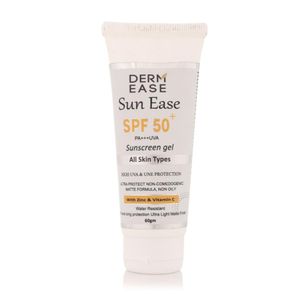

Dermease
Dermease Sun Ease Spf 50+ Suncreen Gel 60 gm

Dermease Sun Ease Spf 50+ Suncreen Gel 60 gm
Dermease
dermease-sun-ease-spf-50-suncreen-gel-60-gm
Suncare
10085123752229
Morning or Evening?
How often will you use this product?
Notes


Highlights
WHAT IS IT?
Sunscreen Gel, 2 main active ingredients: Zinc, Vitamin C
FEATURES
High UVA and UVB defense, strong sun protection, nourishes and revitalizes skin, antioxidant benefits, ultralight noncomedogenic matte formula, non-oily finish, quick absorption, water resistant, long-lasting up to 6 hours
BEST FOR
all skin types
CHECKS
Not specified explicitly but noncomedogenic implies no pore clogging
Who Is It For?
All Ages And GendersWhat Does It Help With?
Sun Protection Prevents Sun Damage Nourishes Skin Antioxidant Benefits Suitable For Acne-prone SkinBudget
Affordable (under $30)How To Use
Which routine should it be used in?
Instructions:
Key Information


What Dermease Says
Product Description:
Dermease Sun Ease SPF 50 Sunscreen Gel is the ultimate sun protection solution for all skin types. Formulated with high UVA and UVB defense this gel provides strong protection against harmful rays. Enriched with Zinc and Vitamin C it nourishes and revitalizes your skin while offering antioxidant benefits. The ultralight noncomedogenic matte formula absorbs quickly leaving a nonoily finish that feels fresh throughout the day. With water resistance and longlasting protection for up to 6 hours it&aposs perfect for outdoor activities. Enjoy a radiant protected complexion with Dermease Sun Ease
About the Brand:
Ingredients Overview
Ingredients List
Zinc,Vitamin C
Key Ingredients
Zinc,Vitamin C
Ingredients Details
Vitamin C
Common Name(s): Vitamin c,cosmetic active,established function
CAS Number: N/a
DESCRIPTION
What It Does: Delivers characteristic cosmetic function — skin conditioning, antioxidant protection, active biological benefit, or formulation function — at recommended use concentration.
Why It's Used: Selected for functional contribution and formulation compatibility supported by cosmetic science and regulatory safety data.
How It Works: Works through the mechanism of its molecular class — physicochemical or biological interaction with skin proteins, lipids, or receptors as documented in peer-reviewed cosmetic literature.
Typically Found In: Skin care formulations
TECHNICAL DETAILS
Primary Category: Active ingredient – cosmetic active
Secondary Functions: Skin conditioning
Application Areas:

Facial Skincare

Body Care
Hair Care
Beard Care
Color Cosmetics (Makeup)
Dietary/Oral Supplements
Typical Concentration Range: 0.1%–10%
SOURCING & ETHICS
Vegan Status: Conditional
Halal Status: Yes
Source Notes: Commercially produced for cosmetic use. verify vegan/halal status with supplier.
SKIN COMPATIBILITY
Irritancy Rating: 1/5 – very low
Comedogenicity Rating: 0/5 – non-comedogenic
Sensitivity Concerns: Well-tolerated by most skin types.
Safe for Sensitive Skin: Yes
SAFETY & COMPATIBILITY
Safety Profile: Good safety profile at recommended concentrations. ewg score: 1–2.
Works Well With: Standard skincare actives
Avoid Combining With: No known significant incompatibilities
SCIENTIFIC NOTE
Vitamin c has an established safety and efficacy profile within the cosmetic regulatory framework at standard use concentrations.
Last Verified: Cosing database,vitamin c technical literature
Primary Sources: 2026-03-12
Zinc
Common Name(s): Zinc
DESCRIPTION
What It Does: Provides antioxidant protection, soothing anti-inflammatory effects, and skin-conditioning benefits through plant-derived polyphenols and phytochemicals.
Why It's Used: Plant extracts concentrate bioactive phytochemicals evolved for environmental protection — uv, microbial, and oxidative stressors — that translate to skin benefits.
How It Works: Polyphenols (flavonoids, phenolic acids) inhibit nf-κb-mediated inflammatory signaling, scavenge reactive oxygen species through electron donation, and chelate pro-oxidant metal ions to reduce oxidative skin damage.
Typically Found In: Lipsticks,foundations,eye shadows,blushers,nail polish
TECHNICAL DETAILS
Primary Category: Colorants
Secondary Functions: Colorant
Application Areas:
Facial Skincare
Body Care
Hair Care
Beard Care
Color Cosmetics (Makeup)
Dietary/Oral Supplements
Typical Concentration Range: As needed for color intensity
SOURCING & ETHICS
Vegan Status: Yes
Halal Status: Yes
Source Notes: Synthetic or mineral colorant; regulatory approval required per region.
SKIN COMPATIBILITY
Irritancy Rating: 1
Comedogenicity Rating: 0
Sensitivity Concerns: Low sensitization potential at recommended use concentrations.
Safe for Sensitive Skin: Yes
SAFETY & COMPATIBILITY
Safety Profile: Well-characterized cosmetic ingredient with established safety profile. generally non-irritating at typical use concentrations. suitable for leave-on and rinse-off cosmetics.
Works Well With: Other pigments,binders,film formers
Avoid Combining With: Incompatible with highly alkaline or acidic formulations (color shift)
SCIENTIFIC NOTE
Plant secondary metabolites (flavonoids, terpenes, phenolic acids) are biosynthesized as defense compounds against uv, herbivores, and pathogens. their anti-inflammatory activity typically derives from competitive inhibition of cox-2 and 5-lox enzymes (ic50 1–50 µm), while antioxidant activity involves single electron transfer (set) and hydrogen atom transfer (hat) mechanisms with structure-dependent rate constants.
Last Verified: Cosing eu database; pcpc cosmetic ingredient safety reviews; ingredient-specific safety and efficacy literature
Primary Sources: 2025-01-15
