

DERMINA
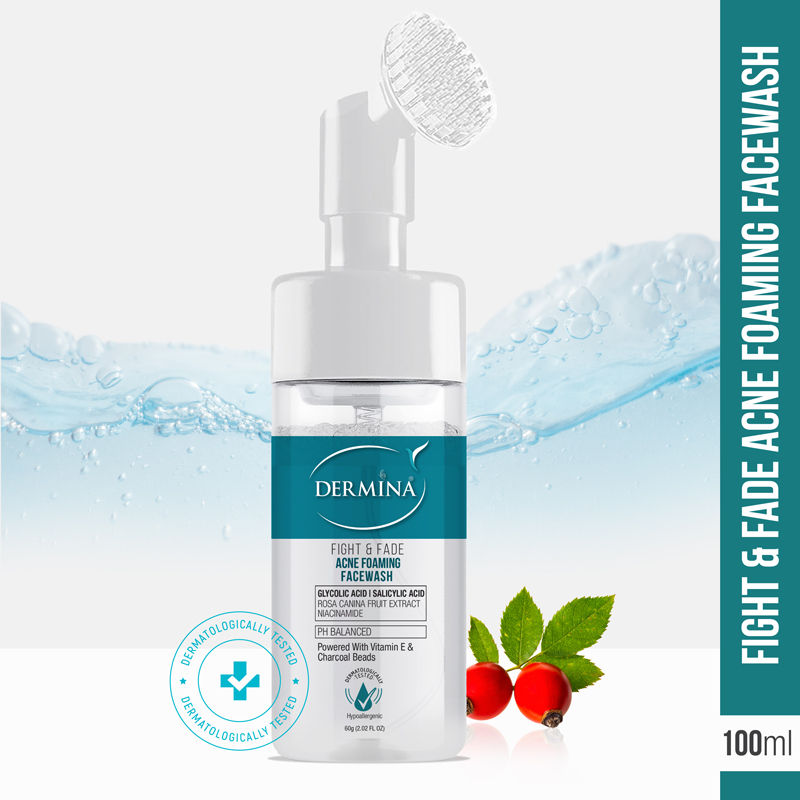
DERMINA Fight & Fade Acne Foaming Facewash

DERMINA Fight & Fade Acne Foaming Facewash
DERMINA
dermina-fight-fade-acne-foaming-facewash
Cleanse
10084815667493
Morning or Evening?
How often will you use this product?
Notes


Highlights
WHAT IS IT?
Acne face wash with key nourishing ingredients such as niacinamide, vitamin C, glycolic acid, hyaluronic acid, and rosa canina
FEATURES
Brightens and evens skin tone, soothes and reduces redness, hydrates and plumps, balances oil and prevents breakouts, dermatologically tested, cruelty-free
BEST FOR
combination
CHECKS
Does not contain animal cruelty, does not cause redness or inflammation, non-drying
Who Is It For?
All Genders Suitable For Sensitive Or Acne-prone SkinWhat Does It Help With?
Targets Acne Fades Dark Spots Brightens Skin Hydrates Reduces Redness And Inflammation Balances Oil ProductionBudget
Affordable (under $30)How To Use
Which routine should it be used in?
Instructions:
Key Information


What DERMINA Says
Product Description:
Dermina’s Tint Premium Face Wash is a new-age acne face wash with a gentle foaming brush for exfoliation and pore cleansing. Enriched with niacinamide, vitamin C, glycolic acid, hyaluronic acid, and rosa canina, it targets acne, fades dark spots, brightens and hydrates skin.
About the Brand:
Ingredients Overview
Ingredients List
Purified-Water,Sodium-Lauroyl-Sarcosinate,Cocamidopropyl-Betaine,Sodium-Cocoyl-Apple-Amino-Acids,Panthenol,Glycerin,Polysorbate-20,1%-Sodium-Hyaluronate-Solution,Dmdm-Hydantoin,Methylchloroisothiazolinone-Methylisothiazolinone,Fragrance,Peg-40-Hydrogenated-Castor-Oil,Citric-Acid,Allantoin,Triethanolamine,Mica,Titanium-Dioxide,Iron-Oxides,Sodium-Gluconate,Salicylic-Acid,Ascorbyl-Tetraisopalmitate,Niacinamide,Ectoin,Alpha-glucan-Oligosaccharide,Polymnia-Sonchifolia-Root-Juice,Maltodextrin,Lactobacillus
Key Ingredients
Niacinamide,Vitamin C,Glycolic Acid,Hyaluronic Acid,Rosa Canina
Ingredients Details
Allantoin
Common Name(s): 5-ureidohydantoin,glyoxyldiureide,aluminum dihydroxy allantoinate
CAS Number: 97-59-6
DESCRIPTION
What It Does: Soothes irritation, accelerates wound healing, promotes skin cell renewal, and provides mild keratolytic exfoliation.
Why It's Used: Gold standard multi-function soothing active – one of the most widely used cosmetic ingredients across all product types for its exceptional tolerability and clinically proven multi-action skin conditioning.
How It Works: Promotes keratinocyte proliferation and fibroblast migration for wound healing. mild keratolytic activity by disrupting corneocyte binding. anti-irritant via direct protein binding and anti-inflammatory cytokine reduction. humectant activity via hydroxyl groups.
Typically Found In: Post-procedure products,sensitive skin formulas,wound care,anti-acne treatments,baby products
TECHNICAL DETAILS
Primary Category: Active ingredient – soothing / anti-inflammatory
Secondary Functions: Wound healing,keratolytic,anti-irritant
Application Areas:

Facial Skincare
Body Care

Hair Care
Beard Care
Color Cosmetics (Makeup)
Dietary/Oral Supplements
Typical Concentration Range: 0.1%–2%
SOURCING & ETHICS
Vegan Status: Conditional - feedstock declaration required
Halal Status: Unverified - feedstock declaration required (plant, animal and petrochemical routes all exist)
Source Notes: Plant-derived extract or synthetic. [audit 2026-07-29 rev2: origin-dependent: the same inci exists in plant, animal and petrochemical versions and the name does not discriminate. determination requires shariah-panel sign-off.]
SKIN COMPATIBILITY
Irritancy Rating: 1/5 – very low
Comedogenicity Rating: 0/5 – non-comedogenic
Sensitivity Concerns: Exceptionally well-tolerated; suitable for all skin types including baby and compromised skin.
Safe for Sensitive Skin: Yes – particularly recommended for sensitive skin
SAFETY & COMPATIBILITY
Safety Profile: Excellent safety profile. ewg score: 1.
Works Well With: Ceramides,panthenol,allantoin,hyaluronic acid,centella asiatica
Avoid Combining With: No significant incompatibilities
SCIENTIFIC NOTE
Allantoin's keratinocyte proliferation stimulation occurs via receptor-mediated signaling (possibly machr activation) rather than non-specific irritation-driven proliferation, making it a true wound-healing stimulant rather than a pro-inflammatory proliferative signal.
Last Verified: 2026-03-12
Primary Sources: Cosing database,cir safety assessment,araújo et al. allantoin review
Ectoin
Common Name(s): Ectoin,extremophile stress protector,anti-aging humectant
CAS Number: N/a
DESCRIPTION
What It Does: Hydrates by forming a water-shell around skin biomolecules, stabilises cellular membranes against heat/uv stress, and reduces inflammatory cytokine release in stressed skin.
Why It's Used: Provides dual humectancy plus cellular protection — unique among humectants for its documented ability to stabilise skin proteins and membranes against uv and environmental stress, not just attract water.
How It Works: Ectoin's tetrahydropyrimidine ring forms an ordered hydration shell around proteins, lipid bilayers, and dna through kosmotropic water structuring. this preferential hydration excludes denaturants and uv-stress mediators from biomolecule surfaces while simultaneously providing humectant moisture binding.
Typically Found In: Sensitive skin,uv protection actives,anti-inflammatory
TECHNICAL DETAILS
Primary Category: Functional ingredient – humectant
Secondary Functions: Tewl reduction,skin plumping
Application Areas:
Facial Skincare
Body Care
Hair Care
Beard Care
Color Cosmetics (Makeup)
Dietary/Oral Supplements
Typical Concentration Range: 0.1%–2%
SOURCING & ETHICS
Vegan Status: Conditional - supplier confirmation required
Halal Status: Unverified - supplier confirmation required
Source Notes: Synthetic or naturally derived. excellent aqueous solubility. [audit 2026-07-29 rev2: status downgraded on audit. determination requires shariah-panel sign-off.]
SKIN COMPATIBILITY
Irritancy Rating: 1/5 – very low
Comedogenicity Rating: 0/5 – non-comedogenic
Sensitivity Concerns: Non-irritating; suitable for all skin types.
Safe for Sensitive Skin: Yes
SAFETY & COMPATIBILITY
Safety Profile: Excellent safety profile. ewg score: 1.
Works Well With: Ceramides,emollients,occlusives,glycerin,hyaluronic acid
Avoid Combining With: No significant incompatibilities
SCIENTIFIC NOTE
Extremophile bacteria accumulate ectoin at up to 15% intracellular concentration to survive 100°c temperatures and extreme salinity — the same biomolecule protection mechanism applies to human skin cells at cosmetic concentrations.
Last Verified: 2026-03-12
Primary Sources: Cosing database,ectoin extremophile anti-stress clinical review
Fragrance
Common Name(s): Fragrance ingredient,eu allergen or aromatic component,olfactory/flavour
CAS Number: N/a
DESCRIPTION
What It Does: Provides the complete fragrance profile contributing to product sensory experience and consumer appeal.
Why It's Used: Fragrance is a major consumer purchase driver — up to 70% of consumers make purchasing decisions partially based on product scent.
How It Works: Fragrance blends interact with olfactory receptors providing the sensory profile — complex mixtures activate multiple receptor types for rich, multidimensional scent experiences.
Typically Found In: All fragrance products
TECHNICAL DETAILS
Primary Category: Active ingredient – cosmetic active
Secondary Functions: Skin conditioning
Application Areas:
Facial Skincare
Body Care
Hair Care
Beard Care
Color Cosmetics (Makeup)
Dietary/Oral Supplements
Typical Concentration Range: Standard use levels
SOURCING & ETHICS
Vegan Status: Conditional - supplier confirmation required
Halal Status: Unverified - supplier confirmation required
Source Notes: Commercially produced for cosmetic use. verify vegan/halal status with supplier. [audit 2026-07-29 rev2: the record's own source_notes does not assert a non-animal origin, or instructs the reader to verify with the supplier; "yes" asserts knowledge the record does not hold. determination requires shariah-panel sign-off.]
SKIN COMPATIBILITY
Irritancy Rating: 1/5 – very low
Comedogenicity Rating: 0/5 – non-comedogenic
Sensitivity Concerns: Well-tolerated by most skin types.
Safe for Sensitive Skin: Yes
SAFETY & COMPATIBILITY
Safety Profile: Good safety profile at recommended concentrations. ewg score: 1–2.
Works Well With: Standard skincare actives
Avoid Combining With: No known significant incompatibilities
SCIENTIFIC NOTE
Ifra guidelines set usage limits for fragrance ingredients based on skin sensitisation and phototoxicity assessment for each application category.
Last Verified: 2026-03-12
Primary Sources: Eu regulation 1223/2009 annex iii,ifra standards,fragrance allergen declaration requirements
Glycerin
Common Name(s): Glycerol,glycerine,1,2,3-propanetriol
CAS Number: 56-81-5
DESCRIPTION
What It Does: Glycerin pulls water from the environment and deeper skin layers into the outer skin layer (epidermis), boosting moisture levels and keeping skin soft, smooth, and plump.
Why It's Used: It is used in virtually every moisturizer, serum, and cleanser because it is highly effective at hydrating skin, is well-tolerated by all skin types, and enhances the texture and spreadability of formulations.
How It Works: As a humectant, glycerin forms hydrogen bonds with water molecules, trapping them in the skin. it also reinforces the skin barrier by integrating into lipid structures between skin cells.
Typically Found In: Moisturizers,serums,cleansers,toners,sheet masks,sunscreens,body lotions,shampoos,conditioners
TECHNICAL DETAILS
Primary Category: Humectant
Secondary Functions: Skin barrier support,emollient,solvent
Application Areas:
Facial Skincare
Body Care
Hair Care
Beard Care
Color Cosmetics (Makeup)
Dietary/Oral Supplements
Typical Concentration Range: 1%–30% (typical: 3–10%)
SOURCING & ETHICS
Vegan Status: Conditional - feedstock declaration required
Halal Status: Unverified - feedstock declaration required (plant, animal and petrochemical routes all exist)
Source Notes: Derived from plant oils via hydrolysis or saponification; synthetic versions also available. palm-derived glycerin carries sustainability concerns. [audit 2026-07-29 rev2: origin-dependent: the same inci exists in plant, animal and petrochemical versions and the name does not discriminate. determination requires shariah-panel sign-off.]
SKIN COMPATIBILITY
Irritancy Rating: 1/5 – very low; non-irritating at all standard concentrations
Comedogenicity Rating: 0/5 – non-comedogenic
Sensitivity Concerns: Extremely rare allergic reactions; generally safe for all skin types including sensitive and baby skin
Safe for Sensitive Skin: Yes
SAFETY & COMPATIBILITY
Safety Profile: Widely recognized as safe. ewg hazard score: 1. no significant concerns for irritation, sensitization, or toxicity at typical concentrations (up to 50%).
Works Well With: Hyaluronic acid,ceramides,niacinamide,panthenol,urea,peptides,retinol,ahas/bhas
Avoid Combining With: No known incompatibilities at standard concentrations
SCIENTIFIC NOTE
Glycerin is an endogenous skin component found naturally in the stratum corneum. aquaporin-3 channels in keratinocytes facilitate glycerin transport, making it integral to natural skin hydration pathways.
Last Verified: 2026-03-12
Primary Sources: Cosing database,cir safety assessment,ewg skin deep,inci decoder