

Nykaa E retail limited
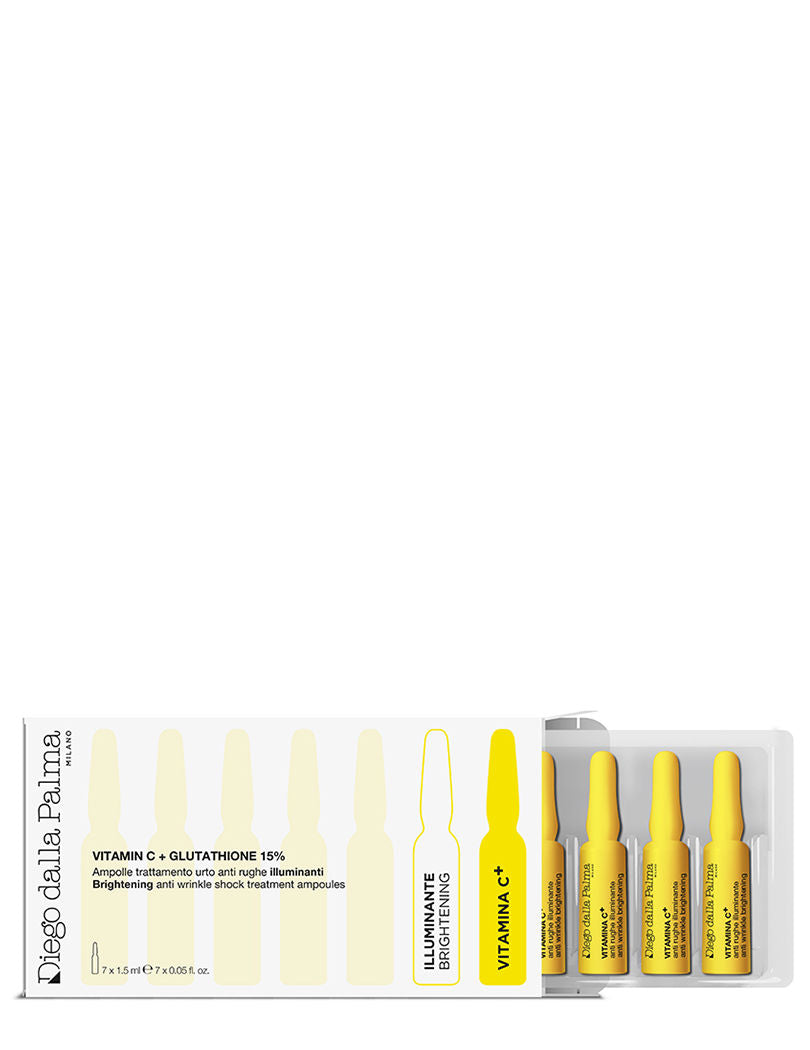
Diego dalla Palma Milano Vitamin C & Glutathione 15% Brightening Anti Wrinkle Treatment Ampoules

Diego dalla Palma Milano Vitamin C & Glutathione 15% Brightening Anti Wrinkle Treatment Ampoules
Nykaa E retail limited
diego-dalla-palma-milano-vitamin-c-glutathione-15-brightening-anti-wrinkle-treatment-ampoules
Serum
10084950016293
Morning or Evening?
How often will you use this product?
Notes


Highlights
WHAT IS IT?
Brightening Anti-Wrinkle Treatment Ampoules with 15% concentration
FEATURES
Brightening and anti-wrinkle treatment containing Vitamin C and Glutathione
BEST FOR
normal
CHECKS
Who Is It For?
Adults Concerned With Aging And Skin BrighteningWhat Does It Help With?
Brightening Anti-wrinkle TreatmentBudget
Premium ($76-$150)How To Use
Which routine should it be used in?
Instructions:
Key Information

What Nykaa E retail limited Says
Product Description:
A brightening and anti-wrinkle treatment in ampoule form containing 15% Vitamin C and Glutathione
About the Brand:
Ingredients Overview
Ingredients List
Simmondsia Chinensis Seed Oil (Simmondsia Chinensis (Jojoba) Seed Oil), Crambe Abyssinica Seed Oil, Helianthus Annuus Seed Oil (Helianthus Annuus (Sunflower) Seed Oil), Oenocarpus Bataua Fruit Oil, Caprylic/Capric Triglyceride, Vanilla Planifolia Fruit Extract, Vanilla Tahitensis Fruit Extract, Passiflora Edulis Seed Oil, Mauritia Flexuosa Fruit Oil, Argania Spinosa Kernel Oil, Orbignya Oleifera Seed Oil, Euterpe Oleracea Fruit Oil, Nymphaea Alba Flower Extract, Hibiscus Sabdariffa Flower Extract, Gardenia Tahitensis Flower Extract, Citrus Tangerina Peel Extract (Citrus Tangerina (Tangerine) Peel Extract), Citrus Aurantium Dulcis Peel Extract (Citrus Aurantium Dulcis (Orange) Peel Extract), Citrus Nobilis Peel Extract (Citrus Nobilis (Mandarin Orange) Peel Extract), Citrus Grandis Fruit Extract (Citrus Grandis (Grapefruit) Fruit Extract), Citrus Clementina Fruit Extract, Gold, Lavandula Angustifolia Flower/Leaf/Stem Extract (Lavandula Angustifolia (Lavender) Flower/Leaf/Stem Extract), Elettaria Cardamomum Seed Extract, Fagraea Berteroana Flower Extract, Plumeria Rubra Flower Extract, Cananga Odorata Flower Extract, Cocos Nucifera Oil (Cocos Nucifera (Coconut) Oil), Gardenia Tahitensis Flower, Prunus Armeniaca Fruit Extract (Prunus Armeniaca (Apricot) Fruit Extract), Pyrus Malus Fruit Extract (Pyrus Malus (Apple) Fruit Extract), Hedychium Spicatum Extract, Plumeria Alba Flower Extract, Oryza Sativa Bran Oil (Oryza Sativa (Rice) Bran Oil), Tocopherol, Limonene, Hydroxycitronellal, Linalool, Benzyl Alcohol
Key Ingredients
Vitamin C, Glutathione
Ingredients Details
Argania Spinosa Kernel Oil
Common Name(s): Argania spinosa kernel oil,botanical carrier oil,emollient fatty acid delivery
CAS Number: N/a
DESCRIPTION
What It Does: Softens and conditions skin by integrating into sc lipid bilayers, delivers essential fatty acids (oleic, linoleic, linolenic) for barrier lipid synthesis, and provides rich, non-stripping moisturisation.
Why It's Used: Natural carrier oils provide the closest compositional match to endogenous sc lipids, delivering emolliency through genuine barrier integration rather than simple surface occlusion.
How It Works: Fatty acid triglycerides partition into sc lipid bilayers — oleic acid (c18:1) provides fluid, emollient integration; linoleic acid (c18:2) acts as essential ceramide precursor; saturated fatty acids provide more occlusive barrier reinforcement.
Typically Found In: Moisturisers,facial oils,natural skin care
TECHNICAL DETAILS
Primary Category: Functional ingredient – emollient
Secondary Functions: Barrier sealing,softening
Application Areas:

Facial Skincare
Body Care
Hair Care

Beard Care
Color Cosmetics (Makeup)
Dietary/Oral Supplements
Typical Concentration Range: 1%–100%
SOURCING & ETHICS
Vegan Status: Conditional
Halal Status: Yes
Source Notes: Plant-derived, synthetic or animal-derived. verify source.
SKIN COMPATIBILITY
Irritancy Rating: 1/5 – very low
Comedogenicity Rating: 1/5 – low; formulation-dependent
Sensitivity Concerns: Non-irritating.
Safe for Sensitive Skin: Yes
SAFETY & COMPATIBILITY
Safety Profile: Excellent safety profile. ewg score: 1.
Works Well With: Humectants,ceramides,actives as carrier
Avoid Combining With: No significant incompatibilities
SCIENTIFIC NOTE
Essential fatty acids — linoleic (c18:2, n-6) and α-linolenic (c18:3, n-3) acids — cannot be synthesised by the body; topical delivery through carrier oils provides direct substrate for ceramide and eicosanoid biosynthesis in the epidermis.
Last Verified: Cosing database,argania spinosa kernel oil carrier oil botanical review
Primary Sources: 2026-03-12
Benzyl Alcohol
Common Name(s): Phenylcarbinol,benzenemethanol,alpha-hydroxytoluene
CAS Number: 100-51-6
DESCRIPTION
What It Does: Provides dual fragrance and preservative activity as an aromatic alcohol.
Why It's Used: Multi-function ingredient serving as both fragrance component and preservative – reduces formulation complexity by providing both functions in one ingredient.
How It Works: Phenylcarbinol provides antimicrobial activity via membrane disruption (effective vs gram-positive bacteria and moulds). solvent for fragrances and difficult-to-dissolve actives. mild oxidative conversion to benzaldehyde provides sweet almond-like fragrance.
Typically Found In: Fragrances,preserved cosmetics,solvent systems
TECHNICAL DETAILS
Primary Category: Fragrance component / preservative
Secondary Functions: Skin conditioning
Application Areas:
Facial Skincare
Body Care
Hair Care
Beard Care
Color Cosmetics (Makeup)
Dietary/Oral Supplements
Typical Concentration Range: 0.001%–1% (fragrance); up to 1% as preservative
SOURCING & ETHICS
Vegan Status: Yes – from toluene, or jasmine absolute
Halal Status: Yes
Source Notes: Commercially produced for cosmetic use. verify vegan/halal status with supplier.
SKIN COMPATIBILITY
Irritancy Rating: 1/5 – very low
Comedogenicity Rating: 0/5 – non-comedogenic
Sensitivity Concerns: Well-tolerated by most skin types.
Safe for Sensitive Skin: Yes
SAFETY & COMPATIBILITY
Safety Profile: Eu cosmetics regulation: declared fragrance allergen. also listed as approved preservative (annex v, max 1%). dual regulatory status (fragrance + preservative) depending on function and concentration.
Works Well With: Standard skincare actives
Avoid Combining With: No known significant incompatibilities
SCIENTIFIC NOTE
Benzyl alcohol's dual regulatory status (fragrance allergen and approved preservative) creates a formulation paradox: it must be listed as a fragrance allergen if present >0.001% (leave-on) regardless of whether it was added for fragrance or preservation. this regulatory dual identity means a preservative added for antimicrobial function triggers the same allergen declaration requirement as a fragrance added for scent.
Last Verified: Cosing database,ifra standards,eu preservative annex v
Primary Sources: 2026-03-12
Cananga Odorata Flower Extract
Common Name(s): Cananga odorata flower extract,botanical extract,phytochemical active
CAS Number: N/a
DESCRIPTION
What It Does: Provides antioxidant protection, anti-inflammatory activity, and skin conditioning from polyphenols, terpenoids, and phytochemicals.
Why It's Used: Multi-functional phytochemical profiles support concurrent skin care claims with authentic botanical heritage.
How It Works: Polyphenols scavenge ros, inhibit nf-kb/cox pathways, and condition skin through phytochemical interactions.
Typically Found In: Botanical skin care
TECHNICAL DETAILS
Primary Category: Active ingredient – antioxidant
Secondary Functions: Free radical scavenging,anti-aging
Application Areas:
Facial Skincare
Body Care
Hair Care
Beard Care
Color Cosmetics (Makeup)
Dietary/Oral Supplements
Typical Concentration Range: 0.1%–30%
SOURCING & ETHICS
Vegan Status: Conditional
Halal Status: Conditional
Source Notes: Plant-derived extract or synthetic.
SKIN COMPATIBILITY
Irritancy Rating: 1/5 – very low
Comedogenicity Rating: 0/5 – non-comedogenic
Sensitivity Concerns: Non-irritating; well-tolerated.
Safe for Sensitive Skin: Yes
SAFETY & COMPATIBILITY
Safety Profile: Excellent safety profile. ewg score: 1.
Works Well With: Vitamin c,vitamin e,ferulic acid,spf,other antioxidants
Avoid Combining With: No significant incompatibilities
SCIENTIFIC NOTE
Plant secondary metabolites evolved for uv photoprotection and pathogen defence — mechanisms directly translatable to cosmetic antioxidant and anti-inflammatory activity in human skin.
Last Verified: Cosing database,cananga odorata flower extract botanical review
Primary Sources: 2026-03-12
Caprylic/capric Triglyceride
Common Name(s): Mct oil,fractionated coconut oil,c8/c10 triglyceride
CAS Number: 73398-61-5
DESCRIPTION
What It Does: Lightweight, stable emollient that solubilizes oil-soluble actives for excellent delivery without greasy feel.
Why It's Used: Universal lightweight emollient base and solubilizer for oil-soluble actives in serums and low-viscosity formulations where mineral oil or petrolatum would be too heavy.
How It Works: Medium-chain length provides ideal balance of spreading coefficient, penetration rate, and barrier-sealing properties. excellent solubilizer for vitamin e, retinoids, and other lipophilic actives.
Typically Found In: Serums,facial oils,sunscreens,anti-aging products,hair products
TECHNICAL DETAILS
Primary Category: Active ingredient – medium-chain triglyceride emollient
Secondary Functions: Active solubilizer,spreading agent
Application Areas:
Facial Skincare
Body Care
Hair Care
Beard Care
Color Cosmetics (Makeup)
Dietary/Oral Supplements
Typical Concentration Range: 1%–50%
SOURCING & ETHICS
Vegan Status: Yes – from coconut/palm kernel oil
Halal Status: Yes
Source Notes: Fractionated by hydrolysis and re-esterification of coconut oil. only c8 and c10 fatty acids retained.
SKIN COMPATIBILITY
Irritancy Rating: 1/5 – very low
Comedogenicity Rating: 1/5 – very low; medium-chain length generally non-comedogenic
Sensitivity Concerns: Non-irritating.
Safe for Sensitive Skin: Yes
SAFETY & COMPATIBILITY
Safety Profile: Excellent safety profile. ewg score: 1.
Works Well With: Humectants,ceramides,actives as carrier
Avoid Combining With: No significant incompatibilities
SCIENTIFIC NOTE
Mct oil's medium-chain length (c8/c10) provides superior oxidative stability vs longer polyunsaturated chains and better skin aesthetics (lighter, less greasy) vs longer chain emollients (c16/c18). excellent solubilizer for retinoic acid, tocopheryl esters, and other lipophilic actives.
Last Verified: Cosing database,cir safety assessment,ewg skin deep
Primary Sources: 2026-03-12
