

Nykaa E retail limited
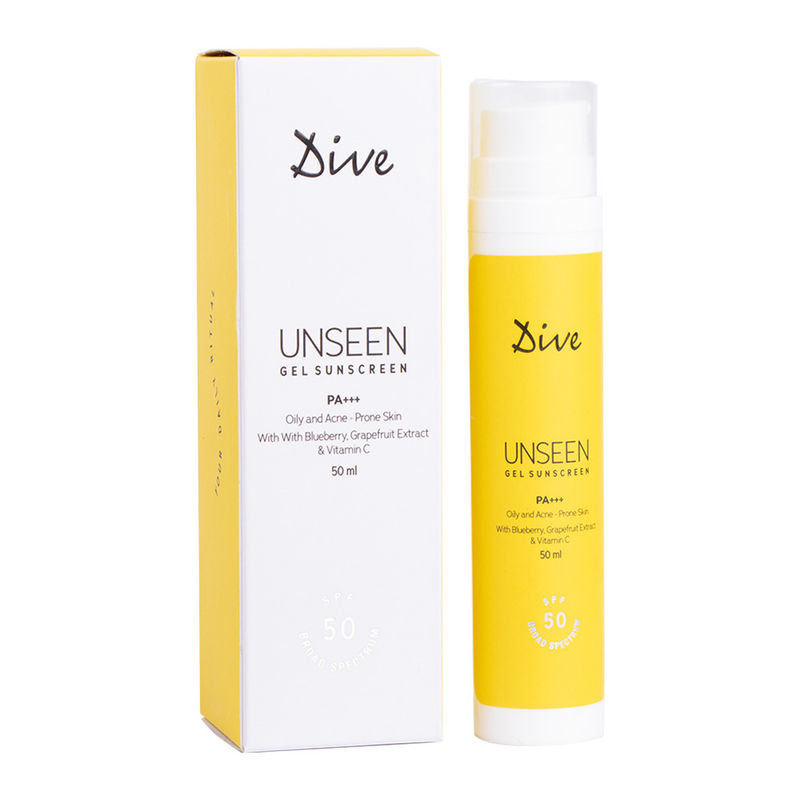
DIVE Unseen Gel Sunscreen

DIVE Unseen Gel Sunscreen
Nykaa E retail limited
dive-unseen-gel-sunscreen
Suncare
10084965024037
Morning or Evening?
How often will you use this product?
Notes


Highlights
WHAT IS IT?
Gel Sunscreen with SPF 50 and 15 ingredients
FEATURES
SPF 50 broad-spectrum with PA+++, shields from UVA and UVB rays, anti-aging benefits with hyaluronic acid and nano zinc oxide, pH balanced, invisible non-whitening finish, lightweight gel formula, fragrance-free, non-greasy matte finish, suitable for oily and acne-prone skin, free from parabens, fragrance, sulfates, gluten, and phthalates
BEST FOR
sensitive
CHECKS
No parabens, No fragrance, No sulfates, Gluten-free, Phthalate-free
Who Is It For?
All Genders Suitable For Sensitive Oily Acne-prone Skin; Diverse Age Range ImpliedWhat Does It Help With?
Sun Protection Anti-aging Reduces Fine Lines And Wrinkles Prevents BreakoutsBudget
Affordable (under $30)How To Use
Which routine should it be used in?
Instructions:
Key Information


What Nykaa E retail limited Says
Product Description:
Dive Unseen Gel Sunscreen provides SPF 50, PA+++ protection, effectively shielding your skin from harmful UVA and UVB rays with 98% coverage. Its lightweight gel formula ensures quick absorption and a non-greasy, matte finish, leaving no sticky residue for all-day comfort. Fragrance-free and non-comedogenic, it’s ideal for sensitive, oily, or acne-prone skin, offering sun protection without clogging pores or causing breakouts. Enriched with hyaluronic acid and nano zinc oxide, it promotes youthful skin while offering anti-aging benefits. This cruelty-free, vegan, gluten-free sunscreen is paraben-free and pH balanced for safe, irritation-free use.
About the Brand:
Ingredients Overview
Ingredients List
Octyl-Methoxycinnamate,Methylene-Bis-Benzotriazolyl-Tetramethylbutylphenol,Benzophenone-3,Sunflower-Oil,Vitamin-E,Blueberry-Extract,Grapefruit-Extract,Zinc-Oxide,Coco-Caprylate/Caprate,Polyglyceryl-3-Polyricinoleate,Isostearic-Acid,Ethyl-Ascorbic-Acid,Micronized-Titanium-Dioxide,Sunscreen-Gel-Base-Qs,Green-Tea,Hyaluronic-Acid,Niacinamide,Buddleja-Officinalis-Flower-Extract
Key Ingredients
Hyaluronic Acid, Nano Zinc Oxide, Niacinamide, Ethyl Ascorbic Acid
Ingredients Details
Benzophenone-3
Common Name(s): Oxybenzone,2-hydroxy-4-methoxybenzophenone,uva+uvb filter
CAS Number: 131-57-7
DESCRIPTION
What It Does: Provides combined uva and uvb filtration in a single chemical uv filter molecule.
Why It's Used: Combined uva+uvb filter historically used for broad-spectrum coverage in a single ingredient, now increasingly restricted.
How It Works: Benzophenone chromophore absorbs uvb (305nm) and uva-ii (326nm) via two separate n→π* transitions. water-soluble allows aqueous phase formulation. single filter providing partial broad-spectrum coverage.
Typically Found In: Sunscreens (being phased out in many markets)
TECHNICAL DETAILS
Primary Category: Active ingredient – chemical uva/uvb filter
Secondary Functions: Skin conditioning
Application Areas:

Facial Skincare

Body Care
Hair Care
Beard Care
Color Cosmetics (Makeup)
Dietary/Oral Supplements
Typical Concentration Range: Up to 6% (eu), 6% (us fda)
SOURCING & ETHICS
Vegan Status: Yes – synthetic
Halal Status: Yes
Source Notes: Commercially produced for cosmetic use. verify vegan/halal status with supplier.
SKIN COMPATIBILITY
Irritancy Rating: 1/5 – very low
Comedogenicity Rating: 0/5 – non-comedogenic
Sensitivity Concerns: Well-tolerated by most skin types.
Safe for Sensitive Skin: Yes
SAFETY & COMPATIBILITY
Safety Profile: Eu max 6%. coral reef/aquatic toxicity — banned hawaii, palau, some us states. potential endocrine activity at high systemic exposure. ewg score: 7. use declining due to regulatory pressure.
Works Well With: Standard skincare actives
Avoid Combining With: No known significant incompatibilities
SCIENTIFIC NOTE
Benzophenone-3's declining use reflects evolving understanding of environmental and endocrine impacts: discovered in coral bleaching studies, its restriction in hawaii (2018) sparked a global trend in marine-safe sunscreen formulations that is reshaping the industry away from bp-3 toward mineral filters and marine-safer organic alternatives.
Last Verified: Cosing database,fda uv filter otc monograph,hawaii bp-3 restriction law
Primary Sources: 2026-03-12
Coco-caprylate/caprate
Common Name(s): Coco-caprylate/caprate
DESCRIPTION
What It Does: Smooths and softens skin by filling intercorneocyte spaces, reducing friction, and providing a pleasant aesthetic skin feel in formulations.
Why It's Used: Synthetic esters provide tailored aesthetic properties — spreadability, skin feel, volatility, refractive index — that natural oils alone cannot consistently deliver.
How It Works: The ester molecule fills microscopic surface irregularities between corneocytes, reducing coefficient of friction, reflecting light uniformly, and providing a lubrication layer that protects the skin surface.
Typically Found In: Moisturizers,sunscreens,color cosmetics,body lotions,lip products
TECHNICAL DETAILS
Primary Category: Synthetic emollients
Secondary Functions: Emollient
Application Areas:
Facial Skincare
Body Care
Hair Care
Beard Care
Color Cosmetics (Makeup)
Dietary/Oral Supplements
Typical Concentration Range: 1–20%
SOURCING & ETHICS
Vegan Status: Yes
Halal Status: Yes
Source Notes: Synthetically produced ester emollient; no animal components.
SKIN COMPATIBILITY
Irritancy Rating: 1
Comedogenicity Rating: 1
Sensitivity Concerns: Low sensitization potential at recommended use concentrations.
Safe for Sensitive Skin: Yes
SAFETY & COMPATIBILITY
Safety Profile: Well-characterized cosmetic ingredient with established safety profile. generally non-irritating at typical use concentrations. suitable for leave-on and rinse-off cosmetics.
Works Well With: Silicones,uv filters,other emollients
Avoid Combining With: Strongly alkaline conditions (risk of saponification of ester-type emollients)
SCIENTIFIC NOTE
The spreading coefficient of an emollient is governed by its surface tension, viscosity, and polarity. esters with branched alkyl chains (e.g., isopropyl, isostearyl) spread rapidly and leave a non-tacky film; linear long-chain esters provide more substantive moisturization. hlb value determines the preferred formulation system (w/o vs o/w emulsions).
Last Verified: Cosing eu database; pcpc cosmetic ingredient safety reviews; ingredient-specific safety and efficacy literature
Primary Sources: 2025-01-15
Niacinamide
Common Name(s): Vitamin b3,nicotinamide,pyridine-3-carboxamide
CAS Number: 98-92-0
DESCRIPTION
What It Does: Niacinamide strengthens the skin barrier, reduces visible pore size, regulates sebum production, fades dark spots, and improves skin texture and tone.
Why It's Used: It is used because it addresses multiple skin concerns at once without irritation, making it suitable for all skin types. it is stable in formulations and pairs well with most other actives.
How It Works: Niacinamide inhibits the transfer of melanosomes (pigment packets) to skin cells, reducing hyperpigmentation. it also stimulates ceramide synthesis to strengthen the skin barrier and reduces inflammation by modulating cytokine activity.
Typically Found In: Serums,moisturizers,toners,cleansers,eye creams,sunscreens,primers
TECHNICAL DETAILS
Primary Category: Active ingredient – vitamin
Secondary Functions: Barrier repair,brightening,anti-inflammatory
Application Areas:
Facial Skincare
Body Care
Hair Care
Beard Care
Color Cosmetics (Makeup)
Dietary/Oral Supplements
Typical Concentration Range: 2%–10% (typical: 5%; higher concentrations may cause flushing in some individuals)
SOURCING & ETHICS
Vegan Status: Yes – synthetically produced
Halal Status: Yes – synthetic origin
Source Notes: Commercially produced via synthesis from nicotinic acid or 3-cyanopyridine. no animal-derived sources used in cosmetic-grade niacinamide.
SKIN COMPATIBILITY
Irritancy Rating: 1/5 – very low; concentrations above 10% may cause temporary flushing in sensitive individuals
Comedogenicity Rating: 0/5 – non-comedogenic
Sensitivity Concerns: At concentrations >10%, some users experience niacin flush (transient redness/tingling). generally very well-tolerated.
Safe for Sensitive Skin: Yes – one of the best-tolerated actives for sensitive skin
SAFETY & COMPATIBILITY
Safety Profile: Extensively studied and considered very safe. ewg hazard score: 1. no significant systemic toxicity concerns at topical concentrations.
Works Well With: Retinol,peptides,ahas/bhas,hyaluronic acid,ceramides,zinc,vitamin c,spf
Avoid Combining With: High concentrations of vitamin c (ascorbic acid) may theoretically convert to niacin – use at different times if using pure l-ascorbic acid above 15%
SCIENTIFIC NOTE
Niacinamide is a precursor to nad+ and nadp+, coenzymes vital to cellular energy metabolism. its benefits for dna repair and mitochondrial function make it a key ingredient in anti-aging strategies.
Last Verified: Cosing database,cir safety assessment,ewg skin deep,pubmed clinical studies
Primary Sources: 2026-03-12
