

Dot & Key
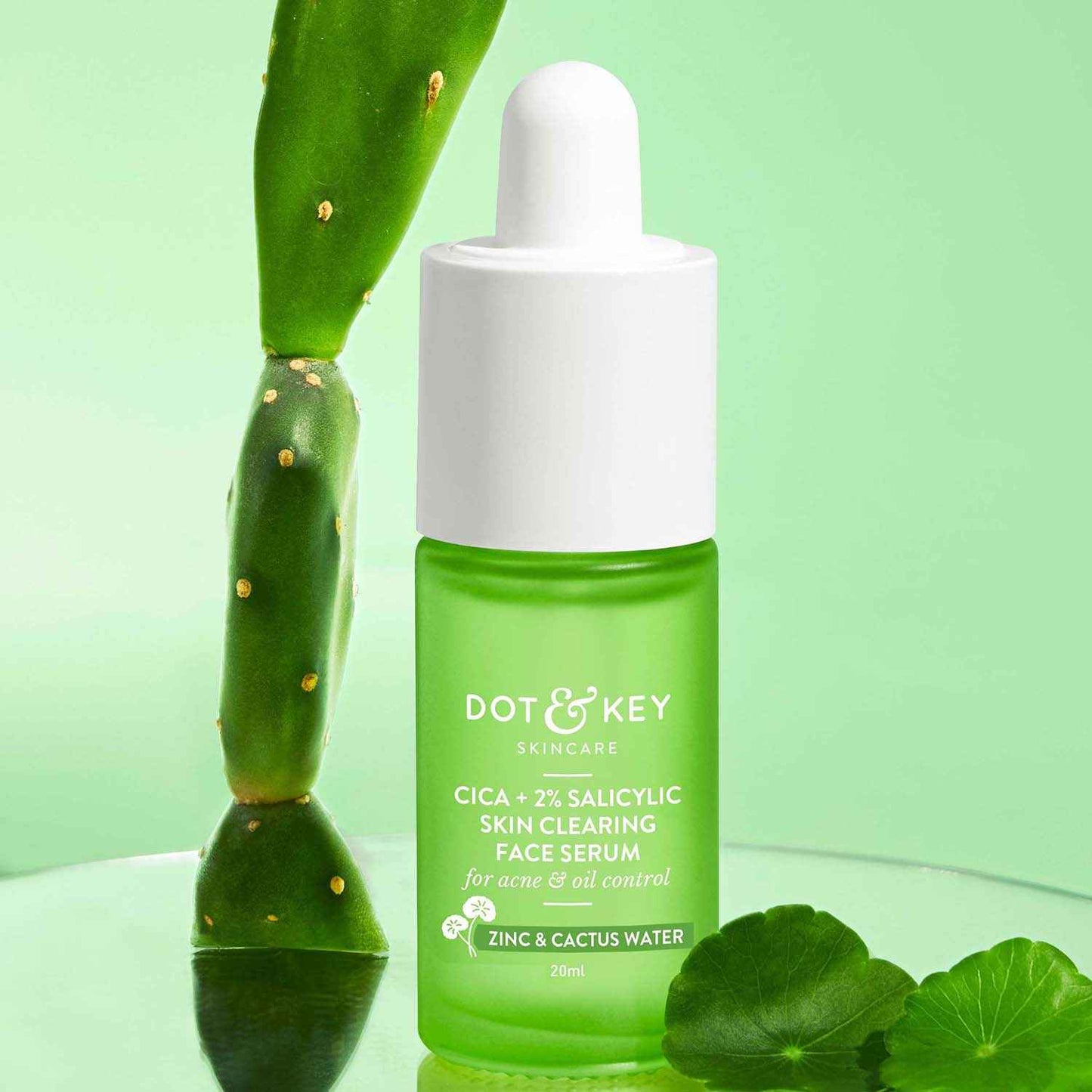
Dot & Key CICA & CACTUS + 2% Salicylic + ZINC Skin Clearing Face Serum for Acne & Oil Control 20 ml

Dot & Key CICA & CACTUS + 2% Salicylic + ZINC Skin Clearing Face Serum for Acne & Oil Control 20 ml
Dot & Key
dot-key-cica-cactus-2-salicylic-zinc-skin-clearing-face-serum-for-acne-oil-control-20-ml
Serum
10084841947429
Morning or Evening?
How often will you use this product?
Notes


Highlights
WHAT IS IT?
Face serum with 3 active ingredients (salicylic acid, cica, zinc)
FEATURES
Treats active acne, removes blackheads and whiteheads, unclogs pores to minimize appearance, soothes skin to calm irritation and redness, clears excess sebum to maintain oil-water balance, lightweight, quick absorbing
BEST FOR
oily
CHECKS
Does not unclog pores, does not brighten complexion, does not reduce dark spots
Who Is It For?
Adults All GendersWhat Does It Help With?
Active Acne Blackheads Whiteheads Excess Sebum Skin Irritation RednessBudget
Affordable (under $30)How To Use
Which routine should it be used in?
Instructions:
Key Information


What Dot & Key Says
Product Description:
Does acne excess oil & skin irritation keep coming back Bid them goodbye with 2% Salicylic Cica Face Serum. A lightweight & quickabsorbing serum it's the ideal antidote for oily acneprone skin. Infused with Active Fusion Technology of 2% salicylic acid, cica & zinc backed by cactus water it gently exfoliates to unclog pores, treats active acne, soothes irritation & controls excess sebum for calm, clear & acnefree. Add it to your AM & PM routine for results like never before.
About the Brand:
Ingredients Overview
Ingredients List
Aqua, Ethoxydiglycol, Propanediol, Butylene Glycol, Salicylic Acid, Glycine Soja (Soybean) Seed Extract (and) Houttuynia Cordata Extract (and) Scutellaria Baicalensis Root Extract [and] Melia Azadirachta Leaf Extract (and) Rehmannia Chinensis Root Extract (and) Salix Alba (Willow) Bark Extract (and) Phellodendron Amurense Bark Extract (and) Lactobacillus/Pear Juice Ferment Filtrate, Centella Asiatica (Cica) Extract, Zinc PCA, Niacinamide, Sodium Hyaluronate, Water (and) Laminaria digitata extract (and) Hydrogenated lecithin (and) Cetyl-PG hydroxyethyl palmitamide [and] Ceramide 1,2,3,4,6|| (and) Cholesterol (and) 1,2-hexanediol, Gluconolactone, Opuntia Ficus-Indica Stem Water, Hamamelis Virginiana (Witch Hazel) Extract Benzoic Acid, Artemisia Vulgaris (Mugwort) Extract, Xanthan Gum, Hydroxyethylcellulose, C18-22 Hydroxyalkyl Hydroxypropyl Guar, Allantoin, Sodium Hydroxide, Sodium Gluconate, Disodium EDTA, Phenoxyethanol (and) Ethylhexylglycerin, Citric Acid
Key Ingredients
salicylic-acid,cica,zinc,cactus-water
Ingredients Details
Allantoin
Common Name(s): 5-ureidohydantoin,glyoxyldiureide,aluminum dihydroxy allantoinate
CAS Number: 97-59-6
DESCRIPTION
What It Does: Soothes irritation, accelerates wound healing, promotes skin cell renewal, and provides mild keratolytic exfoliation.
Why It's Used: Gold standard multi-function soothing active – one of the most widely used cosmetic ingredients across all product types for its exceptional tolerability and clinically proven multi-action skin conditioning.
How It Works: Promotes keratinocyte proliferation and fibroblast migration for wound healing. mild keratolytic activity by disrupting corneocyte binding. anti-irritant via direct protein binding and anti-inflammatory cytokine reduction. humectant activity via hydroxyl groups.
Typically Found In: Post-procedure products,sensitive skin formulas,wound care,anti-acne treatments,baby products
TECHNICAL DETAILS
Primary Category: Active ingredient – soothing / anti-inflammatory
Secondary Functions: Wound healing,keratolytic,anti-irritant
Application Areas:

Facial Skincare
Body Care

Hair Care
Beard Care
Color Cosmetics (Makeup)
Dietary/Oral Supplements
Typical Concentration Range: 0.1%–2%
SOURCING & ETHICS
Vegan Status: Conditional - feedstock declaration required
Halal Status: Unverified - feedstock declaration required (plant, animal and petrochemical routes all exist)
Source Notes: Plant-derived extract or synthetic. [audit 2026-07-29 rev2: origin-dependent: the same inci exists in plant, animal and petrochemical versions and the name does not discriminate. determination requires shariah-panel sign-off.]
SKIN COMPATIBILITY
Irritancy Rating: 1/5 – very low
Comedogenicity Rating: 0/5 – non-comedogenic
Sensitivity Concerns: Exceptionally well-tolerated; suitable for all skin types including baby and compromised skin.
Safe for Sensitive Skin: Yes – particularly recommended for sensitive skin
SAFETY & COMPATIBILITY
Safety Profile: Excellent safety profile. ewg score: 1.
Works Well With: Ceramides,panthenol,allantoin,hyaluronic acid,centella asiatica
Avoid Combining With: No significant incompatibilities
SCIENTIFIC NOTE
Allantoin's keratinocyte proliferation stimulation occurs via receptor-mediated signaling (possibly machr activation) rather than non-specific irritation-driven proliferation, making it a true wound-healing stimulant rather than a pro-inflammatory proliferative signal.
Last Verified: 2026-03-12
Primary Sources: Cosing database,cir safety assessment,araújo et al. allantoin review
Butylene Glycol
Common Name(s): 1,3-butanediol,bg,1,3-butylene glycol
CAS Number: 107-88-0
DESCRIPTION
What It Does: Provides humectant hydration and active ingredient solubilization with excellent skin feel.
Why It's Used: Preferred glycol humectant in premium and k-beauty formulations for superior skin feel vs propylene glycol with equivalent functionality.
How It Works: Two hydroxyl groups at 1,3-positions provide water binding and solvent activity. better tolerated than propylene glycol with minimal sensitization risk. 4-carbon backbone provides slightly greater hydrophobic character enabling dissolution of less polar actives vs pg.
Typically Found In: Toners,essences,serums,k-beauty formulas
TECHNICAL DETAILS
Primary Category: Functional ingredient – glycol humectant
Secondary Functions: Tewl reduction,skin plumping
Application Areas:
Facial Skincare
Body Care
Hair Care
Beard Care
Color Cosmetics (Makeup)
Dietary/Oral Supplements
Typical Concentration Range: 1%–10%
SOURCING & ETHICS
Vegan Status: Yes – synthetic
Halal Status: Yes
Source Notes: Synthetic or naturally derived. excellent aqueous solubility.
SKIN COMPATIBILITY
Irritancy Rating: 1/5 – very low
Comedogenicity Rating: 0/5 – non-comedogenic
Sensitivity Concerns: Non-irritating; suitable for all skin types.
Safe for Sensitive Skin: Yes
SAFETY & COMPATIBILITY
Safety Profile: Excellent safety profile. ewg score: 1.
Works Well With: Ceramides,emollients,occlusives,glycerin,hyaluronic acid
Avoid Combining With: No significant incompatibilities
SCIENTIFIC NOTE
K-beauty's preference for butylene glycol over propylene glycol is driven by two factors: bg's superior skin feel (less tacky than pg's higher viscosity) and its lower sensitization potential (1,3-bg has better spatial distribution of hydroxyl groups that reduces protein interaction vs pg's 1,2-position oh groups).
Last Verified: 2026-03-12
Primary Sources: Cosing database,cir safety assessment
C18-22 Hydroxyalkyl Hydroxypropyl Guar
Common Name(s): C18-22 hydroxyalkyl hydroxypropyl guar
DESCRIPTION
What It Does: Attracts water molecules from the environment and deeper skin layers to the stratum corneum, maintaining surface hydration and suppleness.
Why It's Used: Humectants address the most common skin concern — dryness — by providing immediate and sustained moisture delivery to the stratum corneum.
How It Works: Multiple hydroxyl or other polar groups form hydrogen bonds with water molecules, physically trapping water in the stratum corneum while creating an osmotic driving force for water migration from deeper skin layers.
Typically Found In: Serums,moisturizers,toners,essences,masks
TECHNICAL DETAILS
Primary Category: Humectants
Secondary Functions: Humectant,skin-conditioning
Application Areas:
Facial Skincare
Body Care
Hair Care
Beard Care
Color Cosmetics (Makeup)
Dietary/Oral Supplements
Typical Concentration Range: 0.5–20%
SOURCING & ETHICS
Vegan Status: Yes
Halal Status: Yes
Source Notes: Synthetic or plant-derived humectant; no animal components.
SKIN COMPATIBILITY
Irritancy Rating: 1
Comedogenicity Rating: 0
Sensitivity Concerns: Low sensitization potential at recommended use concentrations.
Safe for Sensitive Skin: Yes
SAFETY & COMPATIBILITY
Safety Profile: Well-characterized cosmetic ingredient with established safety profile. generally non-irritating at typical use concentrations. suitable for leave-on and rinse-off cosmetics.
Works Well With: Ceramides,other humectants,emollients,occlusives
Avoid Combining With: Very low humidity environments without occlusive layer
SCIENTIFIC NOTE
Humectant efficacy correlates with hygroscopic capacity (g water per g humectant at standard rh). glycerin absorbs ~0.83 g water/g at 90% rh; hyaluronic acid retains up to 1000× its weight in water through the polyelectrolyte expansion of its carboxylate groups. optimal formulations balance humectants with occlusives (waxes, silicones) to prevent transepidermal water loss.
Last Verified: 2025-01-15
Primary Sources: Cosing eu database; pcpc cosmetic ingredient safety reviews; ingredient-specific safety and efficacy literature
Citric Acid
Common Name(s): Lemon acid,2-hydroxypropane-1,2,3-tricarboxylic acid
CAS Number: 77-92-9
DESCRIPTION
What It Does: Adjusts ph to optimal ranges, chelates destabilizing metal ions, provides mild exfoliation at higher concentrations.
Why It's Used: Universal cosmetic ph adjuster and chelating agent. aha exfoliant activity is secondary.
How It Works: As ph adjuster, donates protons. as chelating agent, three carboxylic groups bind divalent metals (ca²⁺, mg²⁺, fe²⁺) preventing oxidative degradation.
Typically Found In: Nearly all cosmetic formulations,brightening products,exfoliants
TECHNICAL DETAILS
Primary Category: Active ingredient – alpha hydroxy acid (aha)
Secondary Functions: Chelating agent,ph adjustment,preservation enhancement
Application Areas:
Facial Skincare
Body Care
Hair Care
Beard Care
Color Cosmetics (Makeup)
Dietary/Oral Supplements
Typical Concentration Range: 0.1%–10%
SOURCING & ETHICS
Vegan Status: Yes – synthetic or fermentation-derived
Halal Status: Yes
Source Notes: Produced by fermentation of sugars by aspergillus niger. gras (e330). most abundant organic acid in citrus.
SKIN COMPATIBILITY
Irritancy Rating: 1/5 – very low at low concentrations; 2/5 at exfoliant concentrations
Comedogenicity Rating: 0/5 – non-comedogenic
Sensitivity Concerns: Photosensitizing – mandatory spf use. start at low frequency.
Safe for Sensitive Skin: Use with caution – spf required
SAFETY & COMPATIBILITY
Safety Profile: Safe at otc concentrations. eu: ≤10% leave-on at ph ≥3.5. mandatory spf advisory.
Works Well With: Niacinamide,ceramides,hyaluronic acid,spf
Avoid Combining With: Retinol in same step; multiple exfoliants simultaneously
SCIENTIFIC NOTE
Three carboxylic acid groups provide multiple proton donation sites and stronger chelation than monocarboxylic ahas. this makes citric acid the preferred cosmetic chelating agent alongside edta.
Last Verified: 2026-03-12
Primary Sources: Cosing database,cir safety assessment,ewg skin deep