

Dot & Key
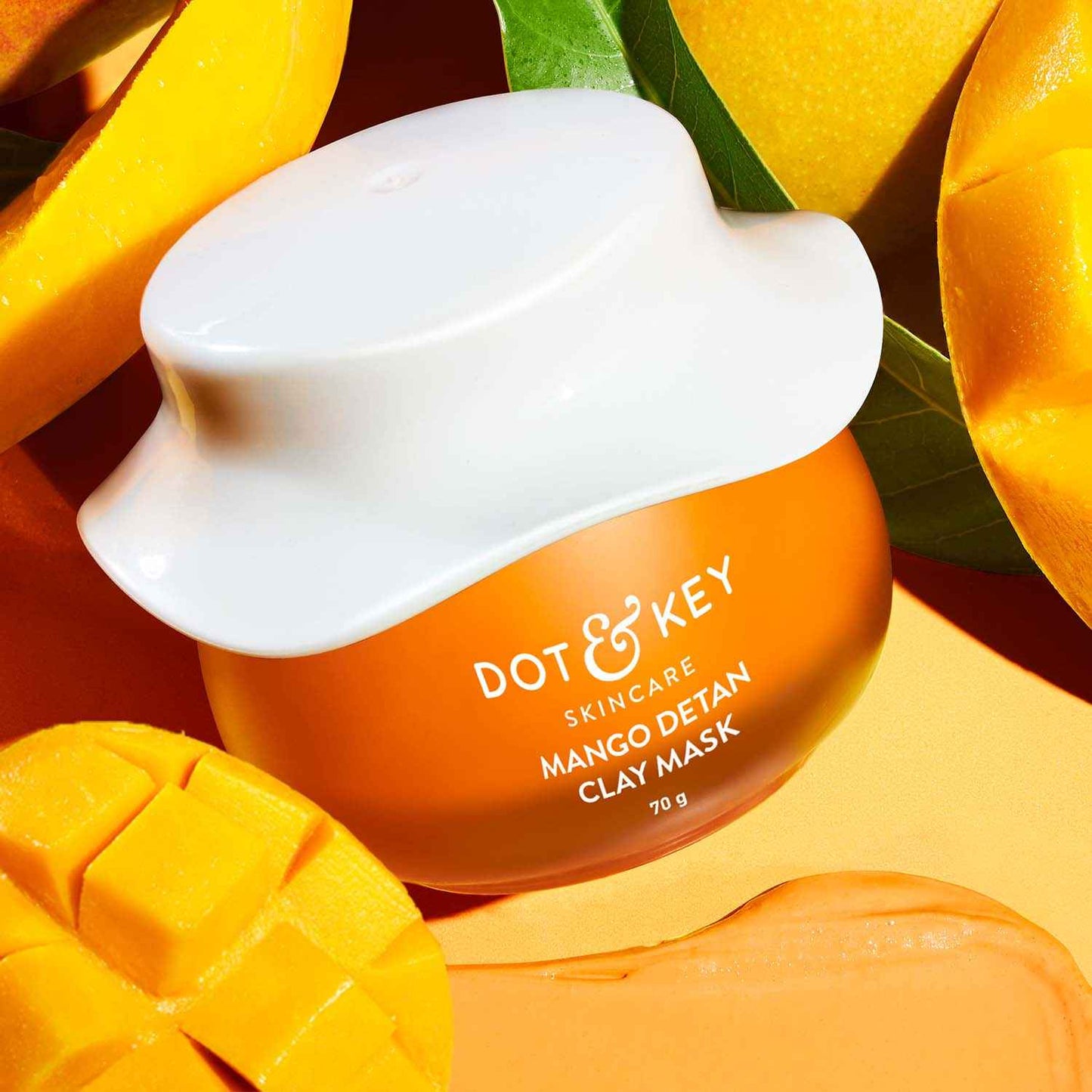
Dot & Key Mango DETAN Clay Mask | D Tan Face Mask with Glycolic + Niacinamide - 70 gm

Dot & Key Mango DETAN Clay Mask | D Tan Face Mask with Glycolic + Niacinamide - 70 gm
Dot & Key
dot-key-mango-detan-clay-mask-d-tan-face-mask-with-glycolic-niacinamide-70-gm
Face Mask
10084842209573
Morning or Evening?
How often will you use this product?
Notes


Highlights
WHAT IS IT?
Detan clay mask with glycolic acid and niacinamide; contains multiple active ingredients
FEATURES
New-age 'ubtan' to visibly reduce tan; gently exfoliates & smoothes skin; unclogs & tightens pores; fades dark spots over time; non-drying & easy to rinse
BEST FOR
sensitive
CHECKS
Does not contain drying agents; non-drying formula
Who Is It For?
No Explicit Gender Mention; Suitable For General Adult Skin UseWhat Does It Help With?
Removes Stubborn Tan; Exfoliates; Smoothes Skin; Unclogs Pores; Tightens Pores; Fades Dark SpotsBudget
Mid-range ($30-$75)How To Use
Which routine should it be used in?
Instructions:
Key Information


What Dot & Key Says
Product Description:
Get clear, tan-free & radiant skin in just 10 minutes with this non-drying detan clay mask. A modern take on 'traditional ubtan' packed with juicy mangoes, AHAs (lactic & glycolic) & niacinamide in kaolin clay, this pillowy soft clay mask not only removes stubborn tan with gentle exfoliation but also unclogs pores of impurities for soft, smooth skin instantly.
About the Brand:
Ingredients Overview
Ingredients List
Aqua, Kaolin, Glycerine, Caprylic/Capric Triglyceride, Cetearyl Alcohol, Bentonite, Cetearyl Alcohol and Polysorbate 60, Niacinamide, Sodium Lactate, Glyceryl Stearate (and) PEG-100 Stearate, Lauryl Glucoside, Hydroxyethylcellulose, Lactic Acid, Hydrolyzed Jojoba Esters, C18-22 Hydroxyalkyl Hydroxypropyl Guar, Sodium Hydroxide, Menthyl Lactate, Disodium EDTA, Scutellaria Baicalensis Root Extract (and) Paeonia Suffruticosa Root Extract (and) Saxifraga Sarmentosa Extract (and) Acetyl Tyrosine (and) Arbutin (and) Glutathione (and) Aminopropyl Ascorbyl Phosphate, Allantoin, Bisabolol, Glycolic Acid, Mangifera Indica (Mango) Fruit Extract, Kojic Dipalmitate, Sodium Hyaluronate, Phenoxyethanol (and) Ethylhexylglycerin, Fragrance, CI 77492, CI 77491, CI 15985
Key Ingredients
kaolin-clay,mango-extract,lactic-acid,glycolic-acid,niacinamide
Ingredients Details
Allantoin
Common Name(s): 5-ureidohydantoin,glyoxyldiureide,aluminum dihydroxy allantoinate
CAS Number: 97-59-6
DESCRIPTION
What It Does: Soothes irritation, accelerates wound healing, promotes skin cell renewal, and provides mild keratolytic exfoliation.
Why It's Used: Gold standard multi-function soothing active – one of the most widely used cosmetic ingredients across all product types for its exceptional tolerability and clinically proven multi-action skin conditioning.
How It Works: Promotes keratinocyte proliferation and fibroblast migration for wound healing. mild keratolytic activity by disrupting corneocyte binding. anti-irritant via direct protein binding and anti-inflammatory cytokine reduction. humectant activity via hydroxyl groups.
Typically Found In: Post-procedure products,sensitive skin formulas,wound care,anti-acne treatments,baby products
TECHNICAL DETAILS
Primary Category: Active ingredient – soothing / anti-inflammatory
Secondary Functions: Wound healing,keratolytic,anti-irritant
Application Areas:

Facial Skincare
Body Care

Hair Care
Beard Care
Color Cosmetics (Makeup)
Dietary/Oral Supplements
Typical Concentration Range: 0.1%–2%
SOURCING & ETHICS
Vegan Status: Conditional - feedstock declaration required
Halal Status: Unverified - feedstock declaration required (plant, animal and petrochemical routes all exist)
Source Notes: Plant-derived extract or synthetic. [audit 2026-07-29 rev2: origin-dependent: the same inci exists in plant, animal and petrochemical versions and the name does not discriminate. determination requires shariah-panel sign-off.]
SKIN COMPATIBILITY
Irritancy Rating: 1/5 – very low
Comedogenicity Rating: 0/5 – non-comedogenic
Sensitivity Concerns: Exceptionally well-tolerated; suitable for all skin types including baby and compromised skin.
Safe for Sensitive Skin: Yes – particularly recommended for sensitive skin
SAFETY & COMPATIBILITY
Safety Profile: Excellent safety profile. ewg score: 1.
Works Well With: Ceramides,panthenol,allantoin,hyaluronic acid,centella asiatica
Avoid Combining With: No significant incompatibilities
SCIENTIFIC NOTE
Allantoin's keratinocyte proliferation stimulation occurs via receptor-mediated signaling (possibly machr activation) rather than non-specific irritation-driven proliferation, making it a true wound-healing stimulant rather than a pro-inflammatory proliferative signal.
Last Verified: 2026-03-12
Primary Sources: Cosing database,cir safety assessment,araújo et al. allantoin review
Bentonite
Common Name(s): Montmorillonite,volcanic ash clay,swelling clay
CAS Number: 1302-78-9
DESCRIPTION
What It Does: Provides thixotropic clay gellation and deep oil absorption from swelling smectite clay.
Why It's Used: Strongest adsorbing clay for deep cleansing masks – bentonite's high cation exchange capacity and swelling capacity provide the deepest oil and toxin adsorption of common cosmetic clays.
How It Works: Montmorillonite 2:1 layered silicate swells up to 15× in water via interlayer water absorption. very high cation exchange capacity (cec: 80-150 meq/100g) provides exceptional adsorption of cations, oils, and toxins. thixotropic gel provides 'mask that hardens' sensory experience.
Typically Found In: Clay masks,deep cleansing products,detoxifying formulas
TECHNICAL DETAILS
Primary Category: Functional ingredient – swelling clay mineral
Secondary Functions: Skin conditioning
Application Areas:
Facial Skincare
Body Care
Hair Care
Beard Care
Color Cosmetics (Makeup)
Dietary/Oral Supplements
Typical Concentration Range: 1%–25%
SOURCING & ETHICS
Vegan Status: Conditional - supplier confirmation required
Halal Status: Unverified - supplier confirmation required
Source Notes: Commercially produced for cosmetic use. verify vegan/halal status with supplier. [audit 2026-07-29 rev2: the record's own source_notes does not assert a non-animal origin, or instructs the reader to verify with the supplier; "yes" asserts knowledge the record does not hold. determination requires shariah-panel sign-off.]
SKIN COMPATIBILITY
Irritancy Rating: 1/5 – very low
Comedogenicity Rating: 0/5 – non-comedogenic
Sensitivity Concerns: Well-tolerated by most skin types.
Safe for Sensitive Skin: Yes
SAFETY & COMPATIBILITY
Safety Profile: Good safety profile at recommended concentrations. ewg score: 1–2.
Works Well With: Standard skincare actives
Avoid Combining With: No known significant incompatibilities
SCIENTIFIC NOTE
Bentonite's extraordinary swelling (up to 15× dry volume) arises from its 2:1 layer structure: sodium bentonite's inter-layer sodium cations attract very thick water shells, forcing the silicate layers apart by electrostatic repulsion. calcium bentonite swells only 2-3× by comparison, explaining why sodium-exchanged bentonite is the industrial standard for swelling applications.
Last Verified: 2026-03-12
Primary Sources: Cosing database,cir safety assessment
Bisabolol
Common Name(s): Alpha-bisabolol,levomenol,(-)-alpha-bisabolol
CAS Number: 515-69-5
DESCRIPTION
What It Does: Reduces skin inflammation, soothes irritation, promotes wound healing, and enhances penetration of co-formulated actives.
Why It's Used: Premium natural soothing active with combined anti-inflammatory, wound healing, and penetration-enhancing activity – clinically validated across sensitive, reactive, and irritated skin types.
How It Works: Inhibits nf-kb pathway reducing pro-inflammatory cytokines il-1β, il-6, tnf-α. enhances stratum corneum lipid fluidity increasing penetration of co-delivered actives. antimicrobial against s. aureus and c. albicans. promotes keratinocyte migration for wound healing.
Typically Found In: Sensitive skin products,post-procedure formulations,anti-irritant formulas,wound healing
TECHNICAL DETAILS
Primary Category: Active ingredient – soothing / anti-inflammatory
Secondary Functions: Anti-inflammatory,penetration enhancement,antimicrobial
Application Areas:
Facial Skincare
Body Care
Hair Care
Beard Care
Color Cosmetics (Makeup)
Dietary/Oral Supplements
Typical Concentration Range: 0.1%–1%
SOURCING & ETHICS
Vegan Status: Conditional - supplier confirmation required
Halal Status: Unverified - supplier confirmation required
Source Notes: Natural (-)-alpha-bisabolol from brazilian candeia tree is more sustainable and potent than chamomile-derived bisabolol. synthetic (±)-bisabolol is racemic with slightly lower anti-inflammatory potency. [audit 2026-07-29 rev2: status downgraded on audit. determination requires shariah-panel sign-off.]
SKIN COMPATIBILITY
Irritancy Rating: 1/5 – very low
Comedogenicity Rating: 0/5 – non-comedogenic
Sensitivity Concerns: Non-irritating; ideal for reactive and sensitive skin.
Safe for Sensitive Skin: Yes – particularly recommended for sensitive skin
SAFETY & COMPATIBILITY
Safety Profile: Excellent safety profile. ewg score: 1.
Works Well With: Ceramides,panthenol,allantoin,hyaluronic acid,centella asiatica
Avoid Combining With: No significant incompatibilities
SCIENTIFIC NOTE
Bisabolol's dual function as both an anti-inflammatory and a penetration enhancer is synergistic – by reducing the inflammatory response that increases barrier tightness while simultaneously fluidizing stratum corneum lipids, it provides enhanced delivery of co-formulated actives in the very conditions where delivery is most needed.
Last Verified: 2026-03-12
Primary Sources: Cosing database,piazza et al. bisabolol anti-inflammatory study,cir safety assessment
C18-22 Hydroxyalkyl Hydroxypropyl Guar
Common Name(s): C18-22 hydroxyalkyl hydroxypropyl guar
DESCRIPTION
What It Does: Attracts water molecules from the environment and deeper skin layers to the stratum corneum, maintaining surface hydration and suppleness.
Why It's Used: Humectants address the most common skin concern — dryness — by providing immediate and sustained moisture delivery to the stratum corneum.
How It Works: Multiple hydroxyl or other polar groups form hydrogen bonds with water molecules, physically trapping water in the stratum corneum while creating an osmotic driving force for water migration from deeper skin layers.
Typically Found In: Serums,moisturizers,toners,essences,masks
TECHNICAL DETAILS
Primary Category: Humectants
Secondary Functions: Humectant,skin-conditioning
Application Areas:
Facial Skincare
Body Care
Hair Care
Beard Care
Color Cosmetics (Makeup)
Dietary/Oral Supplements
Typical Concentration Range: 0.5–20%
SOURCING & ETHICS
Vegan Status: Yes
Halal Status: Yes
Source Notes: Synthetic or plant-derived humectant; no animal components.
SKIN COMPATIBILITY
Irritancy Rating: 1
Comedogenicity Rating: 0
Sensitivity Concerns: Low sensitization potential at recommended use concentrations.
Safe for Sensitive Skin: Yes
SAFETY & COMPATIBILITY
Safety Profile: Well-characterized cosmetic ingredient with established safety profile. generally non-irritating at typical use concentrations. suitable for leave-on and rinse-off cosmetics.
Works Well With: Ceramides,other humectants,emollients,occlusives
Avoid Combining With: Very low humidity environments without occlusive layer
SCIENTIFIC NOTE
Humectant efficacy correlates with hygroscopic capacity (g water per g humectant at standard rh). glycerin absorbs ~0.83 g water/g at 90% rh; hyaluronic acid retains up to 1000× its weight in water through the polyelectrolyte expansion of its carboxylate groups. optimal formulations balance humectants with occlusives (waxes, silicones) to prevent transepidermal water loss.
Last Verified: 2025-01-15
Primary Sources: Cosing eu database; pcpc cosmetic ingredient safety reviews; ingredient-specific safety and efficacy literature