

Dot & Key
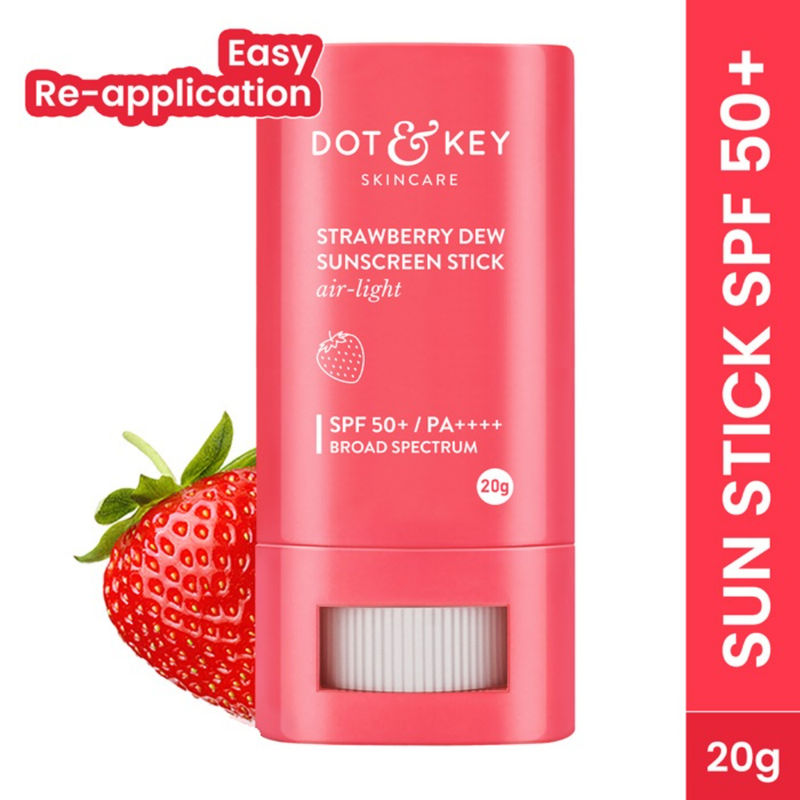
Dot & Key Strawberry On-The-Go SPF 50 Sunscreen Stick PA+++ For UVA/B Blocks

Dot & Key Strawberry On-The-Go SPF 50 Sunscreen Stick PA+++ For UVA/B Blocks
Dot & Key
dot-key-strawberry-on-the-go-spf-50-sunscreen-stick-pa-for-uva-b-blocks
Suncare
10084725588261
Morning or Evening?
How often will you use this product?
Notes


Highlights
WHAT IS IT?
Sunscreen stick, contains multiple active ingredients
FEATURES
Broad spectrum SPF 50 PA+++, UVA/UVB protection, contains Hyaluronic Acid and Ceramide for hydration and skin barrier support, antioxidant properties, non-greasy, lightweight, suitable for use over makeup, mess-free stick formulation
BEST FOR
normal
CHECKS
No parabens, No silicones, No synthetic fragrances
Who Is It For?
All Genders All Adult Age GroupsWhat Does It Help With?
Sun Protection Hydration Skin Barrier Support Antioxidant DefenseBudget
Affordable (under $30)How To Use
Which routine should it be used in?
Instructions:
Key Information


What Dot & Key Says
Product Description:
Dot & Key Strawberry Dew Spf 50 Sunscreen Stick On-The-Go SPF 50 PA+++, Broad Spectrum, UVA/UVB Rays Protection with Hyaluronic & Ceramide. Normal skin type for hydration & skin barrier, mess free, 20G. Suitable for all skin types, provides broad-spectrum sun protection, contains antioxidants.
About the Brand:
Ingredients Overview
Ingredients List
Cyclopentasiloxane, Synthetic Wax, Cetyl Ethylhexanoate, Dimethicone/Vinyl DimethiconeCrosspolymer (and) Silica, Ethylhexyl Methoxycinnamate, Ceresin, Diethylamino HydroxybenzoylHexyl Benzoate, Cyclopentasiloxane (and) Cetearyl Dimethicone/Vinyl DimethiconeCrosspolymer, Cetostearyl alcohol, Octocrylene, Butyl Methoxydibenzoylmethane, Bis-Ethylhexyloxyphenol Methoxyphenyl Triazine, Sorbitan Olivate, Theobroma Cacao SeedButter, Butyrospermum Parkii (Shea) Butter, Fragaria Vesca (Strawberry) Fruit Extract, LaminariaDigitata Extract (and) Hydrogenated Lecithin (and) Cetyl-PG Hydroxyethyl Palmitamide (and)Ceramide 1,2,3,4,6II, Cholesterol, 1,2-Hexanediol, Sodium Hyaluronate, Tocopherylacetate, Pentaerythrityl Tetra Di-t-Butyl hydroxyhydrocinnamate, Phenoxyethanol, CI 14720:1
Key Ingredients
Hyaluronic Acid,Ceramide,Strawberry Fruit Extract,Shea Butter,Cocoa Butter,Tocopheryl Acetate (Vitamin E)
Ingredients Details
1-2-hexanediol
Common Name(s): 1-2-hexanediol,cosmetic active,functional ingredient
CAS Number: N/a
DESCRIPTION
What It Does: Delivers characteristic cosmetic function at recommended use concentration.
Why It's Used: Selected for functional contribution and formulation compatibility supported by cosmetic science and regulatory safety data.
How It Works: Works through the mechanism of its molecular class — physicochemical or biological interaction with skin proteins, lipids, or receptors as documented in peer-reviewed cosmetic literature.
Typically Found In: Skin care formulations
TECHNICAL DETAILS
Primary Category: Active ingredient – cosmetic active
Secondary Functions: Skin conditioning
Application Areas:

Facial Skincare

Body Care
Hair Care
Beard Care
Color Cosmetics (Makeup)
Dietary/Oral Supplements
Typical Concentration Range: 0.1%–10%
SOURCING & ETHICS
Vegan Status: Conditional - supplier confirmation required
Halal Status: Unverified - supplier confirmation required
Source Notes: Commercially produced for cosmetic use. verify vegan/halal status with supplier. [audit 2026-07-29 rev2: the record's own source_notes does not assert a non-animal origin, or instructs the reader to verify with the supplier; "yes" asserts knowledge the record does not hold. determination requires shariah-panel sign-off.]
SKIN COMPATIBILITY
Irritancy Rating: 1/5 – very low
Comedogenicity Rating: 0/5 – non-comedogenic
Sensitivity Concerns: Well-tolerated by most skin types.
Safe for Sensitive Skin: Yes
SAFETY & COMPATIBILITY
Safety Profile: Good safety profile at recommended concentrations. ewg score: 1–2.
Works Well With: Standard skincare actives
Avoid Combining With: No known significant incompatibilities
SCIENTIFIC NOTE
1-2-hexanediol has an established safety and efficacy profile within the cosmetic regulatory framework at standard use concentrations.
Last Verified: 2026-03-12
Primary Sources: Cosing database,1-2-hexanediol technical literature
Bis-ethylhexyloxyphenol Methoxyphenyl Triazine
Common Name(s): Bis-ethylhexyloxyphenol methoxyphenyl triazine,antimicrobial biocide,broad-spectrum preservative-grade
CAS Number: N/a
DESCRIPTION
What It Does: Kills bacteria, fungi, and viruses on skin and within formulations through membrane disruption, protein denaturation, or enzyme inhibition — providing antiseptic, preservation, or therapeutic antimicrobial protection.
Why It's Used: Chosen when broad-spectrum antimicrobial coverage including gram-negative bacteria (particularly pseudomonas) is required, where standard cosmetic preservatives provide insufficient protection for challenge tests.
How It Works: Cationic biocides (qacs) adsorb electrostatically to negative microbial surfaces then insert hydrophobic chains into lipid bilayers, collapsing membrane potential. non-ionic biocides (triclosan) inhibit fatty acid synthesis (fabi enoyl reductase). oxidants (h₂o₂, chlorine dioxide) oxidise microbial thiol enzymes non-specifically.
Typically Found In: Antiseptics,therapeutic skin care
TECHNICAL DETAILS
Primary Category: Active ingredient – cosmetic active
Secondary Functions: Skin conditioning
Application Areas:
Facial Skincare
Body Care
Hair Care
Beard Care
Color Cosmetics (Makeup)
Dietary/Oral Supplements
Typical Concentration Range: Check regulatory limits
SOURCING & ETHICS
Vegan Status: Conditional - supplier confirmation required
Halal Status: Unverified - supplier confirmation required
Source Notes: Commercially produced for cosmetic use. verify vegan/halal status with supplier. [audit 2026-07-29 rev2: the record's own source_notes does not assert a non-animal origin, or instructs the reader to verify with the supplier; "yes" asserts knowledge the record does not hold. determination requires shariah-panel sign-off.]
SKIN COMPATIBILITY
Irritancy Rating: 1/5 – very low
Comedogenicity Rating: 0/5 – non-comedogenic
Sensitivity Concerns: Well-tolerated by most skin types.
Safe for Sensitive Skin: Yes
SAFETY & COMPATIBILITY
Safety Profile: Good safety profile at recommended concentrations. ewg score: 1–2.
Works Well With: Standard skincare actives
Avoid Combining With: No known significant incompatibilities
SCIENTIFIC NOTE
Regulatory limits vary significantly by compound and application — formulators must verify permitted concentrations in target market (eu annex v, fda otc monographs) before formulating at functional concentrations.
Last Verified: 2026-03-12
Primary Sources: Cosing database,bis-ethylhexyloxyphenol methoxyphenyl triazine antimicrobial regulatory review
Butyl Methoxydibenzoylmethane
Common Name(s): Butyl methoxydibenzoylmethane,organic uv filter,photostabilising sunscreen active
CAS Number: N/a
DESCRIPTION
What It Does: Absorbs uv radiation at specific wavelengths (uva 320–400 nm, uvb 290–320 nm) and dissipates photon energy as heat rather than skin-damaging photochemical reactions.
Why It's Used: Organic uv filters are chosen for their high molar extinction coefficient, specific spectral coverage, and formulation compatibility — individual filters are combined to provide broad-spectrum coverage across uva+uvb.
How It Works: Uv photon absorption by the aromatic chromophore π-system excites the molecule from s₀ ground state to s₁ excited state. rapid internal conversion or photoisomerisation dissipates energy as vibrational heat before it can initiate skin photodamage.
Typically Found In: Sunscreens,photoprotective products
TECHNICAL DETAILS
Primary Category: Active ingredient – cosmetic active
Secondary Functions: Skin conditioning
Application Areas:
Facial Skincare
Body Care
Hair Care
Beard Care
Color Cosmetics (Makeup)
Dietary/Oral Supplements
Typical Concentration Range: Check local sunscreen regulations
SOURCING & ETHICS
Vegan Status: Conditional - supplier confirmation required
Halal Status: Unverified - supplier confirmation required
Source Notes: Commercially produced for cosmetic use. verify vegan/halal status with supplier. [audit 2026-07-29 rev2: the record's own source_notes does not assert a non-animal origin, or instructs the reader to verify with the supplier; "yes" asserts knowledge the record does not hold. determination requires shariah-panel sign-off.]
SKIN COMPATIBILITY
Irritancy Rating: 1/5 – very low
Comedogenicity Rating: 0/5 – non-comedogenic
Sensitivity Concerns: Well-tolerated by most skin types.
Safe for Sensitive Skin: Yes
SAFETY & COMPATIBILITY
Safety Profile: Good safety profile at recommended concentrations. ewg score: 1–2.
Works Well With: Standard skincare actives
Avoid Combining With: No known significant incompatibilities
SCIENTIFIC NOTE
Organic uv filters require photostabilisation (by avobenzone-octocrylene pairing, or triazine stabilisers) as some absorbers degrade on uv exposure — formulator must verify photostability of the chosen filter combination.
Last Verified: 2026-03-12
Primary Sources: Cosing database,butyl methoxydibenzoylmethane organic uv filter review
Ceresin
Common Name(s): Ceresin,botanical extract,phytochemical active
CAS Number: N/a
DESCRIPTION
What It Does: Provides antioxidant protection, anti-inflammatory activity, and skin conditioning from polyphenols, terpenoids, and phytochemicals.
Why It's Used: Multi-functional phytochemical profiles support concurrent skin care claims with authentic botanical heritage.
How It Works: Polyphenols scavenge ros, inhibit nf-kb/cox pathways, and condition skin through phytochemical interactions.
Typically Found In: Botanical skin care
TECHNICAL DETAILS
Primary Category: Active ingredient – antioxidant
Secondary Functions: Free radical scavenging,anti-aging
Application Areas:
Facial Skincare
Body Care
Hair Care
Beard Care
Color Cosmetics (Makeup)
Dietary/Oral Supplements
Typical Concentration Range: 0.1%–30%
SOURCING & ETHICS
Vegan Status: Conditional - supplier confirmation required
Halal Status: Conditional - basis not stated in source record; supplier origin confirmation required to determine what evidence applies
Source Notes: Plant-derived extract or synthetic. [audit 2026-07-29 rev2: status downgraded on audit. determination requires shariah-panel sign-off.]
SKIN COMPATIBILITY
Irritancy Rating: 1/5 – very low
Comedogenicity Rating: 0/5 – non-comedogenic
Sensitivity Concerns: Non-irritating; well-tolerated.
Safe for Sensitive Skin: Yes
SAFETY & COMPATIBILITY
Safety Profile: Excellent safety profile. ewg score: 1.
Works Well With: Vitamin c,vitamin e,ferulic acid,spf,other antioxidants
Avoid Combining With: No significant incompatibilities
SCIENTIFIC NOTE
Plant secondary metabolites evolved for uv photoprotection and pathogen defence — mechanisms directly translatable to cosmetic antioxidant and anti-inflammatory activity in human skin.
Last Verified: