

Dot & Key
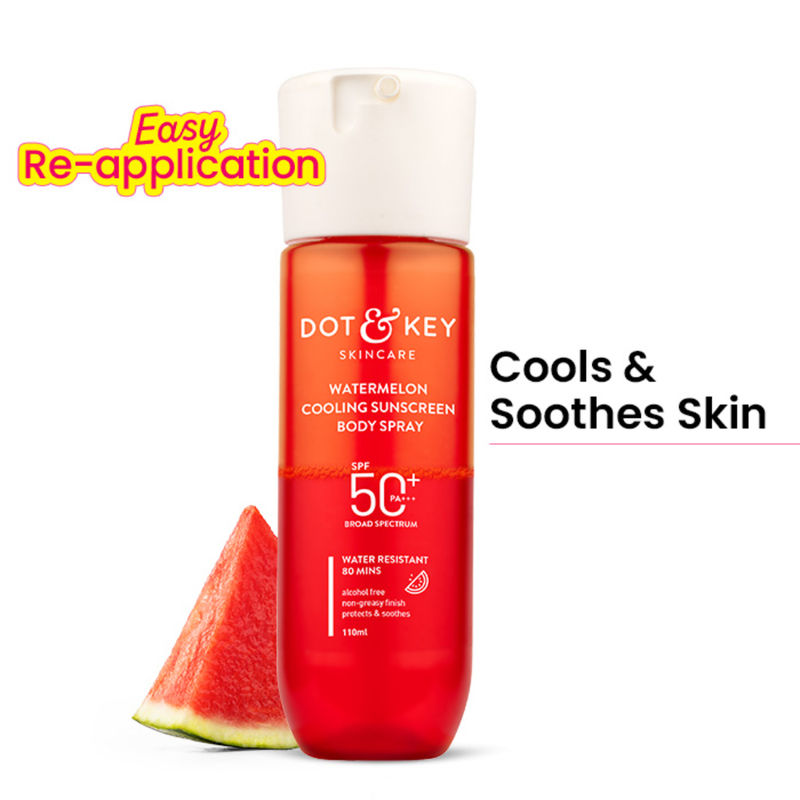
Dot & Key Watermelon Cooling Sunscreen Body Spray With SPF 50+ PA+++

Dot & Key Watermelon Cooling Sunscreen Body Spray With SPF 50+ PA+++
Dot & Key
dot-key-watermelon-cooling-sunscreen-body-spray-with-spf-50-pa
Suncare
10085029216549
Morning or Evening?
How often will you use this product?
Notes


Highlights
WHAT IS IT?
Body sunscreen spray with biphasic formulation and 14 ingredients
FEATURES
Watermelon-infused, Cooling sensation, SPF 50+ PA+++ for broad spectrum protection, Biphasic formulation, Aloe water for hydration, Lightweight, Non-greasy, Quick-absorbing, Moisturizing, Antioxidant-rich, Dermatologist-tested, Instant cooling effect
BEST FOR
sensitive
CHECKS
No white cast, No greasy feeling, No fragrance, Alcohol-free, Non-comedogenic
Who Is It For?
All Genders No Specific Age Range StatedWhat Does It Help With?
Sun Protection Hydration Cooling Sensation Antioxidant Benefits Moisturizing SkinBudget
Affordable (under $30)How To Use
Which routine should it be used in?
Instructions:
Key Information


What Dot & Key Says
Product Description:
Watermelon-infused, Cooling sensation, SPF 40+, PA+++ (high protection against UVA and UVB). Biphasic formulation, Aloe water, Hydrating, Refreshing. Lightweight, Non-greasy, Quick-absorbing, Broad-spectrum protection, Moisturizing. Skin-nourishing, Sun protection, Summer essential, Beach-ready, Hyaluronic acid (if included for added hydration). Antioxidant-rich, Dermatologist-tested, biphasic sunscreen, instant cooling.
About the Brand:
Ingredients Overview
Ingredients List
aloe-barbadensis-leaf-water,cyclopentasiloxane,isododecane,ethylhexyl-methoxycinnamate,butylene-glycol,diethylamino-hydroxybenzoyl-hexyl-benzoate,dibutyl-adipate,phenylbenzimidazole-sulfonic-acid,propylene-glycol,triethanolamine,sodium-chloride,terephthalylidene-dicamphor-sulfonic-acid,menthyl-lactate,citrullus-lanatus-fruit-extracts,sodium-hyaluronate,tocopheryl-acetate,sodium-benzoate-potassium-sorbate-aqua,phenoxyethanol,pentaerythrityl-tetra-di-t-butyl-hydroxyhydrocinnamate
Key Ingredients
Aloe Barbadensis Leaf Water, Watermelon Fruit Extract, Sodium Hyaluronate, Tocopheryl Acetate, Ethylhexyl Methoxycinnamate
Ingredients Details
Cyclopentasiloxane
Common Name(s): Cyclopentasiloxane,cyclic volatile silicone,dry-touch carrier solvent
CAS Number: N/a
DESCRIPTION
What It Does: Provides a dry, weightless application vehicle that evaporates cleanly leaving actives and non-volatile silicones deposited on skin — eliminating the residual heaviness of conventional liquid carrier solvents.
Why It's Used: Cyclosiloxanes are the unique volatile silicone solvents that dissolve non-volatile silicones (dimethicone, cyclomethicone), organic uv filters, and lipophilic actives, providing the sensory-superior dry-touch application experience in premium formulations.
How It Works: Cyclosiloxane vapour pressure (d5 cyclopentasiloxane ~0.3 mmhg at 25°c) provides clean evaporation at body temperature. the cyclic ring structure provides lower boiling point than equivalent linear dimethicone, enabling faster evaporation while the ring conformation maintains the silicone's low surface energy for smooth application.
Typically Found In: Primers,antiperspirants,sunscreens
TECHNICAL DETAILS
Primary Category: Functional ingredient – emollient
Secondary Functions: Barrier sealing,softening
Application Areas:

Facial Skincare
Body Care
Hair Care

Beard Care
Color Cosmetics (Makeup)
Dietary/Oral Supplements
Typical Concentration Range: 1%–50%
SOURCING & ETHICS
Vegan Status: Conditional - supplier confirmation required
Halal Status: Unverified - supplier confirmation required
Source Notes: Plant-derived, synthetic or animal-derived. verify source. [audit 2026-07-29 rev2: the record's own source_notes does not assert a non-animal origin, or instructs the reader to verify with the supplier; "yes" asserts knowledge the record does not hold. determination requires shariah-panel sign-off.]
SKIN COMPATIBILITY
Irritancy Rating: 1/5 – very low
Comedogenicity Rating: 1/5 – low; formulation-dependent
Sensitivity Concerns: Non-irritating.
Safe for Sensitive Skin: Yes
SAFETY & COMPATIBILITY
Safety Profile: Excellent safety profile. ewg score: 1.
Works Well With: Humectants,ceramides,actives as carrier
Avoid Combining With: No significant incompatibilities
SCIENTIFIC NOTE
Cyclopentasiloxane (d5) and cyclohexasiloxane (d6) are under eu regulatory review for potential environmental persistence (pbt assessment) — formulators should monitor eu regulation 2018/35 implementation for restrictions in wash-off products.
Last Verified: 2026-03-12
Primary Sources: Cosing database,eu cyclosiloxane regulatory review
Isododecane
Common Name(s): Permethyl 99a,c12 isoparaffin,volatile hydrocarbon
CAS Number: 31807-55-3
DESCRIPTION
What It Does: Provides quick-dry volatile hydrocarbon carrier for colour cosmetics with complete evaporation and no residue.
Why It's Used: Primary colour cosmetic carrier — isododecane's volatility and excellent pigment dispersion combined with complete evaporation make it the standard carrier for long-wear foundations and colour cosmetics.
How It Works: Volatile isoparaffin (bp 177-188°c) evaporates from skin within 10-20 minutes. excellent pigment dispersion for colour cosmetics. spreading enhancement from low surface tension. no residue after evaporation provides clean, long-wear finish.
Typically Found In: Long-wear foundations,colour cosmetics,primers,sunscreens
TECHNICAL DETAILS
Primary Category: Functional ingredient – volatile hydrocarbon
Secondary Functions: Barrier sealing,softening
Application Areas:
Facial Skincare
Body Care
Hair Care
Beard Care
Color Cosmetics (Makeup)
Dietary/Oral Supplements
Typical Concentration Range: 5%–60%
SOURCING & ETHICS
Vegan Status: Conditional - supplier confirmation required
Halal Status: Unverified - supplier confirmation required
Source Notes: Plant-derived, synthetic or animal-derived. verify source. [audit 2026-07-29 rev2: the record's own source_notes does not assert a non-animal origin, or instructs the reader to verify with the supplier; "yes" asserts knowledge the record does not hold. determination requires shariah-panel sign-off.]
SKIN COMPATIBILITY
Irritancy Rating: 1/5 – very low
Comedogenicity Rating: 1/5 – low; formulation-dependent
Sensitivity Concerns: Non-irritating.
Safe for Sensitive Skin: Yes
SAFETY & COMPATIBILITY
Safety Profile: Excellent safety profile. ewg score: 1.
Works Well With: Humectants,ceramides,actives as carrier
Avoid Combining With: No significant incompatibilities
SCIENTIFIC NOTE
Isododecane's position as the preferred colour cosmetic carrier arises from a unique combination of properties that no other solvent provides simultaneously: volatility (complete evaporation for clean finish), pigment dispersion (superior to water or alcohols), compatibility with silicones (unlike many solvents), and skin safety (inert hydrocarbon without irritation potential of polar solvents).
Last Verified: 2026-03-12
Primary Sources: Cosing database,cir safety assessment
Phenoxyethanol
Common Name(s): 2-phenoxyethanol,rose ether,ethylene glycol monophenyl ether
CAS Number: 122-99-6
DESCRIPTION
What It Does: Prevents microbial contamination and spoilage in cosmetic formulations.
Why It's Used: The benchmark cosmetic preservative – eu-permitted up to 1%, effective against virtually all cosmetically relevant microorganisms, and excellent tolerability.
How It Works: Phenol ring provides broad antimicrobial activity via disruption of bacterial and fungal cell membranes and inhibition of enzymatic activity. effective against gram-positive and gram-negative bacteria, yeasts (candida), and molds (aspergillus). activity ph range: 3-9.
Typically Found In: All cosmetic formulations as primary preservative
TECHNICAL DETAILS
Primary Category: Functional ingredient – broad-spectrum preservative
Secondary Functions: Skin conditioning
Application Areas:
Facial Skincare
Body Care
Hair Care
Beard Care
Color Cosmetics (Makeup)
Dietary/Oral Supplements
Typical Concentration Range: 0.1%–1% (eu max 1%)
SOURCING & ETHICS
Vegan Status: Conditional - supplier confirmation required
Halal Status: Unverified - supplier confirmation required
Source Notes: Commercially produced for cosmetic use. verify vegan/halal status with supplier. [audit 2026-07-29 rev2: the record's own source_notes does not assert a non-animal origin, or instructs the reader to verify with the supplier; "yes" asserts knowledge the record does not hold. determination requires shariah-panel sign-off.]
SKIN COMPATIBILITY
Irritancy Rating: 1/5 – very low
Comedogenicity Rating: 0/5 – non-comedogenic
Sensitivity Concerns: Well-tolerated by most skin types.
Safe for Sensitive Skin: Yes
SAFETY & COMPATIBILITY
Safety Profile: Eu cosmetics regulation max 1%. sccs assessed as safe at ≤1%. avoid use around eyes in baby products per some country regulations. ewg score: 4.
Works Well With: Standard skincare actives
Avoid Combining With: No known significant incompatibilities
SCIENTIFIC NOTE
Phenoxyethanol's widespread adoption as the primary cosmetic preservative followed the phaseout of parabens from many formulations in the 2000s-2010s. despite having a comparable or better safety profile to parabens, it is often cited in 'free-from' formulations – a consumer perception issue rather than a scientific safety concern.
Last Verified:
Triethanolamine
Common Name(s): Triethanolamine,cosmetic active,functional ingredient
CAS Number: N/a
DESCRIPTION
What It Does: Delivers characteristic cosmetic function at recommended use concentration.
Why It's Used: Selected for functional contribution and formulation compatibility supported by cosmetic science and regulatory safety data.
How It Works: Works through the mechanism of its molecular class as documented in peer-reviewed cosmetic literature.
Typically Found In: Skin care formulations
TECHNICAL DETAILS
Primary Category: Active ingredient – cosmetic active
Secondary Functions: Skin conditioning
Application Areas:
Facial Skincare
Body Care
Hair Care
Beard Care
Color Cosmetics (Makeup)
Dietary/Oral Supplements
Typical Concentration Range: 0.1%–10%
SOURCING & ETHICS
Vegan Status: Conditional - supplier confirmation required
Halal Status: Unverified - supplier confirmation required
Source Notes: Commercially produced for cosmetic use. verify vegan/halal status with supplier. [audit 2026-07-29 rev2: the record's own source_notes does not assert a non-animal origin, or instructs the reader to verify with the supplier; "yes" asserts knowledge the record does not hold. determination requires shariah-panel sign-off.]
SKIN COMPATIBILITY
Irritancy Rating: 1/5 – very low
Comedogenicity Rating: 0/5 – non-comedogenic
Sensitivity Concerns: Well-tolerated by most skin types.
Safe for Sensitive Skin: Yes
SAFETY & COMPATIBILITY
Safety Profile: Good safety profile at recommended concentrations. ewg score: 1–2.
Works Well With: Standard skincare actives
Avoid Combining With: No known significant incompatibilities
SCIENTIFIC NOTE
Triethanolamine has an established safety profile within the cosmetic regulatory framework at standard use concentrations.
Last Verified: 2026-03-12
Primary Sources: Cosing database,triethanolamine technical literature