
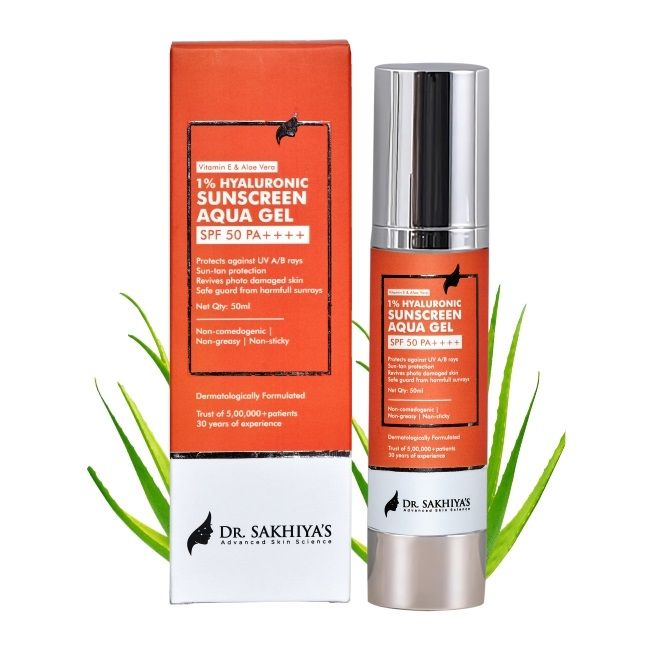

Dr. Sakhiya
Dr. Sakhiya 1% Hyaluronic Aqua Gel Sunscreen Hydrating SPF 50 PA++++ for Sensitive Skin

Dr. Sakhiya 1% Hyaluronic Aqua Gel Sunscreen Hydrating SPF 50 PA++++ for Sensitive Skin
Dr. Sakhiya
dr-sakhiya-1-hyaluronic-aqua-gel-sunscreen-hydrating-spf-50-pa-for-sensitive-skin
Suncare
10084903420197
Morning or Evening?
How often will you use this product?
Notes


Highlights
WHAT IS IT?
A moisturizing face sunscreen with 1% hyaluronic acid
FEATURES
Provides SPF 50 PA++++ broad-spectrum protection, contains 1% hyaluronic acid for hydration, lightweight gel texture, fast absorbing, no white cast, non-comedogenic, suitable for sensitive skin, free from parabens, silicones, sulfates, vegan, cruelty-free, dermatologically tested
BEST FOR
sensitive
CHECKS
No parabens, no harmful silicones, no sulfates
Who Is It For?
All Genders Suitable For Sensitive Skin (no Explicit Age Range)What Does It Help With?
Protects From Uva Uvb Blue Light; Hydrates Skin; Prevents Clogged Pores; Prevents Premature AgingBudget
Mid-range ($30-$75)How To Use
Which routine should it be used in?
Instructions:
Key Information


What Dr. Sakhiya Says
Product Description:
Dr. Sakhiya's 1% Hyaluronic Sunscreen Aqua Gel provides broad-spectrum SPF 50 PA++++ protection against UVA, UVB, and blue light. It is non-comedogenic, non-greasy, non-sticky, and suitable for all skin types including sensitive skin. Enriched with 1% hyaluronic acid, it hydrates, locks moisture, leaves no white cast, absorbs quickly, and is safe under makeup.
About the Brand:
Ingredients Overview
Ingredients List
Aqua,Ethylhexyl-Methoxycinnamate,Butyl-Methoxydibenzoylmethane,Benzophenone-3,Phospholipids,1,3-butylene-Glycol,Stearic-Acid,Glycerin,Cetyl-Alcohol,Sorbitan-Stearate,Sucrose-Cocoate,Caprylic/capric-Triglyceride,Polyacrylamide,C13-14-Isoparaffin,Laureth-7,Coco-Caprylate/caprate,Sodium-Hyaluronate,Daucus-Carota-Seed-Oil,Hedychium-Coronarium-Root-Extract,Crambe-Abyssinica-Seed-Oil,Beta-carotene,Xanthophylls,Tocopherol,Helianthus-Annuus-Seed-Oil,Rosmarinus-Officinalis-Leaf-Extract,Aloe-Barbadensis-Leaf-Extract,Phenoxyethanol,Ethylhexylglycerin,Carbomer,Sodium-Hydroxide,Sodium-Gluconate
Key Ingredients
1% hyaluronic acid,Daucus Carota Seed Oil,Hedychium Coronarium Root Extract,Crambe Abyssinica Seed Oil,Beta-carotene
Ingredients Details
Benzophenone-3
Common Name(s): Oxybenzone,2-hydroxy-4-methoxybenzophenone,uva+uvb filter
CAS Number: 131-57-7
DESCRIPTION
What It Does: Provides combined uva and uvb filtration in a single chemical uv filter molecule.
Why It's Used: Combined uva+uvb filter historically used for broad-spectrum coverage in a single ingredient, now increasingly restricted.
How It Works: Benzophenone chromophore absorbs uvb (305nm) and uva-ii (326nm) via two separate n→π* transitions. water-soluble allows aqueous phase formulation. single filter providing partial broad-spectrum coverage.
Typically Found In: Sunscreens (being phased out in many markets)
TECHNICAL DETAILS
Primary Category: Active ingredient – chemical uva/uvb filter
Secondary Functions: Skin conditioning
Application Areas:

Facial Skincare

Body Care
Hair Care
Beard Care
Color Cosmetics (Makeup)
Dietary/Oral Supplements
Typical Concentration Range: Up to 6% (eu), 6% (us fda)
SOURCING & ETHICS
Vegan Status: Conditional - supplier confirmation required
Halal Status: Unverified - supplier confirmation required
Source Notes: Commercially produced for cosmetic use. verify vegan/halal status with supplier. [audit 2026-07-29 rev2: the record's own source_notes does not assert a non-animal origin, or instructs the reader to verify with the supplier; "yes" asserts knowledge the record does not hold. determination requires shariah-panel sign-off.]
SKIN COMPATIBILITY
Irritancy Rating: 1/5 – very low
Comedogenicity Rating: 0/5 – non-comedogenic
Sensitivity Concerns: Well-tolerated by most skin types.
Safe for Sensitive Skin: Yes
SAFETY & COMPATIBILITY
Safety Profile: Eu max 6%. coral reef/aquatic toxicity — banned hawaii, palau, some us states. potential endocrine activity at high systemic exposure. ewg score: 7. use declining due to regulatory pressure.
Works Well With: Standard skincare actives
Avoid Combining With: No known significant incompatibilities
SCIENTIFIC NOTE
Benzophenone-3's declining use reflects evolving understanding of environmental and endocrine impacts: discovered in coral bleaching studies, its restriction in hawaii (2018) sparked a global trend in marine-safe sunscreen formulations that is reshaping the industry away from bp-3 toward mineral filters and marine-safer organic alternatives.
Last Verified: 2026-03-12
Primary Sources: Cosing database,fda uv filter otc monograph,hawaii bp-3 restriction law
Beta-carotene
Common Name(s): Provitamin a,all-trans-beta-carotene
CAS Number: 7235-40-7
DESCRIPTION
What It Does: Neutralizes free radicals, provides photoprotection support, conditions skin, and imparts healthy skin tone.
Why It's Used: Natural antioxidant, skin conditioning, and natural colorant with additional provitamin a activity.
How It Works: Quenches singlet oxygen and free radicals. enzymatic cleavage yields retinal. accumulates in stratum corneum for photoprotective antioxidant defense.
Typically Found In: Self-tanners,sunscreens,natural colorants,anti-aging formulations
TECHNICAL DETAILS
Primary Category: Active ingredient – vitamin a derivative
Secondary Functions: Uv protection support,natural colorant,vitamin a precursor
Application Areas:
Facial Skincare
Body Care
Hair Care
Beard Care
Color Cosmetics (Makeup)
Dietary/Oral Supplements
Typical Concentration Range: 0.01%–1%
SOURCING & ETHICS
Vegan Status: Conditional - supplier confirmation required
Halal Status: Unverified - supplier confirmation required
Source Notes: Derived from dunaliella salina algae, carrot oil, or synthesized. algae-derived most sustainable. [audit 2026-07-29 rev2: the record's own source_notes does not assert a non-animal origin, or instructs the reader to verify with the supplier; "yes" asserts knowledge the record does not hold. determination requires shariah-panel sign-off.]
SKIN COMPATIBILITY
Irritancy Rating: 1/5 – very low
Comedogenicity Rating: 0/5 – non-comedogenic
Sensitivity Concerns: Very well-tolerated; high concentrations may impart orange tint.
Safe for Sensitive Skin: Yes
SAFETY & COMPATIBILITY
Safety Profile: Safe at cosmetic concentrations. use spf. avoid during pregnancy. ewg score: 2.
Works Well With: Niacinamide,ceramides,hyaluronic acid,spf,tocopherol
Avoid Combining With: No significant incompatibilities
SCIENTIFIC NOTE
Beta-carotene accumulates in the stratum corneum and provides measurable photoprotection against uv-induced oxidative stress when applied topically. not a replacement for uv filters.
Last Verified: 2026-03-12
Primary Sources: Cosing database,cir safety assessment,stahl & sies carotenoid review
Carbomer
Common Name(s): Carbopol,polyacrylic acid,carboxyvinyl polymer
DESCRIPTION
What It Does: Provides transparent gel textures and thickening at very low concentrations via ph-responsive swelling.
Why It's Used: The most widely used gel thickener – provides crystal-clear, stable gels at concentrations as low as 0.1-0.5% with ph-controlled viscosity.
How It Works: Highly crosslinked polyacrylic acid remains tightly coiled at acidic ph. neutralization with naoh or triethanolamine ionizes carboxylic groups causing electrostatic repulsion that unfolds and swells the polymer coils, dramatically increasing viscosity. concentration-dependent thickening.
Typically Found In: Gels,serums,emulsions,sunscreens
TECHNICAL DETAILS
Primary Category: Functional ingredient – polyacrylic acid thickener
Secondary Functions: Skin conditioning
Application Areas:
Facial Skincare
Body Care
Hair Care
Beard Care
Color Cosmetics (Makeup)
Dietary/Oral Supplements
Typical Concentration Range: 0.1%–2%
SOURCING & ETHICS
Vegan Status: Conditional - supplier confirmation required
Halal Status: Unverified - supplier confirmation required
Source Notes: Commercially produced for cosmetic use. verify vegan/halal status with supplier. [audit 2026-07-29 rev2: the record's own source_notes does not assert a non-animal origin, or instructs the reader to verify with the supplier; "yes" asserts knowledge the record does not hold. determination requires shariah-panel sign-off.]
SKIN COMPATIBILITY
Irritancy Rating: 1/5 – very low
Comedogenicity Rating: 0/5 – non-comedogenic
Sensitivity Concerns: Well-tolerated by most skin types.
Safe for Sensitive Skin: Yes
SAFETY & COMPATIBILITY
Safety Profile: Good safety profile at recommended concentrations. ewg score: 1–2.
Works Well With: Standard skincare actives
Avoid Combining With: No known significant incompatibilities
SCIENTIFIC NOTE
Carbomer's ph-responsive swelling mechanism provides an elegant formulation control tool: a neutralized gel can be liquefied by ph reduction (adding acid) and re-thickened by reneutralization. this reversible rheology control allows two-phase products that mix on application without the need for mechanical emulsification.
Last Verified: 2026-03-12
Primary Sources: Cosing database,cir safety assessment
Coco-caprylate/caprate
Common Name(s): Coco-caprylate/caprate
DESCRIPTION
What It Does: Smooths and softens skin by filling intercorneocyte spaces, reducing friction, and providing a pleasant aesthetic skin feel in formulations.
Why It's Used: Synthetic esters provide tailored aesthetic properties — spreadability, skin feel, volatility, refractive index — that natural oils alone cannot consistently deliver.
How It Works: The ester molecule fills microscopic surface irregularities between corneocytes, reducing coefficient of friction, reflecting light uniformly, and providing a lubrication layer that protects the skin surface.
Typically Found In: Moisturizers,sunscreens,color cosmetics,body lotions,lip products
TECHNICAL DETAILS
Primary Category: Synthetic emollients
Secondary Functions: Emollient
Application Areas:
Facial Skincare
Body Care
Hair Care
Beard Care
Color Cosmetics (Makeup)
Dietary/Oral Supplements
Typical Concentration Range: 1–20%
SOURCING & ETHICS
Vegan Status: Conditional - feedstock declaration required
Halal Status: Unverified - feedstock declaration required (plant, animal and petrochemical routes all exist)
Source Notes: Synthetically produced ester emollient; no animal components. [audit 2026-07-29 rev2: origin-dependent: the same inci exists in plant, animal and petrochemical versions and the name does not discriminate. determination requires shariah-panel sign-off.]
SKIN COMPATIBILITY
Irritancy Rating: 1
Comedogenicity Rating: 1
Sensitivity Concerns: Low sensitization potential at recommended use concentrations.
Safe for Sensitive Skin: Yes
SAFETY & COMPATIBILITY
Safety Profile: Well-characterized cosmetic ingredient with established safety profile. generally non-irritating at typical use concentrations. suitable for leave-on and rinse-off cosmetics.
Works Well With: Silicones,uv filters,other emollients
Avoid Combining With: Strongly alkaline conditions (risk of saponification of ester-type emollients)
SCIENTIFIC NOTE
The spreading coefficient of an emollient is governed by its surface tension, viscosity, and polarity. esters with branched alkyl chains (e.g., isopropyl, isostearyl) spread rapidly and leave a non-tacky film; linear long-chain esters provide more substantive moisturization. hlb value determines the preferred formulation system (w/o vs o/w emulsions).
Last Verified: 2025-01-15
Primary Sources: Cosing eu database; pcpc cosmetic ingredient safety reviews; ingredient-specific safety and efficacy literature