

Dr. Sheth's
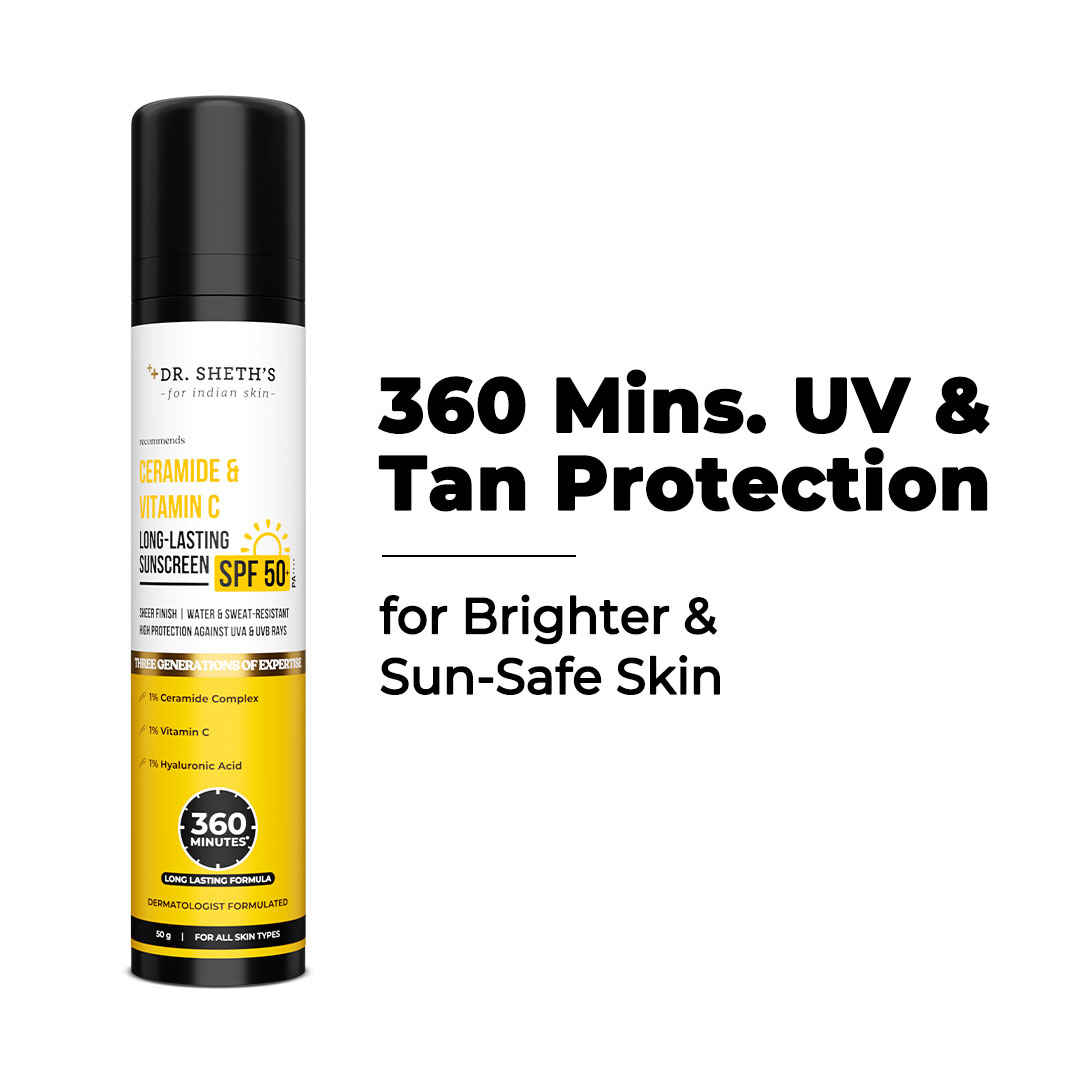
Dr. Sheth's Ceramide & Vitamin C Long lasting Sunscreen SPF 50+ PA++++ UV & Tan Protection | 360 Mins* Long Lasting Formula |No White Cast, Water & Sweat-Resistant | Non-Greasy & Quick-Absorbing | For Women & Men | 50 gm

Dr. Sheth's Ceramide & Vitamin C Long lasting Sunscreen SPF 50+ PA++++ UV & Tan Protection | 360 Mins* Long Lasting Formula |No White Cast, Water & Sweat-Resistant | Non-Greasy & Quick-Absorbing | For Women & Men | 50 gm
Dr. Sheth's
dr-sheths-ceramide-vitamin-c-long-lasting-sunscreen-spf-50-pa-uv-tan-protection-360-mins-long-lasting-formula-no-white-cast-water-sweat-resistant-non-greasy-quick-absorbing-for-women-men-50-gm
Suncare
10084941758757
Morning or Evening?
How often will you use this product?
Notes


Highlights
WHAT IS IT?
Long lasting sunscreen with 3 main actives (Ceramide Complex, Vitamin C, Hyaluronic Acid)
FEATURES
360 minutes long lasting UV and tan protection, water and sweat resistant, oil-free and quick-absorbing, no white cast, broad-spectrum sun protection, hydrates skin and maintains skin barrier health, brightens skin
BEST FOR
sensitive
CHECKS
No white cast, No greasiness
Who Is It For?
For Women & MenWhat Does It Help With?
Sunburn Prevention Tanning Skin Damage Hydration Brightening HyperpigmentationBudget
Mid-range ($30-$75)How To Use
Which routine should it be used in?
Instructions:
Key Information


What Dr. Sheth's Says
Product Description:
Experience unbeatable UV protection with Dr. Sheth’s Ceramide & Vitamin C Long-Lasting Sunscreen SPF 50+ & PA++++, exclusively formulated for prolonged hours in the sun. This sunscreen not only offers water & sweat resistance but provides broad-spectrum protection, thus making it perfect as an on-the-go sun shield during outdoor activities & swim sessions. Enriched with barrier-building Ceramide Complex & spot-reducing Vitamin C, it features an extremely light, oil-free & blendable texture that leaves no white cast & provides an invisible sheer finish. This formula prevents sunburn, tanning & damage - all while hydrating skin & maintaining barrier health for brighter, sun-safe skin.
About the Brand:
Ingredients Overview
Ingredients List
Aqua, Cyclopentasiloxane, Ethylhexyl Methoxycinnamate, Titanium Dioxide, Diethylhexyl Butamido Triazone, Cetyl PEG/PPG 10/1 Dimethicone, Aluminium Chlorohydrate, Dimethicone/Vinyl Dimethicone Crosspolymer, Zinc Oxide, Coco-Caprylate/Caprate, Polyglyceryl-3 Polyricinoleate, Isostearic Acid, Isododecane, Disteardimonium Hectorite, Propylene Carbonate, Bis Ethylhexyloxyphenol Methoxyphenyl Triazine, Physalis Angulata Extract, Caprylic/Capric Triglyceride, Ethyl-Ascorbic Acid, Polymethylsilsesquioxane, Hyaluronic Acid, Laminaria Digitata Extract, Cetyl-PG Hydroxyethyl Palmitamide, Ceramide 1, Ceramide 2, Ceramide 3, Ceramide 4, Ceramide 6 II, Butylene Glycol, Vitamin E, Sodium Benzoate, Phenoxyethanol
Key Ingredients
Ceramide Complex, Vitamin C, Hyaluronic Acid
Ingredients Details
Butylene Glycol
Common Name(s): 1,3-butanediol,bg,1,3-butylene glycol
CAS Number: 107-88-0
DESCRIPTION
What It Does: Provides humectant hydration and active ingredient solubilization with excellent skin feel.
Why It's Used: Preferred glycol humectant in premium and k-beauty formulations for superior skin feel vs propylene glycol with equivalent functionality.
How It Works: Two hydroxyl groups at 1,3-positions provide water binding and solvent activity. better tolerated than propylene glycol with minimal sensitization risk. 4-carbon backbone provides slightly greater hydrophobic character enabling dissolution of less polar actives vs pg.
Typically Found In: Toners,essences,serums,k-beauty formulas
TECHNICAL DETAILS
Primary Category: Functional ingredient – glycol humectant
Secondary Functions: Tewl reduction,skin plumping
Application Areas:

Facial Skincare
Body Care
Hair Care

Beard Care
Color Cosmetics (Makeup)
Dietary/Oral Supplements
Typical Concentration Range: 1%–10%
SOURCING & ETHICS
Vegan Status: Yes – synthetic
Halal Status: Yes
Source Notes: Synthetic or naturally derived. excellent aqueous solubility.
SKIN COMPATIBILITY
Irritancy Rating: 1/5 – very low
Comedogenicity Rating: 0/5 – non-comedogenic
Sensitivity Concerns: Non-irritating; suitable for all skin types.
Safe for Sensitive Skin: Yes
SAFETY & COMPATIBILITY
Safety Profile: Excellent safety profile. ewg score: 1.
Works Well With: Ceramides,emollients,occlusives,glycerin,hyaluronic acid
Avoid Combining With: No significant incompatibilities
SCIENTIFIC NOTE
K-beauty's preference for butylene glycol over propylene glycol is driven by two factors: bg's superior skin feel (less tacky than pg's higher viscosity) and its lower sensitization potential (1,3-bg has better spatial distribution of hydroxyl groups that reduces protein interaction vs pg's 1,2-position oh groups).
Last Verified: 2026-03-12
Primary Sources: Cosing database,cir safety assessment
Caprylic/capric Triglyceride
Common Name(s): Mct oil,fractionated coconut oil,c8/c10 triglyceride
CAS Number: 73398-61-5
DESCRIPTION
What It Does: Lightweight, stable emollient that solubilizes oil-soluble actives for excellent delivery without greasy feel.
Why It's Used: Universal lightweight emollient base and solubilizer for oil-soluble actives in serums and low-viscosity formulations where mineral oil or petrolatum would be too heavy.
How It Works: Medium-chain length provides ideal balance of spreading coefficient, penetration rate, and barrier-sealing properties. excellent solubilizer for vitamin e, retinoids, and other lipophilic actives.
Typically Found In: Serums,facial oils,sunscreens,anti-aging products,hair products
TECHNICAL DETAILS
Primary Category: Active ingredient – medium-chain triglyceride emollient
Secondary Functions: Active solubilizer,spreading agent
Application Areas:
Facial Skincare
Body Care
Hair Care
Beard Care
Color Cosmetics (Makeup)
Dietary/Oral Supplements
Typical Concentration Range: 1%–50%
SOURCING & ETHICS
Vegan Status: Conditional - feedstock declaration required
Halal Status: Unverified - feedstock declaration required (plant, animal and petrochemical routes all exist)
Source Notes: Fractionated by hydrolysis and re-esterification of coconut oil. only c8 and c10 fatty acids retained. [audit 2026-07-29 rev2: origin-dependent: the same inci exists in plant, animal and petrochemical versions and the name does not discriminate. determination requires shariah-panel sign-off.]
SKIN COMPATIBILITY
Irritancy Rating: 1/5 – very low
Comedogenicity Rating: 1/5 – very low; medium-chain length generally non-comedogenic
Sensitivity Concerns: Non-irritating.
Safe for Sensitive Skin: Yes
SAFETY & COMPATIBILITY
Safety Profile: Excellent safety profile. ewg score: 1.
Works Well With: Humectants,ceramides,actives as carrier
Avoid Combining With: No significant incompatibilities
SCIENTIFIC NOTE
Mct oil's medium-chain length (c8/c10) provides superior oxidative stability vs longer polyunsaturated chains and better skin aesthetics (lighter, less greasy) vs longer chain emollients (c16/c18). excellent solubilizer for retinoic acid, tocopheryl esters, and other lipophilic actives.
Last Verified: 2026-03-12
Primary Sources: Cosing database,cir safety assessment,ewg skin deep
Ceramide 1
Common Name(s): Ceramide 1
DESCRIPTION
What It Does: Provides antioxidant protection, soothing anti-inflammatory effects, and skin-conditioning benefits through plant-derived polyphenols and phytochemicals.
Why It's Used: Plant extracts concentrate bioactive phytochemicals evolved for environmental protection — uv, microbial, and oxidative stressors — that translate to skin benefits.
How It Works: Polyphenols (flavonoids, phenolic acids) inhibit nf-κb-mediated inflammatory signaling, scavenge reactive oxygen species through electron donation, and chelate pro-oxidant metal ions to reduce oxidative skin damage.
Typically Found In: Lipsticks,balms,creams,deodorants
TECHNICAL DETAILS
Primary Category: Waxes
Secondary Functions: Emollient,film former
Application Areas:
Facial Skincare
Body Care
Hair Care
Beard Care
Color Cosmetics (Makeup)
Dietary/Oral Supplements
Typical Concentration Range: 1–40%
SOURCING & ETHICS
Vegan Status: Conditional - feedstock declaration required
Halal Status: Unverified - feedstock declaration required (plant, animal and petrochemical routes all exist)
Source Notes: Plant-derived or synthetic wax; check source for vegan status. [audit 2026-07-29 rev2: origin-dependent: the same inci exists in plant, animal and petrochemical versions and the name does not discriminate. determination requires shariah-panel sign-off.]
SKIN COMPATIBILITY
Irritancy Rating: 1
Comedogenicity Rating: 1
Sensitivity Concerns: Low sensitization potential at recommended use concentrations.
Safe for Sensitive Skin: Yes
SAFETY & COMPATIBILITY
Safety Profile: Well-characterized cosmetic ingredient with established safety profile. generally non-irritating at typical use concentrations. suitable for leave-on and rinse-off cosmetics.
Works Well With: Other waxes,emollients,pigments
Avoid Combining With: Strongly alkaline conditions
SCIENTIFIC NOTE
Plant secondary metabolites (flavonoids, terpenes, phenolic acids) are biosynthesized as defense compounds against uv, herbivores, and pathogens. their anti-inflammatory activity typically derives from competitive inhibition of cox-2 and 5-lox enzymes (ic50 1–50 µm), while antioxidant activity involves single electron transfer (set) and hydrogen atom transfer (hat) mechanisms with structure-dependent rate constants.
Last Verified: 2025-01-15
Primary Sources: Cosing eu database; pcpc cosmetic ingredient safety reviews; ingredient-specific safety and efficacy literature
Ceramide 2
Common Name(s): Ceramide 2
DESCRIPTION
What It Does: Provides antioxidant protection, soothing anti-inflammatory effects, and skin-conditioning benefits through plant-derived polyphenols and phytochemicals.
Why It's Used: Plant extracts concentrate bioactive phytochemicals evolved for environmental protection — uv, microbial, and oxidative stressors — that translate to skin benefits.
How It Works: Polyphenols (flavonoids, phenolic acids) inhibit nf-κb-mediated inflammatory signaling, scavenge reactive oxygen species through electron donation, and chelate pro-oxidant metal ions to reduce oxidative skin damage.
Typically Found In: Lipsticks,balms,creams,deodorants
TECHNICAL DETAILS
Primary Category: Waxes
Secondary Functions: Emollient,film former
Application Areas:
Facial Skincare
Body Care
Hair Care
Beard Care
Color Cosmetics (Makeup)
Dietary/Oral Supplements
Typical Concentration Range: 1–40%
SOURCING & ETHICS
Vegan Status: Conditional - feedstock declaration required
Halal Status: Unverified - feedstock declaration required (plant, animal and petrochemical routes all exist)
Source Notes: Plant-derived or synthetic wax; check source for vegan status. [audit 2026-07-29 rev2: origin-dependent: the same inci exists in plant, animal and petrochemical versions and the name does not discriminate. determination requires shariah-panel sign-off.]
SKIN COMPATIBILITY
Irritancy Rating: 1
Comedogenicity Rating: 1
Sensitivity Concerns: Low sensitization potential at recommended use concentrations.
Safe for Sensitive Skin: Yes
SAFETY & COMPATIBILITY
Safety Profile: Well-characterized cosmetic ingredient with established safety profile. generally non-irritating at typical use concentrations. suitable for leave-on and rinse-off cosmetics.
Works Well With: Other waxes,emollients,pigments
Avoid Combining With: Strongly alkaline conditions
SCIENTIFIC NOTE
Plant secondary metabolites (flavonoids, terpenes, phenolic acids) are biosynthesized as defense compounds against uv, herbivores, and pathogens. their anti-inflammatory activity typically derives from competitive inhibition of cox-2 and 5-lox enzymes (ic50 1–50 µm), while antioxidant activity involves single electron transfer (set) and hydrogen atom transfer (hat) mechanisms with structure-dependent rate constants.
Last Verified: 2025-01-15
Primary Sources: Cosing eu database; pcpc cosmetic ingredient safety reviews; ingredient-specific safety and efficacy literature