
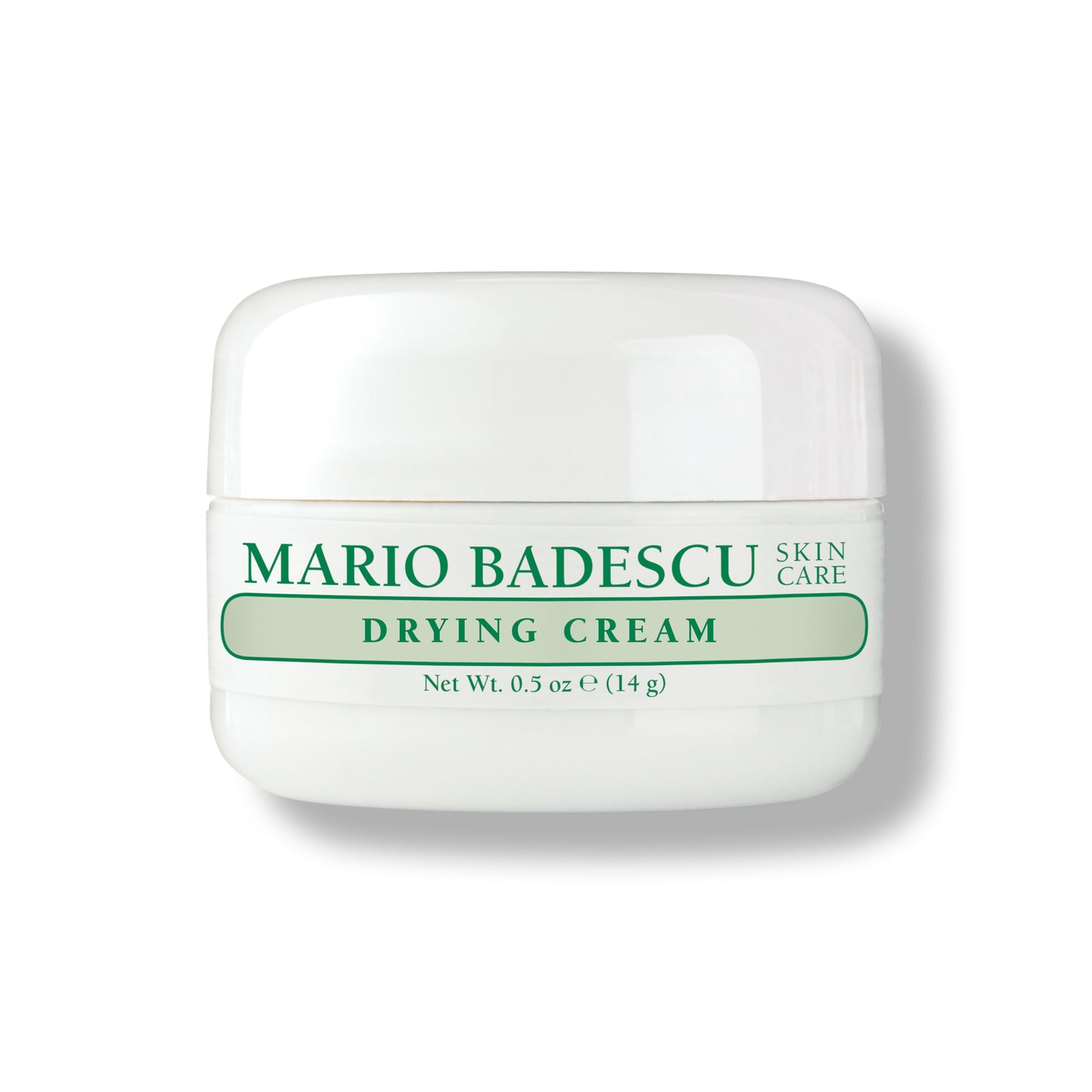

Mario Badescu
Drying Cream

Drying Cream
Mario Badescu
drying-cream
Moisturize
9818360709413
Morning or Evening?
How often will you use this product?
Notes


Highlights
WHAT IS IT?
Acne treatment cream with sulfur and zinc oxide
FEATURES
Clarifies skin, targets blemishes, absorbs excess oil, soothes and moisturizes
BEST FOR
oily, combination
CHECKS
Free of alcohol, silicon, sulfate, phthalate
Who Is It For?
All Ages With Oily Or Combination SkinWhat Does It Help With?
Surface Bumps Blemishes Spots Excess Oil Pore-clogging ImpuritiesBudget
Affordable (under $30)How To Use
Which routine should it be used in?
Instructions:
Key Information


What Mario Badescu Says
Product Description:
Mario Badescu Drying Cream clarifies and targets surface bumps, blemishes and spots with clarifying and oil-absorbing Sulfur and Zinc Oxide. Sulfur and Zinc Oxide clarifies skin, draws out pore-clogging impurities and helps absorb excess oil. Aloe Vera, Biotin, Lemon Extract, Lysine, Anti-inflammatory burdock and Vitamin B and Vitamin E help to re-balance, soothe and moisturize skin.
About the Brand:
Ingredients Overview
Ingredients List
Aloe-Vera, Sulfur, Zinc-Oxide, Biotin, Lemon-Extract, Lysine, Burdock, Vitamin-B, Vitamin-E
Key Ingredients
Sulfur, Zinc Oxide, Aloe Vera, Biotin, Vitamin E
Ingredients Details
Aloe Vera
Common Name(s): Aloe vera juice,aloe vera gel,aloe barbadensis
CAS Number: 85507-69-3
DESCRIPTION
What It Does: Provides acemannan-based wound healing and comprehensive moisturising skin conditioning from the quintessential healing plant.
Why It's Used: The most universally recognised natural healing plant — aloe vera's acemannan polysaccharides, vitamins, and enzymes provide a comprehensive wound healing and soothing profile with thousands of years of documented use.
How It Works: Acemannan (poly-mannose) activates dectin-1 for wound healing immune stimulation. gibberellin promotes fibroblast growth. salicylic acid derivative provides anti-inflammatory. vitamins c and e provide antioxidant. glucomannan provides humectant.
Typically Found In: After-sun products,wound healing,moisturisers,virtually all skin care categories
TECHNICAL DETAILS
Primary Category: Active ingredient – aloe vera gel
Secondary Functions: Redness reduction,anti-inflammatory,calming
Application Areas:

Facial Skincare
Body Care

Hair Care
Beard Care
Color Cosmetics (Makeup)
Dietary/Oral Supplements
Typical Concentration Range: 0.5%–99%
SOURCING & ETHICS
Vegan Status: Yes – from aloe barbadensis leaf
Halal Status: Yes
Source Notes: Plant-derived extract or synthetic.
SKIN COMPATIBILITY
Irritancy Rating: 1/5 – very low
Comedogenicity Rating: 0/5 – non-comedogenic
Sensitivity Concerns: Non-irritating; ideal for reactive and sensitive skin.
Safe for Sensitive Skin: Yes – particularly recommended for sensitive skin
SAFETY & COMPATIBILITY
Safety Profile: Excellent safety profile. ewg score: 1.
Works Well With: Ceramides,panthenol,allantoin,hyaluronic acid,centella asiatica
Avoid Combining With: No significant incompatibilities
SCIENTIFIC NOTE
Aloe vera's clinical evidence for sunburn relief is among the best for any botanical wound healing ingredient. multiple rcts demonstrate that aloe vera gel reduces healing time of first and second degree burns and sunburns, attributed primarily to acemannan's immunomodulatory wound healing activity and the anti-inflammatory salicylate derivatives providing prostaglandin inhibition.
Last Verified: 2026-03-12
Primary Sources: Cosing database,surjushe et al. aloe vera skin review,cir safety assessment
Biotin
Common Name(s): Vitamin b7,vitamin h,d-biotin
CAS Number: 58-85-5
DESCRIPTION
What It Does: Supports keratin production for stronger hair and nails.
Why It's Used: Hair and nail keratin infrastructure support; widely marketed despite evidence being primarily oral supplementation-based.
How It Works: Coenzyme for carboxylase enzymes essential for fatty acid synthesis and amino acid metabolism relevant to hair follicle function.
Typically Found In: Hair growth shampoos,nail treatments,multivitamin products
TECHNICAL DETAILS
Primary Category: Active ingredient – vitamin b7
Secondary Functions: Hair growth support,nail strengthening
Application Areas:
Facial Skincare
Body Care
Hair Care
Beard Care
Color Cosmetics (Makeup)
Dietary/Oral Supplements
Typical Concentration Range: 0.01%–0.5%
SOURCING & ETHICS
Vegan Status: Conditional - feedstock declaration required
Halal Status: Unverified - feedstock declaration required (plant, animal and petrochemical routes all exist)
Source Notes: Synthetically produced for cosmetic use. [audit 2026-07-29 rev2: origin-dependent: the same inci exists in plant, animal and petrochemical versions and the name does not discriminate. determination requires shariah-panel sign-off.]
SKIN COMPATIBILITY
Irritancy Rating: 1/5 – very low
Comedogenicity Rating: 0/5 – non-comedogenic
Sensitivity Concerns: Non-irritating; excellent tolerability.
Safe for Sensitive Skin: Yes
SAFETY & COMPATIBILITY
Safety Profile: Excellent safety profile. ewg score: 1.
Works Well With: Other b vitamins,niacinamide,antioxidant complexes
Avoid Combining With: No significant incompatibilities
SCIENTIFIC NOTE
Evidence for topical biotin efficacy in hair growth is limited – most clinical evidence comes from oral supplementation in biotin-deficient individuals.
Last Verified: 2026-03-12
Primary Sources: Cosing database,cir safety assessment,patel et al. (2017) skin appendage disorders
Lemon Extract
Common Name(s): Lemon extract extract
DESCRIPTION
What It Does: Provides antioxidant protection, soothing anti-inflammatory effects, and skin-conditioning benefits through plant-derived polyphenols and phytochemicals.
Why It's Used: Plant extracts concentrate bioactive phytochemicals evolved for environmental protection — uv, microbial, and oxidative stressors — that translate to skin benefits.
How It Works: Polyphenols (flavonoids, phenolic acids) inhibit nf-κb-mediated inflammatory signaling, scavenge reactive oxygen species through electron donation, and chelate pro-oxidant metal ions to reduce oxidative skin damage.
Typically Found In: Serums,toners,moisturizers,masks,essences
TECHNICAL DETAILS
Primary Category: Botanical extracts
Secondary Functions: Antioxidant,anti-inflammatory
Application Areas:
Facial Skincare
Body Care
Hair Care
Beard Care
Color Cosmetics (Makeup)
Dietary/Oral Supplements
Typical Concentration Range: 0.1–10%
SOURCING & ETHICS
Vegan Status: Yes
Halal Status: Yes
Source Notes: Plant-derived extract; no animal components.
SKIN COMPATIBILITY
Irritancy Rating: 1899-12-31 00:00:00 -0800
Sensitivity Concerns: Low sensitization potential at recommended use concentrations.
Safe for Sensitive Skin: Yes
SAFETY & COMPATIBILITY
Safety Profile: Well-characterized cosmetic ingredient with established safety profile. generally non-irritating at typical use concentrations. suitable for leave-on and rinse-off cosmetics.
Works Well With: Niacinamide,hyaluronic acid,vitamin c,ceramides
Avoid Combining With: Strong oxidizing agents
SCIENTIFIC NOTE
Plant secondary metabolites (flavonoids, terpenes, phenolic acids) are biosynthesized as defense compounds against uv, herbivores, and pathogens. their anti-inflammatory activity typically derives from competitive inhibition of cox-2 and 5-lox enzymes (ic50 1–50 µm), while antioxidant activity involves single electron transfer (set) and hydrogen atom transfer (hat) mechanisms with structure-dependent rate constants.
Last Verified: 2025-01-15
Primary Sources: Cosing eu database; pcpc cosmetic ingredient safety reviews; phytochemical and ethnobotanical literature
Lysine
Common Name(s): 2,6-diaminohexanoic acid,l-lysine hcl
CAS Number: 56-87-1
DESCRIPTION
What It Does: Provides collagen crosslink precursor activity and nmf conditioning from the essential diaminoamino acid.
Why It's Used: Collagen crosslink amino acid — lysine's hydroxylation to hydroxylysine and subsequent cross-link formation via lysyl oxidase provides the structural crosslinks that give collagen mechanical strength.
How It Works: Converted to hydroxylysine by lysyl hydroxylase. hydroxylysine provides collagen crosslink sites for lysyl oxidase-catalysed aldehyde cross-links. nmf amino acid component. basic amino acid (ε-amino group pka 10.5) provides antimicrobial cationic character. antiviral via competition with arginine (essential for herpes virus replication).
Typically Found In: Collagen-support products,antiviral skin care,nmf products
TECHNICAL DETAILS
Primary Category: Active ingredient – essential amino acid
Secondary Functions: Skin conditioning
Application Areas:
Facial Skincare
Body Care
Hair Care
Beard Care
Color Cosmetics (Makeup)
Dietary/Oral Supplements
Typical Concentration Range: 0.5%–5%
SOURCING & ETHICS
Vegan Status: Conditional - feedstock declaration required
Halal Status: Unverified - feedstock declaration required (plant, animal and petrochemical routes all exist)
Source Notes: Commercially produced for cosmetic use. verify vegan/halal status with supplier. [audit 2026-07-29 rev2: origin-dependent: the same inci exists in plant, animal and petrochemical versions and the name does not discriminate. determination requires shariah-panel sign-off.]
SKIN COMPATIBILITY
Irritancy Rating: 1/5 – very low
Comedogenicity Rating: 0/5 – non-comedogenic
Sensitivity Concerns: Well-tolerated by most skin types.
Safe for Sensitive Skin: Yes
SAFETY & COMPATIBILITY
Safety Profile: Good safety profile at recommended concentrations. ewg score: 1–2.
Works Well With: Standard skincare actives
Avoid Combining With: No known significant incompatibilities
SCIENTIFIC NOTE
Lysine's antiviral activity for herpes simplex virus is pharmacologically validated: hsv replicates using arginine as a structural protein component, while lysine competes with arginine for cellular uptake via the same transporter. high lysine:arginine ratio reduces viral protein synthesis — the basis for the clinical practice of high-lysine dietary supplementation and topical application for cold sore prevention.
Last Verified: 2026-03-12
Primary Sources: Cosing database,griffith et al. lysine herpes study,cir safety assessment