
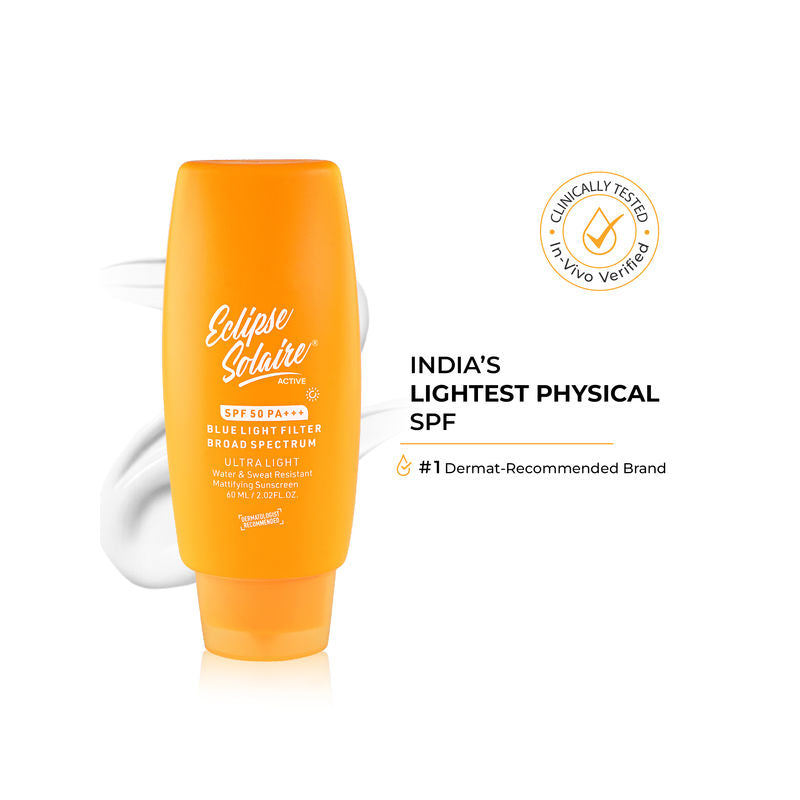

Eclipse Solaire
Eclipse Solaire Active Sunscreen SPF 50 PA+++ for All Skin Types, No White Cast

Eclipse Solaire Active Sunscreen SPF 50 PA+++ for All Skin Types, No White Cast
Eclipse Solaire
eclipse-solaire-active-sunscreen-spf-50-pa-for-all-skin-types-no-white-cast
Suncare
10084904403237
Morning or Evening?
How often will you use this product?
Notes


Highlights
WHAT IS IT?
Mineral-based sunscreen with Zinc Oxide and Titanium Dioxide, includes Vitamin C, Niacinamide, Hyaluronic Acid
FEATURES
Provides broad spectrum protection including UVA, UVB, blue light and infrared radiation; Lightweight, non-greasy, mattifying finish; Suitable for all skin types including sensitive and acne-prone; Hypoallergenic and non-comedogenic
BEST FOR
sensitive
CHECKS
Does not contain ingredients that cause white cast or skin irritation
Who Is It For?
All Genders All AgesWhat Does It Help With?
Protects Against Uv Rays Blue Light Infrared Rays Prevents Photoaging Suitable For Sensitive And Acne-prone SkinBudget
Mid-range ($30-$75)How To Use
Which routine should it be used in?
Instructions:
Key Information


What Eclipse Solaire Says
Product Description:
Eclipse Solaire Active Sunscreen is a Mineral-based formula designed to provide comprehensive protection against UV rays, blue light, and infrared rays. Powered by the advanced Full Light Technology, this sunscreen features a high blend of Zinc Oxide (ZnO) and Titanium Dioxide, two powerful mineral filters that deliver physical sun protection by forming a protective layer on the skin's surface. It offers a lightweight, non-greasy & matte finish that is suitable for all skin types. Its hypoallergenic and non-comedogenic, ensures it is gentle on the skin, making it perfect for sensitive or acne-prone skin. It provides reliable and long-lasting protection, helping to safeguard your skin while maintaining a fresh, smooth appearance. Features: Eclipse Solaire's Full Light Technology provides comprehensive photoprotection against the entire solar spectrum, including UVA, UVB, visible light, blue light (HEV), and infrared radiation (IR), mitigating photoageing and cutaneous damage. Mineral-Based Physical Barrier: The combination of Zinc Oxide (ZnO) and Titanium Dioxide (TiO2) creates a physical barrier on the skin's surface, effectively scattering and reflecting solar radiation. Lightweight & Mattifying The optimized, lightweight formulation exhibits non-greasy, mattifying properties, rendering it ideal for oily and acne-prone skin. Eclipse Solaire's mineral formula exhibits minimal skin irritation potential, rendering it suitable for all skin types. About the Brand: At Eclipse Solaire, we're committed to transforming how you protect and care for your skin.With a vision to redefine skincare, we offer products that combine advanced formulations with proven, long-lasting results.Our mission is to deliver complete skin protection solutions that not only shield your skin but also nourish and rejuvenate it for lasting health and beauty.Crafted with precision and backed by science, our skincare range is designed to prevent damage while supporting skin vitality.We prioritise safety and effectiveness, ensuring our products are suitable for all skin types.At Eclipse Solaire, our dedication to quality, innovation, and visible results makes us a trusted partner in your skincare journey.Eclipse Solaire – Your Skin, Our Expertise.
About the Brand:
Ingredients Overview
Ingredients List
Aqua,Micronized-Zinc-Oxide,Micronized-Titanium-Dioxide,Vitamin-C,Niacinamide,Hyaluronic-Acid,Propanediol,Diisopropyl-Adipate,Lecithin,Acrylic-Acid/Acrylami-Domethyl-Propane-Sulfonic-Acid-Copolymer,Dimethylmethoxy-Chromanol,Glyceryl-Caprylate,Xanthan-Gum,C12-15-Alkyl-Benzoate,Caprylic/Capric-Triglyceride,Caprylyl-Methicone,Cyclopentasiloxane-And-Dimethicone-Cross-Polymer,Scenedesmus-Rubescens-Extract,Rosehip-Oil,Tea-Tree-Oil,Olive-Oil,Sodium-Gluconate
Key Ingredients
Zinc Oxide, Titanium Dioxide, Vitamin C, Niacinamide, Hyaluronic Acid
Ingredients Details
Lecithin
Common Name(s): Soy lecithin,sunflower lecithin,phosphatidylcholine complex
CAS Number: 8002-43-5
DESCRIPTION
What It Does: Provides natural phospholipid emulsification with barrier-compatible delivery and liposome-forming properties.
Why It's Used: The most biologically authentic emulsifier – identical to cell membrane composition providing barrier-compatible delivery and liposome formation unavailable from synthetic emulsifiers.
How It Works: Phosphatidylcholine (pc), phosphatidylethanolamine (pe), phosphatidylinositol (pi) mixture provides hlb 7-12 for o/w emulsification. forms liposomal bilayers for active encapsulation. pc/pe/pi composition mirrors cell membrane for barrier-compatible delivery.
Typically Found In: Natural cosmetics,liposomal products,barrier repair,penetration-enhanced formulas
TECHNICAL DETAILS
Primary Category: Functional ingredient – natural phospholipid emulsifier
Secondary Functions: Skin conditioning
Application Areas:

Facial Skincare

Body Care
Hair Care
Beard Care
Color Cosmetics (Makeup)
Dietary/Oral Supplements
Typical Concentration Range: 0.5%–10%
SOURCING & ETHICS
Vegan Status: No - animal-derived
Halal Status: Conditional - animal origin stated in the record's own description; documentation required
Source Notes: Commercially produced for cosmetic use. verify vegan/halal status with supplier. [audit 2026-07-29 rev2: pass-1 miss: the record's own detail text states an animal derivation, but pass 1 classified on the name and source_notes only. determination requires shariah-panel sign-off.]
SKIN COMPATIBILITY
Irritancy Rating: 1/5 – very low
Comedogenicity Rating: 0/5 – non-comedogenic
Sensitivity Concerns: Well-tolerated by most skin types.
Safe for Sensitive Skin: Yes
SAFETY & COMPATIBILITY
Safety Profile: Good safety profile at recommended concentrations. ewg score: 1–2.
Works Well With: Standard skincare actives
Avoid Combining With: No known significant incompatibilities
SCIENTIFIC NOTE
Lecithin's phospholipid composition mirrors the composition of the stratum corneum's own lamellar bodies that deliver barrier lipids to the skin surface. this structural mimicry allows lecithin-based delivery systems to integrate seamlessly with the barrier lipid structure, exploiting the same transport pathway the skin uses for its own lipid secretion.
Last Verified: 2026-03-12
Primary Sources: Cosing database,cir safety assessment
Niacinamide
Common Name(s): Vitamin b3,nicotinamide,pyridine-3-carboxamide
CAS Number: 98-92-0
DESCRIPTION
What It Does: Niacinamide strengthens the skin barrier, reduces visible pore size, regulates sebum production, fades dark spots, and improves skin texture and tone.
Why It's Used: It is used because it addresses multiple skin concerns at once without irritation, making it suitable for all skin types. it is stable in formulations and pairs well with most other actives.
How It Works: Niacinamide inhibits the transfer of melanosomes (pigment packets) to skin cells, reducing hyperpigmentation. it also stimulates ceramide synthesis to strengthen the skin barrier and reduces inflammation by modulating cytokine activity.
Typically Found In: Serums,moisturizers,toners,cleansers,eye creams,sunscreens,primers
TECHNICAL DETAILS
Primary Category: Active ingredient – vitamin
Secondary Functions: Barrier repair,brightening,anti-inflammatory
Application Areas:
Facial Skincare
Body Care
Hair Care
Beard Care
Color Cosmetics (Makeup)
Dietary/Oral Supplements
Typical Concentration Range: 2%–10% (typical: 5%; higher concentrations may cause flushing in some individuals)
SOURCING & ETHICS
Vegan Status: Yes – synthetically produced
Halal Status: Yes – synthetic origin
Source Notes: Commercially produced via synthesis from nicotinic acid or 3-cyanopyridine. no animal-derived sources used in cosmetic-grade niacinamide.
SKIN COMPATIBILITY
Irritancy Rating: 1/5 – very low; concentrations above 10% may cause temporary flushing in sensitive individuals
Comedogenicity Rating: 0/5 – non-comedogenic
Sensitivity Concerns: At concentrations >10%, some users experience niacin flush (transient redness/tingling). generally very well-tolerated.
Safe for Sensitive Skin: Yes – one of the best-tolerated actives for sensitive skin
SAFETY & COMPATIBILITY
Safety Profile: Extensively studied and considered very safe. ewg hazard score: 1. no significant systemic toxicity concerns at topical concentrations.
Works Well With: Retinol,peptides,ahas/bhas,hyaluronic acid,ceramides,zinc,vitamin c,spf
Avoid Combining With: High concentrations of vitamin c (ascorbic acid) may theoretically convert to niacin – use at different times if using pure l-ascorbic acid above 15%
SCIENTIFIC NOTE
Niacinamide is a precursor to nad+ and nadp+, coenzymes vital to cellular energy metabolism. its benefits for dna repair and mitochondrial function make it a key ingredient in anti-aging strategies.
Last Verified: 2026-03-12
Primary Sources: Cosing database,cir safety assessment,ewg skin deep,pubmed clinical studies
Propanediol
Common Name(s): 1,3-propanediol,zemea,bio-propanediol
CAS Number: 504-63-2
DESCRIPTION
What It Does: Provides humectant and solvent functionality from sustainable corn-based fermentation.
Why It's Used: Bio-based propylene glycol alternative from renewable corn — propanediol provides equivalent functionality to propylene glycol with sustainable renewable feedstock and superior skin feel.
How It Works: Two oh groups provide humectant water binding. excellent solvent for fragrances, actives, and preservatives. mild antimicrobial from diol structure for preservative system boosting. renew corn fermentation origin (dupont zemea process). better skin feel than propylene glycol — less sticky.
Typically Found In: Virtually all cosmetic categories as pg alternative
TECHNICAL DETAILS
Primary Category: Functional ingredient – humectant
Secondary Functions: Tewl reduction,skin plumping
Application Areas:
Facial Skincare
Body Care
Hair Care
Beard Care
Color Cosmetics (Makeup)
Dietary/Oral Supplements
Typical Concentration Range: 1%–20%
SOURCING & ETHICS
Vegan Status: Yes – from corn sugar fermentation
Halal Status: Yes
Source Notes: Synthetic or naturally derived. excellent aqueous solubility.
SKIN COMPATIBILITY
Irritancy Rating: 1/5 – very low
Comedogenicity Rating: 0/5 – non-comedogenic
Sensitivity Concerns: Non-irritating; suitable for all skin types.
Safe for Sensitive Skin: Yes
SAFETY & COMPATIBILITY
Safety Profile: Excellent safety profile. ewg score: 1.
Works Well With: Ceramides,emollients,occlusives,glycerin,hyaluronic acid
Avoid Combining With: No significant incompatibilities
SCIENTIFIC NOTE
Propanediol's dupont tate & lyle bio products 'zemea' process ferments corn sugar to 1,3-propanediol using engineered e. coli — one of the first commercially viable bio-fermentation routes to a cosmetic diol previously made only from petroleum. the renewable route produces chemically identical 1,3-propanediol while reducing carbon footprint by approximately 40% vs petrochemical synthesis.
Last Verified: 2026-03-12
Primary Sources: Cosing database,dupont tate & lyle zemea technical data,cir safety assessment