

EUCERIN
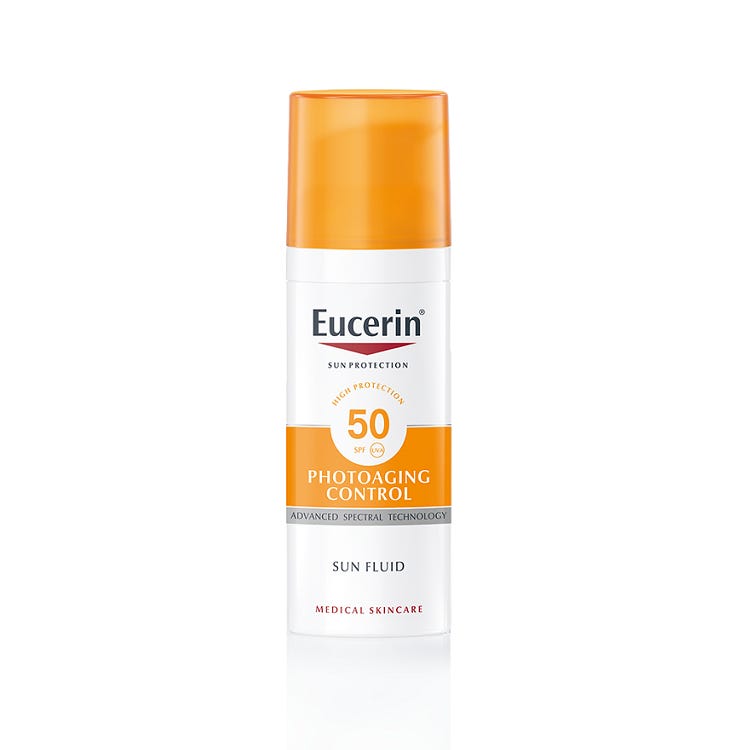
Eucerin Sun Fluid Photoaging Control SPF50 50ml

Eucerin Sun Fluid Photoaging Control SPF50 50ml
EUCERIN
eucerin-sun-fluid-photoaging-control-spf50-50ml
Suncare
10084886970661
Morning or Evening?
How often will you use this product?
Notes


Highlights
WHAT IS IT?
facial sunscreen, 23 ingredients
FEATURES
Protects from sun-induced skin damage, Prevents photoaging, Intensively moisturises, Visibly reduces wrinkles, Offers high factor UVA/UVB protection and HEVIS light defense, Non-comedogenic, Suitable under makeup, Very good skin tolerability even on sensitive skin
BEST FOR
all skin types
CHECKS
Avoid contact with eyes, Avoid direct contact with textiles and hard surfaces to prevent staining
Who Is It For?
All Genders All Age RangesWhat Does It Help With?
Photoaging Wrinkles Sun-induced Skin DamageBudget
Premium ($76-$150)How To Use
Which routine should it be used in?
Instructions:
Key Information


What EUCERIN Says
Product Description:
A facial sunscreen for all skin types that helps prevent photoaging and visibly reduces wrinkles - Protects from sun-induced skin damage - Helps to prevent photoaging & intensively moisturises - Visibly reduces wrinkles on face and decollette - Eucerin’s Advanced Spectral Technology offers high factor UVA/UVB protection and HEVIS (high-energy visible) light defense - Non-comedogenic, suitable under make up - Very good skin tolerability even on sensitive skin
About the Brand:
Ingredients Overview
Ingredients List
Aqua,Homosalate,Glycerin,Butyl-Methoxydibenzoylmethane,Ethylhexyl-Salicylate,Butylene-Glycol-Dicaprylate-Dicaprate,Ethylhexyl-Triazone,Alcohol-Denat,Bis-Ethylhexyloxyphenol-Methoxyphenyl-Triazine,Cetearyl-Alcohol,Phenylbenzimidazole-Sulfonic-Acid,C12-15-Alkyl-Benzoate,Tapioca-Starch,Sodium-Hyaluronate,Glycyrrhetinic-Acid,Glycyrrhiza-Inflata-Root-Extract,Glyceryl-Stearate,Sodium-Stearoyl-Glutamate,Acrylates-C10-30-Alkyl-Acrylate-Crosspolymer,Carbomer,Xanthan-Gum,Dimethicone,Sodium-Hydroxide,Sodium-Chloride,Trisodium-EDTA,Ethylhexylglycerin,Phenoxyethanol
Key Ingredients
Licochalcone A, Hyaluronic Acid, Advanced Spectral Technology (combines UVA/UVB filters)
Ingredients Details
Carbomer
Common Name(s): Carbopol,polyacrylic acid,carboxyvinyl polymer
DESCRIPTION
What It Does: Provides transparent gel textures and thickening at very low concentrations via ph-responsive swelling.
Why It's Used: The most widely used gel thickener – provides crystal-clear, stable gels at concentrations as low as 0.1-0.5% with ph-controlled viscosity.
How It Works: Highly crosslinked polyacrylic acid remains tightly coiled at acidic ph. neutralization with naoh or triethanolamine ionizes carboxylic groups causing electrostatic repulsion that unfolds and swells the polymer coils, dramatically increasing viscosity. concentration-dependent thickening.
Typically Found In: Gels,serums,emulsions,sunscreens
TECHNICAL DETAILS
Primary Category: Functional ingredient – polyacrylic acid thickener
Secondary Functions: Skin conditioning
Application Areas:

Facial Skincare

Body Care
Hair Care
Beard Care
Color Cosmetics (Makeup)
Dietary/Oral Supplements
Typical Concentration Range: 0.1%–2%
SOURCING & ETHICS
Vegan Status: Yes – synthetic
Halal Status: Yes
Source Notes: Commercially produced for cosmetic use. verify vegan/halal status with supplier.
SKIN COMPATIBILITY
Irritancy Rating: 1/5 – very low
Comedogenicity Rating: 0/5 – non-comedogenic
Sensitivity Concerns: Well-tolerated by most skin types.
Safe for Sensitive Skin: Yes
SAFETY & COMPATIBILITY
Safety Profile: Good safety profile at recommended concentrations. ewg score: 1–2.
Works Well With: Standard skincare actives
Avoid Combining With: No known significant incompatibilities
SCIENTIFIC NOTE
Carbomer's ph-responsive swelling mechanism provides an elegant formulation control tool: a neutralized gel can be liquefied by ph reduction (adding acid) and re-thickened by reneutralization. this reversible rheology control allows two-phase products that mix on application without the need for mechanical emulsification.
Last Verified: Cosing database,cir safety assessment
Primary Sources: 2026-03-12
Dimethicone
Common Name(s): Pdms,polydimethylsiloxane,silicone fluid
CAS Number: 9006-65-9
DESCRIPTION
What It Does: Provides silicone-characteristic silky feel and skin protection with adjustable viscosity.
Why It's Used: The benchmark cosmetic silicone – sets the gold standard for silky application feel, spreadability, and skin protection in virtually all skin care categories.
How It Works: Polydimethylsiloxane chain flexibility provides extremely low surface tension and high spreadability. inert si-o backbone provides chemical stability and excellent skin tolerance. occlusive film formation reduces tewl. higher viscosity grades provide more intense conditioning.
Typically Found In: Moisturizers,foundations,primers,sunscreens – nearly universal
TECHNICAL DETAILS
Primary Category: Functional ingredient – polydimethylsiloxane
Secondary Functions: Barrier sealing,softening
Application Areas:
Facial Skincare
Body Care
Hair Care
Beard Care
Color Cosmetics (Makeup)
Dietary/Oral Supplements
Typical Concentration Range: 0.1%–30%
SOURCING & ETHICS
Vegan Status: Yes – synthetic
Halal Status: Yes
Source Notes: Plant-derived, synthetic or animal-derived. verify source.
SKIN COMPATIBILITY
Irritancy Rating: 1/5 – very low
Comedogenicity Rating: 1/5 – low; formulation-dependent
Sensitivity Concerns: Non-irritating.
Safe for Sensitive Skin: Yes
SAFETY & COMPATIBILITY
Safety Profile: Excellent safety profile. ewg score: 1.
Works Well With: Humectants,ceramides,actives as carrier
Avoid Combining With: No significant incompatibilities
SCIENTIFIC NOTE
Dimethicone's exceptional silky feel arises from its very low intermolecular attractive forces (weak van der waals forces due to non-polar methyl groups) that allow silicone chains to slide freely over skin. the coefficient of kinetic friction for pdms against skin (~0.04) is among the lowest of any cosmetic material – explaining why even small amounts transform product feel.
Last Verified: Cosing database,cir safety assessment
Primary Sources: 2026-03-12
Ethylhexylglycerin
Common Name(s): Octylglycerin,2-ethylhexyl glycerol ether,sensiva sc 10
CAS Number: 70445-33-9
DESCRIPTION
What It Does: Provides antimicrobial skin conditioning with deodorant activity and preservation system enhancement.
Why It's Used: Multifunctional clean beauty preservation active — ethylhexylglycerin provides antimicrobial, deodorant, and skin conditioning in a single ingredient accepted in most natural cosmetic certification schemes.
How It Works: Glycerol ether provides antimicrobial via bacterial membrane phospholipid disruption. deodorant activity via reduction of underarm lipase enzyme activity (similar mechanism to triethyl citrate). skin conditioning from glycerol humectant component. synergistic with phenoxyethanol and diols.
Typically Found In: Natural preservation systems,deodorants,skin conditioning products
TECHNICAL DETAILS
Primary Category: Functional ingredient – antimicrobial glycerol ether
Secondary Functions: Skin conditioning
Application Areas:
Facial Skincare
Body Care
Hair Care
Beard Care
Color Cosmetics (Makeup)
Dietary/Oral Supplements
Typical Concentration Range: 0.1%–0.5%
SOURCING & ETHICS
Vegan Status: Yes – synthetic
Halal Status: Yes
Source Notes: Commercially produced for cosmetic use. verify vegan/halal status with supplier.
SKIN COMPATIBILITY
Irritancy Rating: 1/5 – very low
Comedogenicity Rating: 0/5 – non-comedogenic
Sensitivity Concerns: Well-tolerated by most skin types.
Safe for Sensitive Skin: Yes
SAFETY & COMPATIBILITY
Safety Profile: Good safety profile at recommended concentrations. ewg score: 1–2.
Works Well With: Standard skincare actives
Avoid Combining With: No known significant incompatibilities
SCIENTIFIC NOTE
Ethylhexylglycerin's deodorant mechanism is pharmacologically identical to triethyl citrate: both inhibit skin surface microbial lipase enzymes that convert odourless triglycerides to odorous free fatty acids. the glycerol ether structure of ethylhexylglycerin, combined with the 2-ethylhexyl chain, provides lipase inhibition similar to ester-based lipase inhibitors from a different chemical class.
Last Verified: Cosing database,schülke sensiva sc 10 technical data,cir safety assessment
Primary Sources: 2026-03-12
Glycerin
Common Name(s): Glycerol,glycerine,1,2,3-propanetriol
CAS Number: 56-81-5
DESCRIPTION
What It Does: Glycerin pulls water from the environment and deeper skin layers into the outer skin layer (epidermis), boosting moisture levels and keeping skin soft, smooth, and plump.
Why It's Used: It is used in virtually every moisturizer, serum, and cleanser because it is highly effective at hydrating skin, is well-tolerated by all skin types, and enhances the texture and spreadability of formulations.
How It Works: As a humectant, glycerin forms hydrogen bonds with water molecules, trapping them in the skin. it also reinforces the skin barrier by integrating into lipid structures between skin cells.
Typically Found In: Moisturizers,serums,cleansers,toners,sheet masks,sunscreens,body lotions,shampoos,conditioners
TECHNICAL DETAILS
Primary Category: Humectant
Secondary Functions: Skin barrier support,emollient,solvent
Application Areas:
Facial Skincare
Body Care
Hair Care
Beard Care
Color Cosmetics (Makeup)
Dietary/Oral Supplements
Typical Concentration Range: 1%–30% (typical: 3–10%)
SOURCING & ETHICS
Vegan Status: Yes – plant-derived (coconut, soy, palm) or synthetic
Halal Status: Yes – when plant-derived or synthetic; verify source with supplier
Source Notes: Derived from plant oils via hydrolysis or saponification; synthetic versions also available. palm-derived glycerin carries sustainability concerns.
SKIN COMPATIBILITY
Irritancy Rating: 1/5 – very low; non-irritating at all standard concentrations
Comedogenicity Rating: 0/5 – non-comedogenic
Sensitivity Concerns: Extremely rare allergic reactions; generally safe for all skin types including sensitive and baby skin
Safe for Sensitive Skin: Yes
SAFETY & COMPATIBILITY
Safety Profile: Widely recognized as safe. ewg hazard score: 1. no significant concerns for irritation, sensitization, or toxicity at typical concentrations (up to 50%).
Works Well With: Hyaluronic acid,ceramides,niacinamide,panthenol,urea,peptides,retinol,ahas/bhas
Avoid Combining With: No known incompatibilities at standard concentrations
SCIENTIFIC NOTE
Glycerin is an endogenous skin component found naturally in the stratum corneum. aquaporin-3 channels in keratinocytes facilitate glycerin transport, making it integral to natural skin hydration pathways.
Last Verified: Cosing database,cir safety assessment,ewg skin deep,inci decoder
Primary Sources: 2026-03-12
