
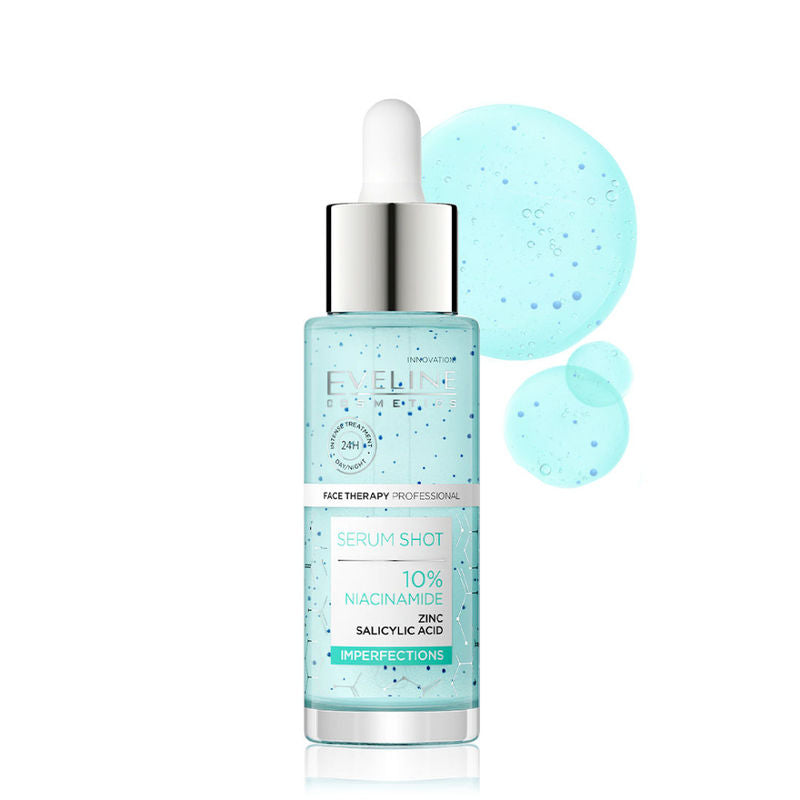

Eveline Cosmetics
Eveline Cosmetics Serum Shot 10% Niacinamide Imperfections

Eveline Cosmetics Serum Shot 10% Niacinamide Imperfections
Eveline Cosmetics
eveline-cosmetics-serum-shot-10-niacinamide-imperfections
Serum
10084727652645
Morning or Evening?
How often will you use this product?
Notes


Highlights
WHAT IS IT?
Serum with 10 ingredients
FEATURES
Contains 10% niacinamide, Optimizes sebaceous glands, Brightens complexion, Nourishes and has antibacterial properties, Zinc narrows pores, Regenerates and soothes acne skin, Salicylic acid cleanses pores, Removes imperfections including blackheads, Non-irritating, Suitable for sensitive skin, Free of parabens, sulfates and phthalates, Lightweight, fast-absorbing formula
BEST FOR
sensitive
CHECKS
Parabens, Sulfates, Phthalates
Who Is It For?
What Does It Help With?
Brightening Complexion Pore Narrowing Acne Soothing Blackhead Removal Nourishing SkinBudget
Mid-range ($30-$75)How To Use
Which routine should it be used in?
Instructions:
Key Information


What Eveline Cosmetics Says
Product Description:
Niacynamide serum is an excellent formula that will restore freshness to problematic skin. 10% niacinamide optimizes the work of sebasceous glands, nouirishes and has antibacterial properties. The complexion will be brightened and visibly nourished. Zinc narrows pores, works perfectly on acne skin - regenerates and soothes it. Salicylic acid effectively cleanses pores, removes imperfections, including blackheads and has anti-acne properties. Features: Contains 10% niacinamide to optimize sebaceous glands. Helps restore freshness to problematic skin. 30ml size for easy application. Non-irritating and suitable for sensitive skin. Suitable for all skin types. Free of parabens, sulfates, and phthalates. Clinically tested and proven results. Non-comedogenic formula with natural ingredients. Lightweight and fast-absorbing formula. Easily absorbed into the skin for maximum effectiveness.
About the Brand:
Ingredients Overview
Ingredients List
Aqua-(Water), Propanediol, Niacinamide, Pentylene-Glycol, 1,2-Hexanediol, Salicylic-Acid, Zinc-Pca, Polyacrylate-Crosspolymer-6, Sodium-Sulfate, Hydroxyacetophenone, Microcrystalline-Cellulose, Xanthan-Gum, Cocamidopropyl-Dimethylamine, Hydroxypropyl-Methylcellulose, Caprylic/Capric-Triglyceride, T-Butyl-Alcohol, Cellulose, Lactose, Retinyl-Palmitate, Tocophetyl-Acetate, Ci-19140, Ci-42051, Ci-42090, Ci-77007
Key Ingredients
Niacinamide, Zinc Pca, Salicylic Acid
Ingredients Details
1-2-hexanediol
Common Name(s): 1-2-hexanediol,cosmetic active,functional ingredient
CAS Number: N/a
DESCRIPTION
What It Does: Delivers characteristic cosmetic function at recommended use concentration.
Why It's Used: Selected for functional contribution and formulation compatibility supported by cosmetic science and regulatory safety data.
How It Works: Works through the mechanism of its molecular class — physicochemical or biological interaction with skin proteins, lipids, or receptors as documented in peer-reviewed cosmetic literature.
Typically Found In: Skin care formulations
TECHNICAL DETAILS
Primary Category: Active ingredient – cosmetic active
Secondary Functions: Skin conditioning
Application Areas:

Facial Skincare

Body Care
Hair Care
Beard Care
Color Cosmetics (Makeup)
Dietary/Oral Supplements
Typical Concentration Range: 0.1%–10%
SOURCING & ETHICS
Vegan Status: Conditional - supplier confirmation required
Halal Status: Unverified - supplier confirmation required
Source Notes: Commercially produced for cosmetic use. verify vegan/halal status with supplier. [audit 2026-07-29 rev2: the record's own source_notes does not assert a non-animal origin, or instructs the reader to verify with the supplier; "yes" asserts knowledge the record does not hold. determination requires shariah-panel sign-off.]
SKIN COMPATIBILITY
Irritancy Rating: 1/5 – very low
Comedogenicity Rating: 0/5 – non-comedogenic
Sensitivity Concerns: Well-tolerated by most skin types.
Safe for Sensitive Skin: Yes
SAFETY & COMPATIBILITY
Safety Profile: Good safety profile at recommended concentrations. ewg score: 1–2.
Works Well With: Standard skincare actives
Avoid Combining With: No known significant incompatibilities
SCIENTIFIC NOTE
1-2-hexanediol has an established safety and efficacy profile within the cosmetic regulatory framework at standard use concentrations.
Last Verified: 2026-03-12
Primary Sources: Cosing database,1-2-hexanediol technical literature
Cellulose
Common Name(s): Cellulose,cosmetic active,functional ingredient
CAS Number: N/a
DESCRIPTION
What It Does: Delivers characteristic cosmetic function at recommended use concentration.
Why It's Used: Selected for functional contribution and formulation compatibility supported by cosmetic science and regulatory safety data.
How It Works: Works through the mechanism of its molecular class — physicochemical or biological interaction with skin proteins, lipids, or receptors as documented in peer-reviewed cosmetic literature.
Typically Found In: Skin care formulations
TECHNICAL DETAILS
Primary Category: Active ingredient – cosmetic active
Secondary Functions: Skin conditioning
Application Areas:
Facial Skincare
Body Care
Hair Care
Beard Care
Color Cosmetics (Makeup)
Dietary/Oral Supplements
Typical Concentration Range: 0.1%–10%
SOURCING & ETHICS
Vegan Status: Conditional - supplier confirmation required
Halal Status: Unverified - supplier confirmation required
Source Notes: Commercially produced for cosmetic use. verify vegan/halal status with supplier. [audit 2026-07-29 rev2: the record's own source_notes does not assert a non-animal origin, or instructs the reader to verify with the supplier; "yes" asserts knowledge the record does not hold. determination requires shariah-panel sign-off.]
SKIN COMPATIBILITY
Irritancy Rating: 1/5 – very low
Comedogenicity Rating: 0/5 – non-comedogenic
Sensitivity Concerns: Well-tolerated by most skin types.
Safe for Sensitive Skin: Yes
SAFETY & COMPATIBILITY
Safety Profile: Good safety profile at recommended concentrations. ewg score: 1–2.
Works Well With: Standard skincare actives
Avoid Combining With: No known significant incompatibilities
SCIENTIFIC NOTE
Cellulose has an established safety and efficacy profile within the cosmetic regulatory framework at standard use concentrations.
Last Verified: 2026-03-12
Primary Sources: Cosing database,cellulose technical literature
Hydroxyacetophenone
Common Name(s): Para-hydroxyacetophenone,piceol,4-acetylphenol
CAS Number: 99-93-4
DESCRIPTION
What It Does: Provides antioxidant and preservative-boosting activity in a naturally-occurring clean-label phenolic.
Why It's Used: Clean-label preservation support — hydroxyacetophenone provides antioxidant and antimicrobial-boosting properties from a naturally-occurring compound accepted in natural cosmetic certifications.
How It Works: Para-hydroxyl group provides antioxidant radical scavenging. disrupts bacterial cell membrane penetration for preservative system boosting. anti-inflammatory via nf-kb inhibition. occurs naturally in plants including pear and raspberry as a secondary metabolite.
Typically Found In: Natural preservation systems,antioxidant serums,clean beauty
TECHNICAL DETAILS
Primary Category: Functional ingredient – antioxidant preservative booster
Secondary Functions: Free radical scavenging,anti-aging
Application Areas:
Facial Skincare
Body Care
Hair Care
Beard Care
Color Cosmetics (Makeup)
Dietary/Oral Supplements
Typical Concentration Range: 0.1%–1%
SOURCING & ETHICS
Vegan Status: Conditional - supplier confirmation required
Halal Status: Unverified - supplier confirmation required
Source Notes: Plant-derived extract or synthetic. [audit 2026-07-29 rev2: status downgraded on audit. determination requires shariah-panel sign-off.]
SKIN COMPATIBILITY
Irritancy Rating: 1/5 – very low
Comedogenicity Rating: 0/5 – non-comedogenic
Sensitivity Concerns: Non-irritating; well-tolerated.
Safe for Sensitive Skin: Yes
SAFETY & COMPATIBILITY
Safety Profile: Excellent safety profile. ewg score: 1.
Works Well With: Vitamin c,vitamin e,ferulic acid,spf,other antioxidants
Avoid Combining With: No significant incompatibilities
SCIENTIFIC NOTE
Hydroxyacetophenone's natural occurrence in fruits (pear, raspberry, passion fruit) at detectable concentrations provides clean-label justification for use in natural cosmetics. its cosmos certification acceptance reflects the growing demand for functional preservation ingredients that meet natural certification criteria — an ingredient with genuine plant-origin credentials that provides meaningful antimicrobial and antioxidant functions simultaneously.
Last Verified:
Lactose
Common Name(s): Milk sugar,d-galactose-beta-d-glucose
CAS Number: 63-42-3
DESCRIPTION
What It Does: Provides gentle humectant moisture retention with natural dairy-origin provenance.
Why It's Used: Dairy-derived natural humectant for formulations with dairy/milk skincare positioning.
How It Works: Glucose-galactose disaccharide with eight hydroxyl groups provides strong water binding capacity. bulking agent function improves formulation texture and creaminess.
Typically Found In: Milk-based skincare,natural moisturizers
TECHNICAL DETAILS
Primary Category: Functional ingredient – disaccharide humectant
Secondary Functions: Dairy-derived humectant,texture support
Application Areas:
Facial Skincare
Body Care
Hair Care
Beard Care
Color Cosmetics (Makeup)
Dietary/Oral Supplements
Typical Concentration Range: 1%–10%
SOURCING & ETHICS
Vegan Status: No - animal-derived
Halal Status: Conditional - dairy or egg origin statement required, plus rennet and enzyme origin upstream
Source Notes: Synthetic or naturally derived. excellent aqueous solubility. [audit 2026-07-29 rev2: dairy or egg protein; rennet and enzyme origin upstream are undocumented. determination requires shariah-panel sign-off.]
SKIN COMPATIBILITY
Irritancy Rating: 1/5 – very low
Comedogenicity Rating: 0/5 – non-comedogenic
Sensitivity Concerns: Non-irritating; suitable for all skin types.
Safe for Sensitive Skin: Yes
SAFETY & COMPATIBILITY
Safety Profile: Excellent safety profile. ewg score: 1.
Works Well With: Ceramides,emollients,occlusives,glycerin,hyaluronic acid
Avoid Combining With: No significant incompatibilities
SCIENTIFIC NOTE
Lactose's disaccharide structure (two hydroxyl-rich monosaccharides connected via beta-1,4-glycosidic bond) provides 8 hydroxyl groups in a larger molecular structure than glucose or fructose. the larger molecule size reduces hygroscopicity slightly vs monosaccharides but improves film formation on skin surface for smoother texture after evaporation.
Last Verified: 2026-03-12
Primary Sources: Cosing database,cir safety assessment