

Eveline Cosmetics
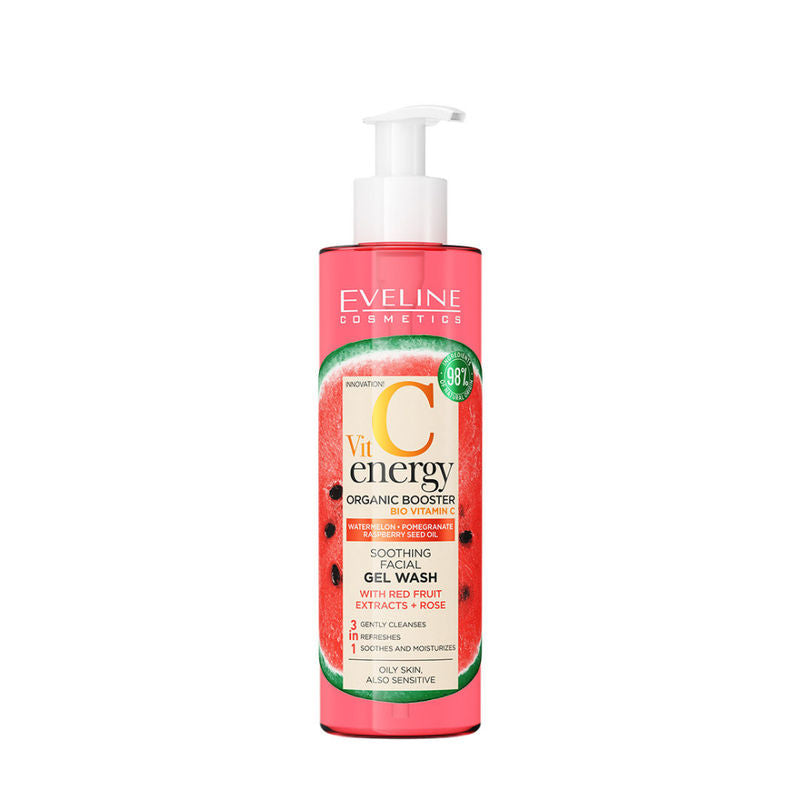
Eveline Cosmetics Vit C Energy Organic Booster Soothing Face Wash Gel-Oil

Eveline Cosmetics Vit C Energy Organic Booster Soothing Face Wash Gel-Oil
Eveline Cosmetics
eveline-cosmetics-vit-c-energy-organic-booster-soothing-face-wash-gel-oil
Cleanse
10084786766117
Morning or Evening?
How often will you use this product?
Notes


Highlights
WHAT IS IT?
Soothing facial gel wash with vitamin C and red fruit extracts
FEATURES
Contains Vitamin C and red fruit extracts for antioxidant benefits, Light oil-gel formula gentle on sensitive skin, Rose extract for soothing, Hydrates and nourishes, 3-in-1 cleanser toner moisturizer, Non-greasy and non-comedogenic, Paraben and sulfate free, Cruelty free and vegan friendly
BEST FOR
sensitive
CHECKS
Paraben, Sulfate
Who Is It For?
What Does It Help With?
Cleansing Impurities And Makeup Antioxidant Benefits Soothing And Moisturizing SkinBudget
Mid-range ($30-$75)How To Use
Which routine should it be used in?
Instructions:
Key Information


What Eveline Cosmetics Says
Product Description:
Experience the amazing power of SOOTHING FACIAL GEL WASH based on red fruit extracts rich in vitamin C and the addition of soothing rose. Thanks to the light, innovative formula with the ingredients of natural origin, it instantly refreshes and thoroughly cleanses the epidermis of any impurities and make-up, leaving the complexion perfectly clean, nourished deeply moisturized and soothed.
About the Brand:
Ingredients Overview
Ingredients List
Aqua-(Water),Coco-Glucoside,Glycerin,Rubus-Idaeus-Seed-Oil,Rosa-Damascena-Flower-Oil,Citrullus-Lanatus-Fruit-Extract,Punica-Granatum-Fruit-Extract,Lycium-Barbarum-Fruit-Extract,Rosa-Gallica-Flower-Extract,Ascorbyl-Glucoside,Bromelain,Papain,Glucose,Phenoxyethanol,Hydroxyacetophenone,Ethylhexylglycerin,Potassium-Sorbate,Sodium-Benzoate,Carbomer,Heptyl-Glucoside,Parfum-(Fragrance),Sodium-Hydroxide,Octyldodecanol,Sorbitan-Tristearate,Propanediol,Sorbic-Acid,Maltodextrin,Agar,Glyceryl-Stearate,C20-24-Alkyl-Dimethicone,Sclerotium-Gum,Citric-Acid,Ci-17200,Ci-19140
Key Ingredients
Vitamin C (Ascorbyl Glucoside), Red fruit extracts (Rubus Idaeus Seed Oil, Citrullus Lanatus Fruit Extract, Punica Granatum Fruit Extract, Lycium Barbarum Fruit Extract), Rose extract (Rosa Damascena Flower Oil, Rosa Gallica Flower Extract)
Ingredients Details
Agar
Common Name(s): Agar-agar,agarose,gelidium amansii extract
CAS Number: 9002-18-0
DESCRIPTION
What It Does: Provides firm, thermally reversible marine-derived gels from natural seaweed polysaccharide.
Why It's Used: Natural seaweed gellant for clean beauty formulations requiring firm, stiff gel textures with authentic marine provenance.
How It Works: Agarose chains form double helix junction zones that aggregate into bundles forming a rigid gel network below 38°c. melts at 85°c but re-gels at 38°c – this 47°c hysteresis window means agar gels remain solid at skin contact (33°c) but dissolve cleanly in hot water for rinse-off products.
Typically Found In: Sheet masks,gel cleansers,firm gel products
TECHNICAL DETAILS
Primary Category: Functional ingredient – seaweed gellant
Secondary Functions: Tewl reduction,skin plumping
Application Areas:

Facial Skincare
Body Care
Hair Care

Beard Care
Color Cosmetics (Makeup)
Dietary/Oral Supplements
Typical Concentration Range: 0.5%–3%
SOURCING & ETHICS
Vegan Status: Conditional - supplier confirmation required
Halal Status: Unverified - supplier confirmation required
Source Notes: Synthetic or naturally derived. excellent aqueous solubility. [audit 2026-07-29 rev2: status downgraded on audit. determination requires shariah-panel sign-off.]
SKIN COMPATIBILITY
Irritancy Rating: 1/5 – very low
Comedogenicity Rating: 0/5 – non-comedogenic
Sensitivity Concerns: Non-irritating; suitable for all skin types.
Safe for Sensitive Skin: Yes
SAFETY & COMPATIBILITY
Safety Profile: Excellent safety profile. ewg score: 1.
Works Well With: Ceramides,emollients,occlusives,glycerin,hyaluronic acid
Avoid Combining With: No significant incompatibilities
SCIENTIFIC NOTE
Agar's thermal hysteresis (melts 85°c, sets 38°c) is unique among natural gellants. this hysteresis arises from the different temperatures required for helix-coil disruption (melting) vs helix formation (setting) in the agarose chains. the practical consequence – a gel that can be sterilized at 121°c yet remains stable at skin temperature (33°c) – makes agar uniquely useful for thermally stable cosmetic gels.
Last Verified: 2026-03-12
Primary Sources: Cosing database,cir safety assessment,fda gras
Bromelain
Common Name(s): Pineapple protease,stem bromelain,ananas comosus enzyme
CAS Number: 9001-00-7
DESCRIPTION
What It Does: Provides gentle enzymatic exfoliation with anti-inflammatory and anti-edema activity beyond simple keratolysis.
Why It's Used: Multi-function enzyme providing exfoliation + anti-inflammatory activity – ideal for post-procedure formulations requiring both resurfacing and calming.
How It Works: Cysteine protease digests keratin for exfoliation (similar to papain). additionally inhibits nf-kb, reduces prostaglandin e2, and breaks down fibrin (anti-edema). anti-inflammatory activity is retained at sub-exfoliating concentrations for standalone soothing use.
Typically Found In: Enzyme peels,post-procedure products,anti-inflammatory serums,brightening masks
TECHNICAL DETAILS
Primary Category: Active ingredient – enzyme
Secondary Functions: Dual exfoliation+anti-inflammatory,fibrin dissolution
Application Areas:
Facial Skincare
Body Care
Hair Care
Beard Care
Color Cosmetics (Makeup)
Dietary/Oral Supplements
Typical Concentration Range: 1%–10%
SOURCING & ETHICS
Vegan Status: Conditional - supplier confirmation required
Halal Status: Unverified - supplier confirmation required
Source Notes: Plant-derived (papaya, pineapple) or fermentation-derived. [audit 2026-07-29 rev2: status downgraded on audit. determination requires shariah-panel sign-off.]
SKIN COMPATIBILITY
Irritancy Rating: 2/5 – low to moderate
Comedogenicity Rating: 0/5 – non-comedogenic
Sensitivity Concerns: Patch test recommended; potential for enzymatic sensitization.
Safe for Sensitive Skin: Use with caution – potential sensitization
SAFETY & COMPATIBILITY
Safety Profile: Safe at cosmetic concentrations. patch test recommended. ewg score: 1–2.
Works Well With: Ahas (synergistic),hyaluronic acid,ceramides
Avoid Combining With: High concentrations on sensitive or compromised skin
SCIENTIFIC NOTE
Bromelain's fibrinolytic activity (dissolving fibrin that accumulates at wound and inflammation sites) is a unique enzyme property not shared by papain. this fibrin dissolution reduces the persistent edema that characterizes chronic post-inflammatory states, making bromelain uniquely valuable in post-procedure inflammation management.
Last Verified: 2026-03-12
Primary Sources: Cosing database,akhtar et al. bromelain anti-inflammatory review
Carbomer
Common Name(s): Carbopol,polyacrylic acid,carboxyvinyl polymer
DESCRIPTION
What It Does: Provides transparent gel textures and thickening at very low concentrations via ph-responsive swelling.
Why It's Used: The most widely used gel thickener – provides crystal-clear, stable gels at concentrations as low as 0.1-0.5% with ph-controlled viscosity.
How It Works: Highly crosslinked polyacrylic acid remains tightly coiled at acidic ph. neutralization with naoh or triethanolamine ionizes carboxylic groups causing electrostatic repulsion that unfolds and swells the polymer coils, dramatically increasing viscosity. concentration-dependent thickening.
Typically Found In: Gels,serums,emulsions,sunscreens
TECHNICAL DETAILS
Primary Category: Functional ingredient – polyacrylic acid thickener
Secondary Functions: Skin conditioning
Application Areas:
Facial Skincare
Body Care
Hair Care
Beard Care
Color Cosmetics (Makeup)
Dietary/Oral Supplements
Typical Concentration Range: 0.1%–2%
SOURCING & ETHICS
Vegan Status: Conditional - supplier confirmation required
Halal Status: Unverified - supplier confirmation required
Source Notes: Commercially produced for cosmetic use. verify vegan/halal status with supplier. [audit 2026-07-29 rev2: the record's own source_notes does not assert a non-animal origin, or instructs the reader to verify with the supplier; "yes" asserts knowledge the record does not hold. determination requires shariah-panel sign-off.]
SKIN COMPATIBILITY
Irritancy Rating: 1/5 – very low
Comedogenicity Rating: 0/5 – non-comedogenic
Sensitivity Concerns: Well-tolerated by most skin types.
Safe for Sensitive Skin: Yes
SAFETY & COMPATIBILITY
Safety Profile: Good safety profile at recommended concentrations. ewg score: 1–2.
Works Well With: Standard skincare actives
Avoid Combining With: No known significant incompatibilities
SCIENTIFIC NOTE
Carbomer's ph-responsive swelling mechanism provides an elegant formulation control tool: a neutralized gel can be liquefied by ph reduction (adding acid) and re-thickened by reneutralization. this reversible rheology control allows two-phase products that mix on application without the need for mechanical emulsification.
Last Verified: 2026-03-12
Primary Sources: Cosing database,cir safety assessment
Coco-glucoside
Common Name(s): Coconut glucoside,apg c8-c16
CAS Number: 68515-73-1
DESCRIPTION
What It Does: Provides gentle, natural-origin cleansing with good foam from mixed coconut chain alkyl glucosides.
Why It's Used: Widely used natural surfactant for green beauty formulations requiring good foam performance with natural-origin and mild credentials.
How It Works: Mixed c8-c16 fatty alcohol chain lengths from coconut provide broader foam stability than single-chain glucosides. non-ionic glucoside headgroup provides mildness. better detergency and rinsing than individual chain-length apgs due to mixed chain distribution.
Typically Found In: Natural shampoos,body washes,facial cleansers
TECHNICAL DETAILS
Primary Category: Functional ingredient – coconut alkyl glucoside
Secondary Functions: Skin conditioning
Application Areas:
Facial Skincare
Body Care
Hair Care
Beard Care
Color Cosmetics (Makeup)
Dietary/Oral Supplements
Typical Concentration Range: 2%–20%
SOURCING & ETHICS
Vegan Status: Conditional - supplier confirmation required
Halal Status: Unverified - supplier confirmation required
Source Notes: Commercially produced for cosmetic use. verify vegan/halal status with supplier. [audit 2026-07-29 rev2: the record's own source_notes does not assert a non-animal origin, or instructs the reader to verify with the supplier; "yes" asserts knowledge the record does not hold. determination requires shariah-panel sign-off.]
SKIN COMPATIBILITY
Irritancy Rating: 1/5 – very low
Comedogenicity Rating: 0/5 – non-comedogenic
Sensitivity Concerns: Well-tolerated by most skin types.
Safe for Sensitive Skin: Yes
SAFETY & COMPATIBILITY
Safety Profile: Good safety profile at recommended concentrations. ewg score: 1–2.
Works Well With: Standard skincare actives
Avoid Combining With: No known significant incompatibilities
SCIENTIFIC NOTE
Coco-glucoside's natural chain length distribution (c8-c16) provides synergistic surfactant effects where different chain lengths optimize different properties: shorter chains provide initial foam burst, longer chains provide foam stability and soil removal, creating better overall performance than any single chain length alone.
Last Verified: 2026-03-12
Primary Sources: Cosing database,cir safety assessment