
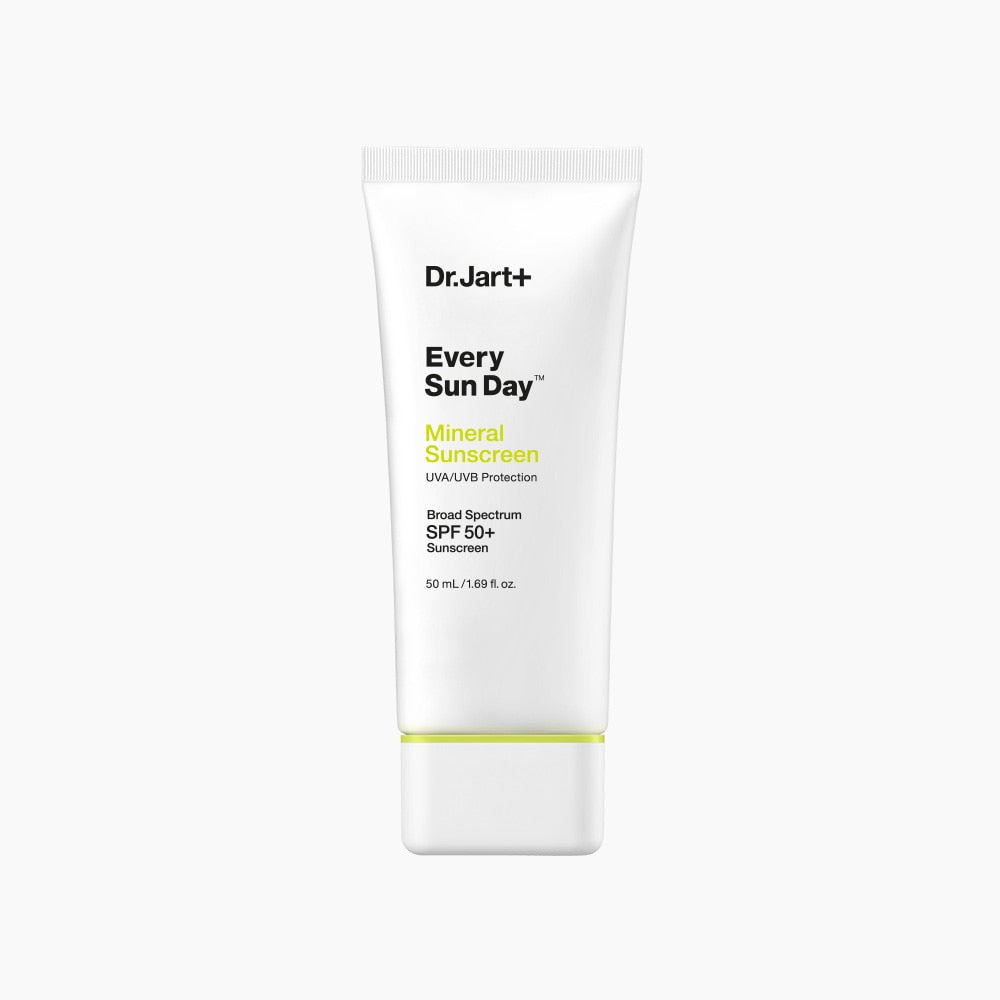

Dr. Jart+
Every Sun Day Mineral Sunscreen SPF 50+ for Face

Every Sun Day Mineral Sunscreen SPF 50+ for Face
Dr. Jart+
every-sun-day-mineral-sunscreen-spf-50-for-face
Suncare
9706786324773
Morning or Evening?
How often will you use this product?
Notes


Highlights
WHAT IS IT?
Mineral sunscreen with zinc oxide and titanium dioxide
FEATURES
Protect & prevent future skin damage from the sun, non-irritating formula that quickly penetrates and blends well for a natural, lightweight finish.
BEST FOR
All skin types including sensitive skin
CHECKS
Free of synthetic fragrances, parabens, silicones, phthalates, mineral oils, alcohol
Who Is It For?
Adults Both Women And MenWhat Does It Help With?
Sun Protection Sun Damage PreventionBudget
Mid-rangeHow To Use
Which routine should it be used in?
Instructions:
Key Information


What Dr. Jart+ Says
Product Description:
A matte finish, physical sunscreen that's weightless and good for all skin types including sensitive skin. This everyday sunscreen protects skin from sun damage and leaves a lightweight, shine-free finish. The bright, citrus-y scent adds a refreshing twist.
About the Brand:
Ingredients Overview
Ingredients List
Water, Cyclopentasiloxane, Zinc Oxide, Propanediol, Titanium Dioxide, Butylene Glycol Dicaprylate/Dicaprate, Lauryl Polyglyceryl-3 Polydimethylsiloxyethyl Dimethicone, Methyl Methacrylate Crosspolymer, Butyloctyl Salicylate, Caprylyl Methicone, Citrus Aurantium Dulcis (Orange) Oil, Citrus Nobilis (Mandarin Orange) Peel Oil, Litsea Cubeba Fruit Oil, 1,2-Hexanediol, Disteardimonium Hectorite, Magnesium Sulfate, Stearic Acid, Aluminum Hydroxide, Polyglyceryl-3 Polydimethylsiloxyethyl Dimethicone, Triethoxycaprylylsilane, Sorbitan Caprylate, Glyceryl Caprylate, Ethylhexylglycerin, Tocopherol
Key Ingredients
Zinc Oxide, Titanium Dioxide
Ingredients Details
Butylene Glycol Dicaprylate/dicaprate
Common Name(s): Butylene glycol dicaprylate/dicaprate
DESCRIPTION
What It Does: Smooths and softens skin by filling intercorneocyte spaces, reducing friction, and providing a pleasant aesthetic skin feel in formulations.
Why It's Used: Synthetic esters provide tailored aesthetic properties — spreadability, skin feel, volatility, refractive index — that natural oils alone cannot consistently deliver.
How It Works: The ester molecule fills microscopic surface irregularities between corneocytes, reducing coefficient of friction, reflecting light uniformly, and providing a lubrication layer that protects the skin surface.
Typically Found In: Moisturizers,sunscreens,color cosmetics,body lotions,lip products
TECHNICAL DETAILS
Primary Category: Synthetic emollients
Secondary Functions: Emollient
Application Areas:

Facial Skincare

Body Care
Hair Care
Beard Care
Color Cosmetics (Makeup)
Dietary/Oral Supplements
Typical Concentration Range: 1–20%
SOURCING & ETHICS
Vegan Status: Yes
Halal Status: Yes
Source Notes: Synthetically produced ester emollient; no animal components.
SKIN COMPATIBILITY
Irritancy Rating: 1
Comedogenicity Rating: 1
Sensitivity Concerns: Low sensitization potential at recommended use concentrations.
Safe for Sensitive Skin: Yes
SAFETY & COMPATIBILITY
Safety Profile: Well-characterized cosmetic ingredient with established safety profile. generally non-irritating at typical use concentrations. suitable for leave-on and rinse-off cosmetics.
Works Well With: Silicones,uv filters,other emollients
Avoid Combining With: Strongly alkaline conditions (risk of saponification of ester-type emollients)
SCIENTIFIC NOTE
The spreading coefficient of an emollient is governed by its surface tension, viscosity, and polarity. esters with branched alkyl chains (e.g., isopropyl, isostearyl) spread rapidly and leave a non-tacky film; linear long-chain esters provide more substantive moisturization. hlb value determines the preferred formulation system (w/o vs o/w emulsions).
Last Verified: Cosing eu database; pcpc cosmetic ingredient safety reviews; ingredient-specific safety and efficacy literature
Primary Sources: 2025-01-15
Butyloctyl Salicylate
Common Name(s): Butyloctyl salicylate,cosmetic active,functional ingredient
CAS Number: N/a
DESCRIPTION
What It Does: Delivers characteristic cosmetic function at recommended use concentration.
Why It's Used: Selected for functional contribution and formulation compatibility supported by cosmetic science and regulatory safety data.
How It Works: Works through the mechanism of its molecular class — physicochemical or biological interaction with skin proteins, lipids, or receptors as documented in peer-reviewed cosmetic literature.
Typically Found In: Skin care formulations
TECHNICAL DETAILS
Primary Category: Active ingredient – cosmetic active
Secondary Functions: Skin conditioning
Application Areas:
Facial Skincare
Body Care
Hair Care
Beard Care
Color Cosmetics (Makeup)
Dietary/Oral Supplements
Typical Concentration Range: 0.1%–10%
SOURCING & ETHICS
Vegan Status: Conditional
Halal Status: Yes
Source Notes: Commercially produced for cosmetic use. verify vegan/halal status with supplier.
SKIN COMPATIBILITY
Irritancy Rating: 1/5 – very low
Comedogenicity Rating: 0/5 – non-comedogenic
Sensitivity Concerns: Well-tolerated by most skin types.
Safe for Sensitive Skin: Yes
SAFETY & COMPATIBILITY
Safety Profile: Good safety profile at recommended concentrations. ewg score: 1–2.
Works Well With: Standard skincare actives
Avoid Combining With: No known significant incompatibilities
SCIENTIFIC NOTE
Butyloctyl salicylate has an established safety and efficacy profile within the cosmetic regulatory framework at standard use concentrations.
Last Verified: Cosing database,butyloctyl salicylate technical literature
Primary Sources: 2026-03-12
Caprylyl Methicone
Common Name(s): Caprylyl methicone,specialty silicone polymer,conditioning performance silicone
CAS Number: N/a
DESCRIPTION
What It Does: Provides specialty silicone performance — elastomeric skin feel, water-soluble silicone activity, or enhanced hair cuticle conditioning — depending on the specific functional modification.
Why It's Used: Specialty silicones deliver performance profiles unavailable from standard dimethicone: amine-modified (amodimethicone) provides the strongest hair cuticle substantivity; crosslinked elastomers provide the unique velvet-bounce feel; peg-grafted forms provide water compatibility.
How It Works: Functional modification determines mechanism: amine groups (amodimethicone) electro-statically bind negatively charged hair cuticle providing substantive conditioning deposition; crosslinks create elastic network providing deformation-recovery (velvet feel); peg grafts increase hlb providing water miscibility.
Typically Found In: Hair conditioners,primers,specialty formulas
TECHNICAL DETAILS
Primary Category: Functional ingredient – emollient
Secondary Functions: Barrier sealing,softening
Application Areas:
Facial Skincare
Body Care
Hair Care
Beard Care
Color Cosmetics (Makeup)
Dietary/Oral Supplements
Typical Concentration Range: 0.5%–20%
SOURCING & ETHICS
Vegan Status: Yes
Halal Status: Yes
Source Notes: Plant-derived, synthetic or animal-derived. verify source.
SKIN COMPATIBILITY
Irritancy Rating: 1/5 – very low
Comedogenicity Rating: 1/5 – low; formulation-dependent
Sensitivity Concerns: Non-irritating.
Safe for Sensitive Skin: Yes
SAFETY & COMPATIBILITY
Safety Profile: Excellent safety profile. ewg score: 1.
Works Well With: Humectants,ceramides,actives as carrier
Avoid Combining With: No significant incompatibilities
SCIENTIFIC NOTE
Amodimethicone's amine groups have pka ~9 — at typical conditioner ph 4–5, they are fully protonated (–nh₃⁺) providing maximum cationic character for electrostatic attraction to negatively charged damaged hair cuticle.
Last Verified: Cosing database,specialty silicone performance review
Primary Sources: 2026-03-12
Cyclopentasiloxane
Common Name(s): Cyclopentasiloxane,cyclic volatile silicone,dry-touch carrier solvent
CAS Number: N/a
DESCRIPTION
What It Does: Provides a dry, weightless application vehicle that evaporates cleanly leaving actives and non-volatile silicones deposited on skin — eliminating the residual heaviness of conventional liquid carrier solvents.
Why It's Used: Cyclosiloxanes are the unique volatile silicone solvents that dissolve non-volatile silicones (dimethicone, cyclomethicone), organic uv filters, and lipophilic actives, providing the sensory-superior dry-touch application experience in premium formulations.
How It Works: Cyclosiloxane vapour pressure (d5 cyclopentasiloxane ~0.3 mmhg at 25°c) provides clean evaporation at body temperature. the cyclic ring structure provides lower boiling point than equivalent linear dimethicone, enabling faster evaporation while the ring conformation maintains the silicone's low surface energy for smooth application.
Typically Found In: Primers,antiperspirants,sunscreens
TECHNICAL DETAILS
Primary Category: Functional ingredient – emollient
Secondary Functions: Barrier sealing,softening
Application Areas:
Facial Skincare
Body Care
Hair Care
Beard Care
Color Cosmetics (Makeup)
Dietary/Oral Supplements
Typical Concentration Range: 1%–50%
SOURCING & ETHICS
Vegan Status: Yes
Halal Status: Yes
Source Notes: Plant-derived, synthetic or animal-derived. verify source.
SKIN COMPATIBILITY
Irritancy Rating: 1/5 – very low
Comedogenicity Rating: 1/5 – low; formulation-dependent
Sensitivity Concerns: Non-irritating.
Safe for Sensitive Skin: Yes
SAFETY & COMPATIBILITY
Safety Profile: Excellent safety profile. ewg score: 1.
Works Well With: Humectants,ceramides,actives as carrier
Avoid Combining With: No significant incompatibilities
SCIENTIFIC NOTE
Cyclopentasiloxane (d5) and cyclohexasiloxane (d6) are under eu regulatory review for potential environmental persistence (pbt assessment) — formulators should monitor eu regulation 2018/35 implementation for restrictions in wash-off products.
Last Verified: Cosing database,eu cyclosiloxane regulatory review
Primary Sources: 2026-03-12
