
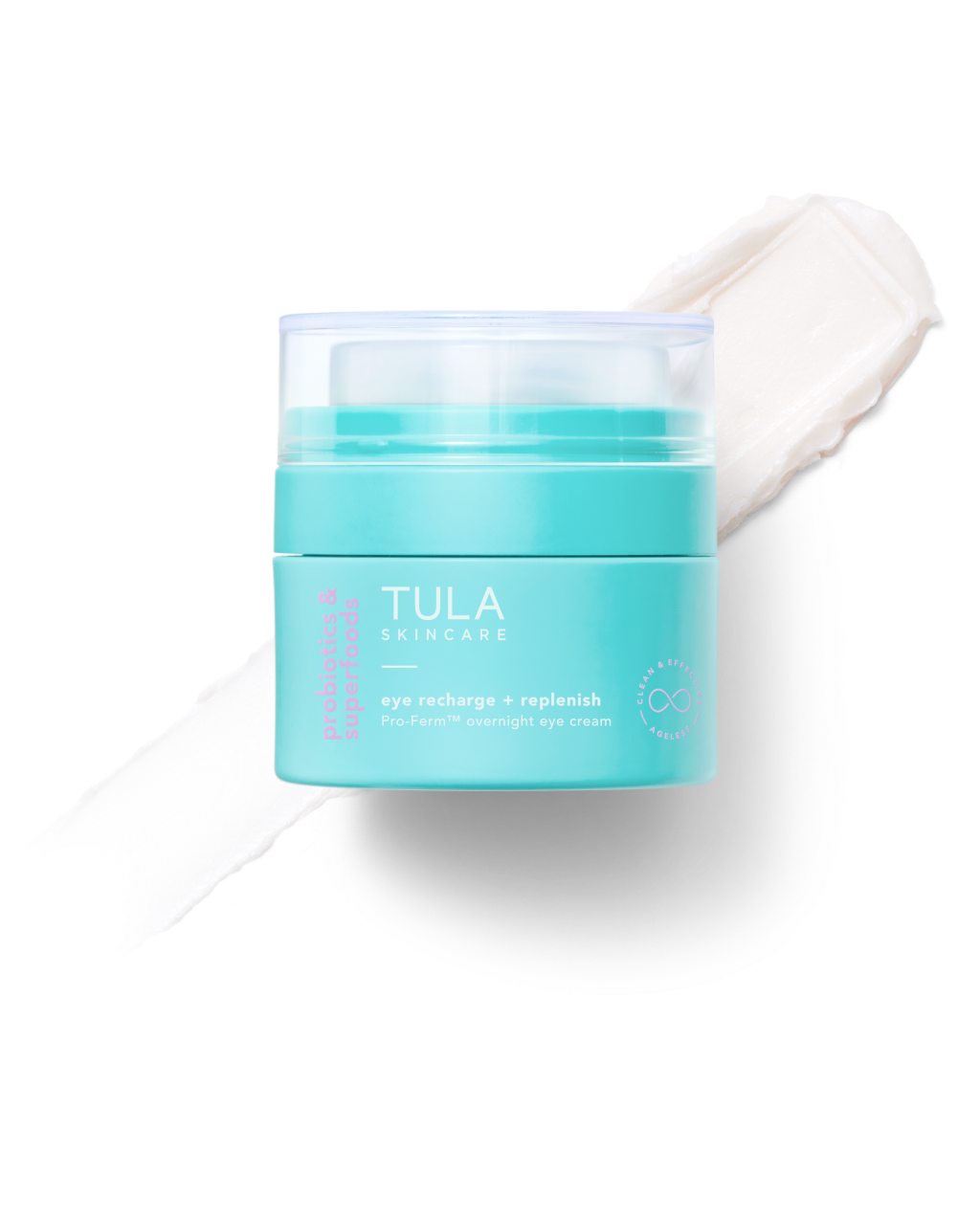

TULA
Eye Recharge + Replenish

Eye Recharge + Replenish
TULA
eye-recharge-replenish
Eyecare
9818384793893
Morning or Evening?
How often will you use this product?
Notes


Highlights
WHAT IS IT?
Overnight eye cream with retinal and tetrapeptides
FEATURES
Works overnight, combats wrinkles and crow's feet, improves elasticity, intensely hydrates
BEST FOR
normal
CHECKS
Free of alcohol, sulfate, paraben, silicon
Who Is It For?
Adults Concerned With Eye Area AgingWhat Does It Help With?
Wrinkles Crow's Feet Elasticity HydrationBudget
Mid-range ($30-$75)How To Use
Which routine should it be used in?
Instructions:
Key Information


What TULA Says
Product Description:
The eye cream that works in overdrive, overnight. Combat the look of wrinkles + crow's feet while improving elasticity all night long with retinal and tetrapeptides. Pillowy overnight cream powered by soothing chamomile and Pro-Ferm™ complex intensely hydrates, replenishes and protects delicate skin around eyes while you sleep.
About the Brand:
Ingredients Overview
Ingredients List
Water (aqua), Butyrospermum Parkii (shea) Butter, Glycerin, Squalane, Isopentyldiol, Myristyl Myristate, Butylene Glycol, 1,2-hexanediol, Pentaerythrityl Tetraisostearate, Lactococcus Ferment Lysate, Arachidyl Alcohol, Cetearyl Olivate, Glyceryl Stearate, Oenothera Biennis (evening Primrose) Oil, Pseudozyma Epicola/camellia Sinensis Seed Oil Ferment Extract Filtrate, Bakuchiol, Lactobacillus, Lactobacillus Ferment, Haematococcus Pluvialis Extract, Beta Vulgaris (beet) Root Extract, Curcuma Longa (turmeric) Root Extract, Rosmarinus Officinalis (rosemary) Leaf Extract, Palmitoyl Tetrapeptide-7, Inulin, Alpha-glucan Oligosaccharide, Ceramide Np, Lactic Acid, Ceramide Ap, Ceramide As, Ceramide Ns, Chrysin, Ceramide Eop, Chamomilla Recutita (matricaria) Flower Extract, Cholesterol, Squalene, Behenyl Alcohol, Sorbitan Olivate, Sodium Polyacryloyldimethyl Taurate, Arachidyl Glucoside, Sodium Polyacrylate Starch, Sodium Polyglutamate, Phosphatidylcholine, Pentylene Glycol, Sodium Dilauramidoglutamide Lysine, 2,3-butanediol, Polymnia Sonchifolia Root Juice, Hydrogenated Lecithin, Maltodextrin, Sodium Benzoate, Citric Acid, Tocopherol, Phytic Acid, Potassium Sorbate, Sodium Chloride, Beta-sitosterol\
Key Ingredients
retinal,tetrapeptides,chamomile,Pro-Ferm complex
Ingredients Details
Chamomile
Common Name(s): Chamomile,cosmetic active,functional ingredient
CAS Number: N/a
DESCRIPTION
What It Does: Delivers characteristic cosmetic function — skin conditioning, protection, preservation, or active biological benefit — at recommended use concentration.
Why It's Used: Selected for its functional contribution and formulation compatibility — supported by cosmetic science literature and regulatory safety assessment.
How It Works: Works through the mechanism of its molecular class — physicochemical interaction with the formulation or biological interaction with skin proteins, lipids, or receptors as documented in peer-reviewed literature.
Typically Found In: Skin care formulations
TECHNICAL DETAILS
Primary Category: Active ingredient – cosmetic active
Secondary Functions: Skin conditioning
Application Areas:

Facial Skincare

Body Care
Hair Care
Beard Care
Color Cosmetics (Makeup)
Dietary/Oral Supplements
Typical Concentration Range: 0.1%–10%
SOURCING & ETHICS
Vegan Status: Conditional - supplier confirmation required
Halal Status: Unverified - supplier confirmation required
Source Notes: Commercially produced for cosmetic use. verify vegan/halal status with supplier. [audit 2026-07-29 rev2: the record's own source_notes does not assert a non-animal origin, or instructs the reader to verify with the supplier; "yes" asserts knowledge the record does not hold. determination requires shariah-panel sign-off.]
SKIN COMPATIBILITY
Irritancy Rating: 1/5 – very low
Comedogenicity Rating: 0/5 – non-comedogenic
Sensitivity Concerns: Well-tolerated by most skin types.
Safe for Sensitive Skin: Yes
SAFETY & COMPATIBILITY
Safety Profile: Good safety profile at recommended concentrations. ewg score: 1–2.
Works Well With: Standard skincare actives
Avoid Combining With: No known significant incompatibilities
SCIENTIFIC NOTE
Chamomile delivers documented functional benefit with an established safety profile within the cosmetic regulatory framework (cosing eu, cir usa).
Last Verified: 2026-03-12
Primary Sources: Cosing database,chamomile technical literature
Retinal
Common Name(s): Retinoid active,rar nuclear receptor,anti-aging gold standard
CAS Number: N/a
DESCRIPTION
What It Does: Stimulates collagen i and iii synthesis, accelerates epidermal renewal, inhibits mmp-1 collagenase, normalises pigmentation, and reverses photoaging signs including wrinkles, laxity, and texture.
Why It's Used: The most clinically validated anti-aging mechanism in dermatology with 40+ years of peer-reviewed evidence — retinoids are the benchmark against which all anti-aging actives are compared.
How It Works: Retinol and esters are enzymatically converted in skin: retinol → retinaldehyde (alcohol dehydrogenase) → all-trans retinoic acid (retinaldehyde dehydrogenase). retinoic acid binds rar-α/β/γ → rare promoter binding → col1a1, timp-1 upregulation; mmp-1 and il-6 downregulation through ap-1 pathway interference.
Typically Found In: Anti-aging serums,night creams
TECHNICAL DETAILS
Primary Category: Active ingredient – vitamin a derivative
Secondary Functions: Collagen booster,antioxidant
Application Areas:
Facial Skincare
Body Care
Hair Care
Beard Care
Color Cosmetics (Makeup)
Dietary/Oral Supplements
Typical Concentration Range: 0.025%–2% (check local limits)
SOURCING & ETHICS
Vegan Status: Conditional - supplier confirmation required
Halal Status: Unverified - supplier confirmation required
Source Notes: Synthetic or plant-derived. requires opaque, airless packaging. [audit 2026-07-29 rev2: status downgraded on audit. determination requires shariah-panel sign-off.]
SKIN COMPATIBILITY
Irritancy Rating: 2/5 – low to moderate
Comedogenicity Rating: 0/5 – non-comedogenic
Sensitivity Concerns: Introduce slowly; retinization expected at higher potencies.
Safe for Sensitive Skin: Use with caution – avoid during pregnancy
SAFETY & COMPATIBILITY
Safety Profile: Safe at cosmetic concentrations. use spf. avoid during pregnancy. ewg score: 2.
Works Well With: Niacinamide,ceramides,hyaluronic acid,spf,tocopherol
Avoid Combining With: Pregnancy; extended uv without spf; benzoyl peroxide
SCIENTIFIC NOTE
Different retinoid potency ladder: retinyl palmitate < retinol < retinaldehyde < retinyl retinoate ≈ hpr < all-trans retinoic acid. corresponding irritation follows the same order — formulators select the potency/tolerance balance for their target consumer.
Last Verified: 2026-03-12
Primary Sources: Cosing database,retinoid anti-aging rar clinical evidence review