
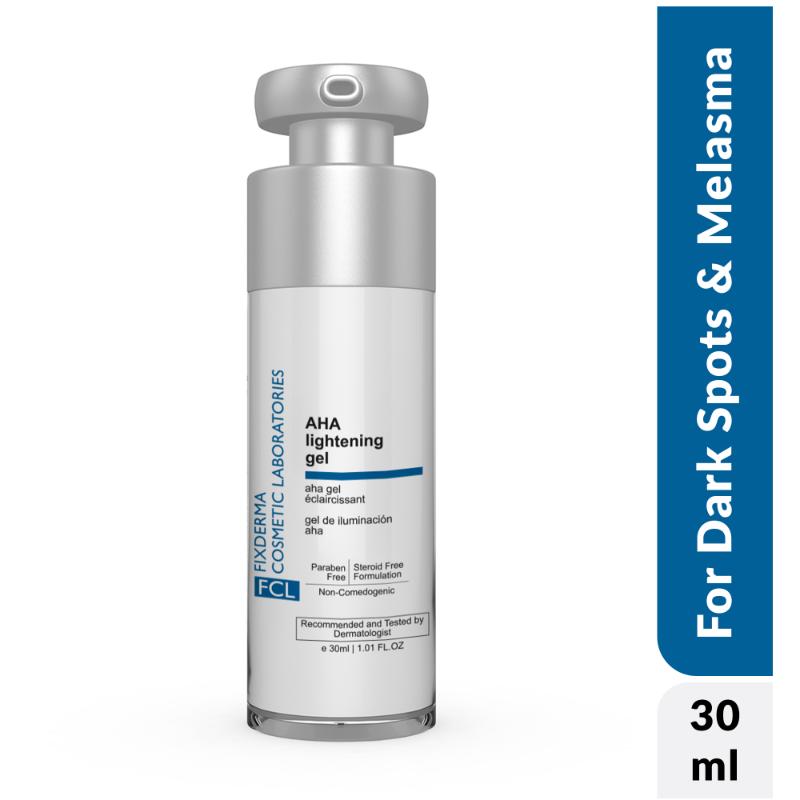

Fixderma Cosmetic Laboratories
FCL Glycolic Acid + Alpha Arbutin Serum AHA Lightening Gel For Skin Lightening

FCL Glycolic Acid + Alpha Arbutin Serum AHA Lightening Gel For Skin Lightening
Fixderma Cosmetic Laboratories
fcl-glycolic-acid-alpha-arbutin-serum-aha-lightening-gel-for-skin-lightening
Serum
10084856398117
Morning or Evening?
How often will you use this product?
Notes


Highlights
WHAT IS IT?
Lightening Gel Serum with 11 ingredients
FEATURES
Removes dead skin cells, brightens skin, promotes even skin tone, exfoliates dead skin layer, reduces hyperpigmentation, minimizes scars, antioxidant rich, anti-aging benefits, brightening effect for youthful radiant skin
BEST FOR
sensitive
CHECKS
No parabens, no sulfates, no alcohol, no silicone, no fragrance
Who Is It For?
Adults Of Any GenderWhat Does It Help With?
Skin Lightening Pigmentation Reduction Scar Minimization Brightening Even Skin Tone Anti-agingBudget
Premium ($76-$150)How To Use
Which routine should it be used in?
Instructions:
Key Information


What Fixderma Cosmetic Laboratories Says
Product Description:
Glycolic Acid effectively removes dead skin cells for brighter skin; Milk Protein vitalizes skin protection and aids in even skin tone; Multifruit BSC exfoliates dead skin reducing hyperpigmentation and scars; Grapefruit Extract provides antioxidant and anti-aging benefits; Alpha Arbutin brightens skin by controlling melanin production; Rona Care Pristine Bright offers brightening for luminous skin tone.
About the Brand:
Ingredients Overview
Ingredients List
Aqua,Glycolic-Acid,Ethoxydiglycol,Milk-Protein,Water,Vaccinium-Myrtillus-Fruit-Extract,Saccharum-Officinarum-Sugar-Cane-Extract,Acer-Saccharum-Sugar-Maple-Extract,Citrus-Aurantium-Dulcis-Orange-Fruit-Extract,Citrus-Limon-Lemon-Fruit-Extract,Citrus-Grandis-Grapefruit-Seed-Extract,Methoxyphenyl-T-Butylphenyl-Propanediol,Alpha-Arbutin,Citric-Acid,Polyquaternium-10
Key Ingredients
Glycolic Acid, Milk Protein, Multifruit BSC, Grapefruit Extract, Alpha Arbutin, Rona Care Pristine Bright
Ingredients Details
Alpha-arbutin
Common Name(s): 4-hydroxyphenyl-alpha-d-glucopyranoside
DESCRIPTION
What It Does: Provides potent tyrosinase inhibition with improved stability and tolerability over other arbutin forms.
Why It's Used: Premium arbutin — alpha configuration provides 10× greater tyrosinase inhibition than beta-arbutin at equivalent concentration, making alpha-arbutin the most effective arbutin form.
How It Works: Alpha-glucoside linkage provides enhanced metabolic stability vs beta-arbutin (less enzymatic hydrolysis to free hydroquinone in skin). inhibits tyrosinase via competitive substrate inhibition (ic50 ~24μg/ml vs beta-arbutin ~525μg/ml — 20× more potent). inhibits dopa oxidase step in melanogenesis.
Typically Found In: Brightening serums,anti-spot products,premium lightening
TECHNICAL DETAILS
Primary Category: Active ingredient – arbutin brightening agent
Secondary Functions: Melanin inhibition,hyperpigmentation reduction
Application Areas:

Facial Skincare

Body Care
Hair Care
Beard Care
Color Cosmetics (Makeup)
Dietary/Oral Supplements
Typical Concentration Range: 0.5%–2%
SOURCING & ETHICS
Vegan Status: Yes – synthetic enzymatic synthesis
Halal Status: Yes
Source Notes: Synthetic or plant-derived.
SKIN COMPATIBILITY
Irritancy Rating: 1/5 – very low
Comedogenicity Rating: 0/5 – non-comedogenic
Sensitivity Concerns: Non-irritating; well-tolerated.
Safe for Sensitive Skin: Yes
SAFETY & COMPATIBILITY
Safety Profile: Excellent safety profile. use with spf for maximum efficacy. ewg score: 1.
Works Well With: Niacinamide,vitamin c,alpha-arbutin,tranexamic acid,spf
Avoid Combining With: No significant incompatibilities
SCIENTIFIC NOTE
Alpha-arbutin's 10–20× greater potency vs beta-arbutin at equivalent concentration arises from the alpha-glycosidic bond geometry — the alpha configuration positions the hydroquinone aglycone at a specific orientation relative to the glucose that fits the tyrosinase active site copper more precisely than the beta isomer's different spatial arrangement.
Last Verified: Cosing database,sugimoto et al. arbutin tyrosinase study
Primary Sources: 2026-03-12
Ethoxydiglycol
Common Name(s): Ethoxydiglycol,glycol co-solvent,humectant formulation aid
CAS Number: N/a
DESCRIPTION
What It Does: Provides co-solvent and penetration enhancer in cosmetic formulations, improving active ingredient dissolution and product texture while delivering mild skin conditioning.
Why It's Used: Glycol solvents are essential for dissolving actives with limited water or oil solubility — the intermediate polarity of glycol ethers provides access to the wider solubility parameter space between pure water and oil phases.
How It Works: Hydroxyl and ether groups provide h-bonding for water miscibility; the organic chain provides compatibility with lipophilic actives. medium-chain glycols (c3–c6) provide the optimal balance of water compatibility, lipophilic active dissolution, and skin-compatible humectancy.
Typically Found In: Skin care formulations,co-solvent systems
TECHNICAL DETAILS
Primary Category: Functional ingredient – humectant
Secondary Functions: Tewl reduction,skin plumping
Application Areas:
Facial Skincare
Body Care
Hair Care
Beard Care
Color Cosmetics (Makeup)
Dietary/Oral Supplements
Typical Concentration Range: 1%–30%
SOURCING & ETHICS
Vegan Status: Yes
Halal Status: Yes
Source Notes: Synthetic or naturally derived. excellent aqueous solubility.
SKIN COMPATIBILITY
Irritancy Rating: 1/5 – very low
Comedogenicity Rating: 0/5 – non-comedogenic
Sensitivity Concerns: Non-irritating; suitable for all skin types.
Safe for Sensitive Skin: Yes
SAFETY & COMPATIBILITY
Safety Profile: Excellent safety profile. ewg score: 1.
Works Well With: Ceramides,emollients,occlusives,glycerin,hyaluronic acid
Avoid Combining With: No significant incompatibilities
SCIENTIFIC NOTE
Glycol ether co-solvents enhance sc penetration of co-applied actives by increasing their thermodynamic activity in the sc lipid phase — high thermodynamic activity (near saturation) drives diffusion by concentration gradient even when absolute concentration is low.
Last Verified: Cosing database,ethoxydiglycol glycol solvent review
Primary Sources: 2026-03-12
Polyquaternium-10
Common Name(s): Pq-10,hydroxyethylcellulose ethyl trimethylammonium chloride,jr-400
CAS Number: 54351-50-7
DESCRIPTION
What It Does: Provides film-forming conditioning and detangling with heat protection in a polymer that adsorbs substantively to hair.
Why It's Used: The most widely used cationic polymer conditioner – provides excellent conditioning and detangling while adsorbing strongly to damaged hair areas that need conditioning most.
How It Works: Cationic quaternary ammonium groups along the polymer backbone adsorb to anionic sites on hair keratin. higher charge density on damaged hair (more negative sites) leads to preferential adsorption where conditioning is needed. polymer film formation provides heat protection and volume.
Typically Found In: Shampoos,2-in-1 products,conditioners,styling products
TECHNICAL DETAILS
Primary Category: Functional ingredient – cationic polymer conditioner
Secondary Functions: Skin conditioning
Application Areas:
Facial Skincare
Body Care
Hair Care
Beard Care
Color Cosmetics (Makeup)
Dietary/Oral Supplements
Typical Concentration Range: 0.1%–2%
SOURCING & ETHICS
Vegan Status: Yes – cellulose-derived
Halal Status: Yes
Source Notes: Commercially produced for cosmetic use. verify vegan/halal status with supplier.
SKIN COMPATIBILITY
Irritancy Rating: 1/5 – very low
Comedogenicity Rating: 0/5 – non-comedogenic
Sensitivity Concerns: Well-tolerated by most skin types.
Safe for Sensitive Skin: Yes
SAFETY & COMPATIBILITY
Safety Profile: Good safety profile at recommended concentrations. ewg score: 1–2.
Works Well With: Standard skincare actives
Avoid Combining With: No known significant incompatibilities
SCIENTIFIC NOTE
Polyquaternium-10's 'self-targeting' to damaged hair sites is a unique smart conditioning mechanism. as hair damage increases negative charge density by exposing keratin's aspartate and glutamate carboxylate groups, pq-10's cationic polymer backbone adsorbs preferentially to these high-charge damage sites – automatically delivering more conditioning where the hair needs it most.
Last Verified: Cosing database,robbins hair science,cir safety assessment
Primary Sources: 2026-03-12
Water
Common Name(s): Water,purified water,deionised water,inci water
CAS Number: 7732-18-5
DESCRIPTION
What It Does: Provides the universal solvent and vehicle for water-soluble actives and the continuous phase of all o/w emulsions.
Why It's Used: The most essential cosmetic ingredient — aqua (water) is listed first on virtually all water-containing cosmetic inci labels as the highest-concentration ingredient, serving as the foundation of the global cosmetics industry.
How It Works: Acts as solvent for all water-soluble ingredients (glycols, amino acids, water-soluble actives). forms the continuous external phase of o/w emulsions (lotions, creams, serums). provides aqueous environment for enzymatic and chemical reactions between actives. ph adjustment medium.
Typically Found In: Virtually all cosmetic products — the most universal cosmetic ingredient globally
TECHNICAL DETAILS
Primary Category: Functional ingredient – water
Secondary Functions: Skin conditioning
Application Areas:
Facial Skincare
Body Care
Hair Care
Beard Care
Color Cosmetics (Makeup)
Dietary/Oral Supplements
Typical Concentration Range: Varies widely — up to 95% in some toners and serums
SOURCING & ETHICS
Vegan Status: Yes – water (deionised/purified)
Halal Status: Yes
Source Notes: Cosmetic-grade water is purified (deionised, distilled, or ro filtered) to prevent mineral content interference with formulation stability. european pharmacopoeial water (aqua purificata ph. eur.) is the quality standard for pharmaceutical and high-end cosmetic formulations.
SKIN COMPATIBILITY
Irritancy Rating: 1/5 – non-irritant
Comedogenicity Rating: 0/5 – non-comedogenic
Sensitivity Concerns: Well-tolerated by most skin types.
Safe for Sensitive Skin: Yes
SAFETY & COMPATIBILITY
Safety Profile: Good safety profile at recommended concentrations. ewg score: 1–2.
Works Well With: Standard skincare actives
Avoid Combining With: No known significant incompatibilities
SCIENTIFIC NOTE
Water's position as the first inci ingredient on most cosmetic labels reflects the regulatory requirement to list ingredients in descending concentration order — meaning water is the most abundant ingredient in the majority of cosmetic products. the fundamental role of water as the universal cosmetic solvent and vehicle makes it simultaneously the most important cosmetic ingredient and the one that requires the most sophisticated formulation chemistry to control — every emulsifier, thickener, preservative, and ph adjuster exists primarily to manage water's interaction with other ingredients in formulation.
Last Verified: Cosing database,eu cosmetics regulation 1223/2009 inci requirements,ph. eur. aqua purificata monograph
Primary Sources: 2026-03-12
