

Nykaa E retail limited
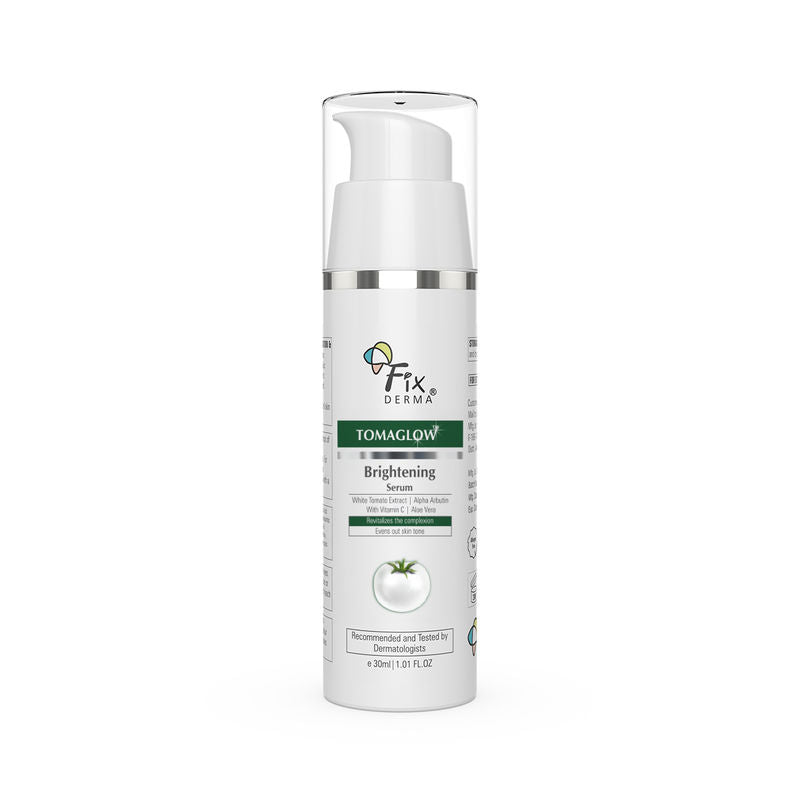
Fixderma Tomaglow Skin Brightening Face Serum

Fixderma Tomaglow Skin Brightening Face Serum
Nykaa E retail limited
fixderma-tomaglow-skin-brightening-face-serum
Serum
10084857020709
Morning or Evening?
How often will you use this product?
Notes


Highlights
WHAT IS IT?
Brightening face serum with multiple active ingredients
FEATURES
Brightens and evens skin tone, fades dark spots and pigmentation, hydrating with aloe vera, lightweight and non-greasy, dermatologist tested
BEST FOR
normal
CHECKS
Phenoxyethanol, Ethylhexylglycerin, Fragrance
Who Is It For?
What Does It Help With?
Dark Spots Hyperpigmentation Dullness Hydration Even Skin ToneBudget
Affordable (under $30)How To Use
Which routine should it be used in?
Instructions:
Key Information


What Nykaa E retail limited Says
Product Description:
Tomaglow Brightening Serum is your ultimate solution for a radiant and even-toned complexion. Powered by white tomato extract, alpha arbutin, and vitamin C, this serum visibly fades dark spots and hyperpigmentation while brightening dull skin. Its lightweight, non-greasy texture absorbs quickly, making it ideal for layering under makeup or other skincare products. Aloe vera in the formula provides deep hydration and soothes the skin, leaving it soft, smooth, and refreshed. Dermatologically tested, this serum uses gentle yet effective ingredients to deliver visible results across all skin types. Features: Brightening serum for radiant, even-toned skin, Powered by white tomato extract, alpha arbutin, and vitamin C, Helps fade dark spots, pigmentation, and dullness, Contains aloe vera to deeply hydrate and soothe skin, Lightweight, non-greasy texture absorbs quickly, Suitable for layering under makeup or skincare, Dermatologist tested, Cruelty-free.
About the Brand:
Ingredients Overview
Ingredients List
Propanediol,Niacinamide,Camellia-Sinensis-Leaf-Extract,Aloe-Barbadensis-Leaf-Powder,Alpha-Arbutin,3-0-Ethyl-Ascorbic-Acid,Linoleamidopropyl-PG-Dimonium-Chloride-Phosphate,Propylene-Glycol,Water,Simmondsia-Chinensis-Seed-Oil,Squalane,Solanum-Lycopersicum-Fruit-Extract,Xylitylglucoside,Anhydroxylitol,Xylitol,Tocopheryl-Acetate,Phenoxyethanol,Ethylhexylglycerin,Sodium-Gluconate,Fragrance,Water-(Aqua)
Key Ingredients
White tomato extract, Alpha arbutin, Vitamin C, Aloe vera
Ingredients Details
Alpha-arbutin
Common Name(s): 4-hydroxyphenyl-alpha-d-glucopyranoside
DESCRIPTION
What It Does: Provides potent tyrosinase inhibition with improved stability and tolerability over other arbutin forms.
Why It's Used: Premium arbutin — alpha configuration provides 10× greater tyrosinase inhibition than beta-arbutin at equivalent concentration, making alpha-arbutin the most effective arbutin form.
How It Works: Alpha-glucoside linkage provides enhanced metabolic stability vs beta-arbutin (less enzymatic hydrolysis to free hydroquinone in skin). inhibits tyrosinase via competitive substrate inhibition (ic50 ~24μg/ml vs beta-arbutin ~525μg/ml — 20× more potent). inhibits dopa oxidase step in melanogenesis.
Typically Found In: Brightening serums,anti-spot products,premium lightening
TECHNICAL DETAILS
Primary Category: Active ingredient – arbutin brightening agent
Secondary Functions: Melanin inhibition,hyperpigmentation reduction
Application Areas:

Facial Skincare

Body Care
Hair Care
Beard Care
Color Cosmetics (Makeup)
Dietary/Oral Supplements
Typical Concentration Range: 0.5%–2%
SOURCING & ETHICS
Vegan Status: Yes – synthetic enzymatic synthesis
Halal Status: Yes
Source Notes: Synthetic or plant-derived.
SKIN COMPATIBILITY
Irritancy Rating: 1/5 – very low
Comedogenicity Rating: 0/5 – non-comedogenic
Sensitivity Concerns: Non-irritating; well-tolerated.
Safe for Sensitive Skin: Yes
SAFETY & COMPATIBILITY
Safety Profile: Excellent safety profile. use with spf for maximum efficacy. ewg score: 1.
Works Well With: Niacinamide,vitamin c,alpha-arbutin,tranexamic acid,spf
Avoid Combining With: No significant incompatibilities
SCIENTIFIC NOTE
Alpha-arbutin's 10–20× greater potency vs beta-arbutin at equivalent concentration arises from the alpha-glycosidic bond geometry — the alpha configuration positions the hydroquinone aglycone at a specific orientation relative to the glucose that fits the tyrosinase active site copper more precisely than the beta isomer's different spatial arrangement.
Last Verified: ##########
Primary Sources: Cosing database,sugimoto et al. arbutin tyrosinase study
Anhydroxylitol
Common Name(s): Anhydroxylitol,cosmetic active,functional ingredient
CAS Number: N/a
DESCRIPTION
What It Does: Delivers characteristic cosmetic function at recommended use concentration.
Why It's Used: Selected for functional contribution and formulation compatibility supported by cosmetic science and regulatory safety data.
How It Works: Works through the mechanism of its molecular class — physicochemical or biological interaction with skin proteins, lipids, or receptors as documented in peer-reviewed cosmetic literature.
Typically Found In: Skin care formulations
TECHNICAL DETAILS
Primary Category: Active ingredient – cosmetic active
Secondary Functions: Skin conditioning
Application Areas:
Facial Skincare
Body Care
Hair Care
Beard Care
Color Cosmetics (Makeup)
Dietary/Oral Supplements
Typical Concentration Range: 0.1%–10%
SOURCING & ETHICS
Vegan Status: Conditional - supplier confirmation required
Halal Status: Unverified - supplier confirmation required
Source Notes: Commercially produced for cosmetic use. verify vegan/halal status with supplier. [audit 2026-07-29 rev2: the record's own source_notes does not assert a non-animal origin, or instructs the reader to verify with the supplier; "yes" asserts knowledge the record does not hold. determination requires shariah-panel sign-off.]
SKIN COMPATIBILITY
Irritancy Rating: 1/5 – very low
Comedogenicity Rating: 0/5 – non-comedogenic
Sensitivity Concerns: Well-tolerated by most skin types.
Safe for Sensitive Skin: Yes
SAFETY & COMPATIBILITY
Safety Profile: Good safety profile at recommended concentrations. ewg score: 1–2.
Works Well With: Standard skincare actives
Avoid Combining With: No known significant incompatibilities
SCIENTIFIC NOTE
Anhydroxylitol has an established safety and efficacy profile within the cosmetic regulatory framework at standard use concentrations.
Last Verified: 2026-03-12
Primary Sources: Cosing database,anhydroxylitol technical literature
Ethylhexylglycerin
Common Name(s): Octylglycerin,2-ethylhexyl glycerol ether,sensiva sc 10
CAS Number: 70445-33-9
DESCRIPTION
What It Does: Provides antimicrobial skin conditioning with deodorant activity and preservation system enhancement.
Why It's Used: Multifunctional clean beauty preservation active — ethylhexylglycerin provides antimicrobial, deodorant, and skin conditioning in a single ingredient accepted in most natural cosmetic certification schemes.
How It Works: Glycerol ether provides antimicrobial via bacterial membrane phospholipid disruption. deodorant activity via reduction of underarm lipase enzyme activity (similar mechanism to triethyl citrate). skin conditioning from glycerol humectant component. synergistic with phenoxyethanol and diols.
Typically Found In: Natural preservation systems,deodorants,skin conditioning products
TECHNICAL DETAILS
Primary Category: Functional ingredient – antimicrobial glycerol ether
Secondary Functions: Skin conditioning
Application Areas:
Facial Skincare
Body Care
Hair Care
Beard Care
Color Cosmetics (Makeup)
Dietary/Oral Supplements
Typical Concentration Range: 0.1%–0.5%
SOURCING & ETHICS
Vegan Status: Conditional - supplier confirmation required
Halal Status: Unverified - supplier confirmation required
Source Notes: Commercially produced for cosmetic use. verify vegan/halal status with supplier. [audit 2026-07-29 rev2: the record's own source_notes does not assert a non-animal origin, or instructs the reader to verify with the supplier; "yes" asserts knowledge the record does not hold. determination requires shariah-panel sign-off.]
SKIN COMPATIBILITY
Irritancy Rating: 1/5 – very low
Comedogenicity Rating: 0/5 – non-comedogenic
Sensitivity Concerns: Well-tolerated by most skin types.
Safe for Sensitive Skin: Yes
SAFETY & COMPATIBILITY
Safety Profile: Good safety profile at recommended concentrations. ewg score: 1–2.
Works Well With: Standard skincare actives
Avoid Combining With: No known significant incompatibilities
SCIENTIFIC NOTE
Ethylhexylglycerin's deodorant mechanism is pharmacologically identical to triethyl citrate: both inhibit skin surface microbial lipase enzymes that convert odourless triglycerides to odorous free fatty acids. the glycerol ether structure of ethylhexylglycerin, combined with the 2-ethylhexyl chain, provides lipase inhibition similar to ester-based lipase inhibitors from a different chemical class.
Last Verified: 2026-03-12
Primary Sources: Cosing database,schülke sensiva sc 10 technical data,cir safety assessment
Fragrance
Common Name(s): Fragrance ingredient,eu allergen or aromatic component,olfactory/flavour
CAS Number: N/a
DESCRIPTION
What It Does: Provides the complete fragrance profile contributing to product sensory experience and consumer appeal.
Why It's Used: Fragrance is a major consumer purchase driver — up to 70% of consumers make purchasing decisions partially based on product scent.
How It Works: Fragrance blends interact with olfactory receptors providing the sensory profile — complex mixtures activate multiple receptor types for rich, multidimensional scent experiences.
Typically Found In: All fragrance products
TECHNICAL DETAILS
Primary Category: Active ingredient – cosmetic active
Secondary Functions: Skin conditioning
Application Areas:
Facial Skincare
Body Care
Hair Care
Beard Care
Color Cosmetics (Makeup)
Dietary/Oral Supplements
Typical Concentration Range: Standard use levels
SOURCING & ETHICS
Vegan Status: Conditional - supplier confirmation required
Halal Status: Unverified - supplier confirmation required
Source Notes: Commercially produced for cosmetic use. verify vegan/halal status with supplier. [audit 2026-07-29 rev2: the record's own source_notes does not assert a non-animal origin, or instructs the reader to verify with the supplier; "yes" asserts knowledge the record does not hold. determination requires shariah-panel sign-off.]
SKIN COMPATIBILITY
Irritancy Rating: 1/5 – very low
Comedogenicity Rating: 0/5 – non-comedogenic
Sensitivity Concerns: Well-tolerated by most skin types.
Safe for Sensitive Skin: Yes
SAFETY & COMPATIBILITY
Safety Profile: Good safety profile at recommended concentrations. ewg score: 1–2.
Works Well With: Standard skincare actives
Avoid Combining With: No known significant incompatibilities
SCIENTIFIC NOTE
Ifra guidelines set usage limits for fragrance ingredients based on skin sensitisation and phototoxicity assessment for each application category.
Last Verified: 2026-03-12
Primary Sources: Eu regulation 1223/2009 annex iii,ifra standards,fragrance allergen declaration requirements