

Forest Essentials
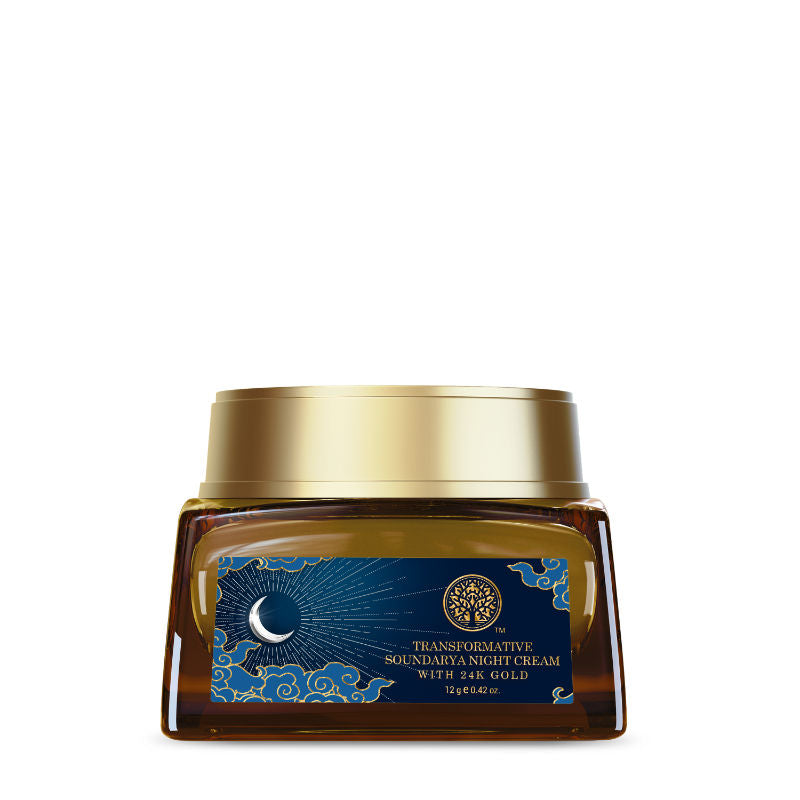
Forest Essentials Transformative Soundarya Night Cream with 24K Gold

Forest Essentials Transformative Soundarya Night Cream with 24K Gold
Forest Essentials
forest-essentials-transformative-soundarya-night-cream-with-24k-gold
Moisturize
10084906926373
Morning or Evening?
How often will you use this product?
Notes


Highlights
WHAT IS IT?
Night Cream with multiple active ingredients
FEATURES
Infused with 24 Karat Gold, Bakuchiol, Hyaluronic Acid and Polyglutamic Acid; improves elasticity; stimulates deep repair; tones and firms skin; deeply nourishes; plumps skin; soothes dry and dehydrated skin
BEST FOR
dry
CHECKS
Paraben-Free,Sulfate-free,Alcohol-free
Who Is It For?
Adults All GendersWhat Does It Help With?
Improves Skin Elasticity Reduces Fine Lines & Wrinkles Brightens & Illuminates Skin Hydrates Skin Builds Skin Resilience & Repair Soothes Dry & Dehydrated Skin Tightens Skin Plumps SkinBudget
Premium ($76-$150)How To Use
Which routine should it be used in?
Instructions:
Key Information


What Forest Essentials Says
Product Description:
This revolutionary Night Cream is a breakthrough blend immersed in an exceptionally rich serum, specially crafted for nighttime. The high level of serum content helps create a restorative hydration surge around the cream to deeply nourish the skin while you rest. Infused with 24 Karat Gold as a natural activator and rejuvenators like Bakuchiol, Hyaluronic Acid and Polyglutamic Acid, this night cream improves elasticity, stimulates deep repair, tones and firms while the skin is at rest. Benefits: Clinically proven: 94% agree it lifts & improves skin elasticity | 96% agree it reduces fine lines & wrinkles | 98% agree it brightens & illuminates skin | 98% said their skin felt hydrated. Helps in building skin resilience & repair intensively. Soothes dry & dehydrated skin and tightens the skin over time. Plumps the skin and provides a silken texture.
About the Brand:
Ingredients Overview
Ingredients List
Aqua,Sorbitan-Olivate-&-Cetearyl-Olivate,Moringa-Oleifera-Oil,Caprylic-Capric-Triglycerides,Sesamum-Indicum-Oil,Triticum-Vulgare-Extract,Prunus-Amygdalus-Dulcis-Oil,Ceramide-III,Saccharide-Isomerate,Polyglutamic-Acid,Bakuchiol,Hydrolyzed-Manihot-Esculenta-Tuber-Extract,Betaine,Veg-Squalane,Propanediol,Xanthan-Gum,Hydrolyzed-Sodium-Hyaluronate,Folic-Acid-Ferment-Filtrate-Extract,Glycerin,Tocopherol-Acetate,Santalum-Album-Extract,Milk,Crocus-Sativus-Extract,Caprylyl-Glycol,Phenoxyethanol,Glycyrrhiza-Glabra-Root-Extract,Hexylene-Glycol,Gold-Bhasma,Curcuma-Longa-Root-Extract,Withania-Somnifera-Root-Extract,Jasminum-Sambac-Oil
Key Ingredients
24 Karat Gold,Bakuchiol,Hyaluronic Acid,Polyglutamic Acid
Ingredients Details
Bakuchiol
Common Name(s): Bakuchiol,(s)-bakuchiol
CAS Number: 10309-37-2
DESCRIPTION
What It Does: Provides retinol-equivalent anti-aging gene expression from a natural plant compound without retinol's limitations.
Why It's Used: The natural retinol alternative — the first plant compound with rct evidence for equivalent anti-aging results to retinol with better safety and photostability.
How It Works: Bakuchiol activates rar beta and retinoid x receptors via allosteric binding mechanism. upregulates type i, iii, and iv collagen synthesis genes. downregulates mmp-1 and mmp-9. antioxidant via phenol radical scavenging. photostable — stable to uv exposure unlike retinol.
Typically Found In: Natural anti-aging serums,pregnancy-safe retinol alternative,photostable anti-aging
TECHNICAL DETAILS
Primary Category: Active ingredient – natural retinol alternative
Secondary Functions: Free radical scavenging,anti-aging
Application Areas:

Facial Skincare
Body Care

Hair Care
Beard Care
Color Cosmetics (Makeup)
Dietary/Oral Supplements
Typical Concentration Range: 0.5%–2%
SOURCING & ETHICS
Vegan Status: Conditional - supplier confirmation required
Halal Status: Unverified - supplier confirmation required
Source Notes: Plant-derived extract or synthetic. [audit 2026-07-29 rev2: status downgraded on audit. determination requires shariah-panel sign-off.]
SKIN COMPATIBILITY
Irritancy Rating: 1/5 – very low
Comedogenicity Rating: 0/5 – non-comedogenic
Sensitivity Concerns: Non-irritating; well-tolerated.
Safe for Sensitive Skin: Yes
SAFETY & COMPATIBILITY
Safety Profile: Excellent safety profile. ewg score: 1.
Works Well With: Vitamin c,vitamin e,ferulic acid,spf,other antioxidants
Avoid Combining With: No significant incompatibilities
SCIENTIFIC NOTE
The dhaliwal et al. (2019, british journal of dermatology) split-face rct directly compared 0.5% bakuchiol vs 0.5% retinol twice daily for 12 weeks — both groups showed equivalent reduction in fine lines and wrinkles, but bakuchiol showed significantly less scaling, stinging, and burning. this is the strongest evidence that bakuchiol provides retinol-equivalent anti-aging with better tolerability.
Last Verified: 2026-03-12
Primary Sources: Cosing database,dhaliwal et al. bakuchiol vs retinol rct
Betaine
Common Name(s): Trimethylglycine,tmg,natural betaine
CAS Number: 107-43-7
DESCRIPTION
What It Does: Provides osmoprotective humectant conditioning with anti-irritant and mild foam-boosting activity.
Why It's Used: Natural-origin multifunctional osmolyte from sugar beet providing hydration, anti-irritancy, and conditioning in virtually every cosmetic category.
How It Works: Quaternary ammonium betaine provides zwitterionic character for water binding via ionic hydration. osmoprotective function at 100–500mm as compatible solute protecting cells from osmotic stress. reduces surfactant irritation by competing with sls for protein binding sites. mild foam enhancement.
Typically Found In: Virtually all categories — moisturisers, shampoos, cleansers
TECHNICAL DETAILS
Primary Category: Functional ingredient – humectant
Secondary Functions: Tewl reduction,skin plumping
Application Areas:
Facial Skincare
Body Care
Hair Care
Beard Care
Color Cosmetics (Makeup)
Dietary/Oral Supplements
Typical Concentration Range: 0.5%–10%
SOURCING & ETHICS
Vegan Status: Conditional - feedstock declaration required
Halal Status: Unverified - feedstock declaration required (plant, animal and petrochemical routes all exist)
Source Notes: Synthetic or naturally derived. excellent aqueous solubility. [audit 2026-07-29 rev2: origin-dependent: the same inci exists in plant, animal and petrochemical versions and the name does not discriminate. determination requires shariah-panel sign-off.]
SKIN COMPATIBILITY
Irritancy Rating: 1/5 – very low
Comedogenicity Rating: 0/5 – non-comedogenic
Sensitivity Concerns: Non-irritating; suitable for all skin types.
Safe for Sensitive Skin: Yes
SAFETY & COMPATIBILITY
Safety Profile: Excellent safety profile. ewg score: 1.
Works Well With: Ceramides,emollients,occlusives,glycerin,hyaluronic acid
Avoid Combining With: No significant incompatibilities
SCIENTIFIC NOTE
Betaine's anti-irritant mechanism for surfactant systems involves competitive protein protection: betaine at high concentrations preferentially interacts with skin proteins, occupying binding sites that would otherwise be occupied by surfactant molecules causing protein denaturation. this competition reduces available protein binding for irritating surfactants, explaining betaine's well-documented ability to reduce sls irritation when co-formulated.
Last Verified: 2026-03-12
Primary Sources: Cosing database,craig betaine osmoprotective review,cir safety assessment
Glycerin
Common Name(s): Glycerol,glycerine,1,2,3-propanetriol
CAS Number: 56-81-5
DESCRIPTION
What It Does: Glycerin pulls water from the environment and deeper skin layers into the outer skin layer (epidermis), boosting moisture levels and keeping skin soft, smooth, and plump.
Why It's Used: It is used in virtually every moisturizer, serum, and cleanser because it is highly effective at hydrating skin, is well-tolerated by all skin types, and enhances the texture and spreadability of formulations.
How It Works: As a humectant, glycerin forms hydrogen bonds with water molecules, trapping them in the skin. it also reinforces the skin barrier by integrating into lipid structures between skin cells.
Typically Found In: Moisturizers,serums,cleansers,toners,sheet masks,sunscreens,body lotions,shampoos,conditioners
TECHNICAL DETAILS
Primary Category: Humectant
Secondary Functions: Skin barrier support,emollient,solvent
Application Areas:
Facial Skincare
Body Care
Hair Care
Beard Care
Color Cosmetics (Makeup)
Dietary/Oral Supplements
Typical Concentration Range: 1%–30% (typical: 3–10%)
SOURCING & ETHICS
Vegan Status: Conditional - feedstock declaration required
Halal Status: Unverified - feedstock declaration required (plant, animal and petrochemical routes all exist)
Source Notes: Derived from plant oils via hydrolysis or saponification; synthetic versions also available. palm-derived glycerin carries sustainability concerns. [audit 2026-07-29 rev2: origin-dependent: the same inci exists in plant, animal and petrochemical versions and the name does not discriminate. determination requires shariah-panel sign-off.]
SKIN COMPATIBILITY
Irritancy Rating: 1/5 – very low; non-irritating at all standard concentrations
Comedogenicity Rating: 0/5 – non-comedogenic
Sensitivity Concerns: Extremely rare allergic reactions; generally safe for all skin types including sensitive and baby skin
Safe for Sensitive Skin: Yes
SAFETY & COMPATIBILITY
Safety Profile: Widely recognized as safe. ewg hazard score: 1. no significant concerns for irritation, sensitization, or toxicity at typical concentrations (up to 50%).
Works Well With: Hyaluronic acid,ceramides,niacinamide,panthenol,urea,peptides,retinol,ahas/bhas
Avoid Combining With: No known incompatibilities at standard concentrations
SCIENTIFIC NOTE
Glycerin is an endogenous skin component found naturally in the stratum corneum. aquaporin-3 channels in keratinocytes facilitate glycerin transport, making it integral to natural skin hydration pathways.
Last Verified: 2026-03-12
Primary Sources: Cosing database,cir safety assessment,ewg skin deep,inci decoder
Milk
Common Name(s): Milk,milk,cosmetic functional ingredient,established active
CAS Number: N/a
DESCRIPTION
What It Does: Provides the characteristic cosmetic function of its ingredient class through molecular chemistry at recommended use concentration.
Why It's Used: Milk is selected for the specific functional properties of its molecular class — the chemical architecture of milk delivers the required cosmetic performance through documented interactions with skin biology and formulation matrix.
How It Works: Functional groups interact with formulation components and skin through h-bonding, ionic association, surface adsorption, or receptor activity as appropriate to the molecular class.
Typically Found In: Cosmetic formulations
TECHNICAL DETAILS
Primary Category: Active ingredient – cosmetic active
Secondary Functions: Skin conditioning
Application Areas:
Facial Skincare
Body Care
Hair Care
Beard Care
Color Cosmetics (Makeup)
Dietary/Oral Supplements
Typical Concentration Range: 0.1%–10%
SOURCING & ETHICS
Vegan Status: No - animal-derived
Halal Status: Conditional - dairy or egg origin statement required, plus rennet and enzyme origin upstream
Source Notes: Commercially produced for cosmetic use. verify vegan/halal status with supplier. [audit 2026-07-29 rev2: dairy or egg protein; rennet and enzyme origin upstream are undocumented. determination requires shariah-panel sign-off.]
SKIN COMPATIBILITY
Irritancy Rating: 1/5 – very low
Comedogenicity Rating: 0/5 – non-comedogenic
Sensitivity Concerns: Well-tolerated by most skin types.
Safe for Sensitive Skin: Yes
SAFETY & COMPATIBILITY
Safety Profile: Good safety profile at recommended concentrations. ewg score: 1–2.
Works Well With: Standard skincare actives
Avoid Combining With: No known significant incompatibilities
SCIENTIFIC NOTE
Safety documented in cosing at standard formulation concentrations.
Last Verified: 2026-03-22
Primary Sources: Cosing database,milk technical review