
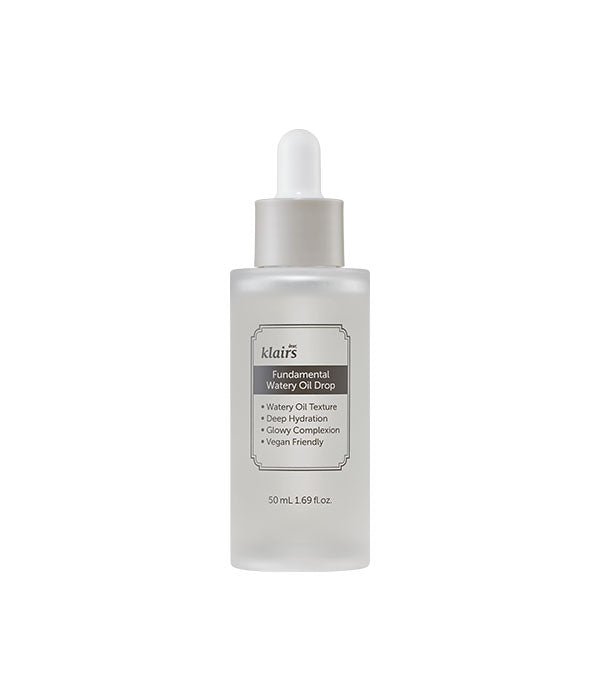

Dear, Klairs
Fundamental Watery Oil Drop

Fundamental Watery Oil Drop
Dear, Klairs
fundamental-watery-oil-drop
Moisturize
9706810999077
Morning or Evening?
How often will you use this product?
Notes


Highlights
WHAT IS IT?
Moisturizing serum
FEATURES
Oil-like moisturizing serum, provides regeneration and antioxidation, water-oil balance
BEST FOR
Combination, oily skin
CHECKS
Free of alcohol, parabens, artifical colors, fragrances
Who Is It For?
Suitable For AdultsWhat Does It Help With?
Promotes Youthful Appearance Provides Regeneration And AntioxidationBudget
AffordableHow To Use
Which routine should it be used in?
Instructions:
Key Information


What Dear, Klairs Says
Product Description:
Fundamental Watery Oil Drop promotes youthful appearance with Oriental Tea Complex, various ferment filtrates and Peptides. The balanced formula combines the energy of a serum and the richness of an oil with Green Tea essential water from Jeju island.
About the Brand:
Ingredients Overview
Ingredients List
Aqua (Water), Glycerin, Butylene Glycol, Camellia Sinensis Leaf Water, Bifida Ferment Extract, Oryza Sativa (Rice) Extract, Dipropylene Glycol, Betaine, 1,2-Hexanediol, Aspergillus/Rice Ferment Extract, Camellia Sinensis Leaf Extract, Sorbitol, Sorbitan Sesquioleate, Ethylhexylglycerin, Arginine, Xanthan Gum, Hydroxyethylcellulose, Sodium Acrylate/Sodium Acryloyldimethyl Taurate Copolymer, Isohexadecane, Dipotassium Glycyrrhizate, Sodium Hyaluronate, Carbomer, Acrylates/C10-30 Alkyl Acrylate Crosspolymer, Tocopheryl Acetate, Laminaria Japonica Extract, Polysorbate 80, Sorbitan Oleate, Hydrogenated Lecithin, Ceramide NP, Disodium Phosphate, Polysorbate 60, Sodium Phosphate, Copper Tripeptide-1, Acetyl Hexapeptide-8
Key Ingredients
Oriental Tea Complex, ferment filtrates, Peptides, Green Tea essential water
Ingredients Details
12 Hexanediol
Common Name(s): 12 hexanediol
DESCRIPTION
What It Does: Delivers targeted skin-conditioning or bioactive benefits through a specific mechanism of action suited to the formulation's intended purpose.
Why It's Used: Specialty actives address specific skin concerns through targeted molecular mechanisms, providing efficacy beyond what base formulation ingredients alone can achieve.
How It Works: The bioactive compound interacts with specific molecular targets in skin cells or the extracellular matrix — enzymes, receptors, structural proteins, or signaling molecules — triggering beneficial biological responses.
Typically Found In: Serums,treatments,moisturizers,specialty products
TECHNICAL DETAILS
Primary Category: Specialty actives
Secondary Functions: Skin-conditioning,anti-aging
Application Areas:

Facial Skincare

Body Care
Hair Care
Beard Care
Color Cosmetics (Makeup)
Dietary/Oral Supplements
Typical Concentration Range: 0.01–5%
SOURCING & ETHICS
Vegan Status: Conditional - supplier confirmation required
Halal Status: Unverified - supplier confirmation required
Source Notes: Specialty active ingredient; check individual sourcing for vegan status. [audit 2026-07-29 rev2: the record's own source_notes does not assert a non-animal origin, or instructs the reader to verify with the supplier; "yes" asserts knowledge the record does not hold. determination requires shariah-panel sign-off.]
SKIN COMPATIBILITY
Irritancy Rating: 1899-12-31 00:00:00 -0800
Sensitivity Concerns: Low sensitization potential at recommended use concentrations.
Safe for Sensitive Skin: Yes
SAFETY & COMPATIBILITY
Safety Profile: Well-characterized cosmetic ingredient with established safety profile. generally non-irritating at typical use concentrations. suitable for leave-on and rinse-off cosmetics.
Works Well With: Niacinamide,hyaluronic acid,vitamin c,peptides
Avoid Combining With: Incompatible with oxidizing agents; check ph stability
SCIENTIFIC NOTE
Specialty actives typically work through enzyme inhibition (e.g., tyrosinase inhibition for brightening, mmp inhibition for anti-aging), receptor activation (e.g., retinoid receptors, ppar-γ for barrier genes), or transcription factor modulation (e.g., nrf2 for antioxidant gene upregulation). structure-activity relationships determine potency and selectivity.
Last Verified: 2025-01-15
Primary Sources: Cosing eu database; pcpc cosmetic ingredient safety reviews; ingredient-specific safety and efficacy literature
Aspergillus/rice Ferment Extract
Common Name(s): Rice ferment extract ferment
DESCRIPTION
What It Does: Delivers postbiotic skin-conditioning metabolites, antioxidant protection, and microbiome-balancing activity through fermentation-derived bioactives.
Why It's Used: Fermentation biotransforms parent substrates into smaller, more bioavailable molecular fractions with enhanced skin activity and postbiotic microbiome benefits.
How It Works: Fermentation-derived metabolites (organic acids, enzymes, peptides, and bioactive polyphenols) interact with skin surface receptors, modulate the microbiome, and penetrate the stratum corneum to condition and protect skin cells.
Typically Found In: Serums,toners,essences,k-beauty formulations,microbiome skincare
TECHNICAL DETAILS
Primary Category: Fermented ingredients
Secondary Functions: Antioxidant,skin-conditioning,brightening
Application Areas:
Facial Skincare
Body Care
Hair Care
Beard Care
Color Cosmetics (Makeup)
Dietary/Oral Supplements
Typical Concentration Range: 0.5–10%
SOURCING & ETHICS
Vegan Status: Yes
Halal Status: Yes
Source Notes: Produced by fermentation process; no animal components unless substrate is animal-derived.
SKIN COMPATIBILITY
Irritancy Rating: 1
Comedogenicity Rating: 0
Sensitivity Concerns: Low sensitization potential at recommended use concentrations.
Safe for Sensitive Skin: Yes
SAFETY & COMPATIBILITY
Safety Profile: Well-characterized cosmetic ingredient with established safety profile. generally non-irritating at typical use concentrations. suitable for leave-on and rinse-off cosmetics.
Works Well With: Niacinamide,hyaluronic acid,ceramides,vitamin c,probiotics
Avoid Combining With: Strong oxidizers; extreme ph
SCIENTIFIC NOTE
Fermentation typically reduces molecular weight of substrate polysaccharides and proteins through enzymatic hydrolysis, increasing skin penetration. postbiotic metabolites (short-chain fatty acids, bacteriocins, organic acids) modulate tlr receptor signaling in keratinocytes, influencing barrier gene expression (filaggrin, loricrin) and immune tone without live microorganism exposure.
Last Verified: 2025-01-15
Primary Sources: Cosing eu database; pcpc cosmetic ingredient safety reviews; postbiotic cosmetic ingredient literature; fermentation biotechnology reviews
Betaine
Common Name(s): Trimethylglycine,tmg,natural betaine
CAS Number: 107-43-7
DESCRIPTION
What It Does: Provides osmoprotective humectant conditioning with anti-irritant and mild foam-boosting activity.
Why It's Used: Natural-origin multifunctional osmolyte from sugar beet providing hydration, anti-irritancy, and conditioning in virtually every cosmetic category.
How It Works: Quaternary ammonium betaine provides zwitterionic character for water binding via ionic hydration. osmoprotective function at 100–500mm as compatible solute protecting cells from osmotic stress. reduces surfactant irritation by competing with sls for protein binding sites. mild foam enhancement.
Typically Found In: Virtually all categories — moisturisers, shampoos, cleansers
TECHNICAL DETAILS
Primary Category: Functional ingredient – humectant
Secondary Functions: Tewl reduction,skin plumping
Application Areas:
Facial Skincare
Body Care
Hair Care
Beard Care
Color Cosmetics (Makeup)
Dietary/Oral Supplements
Typical Concentration Range: 0.5%–10%
SOURCING & ETHICS
Vegan Status: Conditional - feedstock declaration required
Halal Status: Unverified - feedstock declaration required (plant, animal and petrochemical routes all exist)
Source Notes: Synthetic or naturally derived. excellent aqueous solubility. [audit 2026-07-29 rev2: origin-dependent: the same inci exists in plant, animal and petrochemical versions and the name does not discriminate. determination requires shariah-panel sign-off.]
SKIN COMPATIBILITY
Irritancy Rating: 1/5 – very low
Comedogenicity Rating: 0/5 – non-comedogenic
Sensitivity Concerns: Non-irritating; suitable for all skin types.
Safe for Sensitive Skin: Yes
SAFETY & COMPATIBILITY
Safety Profile: Excellent safety profile. ewg score: 1.
Works Well With: Ceramides,emollients,occlusives,glycerin,hyaluronic acid
Avoid Combining With: No significant incompatibilities
SCIENTIFIC NOTE
Betaine's anti-irritant mechanism for surfactant systems involves competitive protein protection: betaine at high concentrations preferentially interacts with skin proteins, occupying binding sites that would otherwise be occupied by surfactant molecules causing protein denaturation. this competition reduces available protein binding for irritating surfactants, explaining betaine's well-documented ability to reduce sls irritation when co-formulated.
Last Verified: 2026-03-12
Primary Sources: Cosing database,craig betaine osmoprotective review,cir safety assessment
Bifida Ferment Extract
Common Name(s): Bifida ferment extract,bifida ferment extract,bifidobacterium postbiotic,skin barrier microbiome support
CAS Number: N/a
DESCRIPTION
What It Does: Strengthens skin barrier through bifidobacterium-produced lactate and acetate reinforcing acid mantle ph, upregulates claudin and occludin tight junction proteins through short-chain fatty acid (scfa) hdac inhibition, and provides anti-inflammatory trained immunity from tlr2-active cell wall lipoteichoic acid.
Why It's Used: Bifidobacterium is the dominant healthy infant microbiome organism associated with intact skin barrier — topical bifidobacterium postbiotics replicate the barrier-supporting metabolite profile of the healthy microbiome in adult skin where bifida abundance naturally declines.
How It Works: Bifidobacterium fermentation produces: lactate (ph 4.5 acid mantle reinforcement); acetate and butyrate (hdac inhibition → claudin-1/occludin gene upregulation → tight junction strengthening); lta (tlr2/tlr6 → il-10 anti-inflammatory tolerance training); exopolysaccharide (humectant film formation). bifida polysaccharide binds dectin receptors providing additional innate immunity training.
Typically Found In: Microbiome skin care,barrier repair,sensitive skin
TECHNICAL DETAILS
Primary Category: Active ingredient – skin microbiome support
Secondary Functions: Microbiome balance,prebiotic effect
Application Areas:
Facial Skincare
Body Care
Hair Care
Beard Care
Color Cosmetics (Makeup)
Dietary/Oral Supplements
Typical Concentration Range: 0.5%–15%
SOURCING & ETHICS
Vegan Status: Yes
Halal Status: Yes
Source Notes: Fermentation-derived or plant-extracted.
SKIN COMPATIBILITY
Irritancy Rating: 1/5 – very low
Comedogenicity Rating: 0/5 – non-comedogenic
Sensitivity Concerns: Non-irritating; beneficial for sensitive skin.
Safe for Sensitive Skin: Yes
SAFETY & COMPATIBILITY
Safety Profile: Excellent safety profile. ewg score: 1.
Works Well With: Ceramides,niacinamide,soothing actives
Avoid Combining With: No significant incompatibilities
SCIENTIFIC NOTE
Bifidobacterium abundance is inversely correlated with atopic dermatitis severity — clinical studies show bifida ferment postbiotic application reduces transepidermal water loss and erythema scores in atopic skin, providing the mechanism-linked efficacy basis for eczema-adjacent microbiome skin care claims.
Last Verified: 2026-03-22
Primary Sources: Cosing database,bifidobacterium postbiotic skin barrier microbiome review