

Nykaa E retail limited
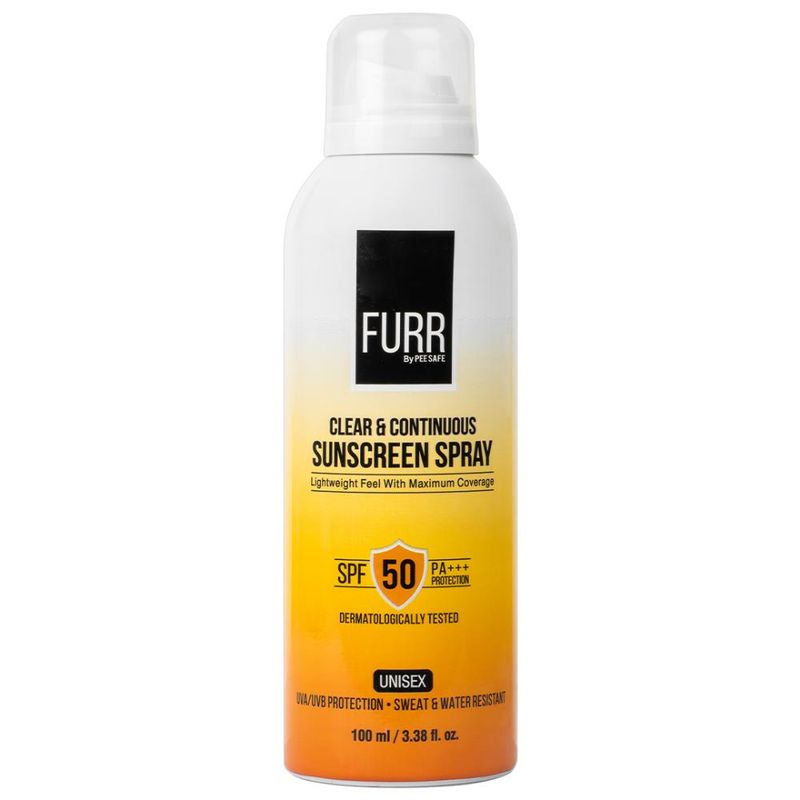
FURR Body Sunscreen With SPF 50 PA+++ No white-cast, Non Greasy & Water Resistant (100ml)

FURR Body Sunscreen With SPF 50 PA+++ No white-cast, Non Greasy & Water Resistant (100ml)
Nykaa E retail limited
furr-body-sunscreen-with-spf-50-pa-no-white-cast-non-greasy-water-resistant-100ml
Suncare
10085040128293
Morning or Evening?
How often will you use this product?
Notes


Highlights
WHAT IS IT?
Sunscreen spray with broad-spectrum SPF 50 and PA++++ protection
FEATURES
Protects against UVA and UVB rays, Water-resistant, Lightweight, Quick-drying, Suitable for all skin types including sensitive skin, Non-irritating, Non-comedogenic, No white-cast
BEST FOR
normal
CHECKS
does not contain paraben, SLS
Who Is It For?
All Genders No Specific Age Range StatedWhat Does It Help With?
Prevents Sunburn Protects Skin From Uv DamageBudget
Affordable (under $30)How To Use
Which routine should it be used in?
Instructions:
Key Information


What Nykaa E retail limited Says
Product Description:
Furr Sunscreen Spray safeguards your skin from UVA and UVB rays with broad-spectrum protection. This water-resistant, lightweight, and quick-drying spray is formulated with a special technology that provides PA++++ protection with SPF 50. It has a clear and invisible formulation that is quick-drying and provides fast and maximum coverage to prevent sunburn and damage from UV rays. This sun-tested and sun-proven formula is long-lasting in the sun and effective when used as directed. Features: Protects your skin from harmful UV rays, lightweight formula, water-resistant, suitable for all skin types including sensitive skin as it is non-irritating and non-comedogenic.
About the Brand:
Ingredients Overview
Ingredients List
Ethyl alcohol (95% v/v), Homosalate, Ethylhexyl methoxycinnamate,Ethylhexyl salicylate, Perfume, Butyl methoxydibenzoylmethane / avobenzone,Aloe vera (Aloe barbadensis) leaf Juice, Polysorbate-20, Diethylhexyl butamidotriazone, Phenoxyethanol, Triethylene glycol, Bis-ethylhexyloxyphenolmethoxyphenyl triazine, Butylated hydroxytoluene, Triethanolmine
Key Ingredients
homosalate, ethylhexyl methoxycinnamate, ethylhexyl salicylate, butyl methoxydibenzoylmethane (avobenzone), aloe vera leaf juice
Ingredients Details
Ethylhexyl Methoxycinnamate
Common Name(s): Ethylhexyl methoxycinnamate,organic uv filter,photostabilising sunscreen active
CAS Number: N/a
DESCRIPTION
What It Does: Absorbs uv radiation at specific wavelengths (uva 320–400 nm, uvb 290–320 nm) and dissipates photon energy as heat rather than skin-damaging photochemical reactions.
Why It's Used: Organic uv filters are chosen for their high molar extinction coefficient, specific spectral coverage, and formulation compatibility — individual filters are combined to provide broad-spectrum coverage across uva+uvb.
How It Works: Uv photon absorption by the aromatic chromophore π-system excites the molecule from s₀ ground state to s₁ excited state. rapid internal conversion or photoisomerisation dissipates energy as vibrational heat before it can initiate skin photodamage.
Typically Found In: Sunscreens,photoprotective products
TECHNICAL DETAILS
Primary Category: Active ingredient – cosmetic active
Secondary Functions: Skin conditioning
Application Areas:

Facial Skincare

Body Care
Hair Care
Beard Care
Color Cosmetics (Makeup)
Dietary/Oral Supplements
Typical Concentration Range: Check local sunscreen regulations
SOURCING & ETHICS
Vegan Status: Conditional - supplier confirmation required
Halal Status: Unverified - supplier confirmation required
Source Notes: Commercially produced for cosmetic use. verify vegan/halal status with supplier. [audit 2026-07-29 rev2: the record's own source_notes does not assert a non-animal origin, or instructs the reader to verify with the supplier; "yes" asserts knowledge the record does not hold. determination requires shariah-panel sign-off.]
SKIN COMPATIBILITY
Irritancy Rating: 1/5 – very low
Comedogenicity Rating: 0/5 – non-comedogenic
Sensitivity Concerns: Well-tolerated by most skin types.
Safe for Sensitive Skin: Yes
SAFETY & COMPATIBILITY
Safety Profile: Good safety profile at recommended concentrations. ewg score: 1–2.
Works Well With: Standard skincare actives
Avoid Combining With: No known significant incompatibilities
SCIENTIFIC NOTE
Organic uv filters require photostabilisation (by avobenzone-octocrylene pairing, or triazine stabilisers) as some absorbers degrade on uv exposure — formulator must verify photostability of the chosen filter combination.
Last Verified: 2026-03-12
Primary Sources: Cosing database,ethylhexyl methoxycinnamate organic uv filter review
Ethylhexyl Salicylate
Common Name(s): Ethylhexyl salicylate,organic uv filter,photostabilising sunscreen active
CAS Number: N/a
DESCRIPTION
What It Does: Absorbs uv radiation at specific wavelengths (uva 320–400 nm, uvb 290–320 nm) and dissipates photon energy as heat rather than skin-damaging photochemical reactions.
Why It's Used: Organic uv filters are chosen for their high molar extinction coefficient, specific spectral coverage, and formulation compatibility — individual filters are combined to provide broad-spectrum coverage across uva+uvb.
How It Works: Uv photon absorption by the aromatic chromophore π-system excites the molecule from s₀ ground state to s₁ excited state. rapid internal conversion or photoisomerisation dissipates energy as vibrational heat before it can initiate skin photodamage.
Typically Found In: Sunscreens,photoprotective products
TECHNICAL DETAILS
Primary Category: Active ingredient – cosmetic active
Secondary Functions: Skin conditioning
Application Areas:
Facial Skincare
Body Care
Hair Care
Beard Care
Color Cosmetics (Makeup)
Dietary/Oral Supplements
Typical Concentration Range: Check local sunscreen regulations
SOURCING & ETHICS
Vegan Status: Conditional - supplier confirmation required
Halal Status: Unverified - supplier confirmation required
Source Notes: Commercially produced for cosmetic use. verify vegan/halal status with supplier. [audit 2026-07-29 rev2: the record's own source_notes does not assert a non-animal origin, or instructs the reader to verify with the supplier; "yes" asserts knowledge the record does not hold. determination requires shariah-panel sign-off.]
SKIN COMPATIBILITY
Irritancy Rating: 1/5 – very low
Comedogenicity Rating: 0/5 – non-comedogenic
Sensitivity Concerns: Well-tolerated by most skin types.
Safe for Sensitive Skin: Yes
SAFETY & COMPATIBILITY
Safety Profile: Good safety profile at recommended concentrations. ewg score: 1–2.
Works Well With: Standard skincare actives
Avoid Combining With: No known significant incompatibilities
SCIENTIFIC NOTE
Organic uv filters require photostabilisation (by avobenzone-octocrylene pairing, or triazine stabilisers) as some absorbers degrade on uv exposure — formulator must verify photostability of the chosen filter combination.
Last Verified: 2026-03-12
Primary Sources: Cosing database,ethylhexyl salicylate organic uv filter review
Homosalate
Common Name(s): Hms,3,3,5-trimethylcyclohexyl salicylate
CAS Number: 118-56-9
DESCRIPTION
What It Does: Provides uvb filtration and co-solvent function enabling higher uv filter concentrations in high-spf formulas.
Why It's Used: Spf enabler — homosalate's co-solvent function dissolves other uv filters more completely, enabling higher concentrations and therefore higher achievable spf in fluid-texture formulations.
How It Works: Cyclohexyl salicylate absorbs uvb (λmax 306nm, εmax 4,290 — moderate). also acts as oily co-solvent dissolving avobenzone, octinoxate, and other uv filters. photostable cyclohexyl structure.
Typically Found In: High-spf combination sunscreens
TECHNICAL DETAILS
Primary Category: Active ingredient – cyclohexyl salicylate uvb filter
Secondary Functions: Skin conditioning
Application Areas:
Facial Skincare
Body Care
Hair Care
Beard Care
Color Cosmetics (Makeup)
Dietary/Oral Supplements
Typical Concentration Range: Up to 15% (eu), 10% (us fda)
SOURCING & ETHICS
Vegan Status: Conditional - supplier confirmation required
Halal Status: Unverified - supplier confirmation required
Source Notes: Commercially produced for cosmetic use. verify vegan/halal status with supplier. [audit 2026-07-29 rev2: the record's own source_notes does not assert a non-animal origin, or instructs the reader to verify with the supplier; "yes" asserts knowledge the record does not hold. determination requires shariah-panel sign-off.]
SKIN COMPATIBILITY
Irritancy Rating: 1/5 – very low
Comedogenicity Rating: 0/5 – non-comedogenic
Sensitivity Concerns: Well-tolerated by most skin types.
Safe for Sensitive Skin: Yes
SAFETY & COMPATIBILITY
Safety Profile: Eu max 15% (sccs 2019 reduced limit). fda: 10%. potential endocrine activity at high concentrations. ewg score: 4.
Works Well With: Standard skincare actives
Avoid Combining With: No known significant incompatibilities
SCIENTIFIC NOTE
Homosalate's maximum concentration in eu was reduced from 10% to 15% in sccs opinion 2019 (counter-intuitively raised, not reduced) specifically to enable effective uv filter dissolution — demonstrating that homosalate's primary value is as a co-solvent enabling other uv filters to function, not solely as a uv filter itself.
Last Verified: 2026-03-12
Primary Sources: Cosing database,fda uv filter otc monograph,sccs homosalate opinion
Phenoxyethanol
Common Name(s): 2-phenoxyethanol,rose ether,ethylene glycol monophenyl ether
CAS Number: 122-99-6
DESCRIPTION
What It Does: Prevents microbial contamination and spoilage in cosmetic formulations.
Why It's Used: The benchmark cosmetic preservative – eu-permitted up to 1%, effective against virtually all cosmetically relevant microorganisms, and excellent tolerability.
How It Works: Phenol ring provides broad antimicrobial activity via disruption of bacterial and fungal cell membranes and inhibition of enzymatic activity. effective against gram-positive and gram-negative bacteria, yeasts (candida), and molds (aspergillus). activity ph range: 3-9.
Typically Found In: All cosmetic formulations as primary preservative
TECHNICAL DETAILS
Primary Category: Functional ingredient – broad-spectrum preservative
Secondary Functions: Skin conditioning
Application Areas:
Facial Skincare
Body Care
Hair Care
Beard Care
Color Cosmetics (Makeup)
Dietary/Oral Supplements
Typical Concentration Range: 0.1%–1% (eu max 1%)
SOURCING & ETHICS
Vegan Status: Conditional - supplier confirmation required
Halal Status: Unverified - supplier confirmation required
Source Notes: Commercially produced for cosmetic use. verify vegan/halal status with supplier. [audit 2026-07-29 rev2: the record's own source_notes does not assert a non-animal origin, or instructs the reader to verify with the supplier; "yes" asserts knowledge the record does not hold. determination requires shariah-panel sign-off.]
SKIN COMPATIBILITY
Irritancy Rating: 1/5 – very low
Comedogenicity Rating: 0/5 – non-comedogenic
Sensitivity Concerns: Well-tolerated by most skin types.
Safe for Sensitive Skin: Yes
SAFETY & COMPATIBILITY
Safety Profile: Eu cosmetics regulation max 1%. sccs assessed as safe at ≤1%. avoid use around eyes in baby products per some country regulations. ewg score: 4.
Works Well With: Standard skincare actives
Avoid Combining With: No known significant incompatibilities
SCIENTIFIC NOTE
Phenoxyethanol's widespread adoption as the primary cosmetic preservative followed the phaseout of parabens from many formulations in the 2000s-2010s. despite having a comparable or better safety profile to parabens, it is often cited in 'free-from' formulations – a consumer perception issue rather than a scientific safety concern.
Last Verified: