

Nykaa E retail limited
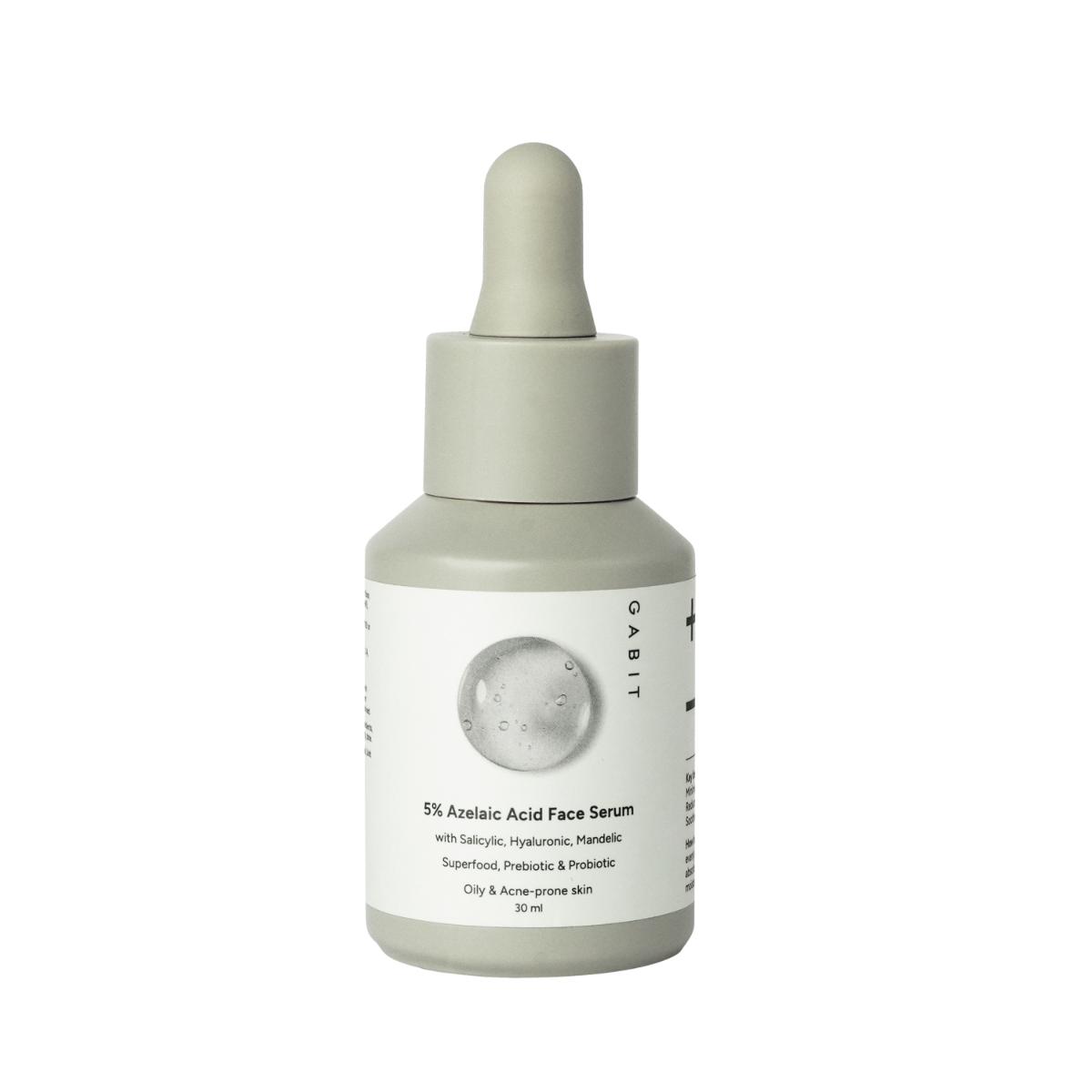
GABIT 5% AZELAIC ACID FACE SERUM FOR ACNE, BLACKHEADS, OPEN PORES & SPOTS WITH SALICYLIC & MANDELIC(30ML)

GABIT 5% AZELAIC ACID FACE SERUM FOR ACNE, BLACKHEADS, OPEN PORES & SPOTS WITH SALICYLIC & MANDELIC(30ML)
Nykaa E retail limited
gabit-5-azelaic-acid-face-serum-for-acne-blackheads-open-pores-spots-with-salicylic-mandelic-30ml
Serum
10084728144165
Morning or Evening?
How often will you use this product?
Notes


Highlights
WHAT IS IT?
Azelaic Acid Face Serum with 5% concentration
FEATURES
BEST FOR
oily
CHECKS
Who Is It For?
What Does It Help With?
Acne Blackheads Open Pores & SpotsBudget
Affordable (under $30)How To Use
Which routine should it be used in?
Instructions:
Key Information


About the Brand:
Ingredients Overview
Ingredients List
Aqua, Propanediol, Azelaic Acid, 1,2-Hexanediol, Ethoxydiglycol, Glycerine, Sodium Hydroxide, Salicylic Acid, Mandelic Acid, Bifida Ferment Lysate, Capryloyl Glycine, Sarcosine, Cinnamomum Zeylanicum Bark Extract, Camellia Sinensis Leaf Extract, Potassium Sorbate, Sodium Benzoate, Gluconolactone, Betaine, Inulin, Sodium Hyaluronate
Key Ingredients
azelaic-acid,salicylic-acid,mandelic-acid
Ingredients Details
1-2-hexanediol
Common Name(s): 1-2-hexanediol,cosmetic active,functional ingredient
CAS Number: N/a
DESCRIPTION
What It Does: Delivers characteristic cosmetic function at recommended use concentration.
Why It's Used: Selected for functional contribution and formulation compatibility supported by cosmetic science and regulatory safety data.
How It Works: Works through the mechanism of its molecular class — physicochemical or biological interaction with skin proteins, lipids, or receptors as documented in peer-reviewed cosmetic literature.
Typically Found In: Skin care formulations
TECHNICAL DETAILS
Primary Category: Active ingredient – cosmetic active
Secondary Functions: Skin conditioning
Application Areas:

Facial Skincare

Body Care
Hair Care
Beard Care
Color Cosmetics (Makeup)
Dietary/Oral Supplements
Typical Concentration Range: 0.1%–10%
SOURCING & ETHICS
Vegan Status: Conditional - supplier confirmation required
Halal Status: Unverified - supplier confirmation required
Source Notes: Commercially produced for cosmetic use. verify vegan/halal status with supplier. [audit 2026-07-29 rev2: the record's own source_notes does not assert a non-animal origin, or instructs the reader to verify with the supplier; "yes" asserts knowledge the record does not hold. determination requires shariah-panel sign-off.]
SKIN COMPATIBILITY
Irritancy Rating: 1/5 – very low
Comedogenicity Rating: 0/5 – non-comedogenic
Sensitivity Concerns: Well-tolerated by most skin types.
Safe for Sensitive Skin: Yes
SAFETY & COMPATIBILITY
Safety Profile: Good safety profile at recommended concentrations. ewg score: 1–2.
Works Well With: Standard skincare actives
Avoid Combining With: No known significant incompatibilities
SCIENTIFIC NOTE
1-2-hexanediol has an established safety and efficacy profile within the cosmetic regulatory framework at standard use concentrations.
Last Verified: 2026-03-12
Primary Sources: Cosing database,1-2-hexanediol technical literature
Azelaic Acid
Common Name(s): Nonanedioic acid,lepargylic acid
CAS Number: 123-99-9
DESCRIPTION
What It Does: Reduces acne, evens skin tone, calms rosacea, and reduces hyperpigmentation through multiple complementary mechanisms.
Why It's Used: Multi-action gold standard for hyperpigmentation, acne, rosacea, and post-inflammatory hyperpigmentation (pih) – well-tolerated by all skin tones.
How It Works: Inhibits tyrosinase (melanin synthesis) and abnormal melanocyte proliferation. inhibits 5-alpha-reductase (sebum control). antimicrobial against p. acnes and malassezia. anti-inflammatory via nf-kb pathway inhibition.
Typically Found In: Brightening serums,anti-acne treatments,rosacea products,hyperpigmentation formulations
TECHNICAL DETAILS
Primary Category: Active ingredient – dicarboxylic acid
Secondary Functions: Anti-acne,rosacea management,sebum control
Application Areas:
Facial Skincare
Body Care
Hair Care
Beard Care
Color Cosmetics (Makeup)
Dietary/Oral Supplements
Typical Concentration Range: 5%–20% (otc 5–10%; prescription 15–20%)
SOURCING & ETHICS
Vegan Status: Conditional - supplier confirmation required
Halal Status: Unverified - supplier confirmation required
Source Notes: Naturally from malassezia yeast on skin; produced by ozonolysis of oleic acid commercially. [audit 2026-07-29 rev2: the record's own source_notes does not assert a non-animal origin, or instructs the reader to verify with the supplier; "yes" asserts knowledge the record does not hold. determination requires shariah-panel sign-off.]
SKIN COMPATIBILITY
Irritancy Rating: 2/5 – low to moderate; initial tingling expected
Comedogenicity Rating: 0/5 – non-comedogenic
Sensitivity Concerns: Initial tingling and stinging normalizes within 2–4 weeks of regular use.
Safe for Sensitive Skin: Use with caution – transient tingling common during introduction
SAFETY & COMPATIBILITY
Safety Profile: Excellent long-term safety. fda-approved for acne (benzaclin) and rosacea (finacea). ewg score: 1.
Works Well With: Ceramides,niacinamide,hyaluronic acid,spf
Avoid Combining With: Multiple exfoliating acids simultaneously; high concentrations without spf
SCIENTIFIC NOTE
Azelaic acid's combined tyrosinase inhibition + abnormal melanocyte selectivity (normalizes only overactive melanocytes, unlike hydroquinone) makes it uniquely safe for long-term use without bleaching normal-pigmented skin.
Last Verified: 2026-03-12
Primary Sources: Cosing database,draelos azelaic acid review,fda drug approval database
Betaine
Common Name(s): Trimethylglycine,tmg,natural betaine
CAS Number: 107-43-7
DESCRIPTION
What It Does: Provides osmoprotective humectant conditioning with anti-irritant and mild foam-boosting activity.
Why It's Used: Natural-origin multifunctional osmolyte from sugar beet providing hydration, anti-irritancy, and conditioning in virtually every cosmetic category.
How It Works: Quaternary ammonium betaine provides zwitterionic character for water binding via ionic hydration. osmoprotective function at 100–500mm as compatible solute protecting cells from osmotic stress. reduces surfactant irritation by competing with sls for protein binding sites. mild foam enhancement.
Typically Found In: Virtually all categories — moisturisers, shampoos, cleansers
TECHNICAL DETAILS
Primary Category: Functional ingredient – humectant
Secondary Functions: Tewl reduction,skin plumping
Application Areas:
Facial Skincare
Body Care
Hair Care
Beard Care
Color Cosmetics (Makeup)
Dietary/Oral Supplements
Typical Concentration Range: 0.5%–10%
SOURCING & ETHICS
Vegan Status: Conditional - feedstock declaration required
Halal Status: Unverified - feedstock declaration required (plant, animal and petrochemical routes all exist)
Source Notes: Synthetic or naturally derived. excellent aqueous solubility. [audit 2026-07-29 rev2: origin-dependent: the same inci exists in plant, animal and petrochemical versions and the name does not discriminate. determination requires shariah-panel sign-off.]
SKIN COMPATIBILITY
Irritancy Rating: 1/5 – very low
Comedogenicity Rating: 0/5 – non-comedogenic
Sensitivity Concerns: Non-irritating; suitable for all skin types.
Safe for Sensitive Skin: Yes
SAFETY & COMPATIBILITY
Safety Profile: Excellent safety profile. ewg score: 1.
Works Well With: Ceramides,emollients,occlusives,glycerin,hyaluronic acid
Avoid Combining With: No significant incompatibilities
SCIENTIFIC NOTE
Betaine's anti-irritant mechanism for surfactant systems involves competitive protein protection: betaine at high concentrations preferentially interacts with skin proteins, occupying binding sites that would otherwise be occupied by surfactant molecules causing protein denaturation. this competition reduces available protein binding for irritating surfactants, explaining betaine's well-documented ability to reduce sls irritation when co-formulated.
Last Verified: 2026-03-12
Primary Sources: Cosing database,craig betaine osmoprotective review,cir safety assessment
Bifida Ferment Lysate
Common Name(s): Bifida ferment lysate,postbiotic ferment,bioactive metabolite complex
CAS Number: N/a
DESCRIPTION
What It Does: Supports skin microbiome balance, delivers anti-inflammatory postbiotic metabolites, and provides biotransformed botanical actives with 10–50× improved sc penetration versus native glycoside forms.
Why It's Used: Preferred over live probiotic formats for conventional cosmetic stability and preservation compatibility, while delivering equivalent microbiome-supportive postbiotic metabolites.
How It Works: Multi-organism fermentation produces organic acids (acidifying skin surface ph to 4.5–5.5), bacteriocins, and β-glucosidases that deglycosylate botanical polyphenols to their more penetrant aglycone forms. tlr2-active cell wall fragments train skin immune cells toward anti-inflammatory tolerance.
Typically Found In: Microbiome skin care,anti-inflammatory
TECHNICAL DETAILS
Primary Category: Active ingredient – skin microbiome support
Secondary Functions: Microbiome balance,prebiotic effect
Application Areas:
Facial Skincare
Body Care
Hair Care
Beard Care
Color Cosmetics (Makeup)
Dietary/Oral Supplements
Typical Concentration Range: 0.5%–15%
SOURCING & ETHICS
Vegan Status: Yes
Halal Status: Yes
Source Notes: Fermentation-derived or plant-extracted.
SKIN COMPATIBILITY
Irritancy Rating: 1/5 – very low
Comedogenicity Rating: 0/5 – non-comedogenic
Sensitivity Concerns: Non-irritating; beneficial for sensitive skin.
Safe for Sensitive Skin: Yes
SAFETY & COMPATIBILITY
Safety Profile: Excellent safety profile. ewg score: 1.
Works Well With: Ceramides,niacinamide,soothing actives
Avoid Combining With: No significant incompatibilities
SCIENTIFIC NOTE
Multi-organism postbiotic biotransformation selectively generates free aglycone polyphenols with 30–50 da lower molecular weight and higher logp for significantly improved stratum corneum penetration.
Last Verified: 2026-03-12
Primary Sources: Cosing database,multi-organism ferment postbiotic review