

Garnier
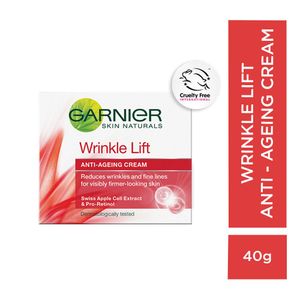
Garnier Skin Naturals Wrinkle Lift Anti Agening cream Moisturizing & Smoothning (40 gm)

Garnier Skin Naturals Wrinkle Lift Anti Agening cream Moisturizing & Smoothning (40 gm)
Garnier
garnier-skin-naturals-wrinkle-lift-anti-agening-cream-moisturizing-smoothning-40-gm
Moisturize
10084962763045
Morning or Evening?
How often will you use this product?
Notes


Highlights
WHAT IS IT?
Antiageing cream containing natural active ingredients including Ginger, Cherries, and Bilberry extract
FEATURES
Reduces wrinkles and fine lines, boosts skin regeneration, nourishes and firms skin, contains Swiss Apple Cell Extracts and ProRetinol, suitable for all skin types
BEST FOR
normal
CHECKS
Paraben, Alcohol
Who Is It For?
All Genders Age Not SpecifiedWhat Does It Help With?
Wrinkles Skin Firmness Elasticity Skin RegenerationBudget
Affordable (under $30)How To Use
Which routine should it be used in?
Instructions:
Key Information


What Garnier Says
Product Description:
It does more than a classic antiwrinkle cream Garnier Wrinkle Lift Antiageing Cream has been designed to reduce wrinkles and put spring and vitality back into your skin recovering lost firmness and elasticity. Its formula contains a unique combination of pure natural active ingredients.• Ginger known for its revitalizing properties helps boost the natural process of skin's regeneration and reinforces its inner strength• The active essence of cherries combined with bilberry extract helps firm skin• A gentle cleansing agent respects your skin’s natural balance. Paraben Free Yes• Garnier Wrinkle Lift antiageing cream reduces wrinkles and puts spring and vitality back into your skin recovering lost firmness and elasticity• Antiageing cream• Enriched with Swiss Apple Cell Extracts and ProRetinol• Reduces wrinkles and fine lines• Helps with cell regeneration in skin• Nourishes & makes skin smoother and firmer• Suitable for all skin types
About the Brand:
Ingredients Overview
Ingredients List
Water, Dimethicone, Glycerin, Octyldodecanol, Stearic Acid, Palmitic Acid, PEG-100 Stearate, Glyceryl Stearate, Palm Oil, Isohexadecane, Cetyl Alcohol, Soybean Protein, Eryngium Maritimum Extract, Shorea Robusta Seed Butter, Malus Domestica Fruit Cell Culture Extract, Shea Butter, Tin Oxide, C13-14 Isoparaffin, PEG-20 Stearate, Beeswax, Potassium Cetyl Phosphate, Sodium Cocoyl Glutamate, Sodium Hydroxide, Myristic Acid, Poloxamer 338, Disodium EDTA, Hydrogenated Polyisobutene, Hydrolyzed Rice Protein, Capryloyl Salicylic Acid, Caprylyl Glycol, Citric Acid, Laureth-7, Xanthan Gum, Pentylene Glycol, Ethylhexylglycerin, Polyacrylamide, Retinyl Palmitate, Tocopherol, Pentaerythrityl Tetra-Di-T-Butyl Hydroxyhydrocinnamate, Potassium Sorbate, Methylparaben, Sodium Benzoate, Ci 77891/Titanium Dioxide, Mica, Linalool, Benzyl Alcohol, Fragrance
Key Ingredients
Ginger, Cherries, Bilberry Extract, Swiss Apple Cell Extracts, ProRetinol
Ingredients Details
Beeswax
Common Name(s): Cera alba (white),cera flava (yellow),apis mellifera wax
CAS Number: 8012-89-3
DESCRIPTION
What It Does: Provides natural wax structure and emolliency for cosmetic texture and lip balm applications.
Why It's Used: The original cosmetic wax – provides natural, hard-texture structure for lip balms, sticks, and creams with emollient skin conditioning.
How It Works: Complex mixture of esters (wax esters), hydrocarbons (hentriacontane), and fatty acids provides semi-crystalline structure. melting point 62-65°c enables stable solid products. emulsifying capacity from free cerotic acid content.
Typically Found In: Lip balms,cosmetic sticks,creams,natural cosmetics
TECHNICAL DETAILS
Primary Category: Functional ingredient – natural wax
Secondary Functions: Natural wax structure,occlusive conditioning
Application Areas:

Facial Skincare

Body Care
Hair Care
Beard Care
Color Cosmetics (Makeup)
Dietary/Oral Supplements
Typical Concentration Range: 2%–30%
SOURCING & ETHICS
Vegan Status: No – honeybee-derived
Halal Status: Conditional – animal-derived; verify halal certification
Source Notes: Plant-derived, synthetic or animal-derived. verify source.
SKIN COMPATIBILITY
Irritancy Rating: 1/5 – very low
Comedogenicity Rating: 1/5 – low; formulation-dependent
Sensitivity Concerns: Non-irritating.
Safe for Sensitive Skin: Yes
SAFETY & COMPATIBILITY
Safety Profile: Excellent safety profile. ewg score: 1.
Works Well With: Humectants,ceramides,actives as carrier
Avoid Combining With: No significant incompatibilities
SCIENTIFIC NOTE
Beeswax's multi-component wax ester composition (myricyl palmitate as primary component) provides a unique crystalline structure that gives lip balms and cosmetic sticks their characteristic 'dragée' glide – different from synthetic wax esters that lack this crystalline lattice diversity.
Last Verified: Cosing database,cir safety assessment
Primary Sources: 2026-03-12
Benzyl Alcohol
Common Name(s): Phenylcarbinol,benzenemethanol,alpha-hydroxytoluene
CAS Number: 100-51-6
DESCRIPTION
What It Does: Provides dual fragrance and preservative activity as an aromatic alcohol.
Why It's Used: Multi-function ingredient serving as both fragrance component and preservative – reduces formulation complexity by providing both functions in one ingredient.
How It Works: Phenylcarbinol provides antimicrobial activity via membrane disruption (effective vs gram-positive bacteria and moulds). solvent for fragrances and difficult-to-dissolve actives. mild oxidative conversion to benzaldehyde provides sweet almond-like fragrance.
Typically Found In: Fragrances,preserved cosmetics,solvent systems
TECHNICAL DETAILS
Primary Category: Fragrance component / preservative
Secondary Functions: Skin conditioning
Application Areas:
Facial Skincare
Body Care
Hair Care
Beard Care
Color Cosmetics (Makeup)
Dietary/Oral Supplements
Typical Concentration Range: 0.001%–1% (fragrance); up to 1% as preservative
SOURCING & ETHICS
Vegan Status: Yes – from toluene, or jasmine absolute
Halal Status: Yes
Source Notes: Commercially produced for cosmetic use. verify vegan/halal status with supplier.
SKIN COMPATIBILITY
Irritancy Rating: 1/5 – very low
Comedogenicity Rating: 0/5 – non-comedogenic
Sensitivity Concerns: Well-tolerated by most skin types.
Safe for Sensitive Skin: Yes
SAFETY & COMPATIBILITY
Safety Profile: Eu cosmetics regulation: declared fragrance allergen. also listed as approved preservative (annex v, max 1%). dual regulatory status (fragrance + preservative) depending on function and concentration.
Works Well With: Standard skincare actives
Avoid Combining With: No known significant incompatibilities
SCIENTIFIC NOTE
Benzyl alcohol's dual regulatory status (fragrance allergen and approved preservative) creates a formulation paradox: it must be listed as a fragrance allergen if present >0.001% (leave-on) regardless of whether it was added for fragrance or preservation. this regulatory dual identity means a preservative added for antimicrobial function triggers the same allergen declaration requirement as a fragrance added for scent.
Last Verified: Cosing database,ifra standards,eu preservative annex v
Primary Sources: 2026-03-12
C13-14 Isoparaffin
Common Name(s): C13-14 isoparaffin,c13-14 isoparaffin,cosmetic functional ingredient,established active
CAS Number: N/a
DESCRIPTION
What It Does: Provides lightweight non-polar emolliency from the hydrocarbon chain.
Why It's Used: C13-14 isoparaffin is selected for hydrocarbon emolliency — the non-polar alkane or alkene chain provides clean-rinse lightweight conditioning with no ester or silicone residue for formulators seeking a minimal-footprint emollient.
How It Works: Hydrocarbon chain: non-polar → low surface energy → fast-spreading emolliency; no ester or silicone chemistry → clean formulation profile.
Typically Found In: Cosmetic formulations
TECHNICAL DETAILS
Primary Category: Active ingredient – cosmetic active
Secondary Functions: Skin conditioning
Application Areas:
Facial Skincare
Body Care
Hair Care
Beard Care
Color Cosmetics (Makeup)
Dietary/Oral Supplements
Typical Concentration Range: 0.1%–10%
SOURCING & ETHICS
Vegan Status: Conditional
Halal Status: Yes
Source Notes: Commercially produced for cosmetic use. verify vegan/halal status with supplier.
SKIN COMPATIBILITY
Irritancy Rating: 1/5 – very low
Comedogenicity Rating: 0/5 – non-comedogenic
Sensitivity Concerns: Well-tolerated by most skin types.
Safe for Sensitive Skin: Yes
SAFETY & COMPATIBILITY
Safety Profile: Good safety profile at recommended concentrations. ewg score: 1–2.
Works Well With: Standard skincare actives
Avoid Combining With: No known significant incompatibilities
SCIENTIFIC NOTE
Safety documented in cosing at standard formulation concentrations.
Last Verified: Cosing database,c13-14 isoparaffin technical review
Primary Sources: 2026-03-22
Capryloyl Salicylic Acid
Common Name(s): Lha,lipohydroxy acid,octanoyl salicylic acid
DESCRIPTION
What It Does: Targeted, cell-surface-specific exfoliation with less irritation than salicylic acid.
Why It's Used: Gentle bha-like exfoliation with lower irritation profile than salicylic acid and greater lipophilicity for superior stratum corneum surface activity.
How It Works: Higher lipophilicity concentrates exfoliation at intercellular lipid bilayers of stratum corneum surface, providing cell-by-cell controlled desquamation rather than deep pore penetration.
Typically Found In: Anti-aging exfoliants,brightening products,sensitive skin bha alternatives
TECHNICAL DETAILS
Primary Category: Active ingredient – lipohydroxy acid (lha)
Secondary Functions: Anti-aging,brightening,targeted desquamation
Application Areas:
Facial Skincare
Body Care
Hair Care
Beard Care
Color Cosmetics (Makeup)
Dietary/Oral Supplements
Typical Concentration Range: 0.1%–2%
SOURCING & ETHICS
Vegan Status: Yes – synthetic or willow-derived
Halal Status: Yes
Source Notes: Synthetic via kolbe-schmitt reaction or from willow bark extract.
SKIN COMPATIBILITY
Irritancy Rating: 1/5 – very low; the gentlest bha-type exfoliant
Comedogenicity Rating: 0/5 – anti-comedogenic
Sensitivity Concerns: Can cause dryness, peeling. follow with moisturizer. not for use in pregnancy.
Safe for Sensitive Skin: Yes – gentler than salicylic acid
SAFETY & COMPATIBILITY
Safety Profile: Safe at otc concentrations (0.5–2%). avoid in pregnancy at high concentrations.
Works Well With: Niacinamide,zinc,hyaluronic acid,ceramides
Avoid Combining With: Multiple exfoliating acids simultaneously; avoid in pregnancy at high concentrations
SCIENTIFIC NOTE
Lha's cell-by-cell controlled desquamation mechanism differs fundamentally from salicylic acid's pore-dissolution mechanism, providing a more controlled, less irritating skin renewal process.
Last Verified: Cosing database,l'oréal research,cir safety assessment
Primary Sources: 2026-03-12
