
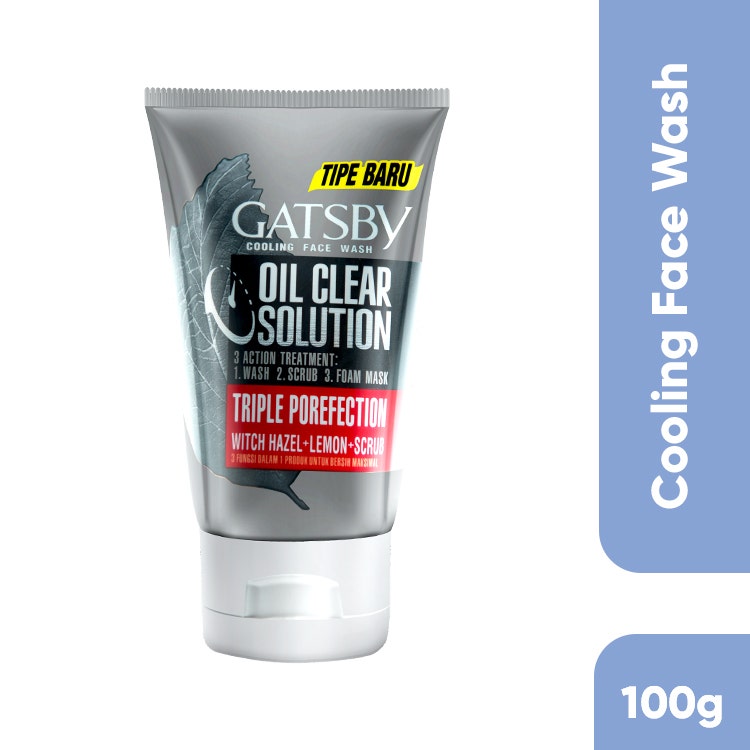

GATSBY
Gatsby Oil Clear Solution Triple Porefection Cooling Face Wash 100G

Gatsby Oil Clear Solution Triple Porefection Cooling Face Wash 100G
GATSBY
gatsby-oil-clear-solution-triple-porefection-cooling-face-wash-100g
Cleanse
10085057691941
Morning or Evening?
How often will you use this product?
Notes


Highlights
WHAT IS IT?
Triple Action Treatment Face Wash, Ingredients count: 21
FEATURES
Combination of lemon and cooling sensation, against excess oil, cleansing, scrubbing & masking functions, helps minimize pore, removes dirt and comedo.
BEST FOR
oily
CHECKS
No parabens, no sulfates explicitly stated, no mention of fragrance-free or alcohol-free; contains fragrance.
Who Is It For?
Men No Specific Age Range MentionedWhat Does It Help With?
Excess Oil Acne Dullness Stickiness Comedo And Minimizing PoresBudget
Affordable (under $30)How To Use
Which routine should it be used in?
Instructions:
Key Information


What GATSBY Says
Product Description:
Face wash product series with combination of lemon and cooling sensation to against excess oil in face that become trigger for men's skin face problem such as acne, dull and stickiness because of excessive oil. Triple Action Treatment Face Wash! Get maximum function of washing face in 1 product (cleansing, scrubing & masking). Skin free from dirt, comedo, and get minimize pore.
About the Brand:
Ingredients Overview
Ingredients List
water-aqua,glycerin,palmitic-acid,myristic-acid,stearic-acid,potassium-hvdroxide,lauric-acid,peg-,-tribehenin,hydrogenated-castor-oil,sorbitol,glyceryl-stearate,menthol,propylene-glycol,lauramidopropyl-betaine,fragrance-parfum,citrus-limon-lemon-juice,butylene,glycol,sodium-chloride,tetrasodium-edta,hamamelis-virginiana-witch-hazel-extract,sodium-benzoate,potassium-sorbate
Key Ingredients
Citrus Limon (Lemon) Juice, Menthol, Witch Hazel Extract
Ingredients Details
Glycerin
Common Name(s): Glycerol,glycerine,1,2,3-propanetriol
CAS Number: 56-81-5
DESCRIPTION
What It Does: Glycerin pulls water from the environment and deeper skin layers into the outer skin layer (epidermis), boosting moisture levels and keeping skin soft, smooth, and plump.
Why It's Used: It is used in virtually every moisturizer, serum, and cleanser because it is highly effective at hydrating skin, is well-tolerated by all skin types, and enhances the texture and spreadability of formulations.
How It Works: As a humectant, glycerin forms hydrogen bonds with water molecules, trapping them in the skin. it also reinforces the skin barrier by integrating into lipid structures between skin cells.
Typically Found In: Moisturizers,serums,cleansers,toners,sheet masks,sunscreens,body lotions,shampoos,conditioners
TECHNICAL DETAILS
Primary Category: Humectant
Secondary Functions: Skin barrier support,emollient,solvent
Application Areas:

Facial Skincare
Body Care
Hair Care
Beard Care

Color Cosmetics (Makeup)
Dietary/Oral Supplements
Typical Concentration Range: 1%–30% (typical: 3–10%)
SOURCING & ETHICS
Vegan Status: Conditional - feedstock declaration required
Halal Status: Unverified - feedstock declaration required (plant, animal and petrochemical routes all exist)
Source Notes: Derived from plant oils via hydrolysis or saponification; synthetic versions also available. palm-derived glycerin carries sustainability concerns. [audit 2026-07-29 rev2: origin-dependent: the same inci exists in plant, animal and petrochemical versions and the name does not discriminate. determination requires shariah-panel sign-off.]
SKIN COMPATIBILITY
Irritancy Rating: 1/5 – very low; non-irritating at all standard concentrations
Comedogenicity Rating: 0/5 – non-comedogenic
Sensitivity Concerns: Extremely rare allergic reactions; generally safe for all skin types including sensitive and baby skin
Safe for Sensitive Skin: Yes
SAFETY & COMPATIBILITY
Safety Profile: Widely recognized as safe. ewg hazard score: 1. no significant concerns for irritation, sensitization, or toxicity at typical concentrations (up to 50%).
Works Well With: Hyaluronic acid,ceramides,niacinamide,panthenol,urea,peptides,retinol,ahas/bhas
Avoid Combining With: No known incompatibilities at standard concentrations
SCIENTIFIC NOTE
Glycerin is an endogenous skin component found naturally in the stratum corneum. aquaporin-3 channels in keratinocytes facilitate glycerin transport, making it integral to natural skin hydration pathways.
Last Verified: 2026-03-12
Primary Sources: Cosing database,cir safety assessment,ewg skin deep,inci decoder
Glycol
Common Name(s): Glycol,glycol,polyethylene glycol medium mw,humectant co-solvent emulsifier
CAS Number: N/a
DESCRIPTION
What It Does: Provides hygroscopic moisture retention and co-solvent activity for active ingredient dissolution from the polyether backbone's multiple ether oxygen water-binding groups.
Why It's Used: Peg molecular weight determines primary function: low mw (co-solvent/humectant), medium mw (emulsifier/solubiliser), high mw (film-former/thickener) — enabling the same chemical class to address multiple formulation needs across the mw range.
How It Works: Peg ether oxygens (1 per ch₂ch₂o repeat unit) provide 2-3 h-bond acceptors per unit — the chain of ether oxygens binding water molecules creating the hygroscopic character. at low mw (liquid state), provides co-solvent dissolution; at high mw (waxy solid), provides film-forming character through chain entanglement.
Typically Found In: Versatile formulations
TECHNICAL DETAILS
Primary Category: Active ingredient – cosmetic active
Secondary Functions: Skin conditioning
Application Areas:
Facial Skincare
Body Care
Hair Care
Beard Care
Color Cosmetics (Makeup)
Dietary/Oral Supplements
Typical Concentration Range: 0.5%–20%
SOURCING & ETHICS
Vegan Status: Conditional - supplier confirmation required
Halal Status: Unverified - supplier confirmation required
Source Notes: Commercially produced for cosmetic use. verify vegan/halal status with supplier. [audit 2026-07-29 rev2: the record's own source_notes does not assert a non-animal origin, or instructs the reader to verify with the supplier; "yes" asserts knowledge the record does not hold. determination requires shariah-panel sign-off.]
SKIN COMPATIBILITY
Irritancy Rating: 1/5 – very low
Comedogenicity Rating: 0/5 – non-comedogenic
Sensitivity Concerns: Well-tolerated by most skin types.
Safe for Sensitive Skin: Yes
SAFETY & COMPATIBILITY
Safety Profile: Good safety profile at recommended concentrations. ewg score: 1–2.
Works Well With: Standard skincare actives
Avoid Combining With: No known significant incompatibilities
SCIENTIFIC NOTE
1,4-dioxane contamination monitoring: ethylene oxide polymerisation generates trace 1,4-dioxane — eu and us regulations require <10 ppm in finished products. supplier coa confirming dioxane level is required for regulatory compliance.
Last Verified: 2026-03-22
Primary Sources: Cosing database,glycol peg polyethylene glycol review
Menthol
Common Name(s): L-menthol,peppermint camphor,(-)-menthol
CAS Number: 89-78-1
DESCRIPTION
What It Does: Activates trpm8 cold thermoreceptors for intense cooling sensation and analgesic activity.
Why It's Used: The most potent cosmetic cooling agent – direct trpm8 agonist providing cooling sensation without actual temperature reduction for refreshing and analgesic formulations.
How It Works: Potent trpm8 (menthol receptor/cold thermosensor) agonist – activation at room temperature mimics cold sensation without actual cooling. anti-pruritic via trpm8 activation competing with itch c-fiber signaling. antimicrobial via membrane disruption.
Typically Found In: Cooling products,scalp treatments,oral care,pain relief,foot care,after-sun
TECHNICAL DETAILS
Primary Category: Active ingredient – cooling sensory terpenoid
Secondary Functions: Redness reduction,anti-inflammatory,calming
Application Areas:
Facial Skincare
Body Care
Hair Care
Beard Care
Color Cosmetics (Makeup)
Dietary/Oral Supplements
Typical Concentration Range: 0.1%–2%
SOURCING & ETHICS
Vegan Status: Conditional - supplier confirmation required
Halal Status: Unverified - supplier confirmation required
Source Notes: Plant-derived extract or synthetic. [audit 2026-07-29 rev2: status downgraded on audit. determination requires shariah-panel sign-off.]
SKIN COMPATIBILITY
Irritancy Rating: 2/5 – low to moderate; potential sensitizer
Comedogenicity Rating: 0/5 – non-comedogenic
Sensitivity Concerns: Non-irritating; ideal for reactive and sensitive skin.
Safe for Sensitive Skin: Avoid near eyes. use with caution at concentrations above 1% for sensitive skin.
SAFETY & COMPATIBILITY
Safety Profile: Eu max 4.5% (leave-on); regulations vary by application site. avoid on infants' face.
Works Well With: Ceramides,panthenol,allantoin,hyaluronic acid,centella asiatica
Avoid Combining With: No significant incompatibilities
SCIENTIFIC NOTE
Menthol's exceptional cooling potency stems from its ec50 for trpm8 activation of approximately 10μm (vs camphor's ec50 of ~5mm – 500× lower potency). this 500× potency advantage explains why even tiny concentrations of menthol provide intense cooling, while much higher concentrations of camphor are required for equivalent sensation.
Last Verified: 2026-03-12
Primary Sources: Cosing database,mckemy et al. menthol trpm8 discovery,cir safety assessment
Sorbitol
Common Name(s): D-glucitol,l-glucitol,sorbol
CAS Number: 50-70-4
DESCRIPTION
What It Does: Attracts and retains moisture providing skin softening and hydration.
Why It's Used: Widely used, cost-effective humectant and formulation ingredient in moisturizers, toothpastes, and personal care.
How It Works: 6 hydroxyl groups provide strong water binding through hydrogen bonding. metabolized slowly by skin as an osmolyte.
Typically Found In: Moisturizers,body lotions,toothpaste,shampoos,many personal care products
TECHNICAL DETAILS
Primary Category: Functional ingredient – sugar alcohol humectant
Secondary Functions: Formulation solvent,viscosity modifier
Application Areas:
Facial Skincare
Body Care
Hair Care
Beard Care
Color Cosmetics (Makeup)
Dietary/Oral Supplements
Typical Concentration Range: 1%–30%
SOURCING & ETHICS
Vegan Status: Conditional - supplier confirmation required
Halal Status: Unverified - supplier confirmation required
Source Notes: Produced by catalytic hydrogenation of glucose. derived from corn starch or other carbohydrate sources. gras food-approved. [audit 2026-07-29 rev2: the record's own source_notes does not assert a non-animal origin, or instructs the reader to verify with the supplier; "yes" asserts knowledge the record does not hold. determination requires shariah-panel sign-off.]
SKIN COMPATIBILITY
Irritancy Rating: 1/5 – very low
Comedogenicity Rating: 0/5 – non-comedogenic
Sensitivity Concerns: Non-irritating; suitable for all skin types.
Safe for Sensitive Skin: Yes
SAFETY & COMPATIBILITY
Safety Profile: Excellent safety profile. ewg score: 1.
Works Well With: Ceramides,emollients,occlusives,glycerin,hyaluronic acid
Avoid Combining With: No significant incompatibilities
SCIENTIFIC NOTE
Sorbitol's osmolyte function in cells (accumulates in response to osmotic stress) suggests it may provide protection to skin cells under dehydrating environmental conditions, complementing its well-established surface humectant activity.
Last Verified: 2026-03-12
Primary Sources: Cosing database,cir safety assessment,ewg skin deep