
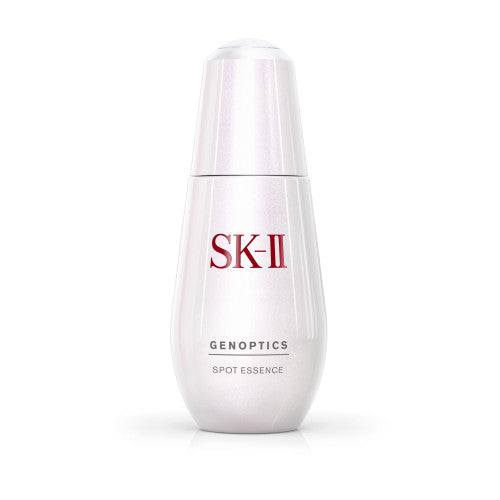

SK-II
GENOPTICS SPOT ESSENCE - SERUM FOR SUN SPOTS

GENOPTICS SPOT ESSENCE - SERUM FOR SUN SPOTS
SK-II
genoptics-spot-essence-serum-for-sun-spots
Serum
9818419331365
Morning or Evening?
How often will you use this product?
Notes


Highlights
WHAT IS IT?
Spot-targeting serum with PITERA™, Niacinamide, Sea Kelp Extract, & Japanese Plum Extract
FEATURES
Targets sun spots and age spots, brightens skin, absorbs quickly, helps control formation of visible age spots
BEST FOR
Oily, Combination, Dry, Normal
CHECKS
Free of sulfate
Who Is It For?
Adults Concerned With Sun Spots And Uneven Skin ToneWhat Does It Help With?
Sun Spots Age Spots Uneven Skin Tone DullnessBudget
Premium ($76-$150)How To Use
Which routine should it be used in?
Instructions:
Key Information


What SK-II Says
Product Description:
Reveal your skin's clarity for bright, even skin with this concentrated spot serum. Packed with spot-resisting ingredients PITERA™, Niacinamide, Sea Kelp Extract, & Japanese Plum Extract, it absorbs quickly to target and help control the formation of visible age spots and dark spots caused by UVA & UVB exposure.
About the Brand:
Ingredients Overview
Ingredients List
Water,Galactomyces-Ferment-Filtrate,Butylene-Glycol,Cyclopentasiloxane,Niacinamide,Triethylhexanoin,Glycerin,Pentylene-Glycol,Nylon-12,Phytosteryl-Octyldodecyl-Lauroyl-Glutamate,Inositol,Polymethylsilsesquioxane,Boron-Nitride,Caprylic-Capric-Triglyceride,Panthenol,Peg-20-Sorbitan-Cocoate,Dimethicone-Vinyl-Dimethicone-Crosspolymer,Acrylates-C10-30-Alkyl-Acrylate-Crosspolymer,Phenoxyethanol,Peg-11-Methyl-Ether-Dimethicone,Polyacrylamide,Laureth-7,Benzyl-Alcohol,Aminomethyl-Propanol,C13-14-Isoparaffin,Disodium-Edta,Methylparaben,Hexyldecanol,Sodium-Benzoate,Xanthan-Gum,Ascorbyl-Glucoside,Laminaria-Saccharina-Extract,Zea-Mays-Oil,Methicone,Ci-77492,Ci-75130
Key Ingredients
PITERA™, Niacinamide, Lumina Sea Kelp Extract, Ume Extract
Ingredients Details
Butylene Glycol
Common Name(s): 1,3-butanediol,bg,1,3-butylene glycol
CAS Number: 107-88-0
DESCRIPTION
What It Does: Provides humectant hydration and active ingredient solubilization with excellent skin feel.
Why It's Used: Preferred glycol humectant in premium and k-beauty formulations for superior skin feel vs propylene glycol with equivalent functionality.
How It Works: Two hydroxyl groups at 1,3-positions provide water binding and solvent activity. better tolerated than propylene glycol with minimal sensitization risk. 4-carbon backbone provides slightly greater hydrophobic character enabling dissolution of less polar actives vs pg.
Typically Found In: Toners,essences,serums,k-beauty formulas
TECHNICAL DETAILS
Primary Category: Functional ingredient – glycol humectant
Secondary Functions: Tewl reduction,skin plumping
Application Areas:

Facial Skincare
Body Care
Hair Care

Beard Care
Color Cosmetics (Makeup)
Dietary/Oral Supplements
Typical Concentration Range: 1%–10%
SOURCING & ETHICS
Vegan Status: Yes – synthetic
Halal Status: Yes
Source Notes: Synthetic or naturally derived. excellent aqueous solubility.
SKIN COMPATIBILITY
Irritancy Rating: 1/5 – very low
Comedogenicity Rating: 0/5 – non-comedogenic
Sensitivity Concerns: Non-irritating; suitable for all skin types.
Safe for Sensitive Skin: Yes
SAFETY & COMPATIBILITY
Safety Profile: Excellent safety profile. ewg score: 1.
Works Well With: Ceramides,emollients,occlusives,glycerin,hyaluronic acid
Avoid Combining With: No significant incompatibilities
SCIENTIFIC NOTE
K-beauty's preference for butylene glycol over propylene glycol is driven by two factors: bg's superior skin feel (less tacky than pg's higher viscosity) and its lower sensitization potential (1,3-bg has better spatial distribution of hydroxyl groups that reduces protein interaction vs pg's 1,2-position oh groups).
Last Verified: 2026-03-12
Primary Sources: Cosing database,cir safety assessment
Cyclopentasiloxane
Common Name(s): Cyclopentasiloxane,cyclic volatile silicone,dry-touch carrier solvent
CAS Number: N/a
DESCRIPTION
What It Does: Provides a dry, weightless application vehicle that evaporates cleanly leaving actives and non-volatile silicones deposited on skin — eliminating the residual heaviness of conventional liquid carrier solvents.
Why It's Used: Cyclosiloxanes are the unique volatile silicone solvents that dissolve non-volatile silicones (dimethicone, cyclomethicone), organic uv filters, and lipophilic actives, providing the sensory-superior dry-touch application experience in premium formulations.
How It Works: Cyclosiloxane vapour pressure (d5 cyclopentasiloxane ~0.3 mmhg at 25°c) provides clean evaporation at body temperature. the cyclic ring structure provides lower boiling point than equivalent linear dimethicone, enabling faster evaporation while the ring conformation maintains the silicone's low surface energy for smooth application.
Typically Found In: Primers,antiperspirants,sunscreens
TECHNICAL DETAILS
Primary Category: Functional ingredient – emollient
Secondary Functions: Barrier sealing,softening
Application Areas:
Facial Skincare
Body Care
Hair Care
Beard Care
Color Cosmetics (Makeup)
Dietary/Oral Supplements
Typical Concentration Range: 1%–50%
SOURCING & ETHICS
Vegan Status: Conditional - supplier confirmation required
Halal Status: Unverified - supplier confirmation required
Source Notes: Plant-derived, synthetic or animal-derived. verify source. [audit 2026-07-29 rev2: the record's own source_notes does not assert a non-animal origin, or instructs the reader to verify with the supplier; "yes" asserts knowledge the record does not hold. determination requires shariah-panel sign-off.]
SKIN COMPATIBILITY
Irritancy Rating: 1/5 – very low
Comedogenicity Rating: 1/5 – low; formulation-dependent
Sensitivity Concerns: Non-irritating.
Safe for Sensitive Skin: Yes
SAFETY & COMPATIBILITY
Safety Profile: Excellent safety profile. ewg score: 1.
Works Well With: Humectants,ceramides,actives as carrier
Avoid Combining With: No significant incompatibilities
SCIENTIFIC NOTE
Cyclopentasiloxane (d5) and cyclohexasiloxane (d6) are under eu regulatory review for potential environmental persistence (pbt assessment) — formulators should monitor eu regulation 2018/35 implementation for restrictions in wash-off products.
Last Verified: 2026-03-12
Primary Sources: Cosing database,eu cyclosiloxane regulatory review
Galactomyces Ferment Filtrate
Common Name(s): Galactomyces ferment filtrate,sake yeast postbiotic,multi-function brightening active
CAS Number: N/a
DESCRIPTION
What It Does: Brightens skin tone by inhibiting melanin transfer from melanocytes to keratinocytes (not tyrosinase inhibition), strengthens the skin barrier by upregulating involucrin and filaggrin expression, minimises pore appearance, and provides antioxidant protection from the ferment's organic acid and flavonoid complex.
Why It's Used: Gff's brightening mechanism differs from all tyrosinase inhibitors — it blocks melanosome transfer rather than melanin synthesis, providing additive brightening when combined with tyrosinase inhibitors and targeting the previously unaddressed transfer step.
How It Works: Gff contains niacinamide (inhibits melanosome par-2 transfer), arbutin-related compounds (tyrosinase inhibition), vitamin b complex, alpha-arbutin, and organic acids. the combined transfer inhibition + tyrosinase inhibition + antioxidant activity explains multi-step brightening. barrier upregulation occurs through fatty acid ceramide precursor provision.
Typically Found In: Brightening,k-beauty,barrier repair
TECHNICAL DETAILS
Primary Category: Active ingredient – skin microbiome support
Secondary Functions: Microbiome balance,prebiotic effect
Application Areas:
Facial Skincare
Body Care
Hair Care
Beard Care
Color Cosmetics (Makeup)
Dietary/Oral Supplements
Typical Concentration Range: 1%–95%
SOURCING & ETHICS
Vegan Status: Yes
Halal Status: Yes
Source Notes: Fermentation-derived or plant-extracted.
SKIN COMPATIBILITY
Irritancy Rating: 1/5 – very low
Comedogenicity Rating: 0/5 – non-comedogenic
Sensitivity Concerns: Non-irritating; beneficial for sensitive skin.
Safe for Sensitive Skin: Yes
SAFETY & COMPATIBILITY
Safety Profile: Excellent safety profile. ewg score: 1.
Works Well With: Ceramides,niacinamide,soothing actives
Avoid Combining With: No significant incompatibilities
SCIENTIFIC NOTE
The legendary sake brewery discovery: morihei uehara observed fermentation workers had unusually smooth, bright skin on their hands despite sun exposure and chemical contact — investigation identified galactomyces as the responsible fermentation organism, leading to the commercial gff cosmetic ingredient.
Last Verified: 2026-03-12
Primary Sources: Cosing database,galactomyces ferment filtrate brightening mechanism review
Glycerin
Common Name(s): Glycerol,glycerine,1,2,3-propanetriol
CAS Number: 56-81-5
DESCRIPTION
What It Does: Glycerin pulls water from the environment and deeper skin layers into the outer skin layer (epidermis), boosting moisture levels and keeping skin soft, smooth, and plump.
Why It's Used: It is used in virtually every moisturizer, serum, and cleanser because it is highly effective at hydrating skin, is well-tolerated by all skin types, and enhances the texture and spreadability of formulations.
How It Works: As a humectant, glycerin forms hydrogen bonds with water molecules, trapping them in the skin. it also reinforces the skin barrier by integrating into lipid structures between skin cells.
Typically Found In: Moisturizers,serums,cleansers,toners,sheet masks,sunscreens,body lotions,shampoos,conditioners
TECHNICAL DETAILS
Primary Category: Humectant
Secondary Functions: Skin barrier support,emollient,solvent
Application Areas:
Facial Skincare
Body Care
Hair Care
Beard Care
Color Cosmetics (Makeup)
Dietary/Oral Supplements
Typical Concentration Range: 1%–30% (typical: 3–10%)
SOURCING & ETHICS
Vegan Status: Conditional - feedstock declaration required
Halal Status: Unverified - feedstock declaration required (plant, animal and petrochemical routes all exist)
Source Notes: Derived from plant oils via hydrolysis or saponification; synthetic versions also available. palm-derived glycerin carries sustainability concerns. [audit 2026-07-29 rev2: origin-dependent: the same inci exists in plant, animal and petrochemical versions and the name does not discriminate. determination requires shariah-panel sign-off.]
SKIN COMPATIBILITY
Irritancy Rating: 1/5 – very low; non-irritating at all standard concentrations
Comedogenicity Rating: 0/5 – non-comedogenic
Sensitivity Concerns: Extremely rare allergic reactions; generally safe for all skin types including sensitive and baby skin
Safe for Sensitive Skin: Yes
SAFETY & COMPATIBILITY
Safety Profile: Widely recognized as safe. ewg hazard score: 1. no significant concerns for irritation, sensitization, or toxicity at typical concentrations (up to 50%).
Works Well With: Hyaluronic acid,ceramides,niacinamide,panthenol,urea,peptides,retinol,ahas/bhas
Avoid Combining With: No known incompatibilities at standard concentrations
SCIENTIFIC NOTE
Glycerin is an endogenous skin component found naturally in the stratum corneum. aquaporin-3 channels in keratinocytes facilitate glycerin transport, making it integral to natural skin hydration pathways.
Last Verified: 2026-03-12
Primary Sources: Cosing database,cir safety assessment,ewg skin deep,inci decoder