
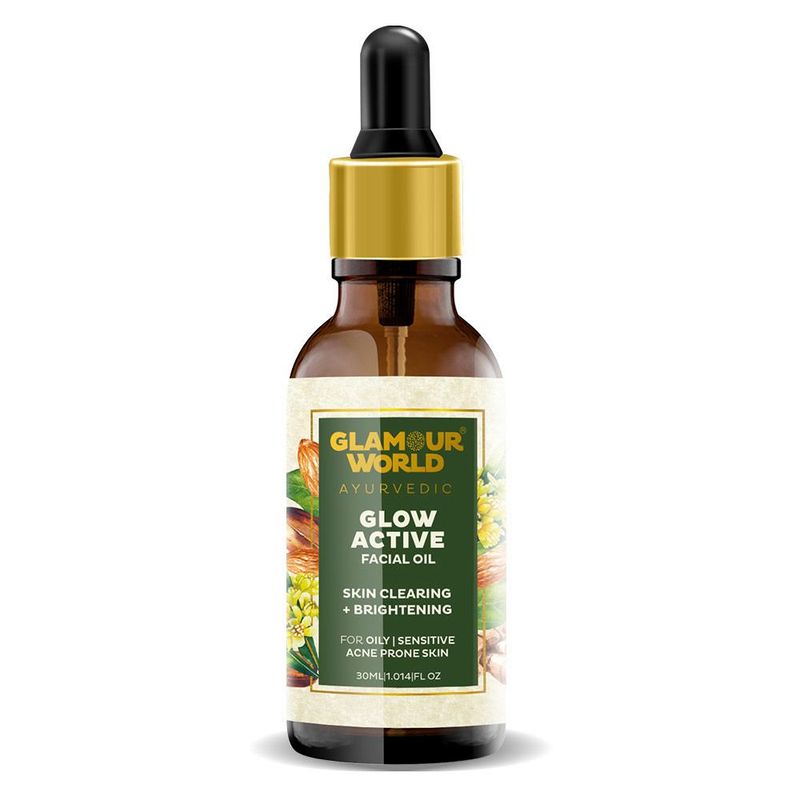

GLAMOUR WORLD AYURVEDIC
GLAMOUR WORLD AYURVEDIC Glow Active Facial Oil

GLAMOUR WORLD AYURVEDIC Glow Active Facial Oil
GLAMOUR WORLD AYURVEDIC
glamour-world-ayurvedic-glow-active-facial-oil
Face Oil
10085507531045
Morning or Evening?
How often will you use this product?
Notes


Highlights
WHAT IS IT?
Face Oil with 6 ingredients
FEATURES
Intensely moisturises skin, softens skin, controls rashes and breakouts, brightens complexion, leaves skin smooth and soft, protects against moisture loss, reduces dark spots, purifies, rebalances, refines skin texture, helps tighten pores
BEST FOR
sensitive
CHECKS
Does not contain paraben, sulfate, silicone-free not explicitly stated but no harsh ingredients mentioned
Who Is It For?
Men And Women No Explicit Age Range MentionedWhat Does It Help With?
Moisturizes Controls Rashes And Breakouts Brightens Complexion Reduces Dark Spots Refines Skin Texture Tightens PoresBudget
Affordable (under $30)How To Use
Which routine should it be used in?
Instructions:
Key Information


What GLAMOUR WORLD AYURVEDIC Says
Product Description:
We have a wide range of products, from skincare to hair care and beauty products that cater to the unique needs of both men and women. Our products are enriched with the goodness of nature and ayurveda that have been known for their beauty-enhancing and divine properties since decades. Glamour World Ayurvedic adheres to stringent quality control methods, constant research & development and advanced production facilities to ensure international quality standards for its products. Benefits: Intensely moisturises, softens the skin, controls rashes and breakouts. Brightens complexion. Patchouli Oil , Jojoba Oil , Tea Tree Oil ,Turmeric Root Oil , Grape Seed Oil , Almond Oil. Leaves skin smooth, soft with an even, bright complexion, protects against moisture loss, reduces dark spots. Purifies, rebalances, refines skin texture and helps tighten pores. About The Brand: At Glamour World Ayurvedic we believe that every person is unique, thus our belief in the philosophy unique you. Ayurveda is the science of life; in Sanskrit ‘Ayur’ means ‘life’ and ‘Veda’ means ‘science or knowledge’. Launched in year 2004 in India, Glamour World Ayurvedic is a leading company that manufactures and sells ayurvedic products in India and across the globe. Year 2019 marks our 15 years of delivering excellence and dedication towards our goal i.e. bringing the goodness of ayurveda to the masses.
About the Brand:
Ingredients Overview
Ingredients List
Almond-Oil,Turmeric-Root-Oil,Grape-Seed-Oil,Jojoba-Oil,Tea-Tree-Oil,Patchouli-Oil
Key Ingredients
Patchouli Oil, Jojoba Oil, Tea Tree Oil, Turmeric Root Oil, Grape Seed Oil, Almond Oil
Ingredients Details
Almond Oil
Common Name(s): Almond oil,botanical carrier oil,emollient fatty acid delivery
CAS Number: N/a
DESCRIPTION
What It Does: Softens and conditions skin by integrating into sc lipid bilayers, delivers essential fatty acids (oleic, linoleic, linolenic) for barrier lipid synthesis, and provides rich, non-stripping moisturisation.
Why It's Used: Natural carrier oils provide the closest compositional match to endogenous sc lipids, delivering emolliency through genuine barrier integration rather than simple surface occlusion.
How It Works: Fatty acid triglycerides partition into sc lipid bilayers — oleic acid (c18:1) provides fluid, emollient integration; linoleic acid (c18:2) acts as essential ceramide precursor; saturated fatty acids provide more occlusive barrier reinforcement.
Typically Found In: Moisturisers,facial oils,natural skin care
TECHNICAL DETAILS
Primary Category: Functional ingredient – emollient
Secondary Functions: Barrier sealing,softening
Application Areas:

Facial Skincare
Body Care
Hair Care

Beard Care
Color Cosmetics (Makeup)
Dietary/Oral Supplements
Typical Concentration Range: 1%–100%
SOURCING & ETHICS
Vegan Status: Conditional
Halal Status: Yes
Source Notes: Plant-derived, synthetic or animal-derived. verify source.
SKIN COMPATIBILITY
Irritancy Rating: 1/5 – very low
Comedogenicity Rating: 1/5 – low; formulation-dependent
Sensitivity Concerns: Non-irritating.
Safe for Sensitive Skin: Yes
SAFETY & COMPATIBILITY
Safety Profile: Excellent safety profile. ewg score: 1.
Works Well With: Humectants,ceramides,actives as carrier
Avoid Combining With: No significant incompatibilities
SCIENTIFIC NOTE
Essential fatty acids — linoleic (c18:2, n-6) and α-linolenic (c18:3, n-3) acids — cannot be synthesised by the body; topical delivery through carrier oils provides direct substrate for ceramide and eicosanoid biosynthesis in the epidermis.
Last Verified: Cosing database,almond oil carrier oil botanical review
Primary Sources: 2026-03-12
Grape Seed Oil
Common Name(s): Grape seed oil,botanical oil,phytochemical active
CAS Number: N/a
DESCRIPTION
What It Does: Provides antioxidant protection from reactive oxygen species, reduces inflammatory cytokine production in skin, and conditions skin through the plant's phytochemical complex.
Why It's Used: Natural origin narrative, traditional use heritage, and multi-functional phytochemical profile supporting concurrent skin care claims from one ingredient.
How It Works: Polyphenols, terpenoids, and alkaloids scavenge ros via h• donation, inhibit nf-kb or cox-2 inflammatory pathways, and interact with skin surface proteins for conditioning.
Typically Found In: Botanical skin care,natural products
TECHNICAL DETAILS
Primary Category: Active ingredient – antioxidant
Secondary Functions: Free radical scavenging,anti-aging
Application Areas:
Facial Skincare
Body Care
Hair Care
Beard Care
Color Cosmetics (Makeup)
Dietary/Oral Supplements
Typical Concentration Range: 0.1%–10%
SOURCING & ETHICS
Vegan Status: Conditional
Halal Status: Yes
Source Notes: Plant-derived extract or synthetic.
SKIN COMPATIBILITY
Irritancy Rating: 1/5 – very low
Comedogenicity Rating: 0/5 – non-comedogenic
Sensitivity Concerns: Non-irritating; well-tolerated.
Safe for Sensitive Skin: Yes
SAFETY & COMPATIBILITY
Safety Profile: Excellent safety profile. ewg score: 1.
Works Well With: Vitamin c,vitamin e,ferulic acid,spf,other antioxidants
Avoid Combining With: No significant incompatibilities
SCIENTIFIC NOTE
Plant secondary metabolites evolved as photoprotectants and antimicrobials — mechanisms directly applicable to cosmetic antioxidant and anti-inflammatory activity in human skin.
Last Verified: Cosing database,grape seed oil botanical review
Primary Sources: 2026-03-12
Jojoba Oil
Common Name(s): Jojoba oil,jojoba seed oil
CAS Number: 61789-91-1
DESCRIPTION
What It Does: Provides sebum-identical emolliency with outstanding oxidative stability and non-comedogenic profile.
Why It's Used: The most sebum-compatible plant oil – its wax ester composition mimics human sebum for superior skin compatibility across all skin types including oily and acne-prone.
How It Works: Liquid wax ester composition (primarily c20:1 and c22:1 wax esters) provides exceptional molecular mimicry of human sebum wax esters. regulates sebum production via negative feedback to sebaceous glands. remarkable oxidative stability from fully unsaturated wax ester structure vs polyunsaturated triglycerides.
Typically Found In: Facial oils,hair oils,serums,body care,lip care,virtually all product categories
TECHNICAL DETAILS
Primary Category: Functional ingredient – emollient
Secondary Functions: Sebum balancing,oxidative stability,non-comedogenic
Application Areas:
Facial Skincare
Body Care
Hair Care
Beard Care
Color Cosmetics (Makeup)
Dietary/Oral Supplements
Typical Concentration Range: 1%–100%
SOURCING & ETHICS
Vegan Status: Yes – from simmondsia chinensis (jojoba) seeds
Halal Status: Yes
Source Notes: Cold-pressed from jojoba seeds. among the most oxidation-stable plant oils (shelf life 5+ years). desert-grown, drought-resistant crop.
SKIN COMPATIBILITY
Irritancy Rating: 1/5 – very low
Comedogenicity Rating: 0/5 – non-comedogenic; sebum-identical composition
Sensitivity Concerns: Non-irritating.
Safe for Sensitive Skin: Yes
SAFETY & COMPATIBILITY
Safety Profile: Excellent safety profile. ewg score: 1.
Works Well With: Humectants,ceramides,actives as carrier
Avoid Combining With: No significant incompatibilities
SCIENTIFIC NOTE
Jojoba oil's wax ester composition is uniquely different from all other plant oils (which are triglycerides). human sebum contains approximately 25% wax esters – the proportion matched by jojoba. this structural identity explains jojoba's superior skin and hair compatibility versus conventional triglyceride oils.
Last Verified: Cosing database,gad et al. jojoba review,cir safety assessment
Primary Sources: 2026-03-12
Tea Tree Oil
Common Name(s): Tea tree oil,tto,melaleuca oil
CAS Number: 68647-73-4
DESCRIPTION
What It Does: Provides the most potent single-plant broad-spectrum antimicrobial essential oil for skin antiseptic applications.
Why It's Used: The antimicrobial essential oil – tea tree oil's terpinen-4-ol provides clinically proven broad-spectrum antimicrobial activity in rct-level clinical studies for acne and mrsa decolonisation.
How It Works: Terpinen-4-ol (30-48%) provides membrane-disrupting antimicrobial activity vs gram+/- bacteria, fungi, and enveloped viruses. iso 4730 requires minimum 30% terpinen-4-ol and maximum 5% 1,8-cineole (sensitiser). anti-biofilm activity vs staphylococcus.
Typically Found In: Anti-acne products,antiseptic formulas,natural antimicrobials,scalp treatments
TECHNICAL DETAILS
Primary Category: Active ingredient – soothing / anti-inflammatory
Secondary Functions: Redness reduction,anti-inflammatory,calming
Application Areas:
Facial Skincare
Body Care
Hair Care
Beard Care
Color Cosmetics (Makeup)
Dietary/Oral Supplements
Typical Concentration Range: 0.001%–5%
SOURCING & ETHICS
Vegan Status: Yes – from melaleuca alternifolia leaves (australia)
Halal Status: Yes
Source Notes: Plant-derived extract or synthetic.
SKIN COMPATIBILITY
Irritancy Rating: 1/5 – very low
Comedogenicity Rating: 0/5 – non-comedogenic
Sensitivity Concerns: Non-irritating; ideal for reactive and sensitive skin.
Safe for Sensitive Skin: Yes – particularly recommended for sensitive skin
SAFETY & COMPATIBILITY
Safety Profile: Iso 4730:2017 quality standard defines authentic tea tree oil. can cause contact sensitisation at high concentrations. toxic if ingested.
Works Well With: Ceramides,panthenol,allantoin,hyaluronic acid,centella asiatica
Avoid Combining With: No significant incompatibilities
SCIENTIFIC NOTE
Randomised controlled trial comparison of 5% tea tree oil gel vs 5% benzoyl peroxide lotion for acne demonstrated equivalent efficacy for acne lesion reduction at 3 months. tea tree's slower onset (8 weeks vs 4 weeks for bpo) was offset by significantly fewer side effects (dryness, irritation, peeling) in the tto group – providing evidence-based support for clinical tto use as a well-tolerated bpo alternative.
Last Verified: Cosing database,bassett et al. tea tree oil acne rct,iso 4730
Primary Sources: 2026-03-12
