

Nykaa E retail limited
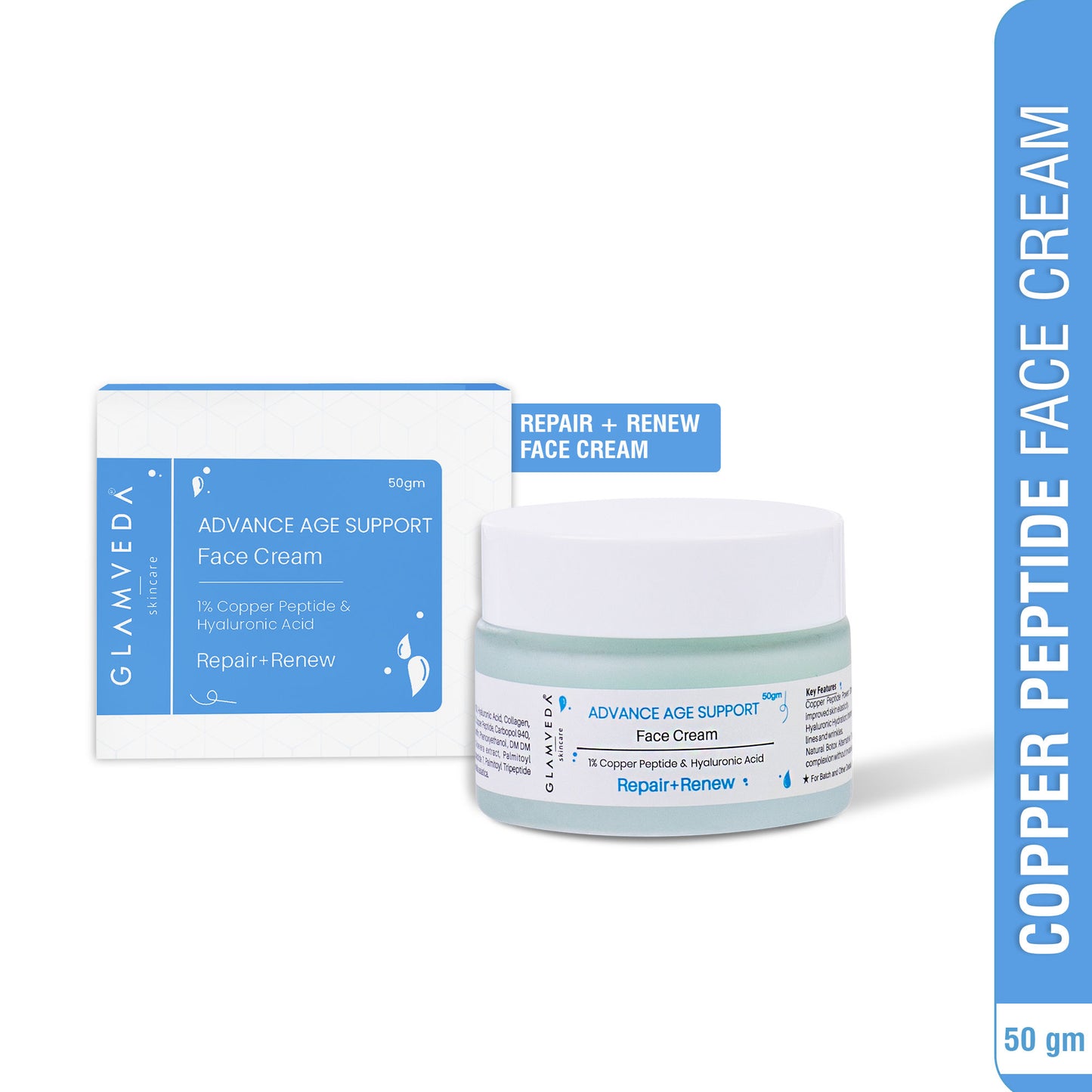
GLAMVEDA 1% COPPER PEPTIDE + HYALURONIC ACID BARRIER REPAIR CREAM - RETAINS MOISTURE FOR ANTI-AGEING(50G)

GLAMVEDA 1% COPPER PEPTIDE + HYALURONIC ACID BARRIER REPAIR CREAM - RETAINS MOISTURE FOR ANTI-AGEING(50G)
Nykaa E retail limited
glamveda-1-copper-peptide-hyaluronic-acid-barrier-repair-cream-retains-moisture-for-anti-ageing-50g
Moisturize
10085084561701
Morning or Evening?
How often will you use this product?
Notes


Highlights
WHAT IS IT?
Barrier Repair Face Cream with 1% Copper Peptide
FEATURES
BEST FOR
CHECKS
Who Is It For?
What Does It Help With?
Anti-aging Moisture Retention Barrier RepairBudget
Affordable (under $30)How To Use
Which routine should it be used in?
Instructions:
Key Information

About the Brand:
Ingredients Overview
Ingredients List
Purified Water, Retinol, Olive Oil, H y a l uro n i c A c i d , C o l l a g e n , B l a d y g r a s s ex t r a c t, Vitamin E, Copper Peptide, Carbopol 940, Aristoflex AVC,Light liquid paraffin ,Phenoxyethanol , DM DM Hydantoin,Honey extract,Aloevera extract, Palmitoyl oligopeptide, Palmitoyl oligopeptide 7, Palmitoyl Tripeptide 1, Palmitoyl Hexapeptide ,Centella asiatica, Multi Peptide
Key Ingredients
copper peptide 1%, hyaluronic acid
Ingredients Details
Honey Extract
Common Name(s): Honey extract,bee honey extract,natural honey
CAS Number: 8028-66-8
DESCRIPTION
What It Does: Provides h2o2 antimicrobial and osmotic healing alongside gluconic acid and flavonoid anti-inflammatory.
Why It's Used: The most ancient healing substance — honey's documented wound healing use spans 8,000 years across all civilisations, with modern research validating the h2o2, osmotic, ph, and mgo antimicrobial mechanisms.
How It Works: Diluted honey releases h2o2 via glucose oxidase for antimicrobial activity. very low water activity (0.56) provides osmotic drawing in wounds. gluconic acid provides mild acidic ph (3.5-4.5) inhibiting bacteria. manuka honey mgo (methylglyoxal) provides antibiotic-independent antimicrobial. flavonoids provide anti-inflammatory activity.
Typically Found In: Wound healing products,natural antimicrobials,humectant masks
TECHNICAL DETAILS
Primary Category: Active ingredient – soothing / anti-inflammatory
Secondary Functions: Redness reduction,anti-inflammatory,calming
Application Areas:

Facial Skincare
Body Care

Hair Care
Beard Care
Color Cosmetics (Makeup)
Dietary/Oral Supplements
Typical Concentration Range: 1%–20%
SOURCING & ETHICS
Vegan Status: No - animal-derived
Halal Status: Conditional - bee-derived; widely held permissible, confirm certifier stance
Source Notes: Plant-derived extract or synthetic. [audit 2026-07-29 rev2: bee-derived; permissibility widely accepted but fatwa varies by jurisdiction. determination requires shariah-panel sign-off.]
SKIN COMPATIBILITY
Irritancy Rating: 1/5 – very low
Comedogenicity Rating: 0/5 – non-comedogenic
Sensitivity Concerns: Non-irritating; ideal for reactive and sensitive skin.
Safe for Sensitive Skin: Yes – particularly recommended for sensitive skin
SAFETY & COMPATIBILITY
Safety Profile: Excellent safety profile. ewg score: 1.
Works Well With: Ceramides,panthenol,allantoin,hyaluronic acid,centella asiatica
Avoid Combining With: No significant incompatibilities
SCIENTIFIC NOTE
Honey is the oldest documented medical treatment with continuous evidence spanning from egyptian ebers papyrus (1550 bc) through islamic medicine (al-qanun fi at-tibb, ibn sina) to modern cochrane reviews confirming wound healing superiority over conventional dressings. medical-grade manuka honey (medihoney) has fda 510(k) clearance for wound care — making honey the only cosmetic humectant with concurrent fda medical device approval for wound management.
Last Verified: 2026-03-12
Primary Sources: Cosing database,molan honey wound review,cochrane review honey vs wound dressings
Olive Oil
Common Name(s): Olive oil oil
DESCRIPTION
What It Does: Nourishes and softens skin through its balanced fatty acid profile, while antioxidant compounds protect against oxidative skin damage.
Why It's Used: Plant oils provide physiologically compatible lipid structures that integrate into the skin barrier and deliver fat-soluble antioxidants directly to skin cells.
How It Works: Fatty acids integrate into stratum corneum lipid lamellae, reinforcing the lipid barrier. antioxidants (tocopherols, carotenoids, polyphenols) neutralize ros through electron donation or singlet oxygen quenching.
Typically Found In: Face oils,serums,moisturizers,hair treatments,body oils
TECHNICAL DETAILS
Primary Category: Plant oils
Secondary Functions: Emollient,antioxidant
Application Areas:
Facial Skincare
Body Care
Hair Care
Beard Care
Color Cosmetics (Makeup)
Dietary/Oral Supplements
Typical Concentration Range: 0.5–30%
SOURCING & ETHICS
Vegan Status: Yes
Halal Status: Yes
Source Notes: Cold-pressed or solvent-extracted plant oil; no animal components.
SKIN COMPATIBILITY
Irritancy Rating: 1899-12-31 00:00:00 -0800
Comedogenicity Rating: 2000-01-01 00:00:00 -0800
Sensitivity Concerns: Low sensitization potential at recommended use concentrations.
Safe for Sensitive Skin: Yes
SAFETY & COMPATIBILITY
Safety Profile: Well-characterized cosmetic ingredient with established safety profile. generally non-irritating at typical use concentrations. suitable for leave-on and rinse-off cosmetics.
Works Well With: Vitamin e,ceramides,other plant oils,squalane
Avoid Combining With: Strong oxidizers (accelerate rancidity)
SCIENTIFIC NOTE
Vegetable oils are triglyceride matrices where the fatty acid composition determines skin compatibility, barrier function, and comedogenicity. oleic acid-rich oils (>60%) soften barrier lipids and enhance penetration; linoleic acid-rich oils reinforce ceramide-poor stratum corneum; saturated fatty acid-rich oils provide occlusion without skin penetration.
Last Verified: 2025-01-15
Primary Sources: Cosing eu database; pcpc cosmetic ingredient safety reviews; aocs plant oil composition databases; fatty acid pharmacology reviews
Palmitoyl Oligopeptide
Common Name(s): Pal-oligopeptide,gqpr palmitoyl complex
CAS Number: N/a
DESCRIPTION
What It Does: Stimulates multiple ecm proteins simultaneously for comprehensive skin density and wrinkle reduction.
Why It's Used: Multi-target anti-aging peptide addressing several ecm proteins concurrently for comprehensive skin structural restoration.
How It Works: Palmitoylated oligopeptide sequence activates multiple fibroblast receptor pathways simultaneously, upregulating synthesis of collagen types i and iii, elastin, and proteoglycans for comprehensive ecm rebuilding.
Typically Found In: Anti-aging serums,skin density products,multi-action anti-aging
TECHNICAL DETAILS
Primary Category: Active ingredient – collagen stimulating oligopeptide
Secondary Functions: Multi-ecm stimulation,skin density restoration
Application Areas:
Facial Skincare
Body Care
Hair Care
Beard Care
Color Cosmetics (Makeup)
Dietary/Oral Supplements
Typical Concentration Range: 100–1000 ppm
SOURCING & ETHICS
Vegan Status: Yes – synthetically produced
Halal Status: Yes
Source Notes: Synthetically produced by solid-phase peptide synthesis (spps). may be palmitoylated for stability.
SKIN COMPATIBILITY
Irritancy Rating: 1/5 – very low
Comedogenicity Rating: 0/5 – non-comedogenic
Sensitivity Concerns: Non-irritating; suitable for all skin types.
Safe for Sensitive Skin: Yes
SAFETY & COMPATIBILITY
Safety Profile: Exceptional safety profile. ewg score: 1.
Works Well With: Hyaluronic acid,ceramides,retinol,vitamin c,niacinamide
Avoid Combining With: Avoid mixing with high-concentration ahas at same ph (may hydrolyze peptide bonds)
SCIENTIFIC NOTE
Multiple ecm protein stimulation from a single ingredient provides formulation efficiency – particularly useful in complex anti-aging serums where formulator space (and consumer patience) for multiple individual peptides is limited.
Last Verified: 2026-03-12
Primary Sources: Cosing database,gorouhi & maibach peptide review
Phenoxyethanol
Common Name(s): 2-phenoxyethanol,rose ether,ethylene glycol monophenyl ether
CAS Number: 122-99-6
DESCRIPTION
What It Does: Prevents microbial contamination and spoilage in cosmetic formulations.
Why It's Used: The benchmark cosmetic preservative – eu-permitted up to 1%, effective against virtually all cosmetically relevant microorganisms, and excellent tolerability.
How It Works: Phenol ring provides broad antimicrobial activity via disruption of bacterial and fungal cell membranes and inhibition of enzymatic activity. effective against gram-positive and gram-negative bacteria, yeasts (candida), and molds (aspergillus). activity ph range: 3-9.
Typically Found In: All cosmetic formulations as primary preservative
TECHNICAL DETAILS
Primary Category: Functional ingredient – broad-spectrum preservative
Secondary Functions: Skin conditioning
Application Areas:
Facial Skincare
Body Care
Hair Care
Beard Care
Color Cosmetics (Makeup)
Dietary/Oral Supplements
Typical Concentration Range: 0.1%–1% (eu max 1%)
SOURCING & ETHICS
Vegan Status: Conditional - supplier confirmation required
Halal Status: Unverified - supplier confirmation required
Source Notes: Commercially produced for cosmetic use. verify vegan/halal status with supplier. [audit 2026-07-29 rev2: the record's own source_notes does not assert a non-animal origin, or instructs the reader to verify with the supplier; "yes" asserts knowledge the record does not hold. determination requires shariah-panel sign-off.]
SKIN COMPATIBILITY
Irritancy Rating: 1/5 – very low
Comedogenicity Rating: 0/5 – non-comedogenic
Sensitivity Concerns: Well-tolerated by most skin types.
Safe for Sensitive Skin: Yes
SAFETY & COMPATIBILITY
Safety Profile: Eu cosmetics regulation max 1%. sccs assessed as safe at ≤1%. avoid use around eyes in baby products per some country regulations. ewg score: 4.
Works Well With: Standard skincare actives
Avoid Combining With: No known significant incompatibilities
SCIENTIFIC NOTE
Phenoxyethanol's widespread adoption as the primary cosmetic preservative followed the phaseout of parabens from many formulations in the 2000s-2010s. despite having a comparable or better safety profile to parabens, it is often cited in 'free-from' formulations – a consumer perception issue rather than a scientific safety concern.
Last Verified: