

Good Vibes
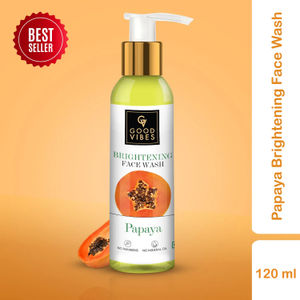
Good Vibes Papaya Brightening Even Skin Tone Face Wash with Power of Serum (120 ml)

Good Vibes Papaya Brightening Even Skin Tone Face Wash with Power of Serum (120 ml)
Good Vibes
good-vibes-papaya-brightening-even-skin-tone-face-wash-with-power-of-serum-120-ml
Cleanse
10085482135845
Morning or Evening?
How often will you use this product?
Notes


Highlights
WHAT IS IT?
Face wash product with multiple beneficial ingredients
FEATURES
Deep pore cleansing, Non-drying, Brightening properties, Protects skin from tanning, Combats acne
BEST FOR
oily
CHECKS
No Parabens, No Mineral Oil, No Animal Testing
Who Is It For?
What Does It Help With?
Brightening Acne Control Even Skin Tone Skin ElasticityBudget
Affordable (under $30)How To Use
Which routine should it be used in?
Instructions:
Key Information


What Good Vibes Says
Product Description:
Good Vibes Papaya Brightening Face wash is infused with the goodness of Papaya known for its brightening properties. Rich in Papain and Vitamin A and C Papaya lightens and evens the skin tone. It also protects the skin from tanning leaving behind a natural glow. Papaya also combats acne making this face wash ideal for oily skin. But the goodness of this face wash doesn’t stop at the richness of Papaya there are other wonderful ingredients in this formulaiton as well There’s Grape Seed Oil that eliminates impurities Liquorice to improve complexion Orange to smoothen the skin and Mulberry to enhance skin elasticity. Your face will love this fruity and fresh treat
About the Brand:
Ingredients Overview
Ingredients List
Papaya
Key Ingredients
Papaya, Papain, Vitamin A, Vitamin C, Grape Seed Oil, Liquorice, Orange, Mulberry
Ingredients Details
Grape Seed Oil
Common Name(s): Grape seed oil,botanical oil,phytochemical active
CAS Number: N/a
DESCRIPTION
What It Does: Provides antioxidant protection from reactive oxygen species, reduces inflammatory cytokine production in skin, and conditions skin through the plant's phytochemical complex.
Why It's Used: Natural origin narrative, traditional use heritage, and multi-functional phytochemical profile supporting concurrent skin care claims from one ingredient.
How It Works: Polyphenols, terpenoids, and alkaloids scavenge ros via h• donation, inhibit nf-kb or cox-2 inflammatory pathways, and interact with skin surface proteins for conditioning.
Typically Found In: Botanical skin care,natural products
TECHNICAL DETAILS
Primary Category: Active ingredient – antioxidant
Secondary Functions: Free radical scavenging,anti-aging
Application Areas:

Facial Skincare
Body Care

Hair Care
Beard Care
Color Cosmetics (Makeup)
Dietary/Oral Supplements
Typical Concentration Range: 0.1%–10%
SOURCING & ETHICS
Vegan Status: Conditional
Halal Status: Yes
Source Notes: Plant-derived extract or synthetic.
SKIN COMPATIBILITY
Irritancy Rating: 1/5 – very low
Comedogenicity Rating: 0/5 – non-comedogenic
Sensitivity Concerns: Non-irritating; well-tolerated.
Safe for Sensitive Skin: Yes
SAFETY & COMPATIBILITY
Safety Profile: Excellent safety profile. ewg score: 1.
Works Well With: Vitamin c,vitamin e,ferulic acid,spf,other antioxidants
Avoid Combining With: No significant incompatibilities
SCIENTIFIC NOTE
Plant secondary metabolites evolved as photoprotectants and antimicrobials — mechanisms directly applicable to cosmetic antioxidant and anti-inflammatory activity in human skin.
Last Verified: Cosing database,grape seed oil botanical review
Primary Sources: 2026-03-12
Papain
Common Name(s): Carica papaya enzyme,papaya protease
CAS Number: 9001-73-4
DESCRIPTION
What It Does: Gently digests dead keratin proteins for enzymatic exfoliation without acid irritation.
Why It's Used: Gentle enzymatic exfoliant for acid-sensitive skin types requiring exfoliation without ph-dependent aha/bha irritation.
How It Works: Cysteine protease specifically cleaves peptide bonds in keratin proteins at neutral ph, dissolving corneocyte protein bridges without requiring acidic ph. activity is ph- and temperature-dependent (optimal ph 6.5, 37°c). also gently solubilizes sebum plugs.
Typically Found In: Enzyme peels,gentle exfoliants,sensitive skin exfoliants,brightening masks
TECHNICAL DETAILS
Primary Category: Active ingredient – enzyme
Secondary Functions: Protein-specific exfoliation,neutral-ph keratolysis
Application Areas:
Facial Skincare
Body Care
Hair Care
Beard Care
Color Cosmetics (Makeup)
Dietary/Oral Supplements
Typical Concentration Range: 1%–10% (active enzyme)
SOURCING & ETHICS
Vegan Status: Yes – from carica papaya latex
Halal Status: Yes
Source Notes: Plant-derived (papaya, pineapple) or fermentation-derived.
SKIN COMPATIBILITY
Irritancy Rating: 2/5 – low to moderate; potential sensitization with repeated exposure
Comedogenicity Rating: 0/5 – non-comedogenic
Sensitivity Concerns: Patch test recommended; potential for enzymatic sensitization.
Safe for Sensitive Skin: Use with caution – potential sensitization
SAFETY & COMPATIBILITY
Safety Profile: Latex allergy cross-reactivity possible. avoid high concentrations on compromised skin.
Works Well With: Ahas (synergistic),hyaluronic acid,ceramides
Avoid Combining With: High concentrations on sensitive or compromised skin
SCIENTIFIC NOTE
Papain's specificity for peptide bonds at hydrophobic residues (leu, phe, val) in keratin provides preferential digestion of the abundant hydrophobic corneocyte proteins, causing selective dissolution of corneocyte protein bridges without disrupting the non-protein lipid matrix of the stratum corneum.
Last Verified: Cosing database,cir safety assessment,enzyme exfoliant review literature
Primary Sources: 2026-03-12
Vitamin A
Common Name(s): Vitamin a,cosmetic active,established function
CAS Number: N/a
DESCRIPTION
What It Does: Delivers characteristic cosmetic function — skin conditioning, antioxidant protection, active biological benefit, or formulation function — at recommended use concentration.
Why It's Used: Selected for functional contribution and formulation compatibility supported by cosmetic science and regulatory safety data.
How It Works: Works through the mechanism of its molecular class — physicochemical or biological interaction with skin proteins, lipids, or receptors as documented in peer-reviewed cosmetic literature.
Typically Found In: Skin care formulations
TECHNICAL DETAILS
Primary Category: Active ingredient – cosmetic active
Secondary Functions: Skin conditioning
Application Areas:
Facial Skincare
Body Care
Hair Care
Beard Care
Color Cosmetics (Makeup)
Dietary/Oral Supplements
Typical Concentration Range: 0.1%–10%
SOURCING & ETHICS
Vegan Status: Conditional
Halal Status: Yes
Source Notes: Commercially produced for cosmetic use. verify vegan/halal status with supplier.
SKIN COMPATIBILITY
Irritancy Rating: 1/5 – very low
Comedogenicity Rating: 0/5 – non-comedogenic
Sensitivity Concerns: Well-tolerated by most skin types.
Safe for Sensitive Skin: Yes
SAFETY & COMPATIBILITY
Safety Profile: Good safety profile at recommended concentrations. ewg score: 1–2.
Works Well With: Standard skincare actives
Avoid Combining With: No known significant incompatibilities
SCIENTIFIC NOTE
Vitamin a has an established safety and efficacy profile within the cosmetic regulatory framework at standard use concentrations.
Last Verified: Cosing database,vitamin a technical literature
Primary Sources: 2026-03-12
Vitamin C
Common Name(s): Vitamin c,cosmetic active,established function
CAS Number: N/a
DESCRIPTION
What It Does: Delivers characteristic cosmetic function — skin conditioning, antioxidant protection, active biological benefit, or formulation function — at recommended use concentration.
Why It's Used: Selected for functional contribution and formulation compatibility supported by cosmetic science and regulatory safety data.
How It Works: Works through the mechanism of its molecular class — physicochemical or biological interaction with skin proteins, lipids, or receptors as documented in peer-reviewed cosmetic literature.
Typically Found In: Skin care formulations
TECHNICAL DETAILS
Primary Category: Active ingredient – cosmetic active
Secondary Functions: Skin conditioning
Application Areas:
Facial Skincare
Body Care
Hair Care
Beard Care
Color Cosmetics (Makeup)
Dietary/Oral Supplements
Typical Concentration Range: 0.1%–10%
SOURCING & ETHICS
Vegan Status: Conditional
Halal Status: Yes
Source Notes: Commercially produced for cosmetic use. verify vegan/halal status with supplier.
SKIN COMPATIBILITY
Irritancy Rating: 1/5 – very low
Comedogenicity Rating: 0/5 – non-comedogenic
Sensitivity Concerns: Well-tolerated by most skin types.
Safe for Sensitive Skin: Yes
SAFETY & COMPATIBILITY
Safety Profile: Good safety profile at recommended concentrations. ewg score: 1–2.
Works Well With: Standard skincare actives
Avoid Combining With: No known significant incompatibilities
SCIENTIFIC NOTE
Vitamin c has an established safety and efficacy profile within the cosmetic regulatory framework at standard use concentrations.
Last Verified: Cosing database,vitamin c technical literature
Primary Sources: 2026-03-12
