
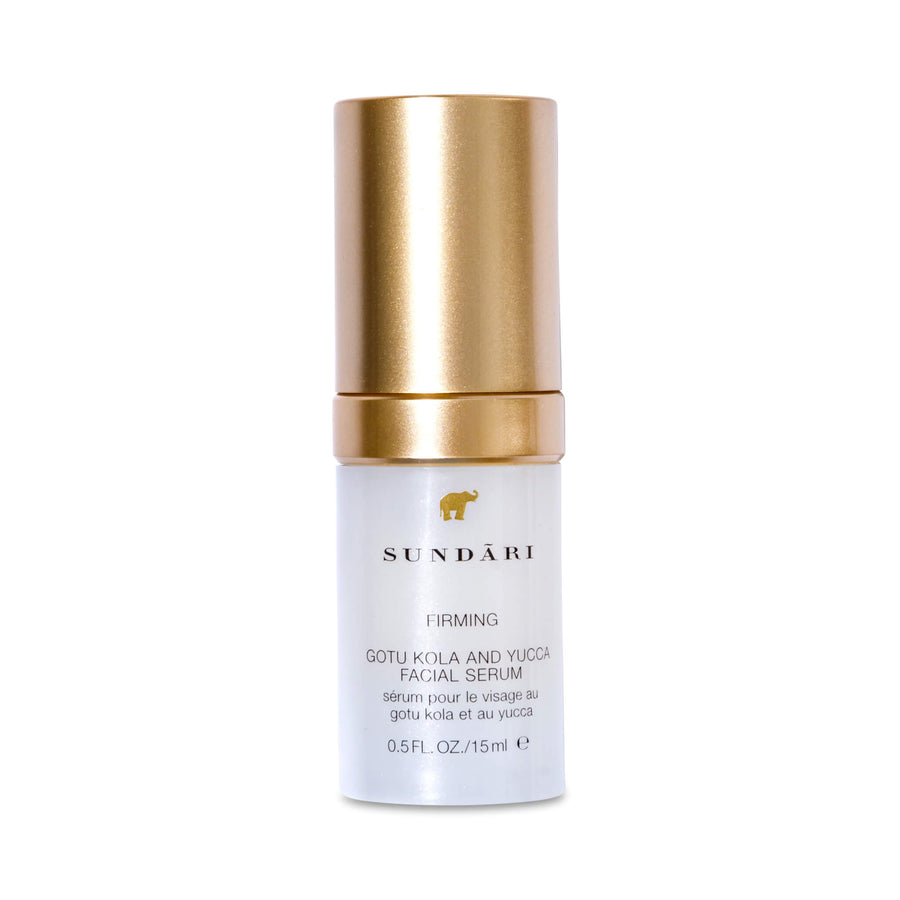

SUNDÃRI
Gotu Kola and Yucca Facial Serum

Gotu Kola and Yucca Facial Serum
SUNDÃRI
gotu-kola-and-yucca-facial-serum
Serum
9706839114021
Morning or Evening?
How often will you use this product?
Notes


Highlights
WHAT IS IT?
Facial serum with multiple ingredients
FEATURES
Firming, lifting, hydrating
BEST FOR
, seems suitable for multiple skin types
CHECKS
Free of parabens, sulfate, phthalates
Who Is It For?
Adults Both Men And WomenWhat Does It Help With?
Skin Firmness Hydration Tired SkinBudget
Mid-rangeHow To Use
Which routine should it be used in?
Instructions:
Key Information


What SUNDÃRI Says
Product Description:
An intense firming serum to stimulate and lift tired skin, improving skin firmness and dramatically increasing hydration. Gotu Kola, a traditional Ayurvedic herb, helps to firm and lift tired skin. Fortified with a unique technological peptide and biotechnologically produced purified algae extract to produce faster effects, this serum also contains skin renewing Yucca extract to promote a youthful look. Most people observe visible results within one week.
About the Brand:
Ingredients Overview
Ingredients List
aqua/water, algae extract, acetyl hexapeptide-8, caprylic/capric triglycerides, prunus armeniaca (apricot) kernel oil, glycerin, cetearyl wheat straw glycosides, cetearyl alcohol, dipalmitoyl hydroxyproline, squalane, coco glucoside, cocos nucifera (coconut) oil, yucca glauca root extract, lonicera japonica caprifolium extract, sclerotium gum, phenoxyethanol, octanediol, butyrospermum parkii (shea) butter, peg-400, bisabolol, santalum album (sandalwood) oil, tocopherol, cymbopogon martini (palmarosa) oil, aniba rosaeodora wood extract, pelargonium graveolens (geranium) flower oil, cananga odorata (ylang iylang) oil, ascorbyl palmitate, betaine, centella asiatica (gotu kola) extract, pogostemon cablin extract, boswellia carterii extract, ascorbic acid, citric acid
Key Ingredients
Gotu Kola, Yucca extract, algae extract, acetyl hexapeptide-8
Ingredients Details
Acetyl Hexapeptide-8
Common Name(s): Argireline plus,snap-6,acetyl glutamyl hexapeptide-3 modified
CAS Number: 616204-22-9
DESCRIPTION
What It Does: Inhibits neuromuscular acetylcholine release for reduced facial muscle contraction and expression line formation.
Why It's Used: Enhanced argireline analog with improved stability for formulations requiring optimized neuro-inhibiting anti-wrinkle performance.
How It Works: Competes with snap-25 protein for binding to the snare complex, reducing vesicular acetylcholine release at neuromuscular junctions. reduced acetylcholine binding decreases muscle contraction amplitude, reducing expression line depth with repeated use.
Typically Found In: Anti-wrinkle creams,expression line treatments,forehead/eye area products
TECHNICAL DETAILS
Primary Category: Active ingredient – neurotransmitter-inhibiting peptide
Secondary Functions: Enhanced snare inhibition,improved stability
Application Areas:

Facial Skincare

Body Care
Hair Care
Beard Care
Color Cosmetics (Makeup)
Dietary/Oral Supplements
Typical Concentration Range: 3–1000 ppm
SOURCING & ETHICS
Vegan Status: Yes – synthetic
Halal Status: Yes
Source Notes: Synthetically produced. encapsulation may improve delivery to neuromuscular junction.
SKIN COMPATIBILITY
Irritancy Rating: 1/5 – very low
Comedogenicity Rating: 0/5 – non-comedogenic
Sensitivity Concerns: Non-irritating.
Safe for Sensitive Skin: Yes
SAFETY & COMPATIBILITY
Safety Profile: Exceptional safety profile. ewg score: 1.
Works Well With: Hyaluronic acid,ceramides,retinol,moisturizers
Avoid Combining With: No significant incompatibilities
SCIENTIFIC NOTE
Hexapeptide-8 differs from argireline (hexapeptide-3) in its c-terminal modification that increases resistance to enzymatic degradation by skin proteases. this improved stability extends the bioavailability of the active peptide at the neuromuscular junction, potentially improving clinical anti-wrinkle efficacy vs the original argireline.
Last Verified: 2026-03-12
Primary Sources: Cosing database,lipotec argireline plus data
Algae Extract
Common Name(s): Algae extract,botanical extract,phytochemical active
CAS Number: N/a
DESCRIPTION
What It Does: Provides antioxidant protection from reactive oxygen species, reduces inflammatory cytokine production in skin, and conditions skin surface through the plant's secondary metabolite complex.
Why It's Used: Chosen for its natural origin narrative, traditional use heritage, and multi-functional phytochemical profile that supports several concurrent skin care claims from one ingredient.
How It Works: Polyphenols, terpenoids, and alkaloids in the extract scavenge ros via hydrogen atom transfer, inhibit nf-kb or cox-2 inflammatory pathways, and interact with skin surface proteins for conditioning.
Typically Found In: Botanical skin care,natural products
TECHNICAL DETAILS
Primary Category: Active ingredient – antioxidant
Secondary Functions: Free radical scavenging,anti-aging
Application Areas:
Facial Skincare
Body Care
Hair Care
Beard Care
Color Cosmetics (Makeup)
Dietary/Oral Supplements
Typical Concentration Range: 0.1%–10%
SOURCING & ETHICS
Vegan Status: Yes
Halal Status: Yes
Source Notes: Plant-derived extract or synthetic.
SKIN COMPATIBILITY
Irritancy Rating: 1/5 – very low
Comedogenicity Rating: 0/5 – non-comedogenic
Sensitivity Concerns: Non-irritating; well-tolerated.
Safe for Sensitive Skin: Yes
SAFETY & COMPATIBILITY
Safety Profile: Excellent safety profile. ewg score: 1.
Works Well With: Vitamin c,vitamin e,ferulic acid,spf,other antioxidants
Avoid Combining With: No significant incompatibilities
SCIENTIFIC NOTE
Plant secondary metabolites evolved as uv photoprotectants and antimicrobial agents — mechanisms that directly translate to cosmetic antioxidant and anti-inflammatory activity in human skin.
Last Verified: 2026-03-12
Primary Sources: Cosing database,algae extract botanical review
Cetearyl Alcohol
Common Name(s): Cetostearyl alcohol,c16-18 fatty alcohol
CAS Number: 8005-44-5
DESCRIPTION
What It Does: Provides fatty alcohol emulsification and thickening for stable, well-textured emulsions.
Why It's Used: The most widely used fatty alcohol in cosmetics – provides emulsification, thickening, and emolliency simultaneously from a single ingredient with excellent safety profile.
How It Works: Forms bilayer lamellar structures in water with emulsifiers creating a viscous structured network that thickens and stabilizes emulsions. fatty alcohol emolliency provides direct skin conditioning. bilayer formation reduces inter-droplet coalescence in emulsions.
Typically Found In: Creams,lotions,conditioners – virtually all emulsion products
TECHNICAL DETAILS
Primary Category: Functional ingredient – fatty alcohol emulsifier/thickener
Secondary Functions: Barrier sealing,softening
Application Areas:
Facial Skincare
Body Care
Hair Care
Beard Care
Color Cosmetics (Makeup)
Dietary/Oral Supplements
Typical Concentration Range: 1%–25%
SOURCING & ETHICS
Vegan Status: Yes - standard ethanol routes are non-animal; confirm denaturant origin
Halal Status: Conditional - ethanol production route and residual concentration; jurisdiction-dependent, refer to certifier stance
Source Notes: Plant-derived, synthetic or animal-derived. verify source. [audit 2026-07-29 rev2: ethanol pathway; determination depends on route, on whether the plant also produces beverage alcohol, and on residual concentration. determination requires shariah-panel sign-off.]
SKIN COMPATIBILITY
Irritancy Rating: 1/5 – very low
Comedogenicity Rating: 1/5 – low; formulation-dependent
Sensitivity Concerns: Non-irritating.
Safe for Sensitive Skin: Yes
SAFETY & COMPATIBILITY
Safety Profile: Excellent safety profile. ewg score: 1.
Works Well With: Humectants,ceramides,actives as carrier
Avoid Combining With: No significant incompatibilities
SCIENTIFIC NOTE
Cetearyl alcohol's ability to form lamellar liquid crystal structures ('krafft phases') with water and co-emulsifiers provides not only emulsion stability but also enhanced skin penetration via the lamellar skin barrier pathway. these crystalline structures can act as a reservoir for active ingredients, slowly releasing them as the lamellar structure melts on skin contact.
Last Verified: 2026-03-12
Primary Sources: Cosing database,cir safety assessment
Cetearyl Wheat Straw Glycosides
Common Name(s): Cetearyl wheat straw glycosides
DESCRIPTION
What It Does: Delivers targeted skin-conditioning or bioactive benefits through a specific mechanism of action suited to the formulation's intended purpose.
Why It's Used: Specialty actives address specific skin concerns through targeted molecular mechanisms, providing efficacy beyond what base formulation ingredients alone can achieve.
How It Works: The bioactive compound interacts with specific molecular targets in skin cells or the extracellular matrix — enzymes, receptors, structural proteins, or signaling molecules — triggering beneficial biological responses.
Typically Found In: Serums,treatments,moisturizers,specialty products
TECHNICAL DETAILS
Primary Category: Specialty actives
Secondary Functions: Skin-conditioning,anti-aging
Application Areas:
Facial Skincare
Body Care
Hair Care
Beard Care
Color Cosmetics (Makeup)
Dietary/Oral Supplements
Typical Concentration Range: 0.01–5%
SOURCING & ETHICS
Vegan Status: Conditional - supplier confirmation required
Halal Status: Unverified - supplier confirmation required
Source Notes: Specialty active ingredient; check individual sourcing for vegan status. [audit 2026-07-29 rev2: the record's own source_notes does not assert a non-animal origin, or instructs the reader to verify with the supplier; "yes" asserts knowledge the record does not hold. determination requires shariah-panel sign-off.]
SKIN COMPATIBILITY
Irritancy Rating: 1
Comedogenicity Rating: 0
Sensitivity Concerns: Low sensitization potential at recommended use concentrations.
Safe for Sensitive Skin: Yes
SAFETY & COMPATIBILITY
Safety Profile: Well-characterized cosmetic ingredient with established safety profile. generally non-irritating at typical use concentrations. suitable for leave-on and rinse-off cosmetics.
Works Well With: Niacinamide,hyaluronic acid,vitamin c,peptides
Avoid Combining With: Incompatible with oxidizing agents; check ph stability
SCIENTIFIC NOTE
Specialty actives typically work through enzyme inhibition (e.g., tyrosinase inhibition for brightening, mmp inhibition for anti-aging), receptor activation (e.g., retinoid receptors, ppar-γ for barrier genes), or transcription factor modulation (e.g., nrf2 for antioxidant gene upregulation). structure-activity relationships determine potency and selectivity.
Last Verified: 2025-01-15
Primary Sources: Cosing eu database; pcpc cosmetic ingredient safety reviews; ingredient-specific safety and efficacy literature