
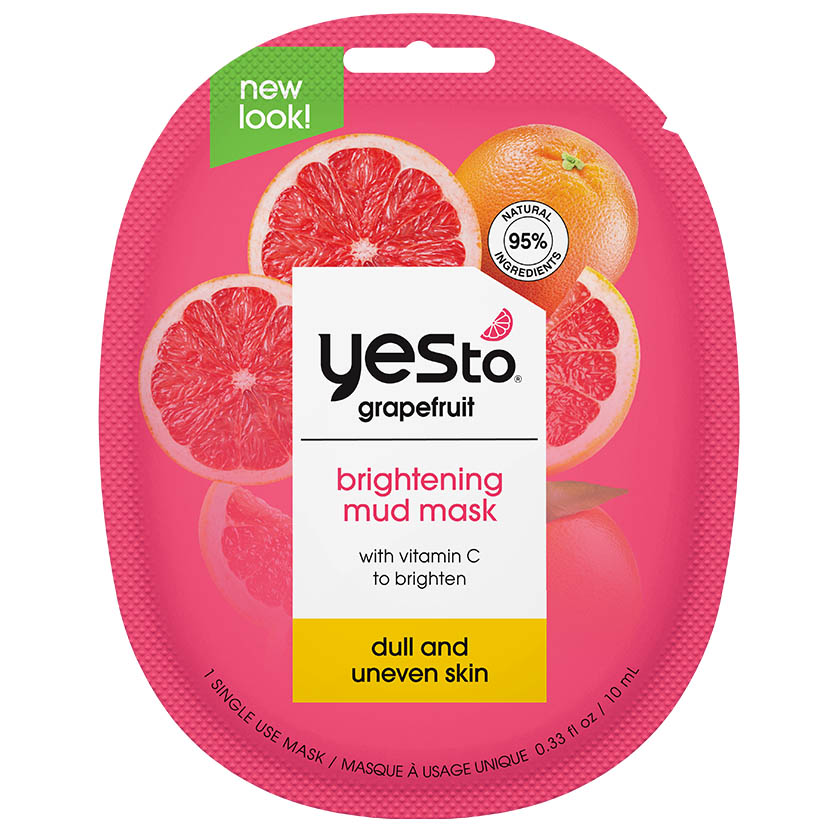

Yes To
grapefruit brightening mud mask with vitamin C to brighten dull and uneven skin _x0096_ single use

grapefruit brightening mud mask with vitamin C to brighten dull and uneven skin _x0096_ single use
Yes To
grapefruit-brightening-mud-mask-with-vitamin-c-to-brighten-dull-and-uneven-skin-single-use
Face Mask
9706833477925
Morning or Evening?
How often will you use this product?
Notes


Highlights
WHAT IS IT?
Single-use brightening mud mask
FEATURES
Enhances glow, minimizes pores and shine, illuminates skin, cleanses pores without stripping or drying
BEST FOR
Dull and uneven skin
CHECKS
Free of parabens, silicones, phthalates
Who Is It For?
AdultsWhat Does It Help With?
Brightens Dull Skin Evens Out Skin Tone Cleanses PoresBudget
AffordableHow To Use
Which routine should it be used in?
Instructions:
Key Information


What Yes To Says
Product Description:
Brighten your day with this mud mask formulated to enhance your glow while minimizing pores and shine. The single use mud mask illuminates skin with the help of antioxidant Grapefruit and the brightening power of Vitamin C, while Pink Kaolin Clay effectively cleanses pores without stripping or drying, leaving skin fresh and glowing. Recommended for adult use only.
About the Brand:
Ingredients Overview
Ingredients List
Water (Aqua), Aloe Barbadensis Leaf Juice, Kaolin, Bentonite, Propanediol, Hamamelis Virginiana (Witch Hazel) Water, Citrus Grandis (Grapefruit) Fruit Water, Cetearyl Alcohol, Magnesium Aluminum Silicate, Titanium Dioxide (CI 77891), Glyceryl Stearate, Hydrogenated Vegetable Glycerides, Polyglyceryl-10 Oleate, Citrus Paradisi (Grapefruit) Seed Oil, Citrus Grandis (Grapefruit) Fruit Extract, Vaccinium Myrtillus Fruit Extract, Saccharum Officinarum (Sugar Cane) Extract, Butyrospermum Parkii (Shea) Butter, Prunus Armeniaca (Apricot) Kernel Oil, Citrus Aurantium Dulcis (Orange) Fruit Extract, Citrus Limon (Lemon) Fruit Extract, Glycyrrhiza Glabra (Licorice) Root Extract, Acer Saccharum (Sugar Maple) Extract, Hydrolyzed Jojoba Esters, Illite, Montmorillonite, Ascorbyl Glucoside, Glycerin, Dipotassium Glycyrrhizate, Xanthan Gum, Glyceryl Caprylate, Tetrasodium Glutamate Diacetate, Ethylhexylglycerin, Citric Acid, Phenoxyethanol, Fragrance (Parfum), Limonene.
Key Ingredients
Grapefruit, Vitamin C, Pink Kaolin Clay
Ingredients Details
Aloe Barbadensis Leaf Juice
Common Name(s): Aloe barbadensis leaf juice,cosmetic active,functional ingredient
CAS Number: N/a
DESCRIPTION
What It Does: Delivers characteristic cosmetic function — skin conditioning, protection, preservation, or active biological benefit — at recommended use concentration.
Why It's Used: Selected for its functional contribution and formulation compatibility — supported by cosmetic science literature and regulatory safety assessment.
How It Works: Works through the mechanism of its molecular class — physicochemical interaction with the formulation or biological interaction with skin proteins, lipids, or receptors as documented in peer-reviewed literature.
Typically Found In: Skin care formulations
TECHNICAL DETAILS
Primary Category: Active ingredient – cosmetic active
Secondary Functions: Skin conditioning
Application Areas:

Facial Skincare

Body Care
Hair Care
Beard Care
Color Cosmetics (Makeup)
Dietary/Oral Supplements
Typical Concentration Range: 0.1%–10%
SOURCING & ETHICS
Vegan Status: Conditional - supplier confirmation required
Halal Status: Unverified - supplier confirmation required
Source Notes: Commercially produced for cosmetic use. verify vegan/halal status with supplier. [audit 2026-07-29 rev2: the record's own source_notes does not assert a non-animal origin, or instructs the reader to verify with the supplier; "yes" asserts knowledge the record does not hold. determination requires shariah-panel sign-off.]
SKIN COMPATIBILITY
Irritancy Rating: 1/5 – very low
Comedogenicity Rating: 0/5 – non-comedogenic
Sensitivity Concerns: Well-tolerated by most skin types.
Safe for Sensitive Skin: Yes
SAFETY & COMPATIBILITY
Safety Profile: Good safety profile at recommended concentrations. ewg score: 1–2.
Works Well With: Standard skincare actives
Avoid Combining With: No known significant incompatibilities
SCIENTIFIC NOTE
Aloe barbadensis leaf juice delivers documented functional benefit with an established safety profile within the cosmetic regulatory framework (cosing eu, cir usa).
Last Verified: 2026-03-12
Primary Sources: Cosing database,aloe barbadensis leaf juice technical literature
Bentonite
Common Name(s): Montmorillonite,volcanic ash clay,swelling clay
CAS Number: 1302-78-9
DESCRIPTION
What It Does: Provides thixotropic clay gellation and deep oil absorption from swelling smectite clay.
Why It's Used: Strongest adsorbing clay for deep cleansing masks – bentonite's high cation exchange capacity and swelling capacity provide the deepest oil and toxin adsorption of common cosmetic clays.
How It Works: Montmorillonite 2:1 layered silicate swells up to 15× in water via interlayer water absorption. very high cation exchange capacity (cec: 80-150 meq/100g) provides exceptional adsorption of cations, oils, and toxins. thixotropic gel provides 'mask that hardens' sensory experience.
Typically Found In: Clay masks,deep cleansing products,detoxifying formulas
TECHNICAL DETAILS
Primary Category: Functional ingredient – swelling clay mineral
Secondary Functions: Skin conditioning
Application Areas:
Facial Skincare
Body Care
Hair Care
Beard Care
Color Cosmetics (Makeup)
Dietary/Oral Supplements
Typical Concentration Range: 1%–25%
SOURCING & ETHICS
Vegan Status: Conditional - supplier confirmation required
Halal Status: Unverified - supplier confirmation required
Source Notes: Commercially produced for cosmetic use. verify vegan/halal status with supplier. [audit 2026-07-29 rev2: the record's own source_notes does not assert a non-animal origin, or instructs the reader to verify with the supplier; "yes" asserts knowledge the record does not hold. determination requires shariah-panel sign-off.]
SKIN COMPATIBILITY
Irritancy Rating: 1/5 – very low
Comedogenicity Rating: 0/5 – non-comedogenic
Sensitivity Concerns: Well-tolerated by most skin types.
Safe for Sensitive Skin: Yes
SAFETY & COMPATIBILITY
Safety Profile: Good safety profile at recommended concentrations. ewg score: 1–2.
Works Well With: Standard skincare actives
Avoid Combining With: No known significant incompatibilities
SCIENTIFIC NOTE
Bentonite's extraordinary swelling (up to 15× dry volume) arises from its 2:1 layer structure: sodium bentonite's inter-layer sodium cations attract very thick water shells, forcing the silicate layers apart by electrostatic repulsion. calcium bentonite swells only 2-3× by comparison, explaining why sodium-exchanged bentonite is the industrial standard for swelling applications.
Last Verified: 2026-03-12
Primary Sources: Cosing database,cir safety assessment
Cetearyl Alcohol
Common Name(s): Cetostearyl alcohol,c16-18 fatty alcohol
CAS Number: 8005-44-5
DESCRIPTION
What It Does: Provides fatty alcohol emulsification and thickening for stable, well-textured emulsions.
Why It's Used: The most widely used fatty alcohol in cosmetics – provides emulsification, thickening, and emolliency simultaneously from a single ingredient with excellent safety profile.
How It Works: Forms bilayer lamellar structures in water with emulsifiers creating a viscous structured network that thickens and stabilizes emulsions. fatty alcohol emolliency provides direct skin conditioning. bilayer formation reduces inter-droplet coalescence in emulsions.
Typically Found In: Creams,lotions,conditioners – virtually all emulsion products
TECHNICAL DETAILS
Primary Category: Functional ingredient – fatty alcohol emulsifier/thickener
Secondary Functions: Barrier sealing,softening
Application Areas:
Facial Skincare
Body Care
Hair Care
Beard Care
Color Cosmetics (Makeup)
Dietary/Oral Supplements
Typical Concentration Range: 1%–25%
SOURCING & ETHICS
Vegan Status: Yes - standard ethanol routes are non-animal; confirm denaturant origin
Halal Status: Conditional - ethanol production route and residual concentration; jurisdiction-dependent, refer to certifier stance
Source Notes: Plant-derived, synthetic or animal-derived. verify source. [audit 2026-07-29 rev2: ethanol pathway; determination depends on route, on whether the plant also produces beverage alcohol, and on residual concentration. determination requires shariah-panel sign-off.]
SKIN COMPATIBILITY
Irritancy Rating: 1/5 – very low
Comedogenicity Rating: 1/5 – low; formulation-dependent
Sensitivity Concerns: Non-irritating.
Safe for Sensitive Skin: Yes
SAFETY & COMPATIBILITY
Safety Profile: Excellent safety profile. ewg score: 1.
Works Well With: Humectants,ceramides,actives as carrier
Avoid Combining With: No significant incompatibilities
SCIENTIFIC NOTE
Cetearyl alcohol's ability to form lamellar liquid crystal structures ('krafft phases') with water and co-emulsifiers provides not only emulsion stability but also enhanced skin penetration via the lamellar skin barrier pathway. these crystalline structures can act as a reservoir for active ingredients, slowly releasing them as the lamellar structure melts on skin contact.
Last Verified: 2026-03-12
Primary Sources: Cosing database,cir safety assessment
Kaolin
Common Name(s): China clay,kaolinite,white cosmetic clay
CAS Number: 1332-58-7
DESCRIPTION
What It Does: Provides oil absorption and matting from the fine platelet clay structure.
Why It's Used: Most versatile cosmetic clay – gentle enough for sensitive skin while providing effective oil absorption, matting, and mineral conditioning.
How It Works: 1:1 layered silicate clay platelets absorb oils via capillary action in inter-platelet spaces. very mild ph (6-7). white colour from al-o-si lattice. fine particle size (0.5-4μm) provides gentle exfoliation and smooth texture. negative surface charge provides light skin conditioning.
Typically Found In: Masks,foundations,dry shampoo,mattifying products
TECHNICAL DETAILS
Primary Category: Functional ingredient – white clay mineral
Secondary Functions: Skin conditioning
Application Areas:
Facial Skincare
Body Care
Hair Care
Beard Care
Color Cosmetics (Makeup)
Dietary/Oral Supplements
Typical Concentration Range: 0.1%–50%
SOURCING & ETHICS
Vegan Status: Conditional - supplier confirmation required
Halal Status: Unverified - supplier confirmation required
Source Notes: Commercially produced for cosmetic use. verify vegan/halal status with supplier. [audit 2026-07-29 rev2: the record's own source_notes does not assert a non-animal origin, or instructs the reader to verify with the supplier; "yes" asserts knowledge the record does not hold. determination requires shariah-panel sign-off.]
SKIN COMPATIBILITY
Irritancy Rating: 1/5 – very low
Comedogenicity Rating: 0/5 – non-comedogenic
Sensitivity Concerns: Well-tolerated by most skin types.
Safe for Sensitive Skin: Yes
SAFETY & COMPATIBILITY
Safety Profile: Good safety profile at recommended concentrations. ewg score: 1–2.
Works Well With: Standard skincare actives
Avoid Combining With: No known significant incompatibilities
SCIENTIFIC NOTE
Kaolin's oil absorption mechanism involves genuine capillary condensation of oils into the inter-platelet micropores between its layered silicate sheets. the surface area of cosmetic-grade kaolin (10-30 m²/g) provides thousands of square meters of oil-adsorbing surface per gram – explaining its exceptional mattifying efficacy despite its inert mineral composition.
Last Verified: 2026-03-12
Primary Sources: Cosing database,cir safety assessment