

Korres
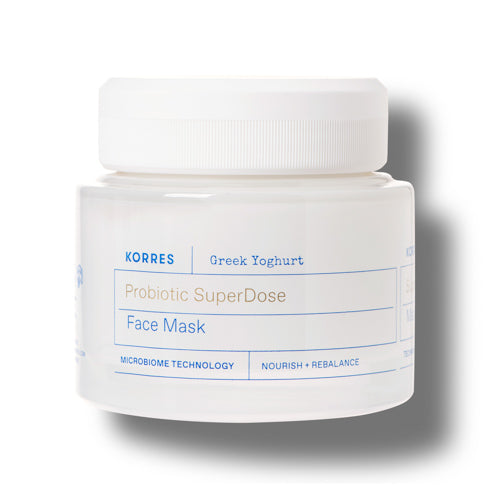
Greek Yoghurt Probiotic SuperDose Face Mask

Greek Yoghurt Probiotic SuperDose Face Mask
Korres
greek-yoghurt-probiotic-superdose-face-mask
Face Mask
9706858709285
Morning or Evening?
How often will you use this product?
Notes


Highlights
WHAT IS IT?
Face mask
FEATURES
Probiotic-rich, Greek yoghurt-based
BEST FOR
Sensitive skin
CHECKS
Clean formulation, free of mineral oils, silicones, parabens, propylene glycol, phthalates, sulfates
Who Is It For?
Suitable For Adults 18+ Both Women And MenWhat Does It Help With?
Hydration Skin Balancing Redness ReductionBudget
PremiumHow To Use
Which routine should it be used in?
Instructions:
Key Information


What Korres Says
Product Description:
A super-dosed Greek Yoghurt facial mask works as a total skin reset in less than 10 minutes, powered by more pre & probiotic rich real Greek Yoghurt than any other skincare product.
About the Brand:
Ingredients Overview
Ingredients List
AQUA/WATER/EAU, YOGURT, GLYCERIN, HEXYLDECYL STEARATE, DIISOSTEARYL MALATE, PRUNUS ARMENIACA (APRICOT) KERNEL OIL, SQUALANE, C14-22 ALCOHOLS, ISOAMYL LAURATE, PRUNUS AMYGDALUS DULCIS (SWEET ALMOND) OIL, ARACHIDYL ALCOHOL, PENTYLENE GLYCOL, BUTYROSPERMUM PARKII (SHEA) BUTTER, C10-18 TRIGLYCERIDES, PEG-100 STEARATE, ALOE BARBADENSIS LEAF JUICE POWDER, ALGIN, ALPHA-GLUCAN OLIGOSACCHARIDE, ARACHIDYL GLUCOSIDE, ASCORBYL PALMITATE, BEHENYL ALCOHOL, BISABOLOL, C12-20 ALKYL GLUCOSIDE, CAPRYLYL GLYCOL, CHLORELLA VULGARIS EXTRACT, DISODIUM PHOSPHATE, EPIGALLOCATECHIN GALLATYL GLUCOSIDE, ETHYLHEXYLGLYCERIN, GALLYL GLUCOSIDE, GLYCERYL POLYACRYLATE, HELIANTHUS ANNUUS (SUNFLOWER) SEED OIL, HYDROLYZED SODIUM HYALURONATE, HYDROXYETHYL ACRYLATE/SODIUM ACRYLOYLDIMETHYL TAURATE COPOLYMER, LACTIC ACID, LACTOBACILLUS, LAMINARIA DIGITATA EXTRACT, LECITHIN, LONICERA CAPRIFOLIUM (HONEYSUCKLE) FLOWER EXTRACT, LONICERA JAPONICA (HONEYSUCKLE) FLOWER EXTRACT, MALTODEXTRIN, MARIS AQUA/SEA WATER/EAU DE MER, ORYZA SATIVA (RICE) EXTRACT, PHENETHYL ALCOHOL, POLYMNIA SONCHIFOLIA ROOT JUICE, POLYSORBATE 60, POTASSIUM PHOSPHATE, PROPYL GALLATE, PULLULAN, SACCHARIDE ISOMERATE, SERINE, SODIUM CARBOXYMETHYL BETA-GLUCAN, SODIUM HYALURONATE, SODIUM POLYACRYLATE STARCH, SORBITAN ISOSTEARATE, TETRASODIUM GLUTAMATE DIACETATE, TOCOPHEROL, TREHALOSE, UREA, ZINGIBER OFFICINALE (GINGER) ROOT EXTRACT, BENZYL ALCOHOL, DEHYDROACETIC ACID, PHENOXYETHANOL.
Key Ingredients
Greek Yoghurt, Probiotics, Apricot Kernel Oil, Sweet Almond Oil, Shea Butter, Aloe Barbadensis Leaf Juice Powder
Ingredients Details
C14-22 Alcohols
Common Name(s): Fatty alcohol,co-emulsifier thickener,emollient emulsion stabiliser
CAS Number: N/a
DESCRIPTION
What It Does: Thickens o/w emulsions by forming a lamellar crystal gel network with nonionic emulsifiers, provides co-emulsifier activity at the oil-water interface, and conditions skin from the c16-c18 chain's sc lipid compatibility.
Why It's Used: Fatty alcohols are irreplaceable in conventional o/w cream formulation — the lamellar gel network they form with peg emulsifiers provides the thick, stable cream texture that consumers expect, while delivering emolliency unavailable from wax-only structuring.
How It Works: Cetyl/stearyl alcohol packs into α-gel or β-gel crystal phases with peg surfactants (ceteareth-20, polysorbates) at 60–80°c, forming an ordered lamellar bilayer network on cooling. this network provides zero-shear viscosity (cream texture) and mechanical emulsion stability simultaneously — the fundamental mechanism of classical o/w cream formulation.
Typically Found In: Creams,lotions,o/w emulsions
TECHNICAL DETAILS
Primary Category: Functional ingredient – emollient
Secondary Functions: Barrier sealing,softening
Application Areas:

Facial Skincare
Body Care
Hair Care

Beard Care
Color Cosmetics (Makeup)
Dietary/Oral Supplements
Typical Concentration Range: 1%–15%
SOURCING & ETHICS
Vegan Status: Yes
Halal Status: Yes
Source Notes: Plant-derived, synthetic or animal-derived. verify source.
SKIN COMPATIBILITY
Irritancy Rating: 1/5 – very low
Comedogenicity Rating: 1/5 – low; formulation-dependent
Sensitivity Concerns: Non-irritating.
Safe for Sensitive Skin: Yes
SAFETY & COMPATIBILITY
Safety Profile: Excellent safety profile. ewg score: 1.
Works Well With: Humectants,ceramides,actives as carrier
Avoid Combining With: No significant incompatibilities
SCIENTIFIC NOTE
The fatty alcohol + peg emulsifier ratio is critical: 1:3 (fatty alcohol:peg emulsifier by weight) typically provides optimal lamellar gel network formation and cream texture. deviating from this ratio shifts the phase structure from lamellar gel to micellar, reducing viscosity.
Last Verified: Cosing database,fatty alcohol lamellar gel cream texture review
Primary Sources: 2026-03-12
Diisostearyl Malate
Common Name(s): Diisostearyl malate,cosmetic active,functional ingredient
CAS Number: N/a
DESCRIPTION
What It Does: Delivers characteristic cosmetic function at recommended use concentration.
Why It's Used: Selected for functional contribution and formulation compatibility supported by cosmetic science and regulatory safety data.
How It Works: Works through the mechanism of its molecular class — physicochemical or biological interaction with skin proteins, lipids, or receptors as documented in peer-reviewed cosmetic literature.
Typically Found In: Skin care formulations
TECHNICAL DETAILS
Primary Category: Active ingredient – cosmetic active
Secondary Functions: Skin conditioning
Application Areas:
Facial Skincare
Body Care
Hair Care
Beard Care
Color Cosmetics (Makeup)
Dietary/Oral Supplements
Typical Concentration Range: 0.1%–10%
SOURCING & ETHICS
Vegan Status: Conditional
Halal Status: Yes
Source Notes: Commercially produced for cosmetic use. verify vegan/halal status with supplier.
SKIN COMPATIBILITY
Irritancy Rating: 1/5 – very low
Comedogenicity Rating: 0/5 – non-comedogenic
Sensitivity Concerns: Well-tolerated by most skin types.
Safe for Sensitive Skin: Yes
SAFETY & COMPATIBILITY
Safety Profile: Good safety profile at recommended concentrations. ewg score: 1–2.
Works Well With: Standard skincare actives
Avoid Combining With: No known significant incompatibilities
SCIENTIFIC NOTE
Diisostearyl malate has an established safety and efficacy profile within the cosmetic regulatory framework at standard use concentrations.
Last Verified: Cosing database,diisostearyl malate technical literature
Primary Sources: 2026-03-12
Glycerin
Common Name(s): Glycerol,glycerine,1,2,3-propanetriol
CAS Number: 56-81-5
DESCRIPTION
What It Does: Glycerin pulls water from the environment and deeper skin layers into the outer skin layer (epidermis), boosting moisture levels and keeping skin soft, smooth, and plump.
Why It's Used: It is used in virtually every moisturizer, serum, and cleanser because it is highly effective at hydrating skin, is well-tolerated by all skin types, and enhances the texture and spreadability of formulations.
How It Works: As a humectant, glycerin forms hydrogen bonds with water molecules, trapping them in the skin. it also reinforces the skin barrier by integrating into lipid structures between skin cells.
Typically Found In: Moisturizers,serums,cleansers,toners,sheet masks,sunscreens,body lotions,shampoos,conditioners
TECHNICAL DETAILS
Primary Category: Humectant
Secondary Functions: Skin barrier support,emollient,solvent
Application Areas:
Facial Skincare
Body Care
Hair Care
Beard Care
Color Cosmetics (Makeup)
Dietary/Oral Supplements
Typical Concentration Range: 1%–30% (typical: 3–10%)
SOURCING & ETHICS
Vegan Status: Yes – plant-derived (coconut, soy, palm) or synthetic
Halal Status: Yes – when plant-derived or synthetic; verify source with supplier
Source Notes: Derived from plant oils via hydrolysis or saponification; synthetic versions also available. palm-derived glycerin carries sustainability concerns.
SKIN COMPATIBILITY
Irritancy Rating: 1/5 – very low; non-irritating at all standard concentrations
Comedogenicity Rating: 0/5 – non-comedogenic
Sensitivity Concerns: Extremely rare allergic reactions; generally safe for all skin types including sensitive and baby skin
Safe for Sensitive Skin: Yes
SAFETY & COMPATIBILITY
Safety Profile: Widely recognized as safe. ewg hazard score: 1. no significant concerns for irritation, sensitization, or toxicity at typical concentrations (up to 50%).
Works Well With: Hyaluronic acid,ceramides,niacinamide,panthenol,urea,peptides,retinol,ahas/bhas
Avoid Combining With: No known incompatibilities at standard concentrations
SCIENTIFIC NOTE
Glycerin is an endogenous skin component found naturally in the stratum corneum. aquaporin-3 channels in keratinocytes facilitate glycerin transport, making it integral to natural skin hydration pathways.
Last Verified: Cosing database,cir safety assessment,ewg skin deep,inci decoder
Primary Sources: 2026-03-12
Hexyldecyl Stearate
Common Name(s): Hexyldecyl stearate,hexyldecanol (branched c16) stearic acid (c18) ester
DESCRIPTION
What It Does: Softens and conditions skin with a light, non-greasy feel.
Why It's Used: Used for its semi-solid non-greasy branched ester; non-crystallizing; widely used premium emollient emollient properties; suitable for lightweight skin care where non-greasy texture is key.
How It Works: Ester of hexyldecanol (branched c16) (branched or specialty alcohol) with stearic acid (c18); branching reduces crystallinity and greasiness; provides smooth, dry-oil skin feel.
Typically Found In: Lightweight moisturizers,sunscreens,skin serums,body lotions
TECHNICAL DETAILS
Primary Category: Functional ingredient – emollient
Secondary Functions: Skin conditioning,texture modification,spreading agent
Application Areas:
Facial Skincare
Body Care
Hair Care
Beard Care
Color Cosmetics (Makeup)
Dietary/Oral Supplements
Typical Concentration Range: 0.5%–10%
SOURCING & ETHICS
Vegan Status: Yes
Halal Status: Yes
Source Notes: Hexyldecanol (branched c16) and stearic acid (c18); plant or synthetic origin.
SKIN COMPATIBILITY
Irritancy Rating: 1/5 – very low
Comedogenicity Rating: 1/5 – low
Sensitivity Concerns: Generally well tolerated.
Safe for Sensitive Skin: Yes
SAFETY & COMPATIBILITY
Safety Profile: Good safety profile. ewg score: 1.
Works Well With: Other emollients,silicones,natural oils,humectants
Avoid Combining With: No significant incompatibilities
SCIENTIFIC NOTE
Hexyldecyl stearate: branched c16 hexyldecanol + c18 stearate; semi-solid at room temperature but non-crystallizing due to branching; very widely used premium emollient in skin care and color cosmetics for its elegant, non-greasy feel.
Last Verified: Cosing database,inci dictionary
Primary Sources: 2026-03-28
