

HADA LABO
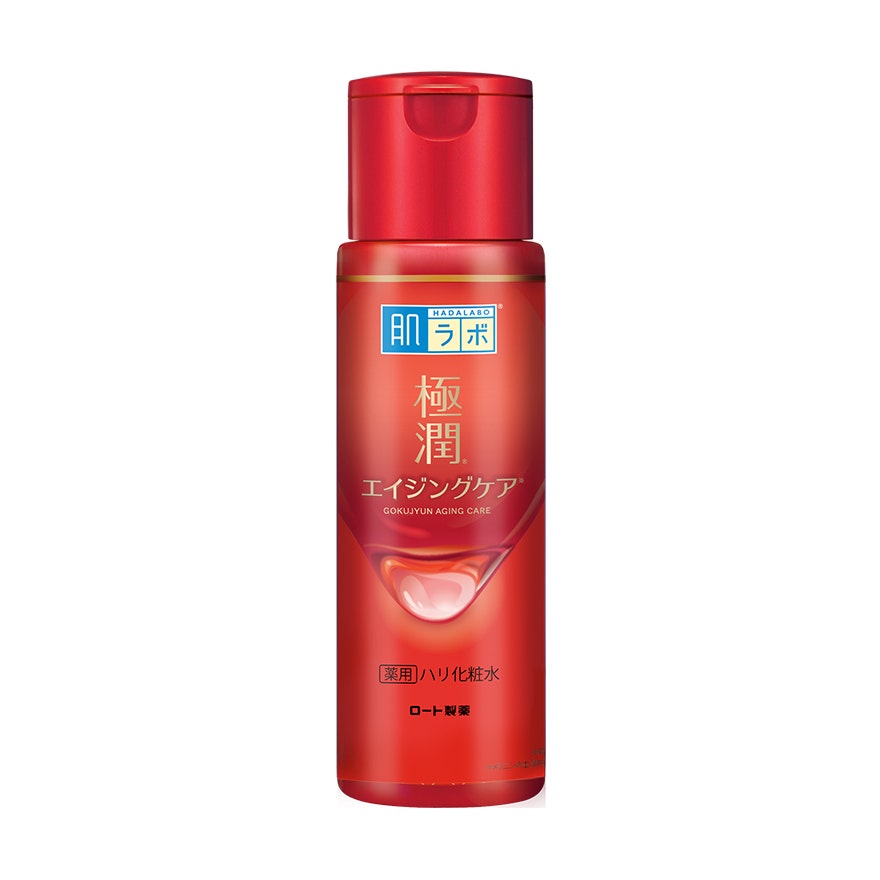
Hada Labo Aging Care Lotion 170Ml

Hada Labo Aging Care Lotion 170Ml
HADA LABO
hada-labo-aging-care-lotion-170ml
Moisturize
10084962697509
Morning or Evening?
How often will you use this product?
Notes


Highlights
WHAT IS IT?
Lotion with multiple types of hyaluronic acid and niacinamide
FEATURES
Minimizes fine lines, brightens dull skin, deeply hydrates skin layers, pH balanced, gentle on delicate skin, free of alcohol, paraben, fragrance, colourant, and mineral oil
BEST FOR
sensitive
CHECKS
Alcohol, Paraben, Fragrance, Colourant, Mineral oil
Who Is It For?
What Does It Help With?
Fine Lines Dull Skin Hydration Aging SignsBudget
Mid-range ($30-$75)How To Use
Which routine should it be used in?
Instructions:
Key Information

What HADA LABO Says
Product Description:
Hada Labo Aging Care Lotion contains Niacinamide and 3 types of Hyaluronic Acid to improve the key signs of aging and reveal a more lifted, youthful radiance and smoother skin. Contains Niacinamide to minimize fine lines and brighten dull skin. Contains 3 types of Hyaluronic Acid to deeply hydrate skin from surface to inner skin layers for significantly soft and supple skin. Skin pH balanced. Gentle on delicate skin. Free of alcohol, paraben, fragrance, colourant and mineral oil.
About the Brand:
Ingredients Overview
Ingredients List
Water,Butylene-Glycol,Glycerin,Niacinamide,Pentylene-Glycol,Hydrogenated-Poly(C6-14-Olefin),PEG-32,PEG-6,PPG-6-Decyltetradeceth-30,Phenoxyethanol,Beheneth-30,Limnanthes-Alba-(Meadowfoam)-Seed-Oil,Carbomer,Triethanolamine,Disodium-EDTA,Hydroxyethylcellulose,Phellodendron-Amurense-Bark-Extract,Sodium-Acetylated-Hyaluronate,Sodium-Hyaluronate,Acetyl-Glucosamine,Hydrolyzed-Hyaluronic-Acid
Key Ingredients
Niacinamide,Sodium-Acetylated-Hyaluronate,Sodium-Hyaluronate,Acetyl-Glucosamine,Hydrolyzed-Hyaluronic-Acid
Ingredients Details
Beheneth-30
Common Name(s): Beheneth-30,c18 fatty alcohol 30-mole ethoxylate,nonionic o/w emulsifier
CAS Number: N/a
DESCRIPTION
What It Does: Beheneth-30 stabilises emulsions and builds cream viscosity by forming a packed, oriented monolayer at the oil-water interface alongside creating a lamellar crystal gel network in the water phase (at moderate eo counts) — the combination provides both thermodynamic emulsion stability and the thick, elegant texture expected in premium skin creams and lotions.
Why It's Used: Formulators select beheneth-30 because the eo count (30) provides a defined hlb, and the c18 saturated chain provides a solid, waxy structure that contributes to emulsion thickening through gel network formation. at eo counts of 2–10, the stearyl chain packs into ordered crystalline bilayers at the oil-water interface — a 'liquid crystalline' interfacial film that acts as a mechanical barrier to droplet coalescence while simultaneously building viscosity from the lamellar gel structure in the continuous phase. this combination of thermodynamic and mechanical stabilisation produces the characteristic thick, stable cream texture of classic o/w cosmetic emulsions.
How It Works: Beheneth-30 functions through two simultaneous mechanisms: (1) interfacial adsorption — the c18 stearyl chain anchors into the oil droplet surface while the 30-unit peo chain extends into the water phase, sterically preventing droplet coalescence; (2) lamellar gel network formation — at moderate eo counts, the stearyl chains of adjacent surfactant molecules interdigitate into parallel bilayers in the water phase forming a crystalline gel network that provides viscosity and mechanical emulsion stability. the gel network builds as the emulsion cools from processing temperature, creating the characteristic 'cream texture set' that formulators experience when a cream thickens on cooling. the hlb of the 30-eo version (approximately 14) positions it in the o/w emulsification range.
Typically Found In: Creams,lotions,o/w emulsion bases
TECHNICAL DETAILS
Primary Category: Active ingredient – cosmetic active
Secondary Functions: Skin conditioning
Application Areas:

Facial Skincare

Body Care
Hair Care
Beard Care
Color Cosmetics (Makeup)
Dietary/Oral Supplements
Typical Concentration Range: 1%–15%
SOURCING & ETHICS
Vegan Status: Yes
Halal Status: Yes
Source Notes: Commercially produced for cosmetic use. verify vegan/halal status with supplier.
SKIN COMPATIBILITY
Irritancy Rating: 1/5 – very low
Comedogenicity Rating: 0/5 – non-comedogenic
Sensitivity Concerns: Well-tolerated by most skin types.
Safe for Sensitive Skin: Yes
SAFETY & COMPATIBILITY
Safety Profile: Good safety profile at recommended concentrations. ewg score: 1–2.
Works Well With: Standard skincare actives
Avoid Combining With: No known significant incompatibilities
SCIENTIFIC NOTE
Lamellar gel thickening at moderate eo: steareth-2 and steareth-10 form ordered lamellar crystal phases in the water phase — the c18 chains pack in parallel bilayers separated by peg water layers. this three-dimensional liquid crystal network provides zero-shear viscosity and yield stress (cream texture) while remaining shear-thinnable (spreads on application). higher eo versions (steareth-20+) become too hydrophilic to form lamellar crystals, functioning purely as o/w emulsifiers without gel thickening — the eo count controls the mechanism shift between thickening and pure emulsification within one chemical series.
Last Verified: Cosing database,beheneth-30 steareth nonionic emulsifier review
Primary Sources: 2026-03-12
Carbomer
Common Name(s): Carbopol,polyacrylic acid,carboxyvinyl polymer
DESCRIPTION
What It Does: Provides transparent gel textures and thickening at very low concentrations via ph-responsive swelling.
Why It's Used: The most widely used gel thickener – provides crystal-clear, stable gels at concentrations as low as 0.1-0.5% with ph-controlled viscosity.
How It Works: Highly crosslinked polyacrylic acid remains tightly coiled at acidic ph. neutralization with naoh or triethanolamine ionizes carboxylic groups causing electrostatic repulsion that unfolds and swells the polymer coils, dramatically increasing viscosity. concentration-dependent thickening.
Typically Found In: Gels,serums,emulsions,sunscreens
TECHNICAL DETAILS
Primary Category: Functional ingredient – polyacrylic acid thickener
Secondary Functions: Skin conditioning
Application Areas:
Facial Skincare
Body Care
Hair Care
Beard Care
Color Cosmetics (Makeup)
Dietary/Oral Supplements
Typical Concentration Range: 0.1%–2%
SOURCING & ETHICS
Vegan Status: Yes – synthetic
Halal Status: Yes
Source Notes: Commercially produced for cosmetic use. verify vegan/halal status with supplier.
SKIN COMPATIBILITY
Irritancy Rating: 1/5 – very low
Comedogenicity Rating: 0/5 – non-comedogenic
Sensitivity Concerns: Well-tolerated by most skin types.
Safe for Sensitive Skin: Yes
SAFETY & COMPATIBILITY
Safety Profile: Good safety profile at recommended concentrations. ewg score: 1–2.
Works Well With: Standard skincare actives
Avoid Combining With: No known significant incompatibilities
SCIENTIFIC NOTE
Carbomer's ph-responsive swelling mechanism provides an elegant formulation control tool: a neutralized gel can be liquefied by ph reduction (adding acid) and re-thickened by reneutralization. this reversible rheology control allows two-phase products that mix on application without the need for mechanical emulsification.
Last Verified: Cosing database,cir safety assessment
Primary Sources: 2026-03-12
Glycerin
Common Name(s): Glycerol,glycerine,1,2,3-propanetriol
CAS Number: 56-81-5
DESCRIPTION
What It Does: Glycerin pulls water from the environment and deeper skin layers into the outer skin layer (epidermis), boosting moisture levels and keeping skin soft, smooth, and plump.
Why It's Used: It is used in virtually every moisturizer, serum, and cleanser because it is highly effective at hydrating skin, is well-tolerated by all skin types, and enhances the texture and spreadability of formulations.
How It Works: As a humectant, glycerin forms hydrogen bonds with water molecules, trapping them in the skin. it also reinforces the skin barrier by integrating into lipid structures between skin cells.
Typically Found In: Moisturizers,serums,cleansers,toners,sheet masks,sunscreens,body lotions,shampoos,conditioners
TECHNICAL DETAILS
Primary Category: Humectant
Secondary Functions: Skin barrier support,emollient,solvent
Application Areas:
Facial Skincare
Body Care
Hair Care
Beard Care
Color Cosmetics (Makeup)
Dietary/Oral Supplements
Typical Concentration Range: 1%–30% (typical: 3–10%)
SOURCING & ETHICS
Vegan Status: Yes – plant-derived (coconut, soy, palm) or synthetic
Halal Status: Yes – when plant-derived or synthetic; verify source with supplier
Source Notes: Derived from plant oils via hydrolysis or saponification; synthetic versions also available. palm-derived glycerin carries sustainability concerns.
SKIN COMPATIBILITY
Irritancy Rating: 1/5 – very low; non-irritating at all standard concentrations
Comedogenicity Rating: 0/5 – non-comedogenic
Sensitivity Concerns: Extremely rare allergic reactions; generally safe for all skin types including sensitive and baby skin
Safe for Sensitive Skin: Yes
SAFETY & COMPATIBILITY
Safety Profile: Widely recognized as safe. ewg hazard score: 1. no significant concerns for irritation, sensitization, or toxicity at typical concentrations (up to 50%).
Works Well With: Hyaluronic acid,ceramides,niacinamide,panthenol,urea,peptides,retinol,ahas/bhas
Avoid Combining With: No known incompatibilities at standard concentrations
SCIENTIFIC NOTE
Glycerin is an endogenous skin component found naturally in the stratum corneum. aquaporin-3 channels in keratinocytes facilitate glycerin transport, making it integral to natural skin hydration pathways.
Last Verified: Cosing database,cir safety assessment,ewg skin deep,inci decoder
Primary Sources: 2026-03-12
Hydroxyethylcellulose
Common Name(s): Hec,natrosol,ethylhydroxyethylcellulose
CAS Number: 9004-62-0
DESCRIPTION
What It Does: Provides non-ionic thickening compatible with anionic surfactants and electrolyte-containing formulations.
Why It's Used: Non-ionic cellulose thickener for surfactant systems where anionic/cationic thickener incompatibility is a concern.
How It Works: Hydroxyethyl substitution disrupts cellulose crystallinity enabling water solubility. non-ionic nature provides compatibility with anionic, cationic, and amphoteric surfactants. pseudoplastic rheology provides shear-thinning for dispensing. film formation from cellulose backbone.
Typically Found In: Shampoos,body washes,clear gels,surfactant systems
TECHNICAL DETAILS
Primary Category: Functional ingredient – cellulose thickener
Secondary Functions: Tewl reduction,skin plumping
Application Areas:
Facial Skincare
Body Care
Hair Care
Beard Care
Color Cosmetics (Makeup)
Dietary/Oral Supplements
Typical Concentration Range: 0.1%–3%
SOURCING & ETHICS
Vegan Status: Yes – from cellulose (plant)
Halal Status: Yes
Source Notes: Synthetic or naturally derived. excellent aqueous solubility.
SKIN COMPATIBILITY
Irritancy Rating: 1/5 – very low
Comedogenicity Rating: 0/5 – non-comedogenic
Sensitivity Concerns: Non-irritating; suitable for all skin types.
Safe for Sensitive Skin: Yes
SAFETY & COMPATIBILITY
Safety Profile: Excellent safety profile. ewg score: 1.
Works Well With: Ceramides,emollients,occlusives,glycerin,hyaluronic acid
Avoid Combining With: No significant incompatibilities
SCIENTIFIC NOTE
Hydroxyethylcellulose's non-ionic character is its primary differentiator from anionic carboxymethylcellulose – the absence of ionizable groups means hec maintains stable viscosity across ph 2-12 and at high electrolyte concentrations where carboxymethylcellulose destabilizes. this ionic independence makes hec the preferred cellulose thickener for acidic and salt-containing formulations.
Last Verified: Cosing database,ashland hec technical data,cir safety assessment
Primary Sources: 2026-03-12
