

First Aid Beauty
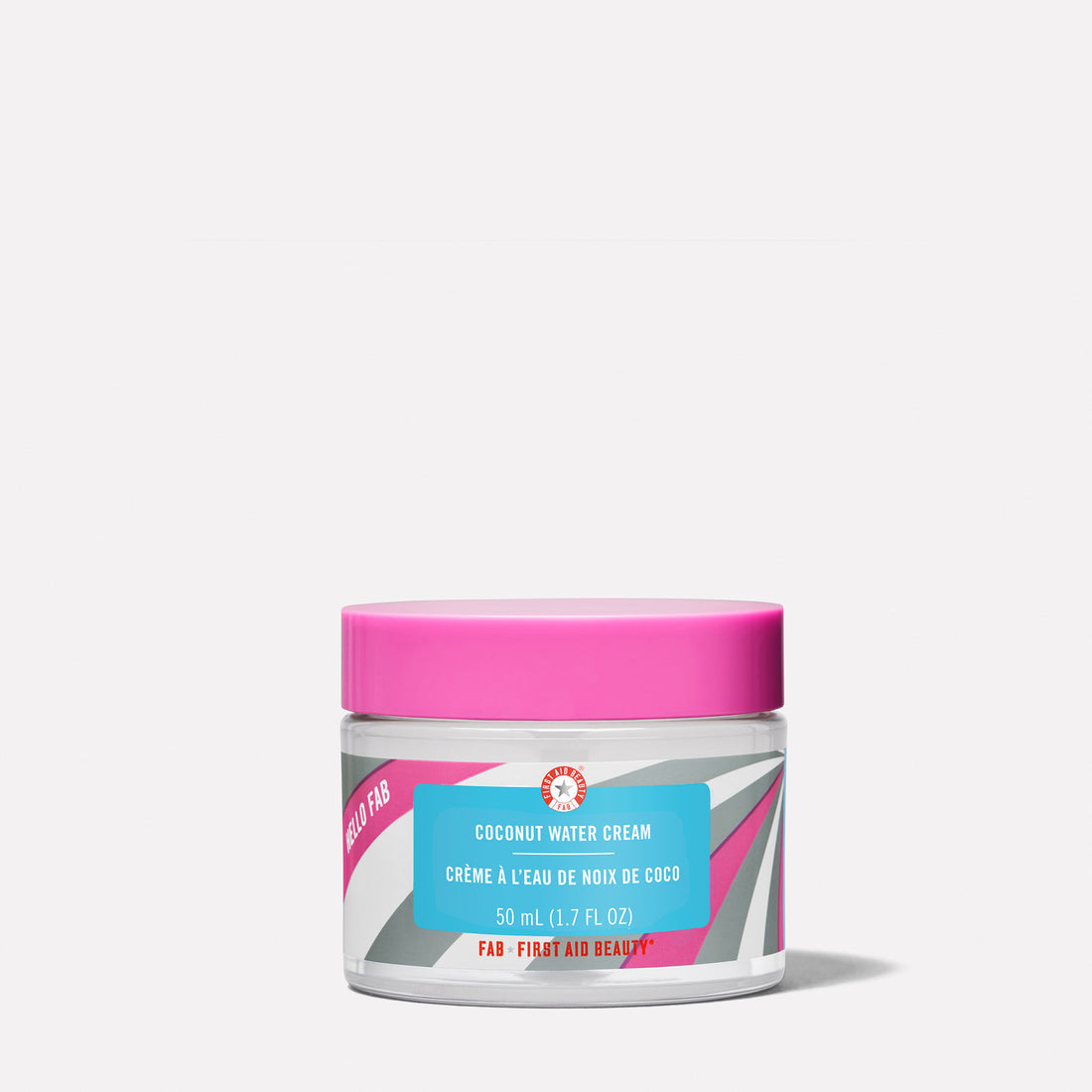
Hello FAB Coconut Water Cream

Hello FAB Coconut Water Cream
First Aid Beauty
hello-fab-coconut-water-cream
Moisturize
9706825777445
Morning or Evening?
How often will you use this product?
Notes


Highlights
WHAT IS IT?
A lightweight moisturizing cream
FEATURES
Helps hydrate, smooth and recharge
BEST FOR
Normal, Combination, Oily skin types
CHECKS
Free of paraben, sulfate, phthalates, artificial fragrances and dyes
Who Is It For?
Adults (18+) Both Women And MenWhat Does It Help With?
Hydration Smoothness SoftnessBudget
Mid-rangeHow To Use
Which routine should it be used in?
Instructions:
Key Information


What First Aid Beauty Says
Product Description:
A refreshingly light water cream infused with nourishing coconut water to hydrate your skin with a burst of weightless moisture.
About the Brand:
Ingredients Overview
Ingredients List
Cocos Nucifera (Coconut) Fruit Juice, Glucose, Maltodextrin, Aqua (Water, Eau), Dimethicone, Sodium Acrylate/Sodium Acryloyldimethyl Taurate Copolymer, Cocos Nucifera (Coconut) Fruit Extract, Sodium Hyaluronate, Alteromonas Ferment Filtrate, Pyrus Malus (Apple) Fruit Extract, Prunus Armeniaca (Apricot) Fruit Extract, Vanilla Planifolia Fruit Extract, Sea Salt (Maris Sal, Sal Marin), Lycium Barbarum Fruit Extract, Glycyrrhiza Glabra (Licorice) Root Extract, Chrysanthemum Parthenium (Feverfew) Extract, Camellia Sinensis Leaf Extract, Dipteryx Odorata Seed Extract, Coffea Arabica (Coffee) Seed Extract, Tocopherol, Caprylyl Glycol, Caprylic/Capric Triglyceride, Butylene Glycol, Hydrogenated Polydecene, Dipropylene Glycol, Cetyl Diglyceryl Tris(Trimethylsiloxy)silylethyl Dimethicone, Polysilicone-11, Laureth-8, Phenoxyethanol
Key Ingredients
Coconut Water, Sodium Hyaluronate, Alteromonas Ferment Filtrate
Ingredients Details
Alteromonas Ferment Filtrate
Common Name(s): Alteromonas ferment filtrate,alteromonas ferment filtrate,multi-organism postbiotic ferment,biotransformed active filtrate
CAS Number: N/a
DESCRIPTION
What It Does: Supports skin microbiome ph balance through organic acid production, delivers biotransformed actives with improved sc penetration, and provides microbiome-supportive metabolites from the multi-organism fermentation.
Why It's Used: Postbiotic ferments deliver microbiome-active benefits in a stable cosmetically preservable format — the specific organism determines the metabolite profile providing unique functionality beyond standard lab or yeast ferments.
How It Works: Multi-organism fermentation produces organism-specific metabolite profiles: enzyme biotransformation of substrate polyphenols to bioavailable aglycones, organic acid ph support, and unique organism-derived secondary metabolites providing the specific skin conditioning and bioactivity.
Typically Found In: Microbiome skin care,postbiotic anti-aging
TECHNICAL DETAILS
Primary Category: Active ingredient – skin microbiome support
Secondary Functions: Microbiome balance,prebiotic effect
Application Areas:

Facial Skincare

Body Care
Hair Care
Beard Care
Color Cosmetics (Makeup)
Dietary/Oral Supplements
Typical Concentration Range: 0.5%–15%
SOURCING & ETHICS
Vegan Status: Yes
Halal Status: Yes
Source Notes: Fermentation-derived or plant-extracted.
SKIN COMPATIBILITY
Irritancy Rating: 1/5 – very low
Comedogenicity Rating: 0/5 – non-comedogenic
Sensitivity Concerns: Non-irritating; beneficial for sensitive skin.
Safe for Sensitive Skin: Yes
SAFETY & COMPATIBILITY
Safety Profile: Excellent safety profile. ewg score: 1.
Works Well With: Ceramides,niacinamide,soothing actives
Avoid Combining With: No significant incompatibilities
SCIENTIFIC NOTE
Multi-organism ferments provide the most comprehensive biotransformation profiles — combining enzyme sets from different organisms enables complete substrate transformation unavailable from any single fermentation organism.
Last Verified: 2026-03-22
Primary Sources: Cosing database,multi-organism postbiotic ferment review
Cocos Nucifera (coconut) Fruit Extract
Common Name(s): Cocos nucifera (coconut) fruit extract,botanical extract,phytochemical active
CAS Number: N/a
DESCRIPTION
What It Does: Provides antioxidant protection from reactive oxygen species, reduces inflammatory cytokine production in skin, and conditions skin surface through the plant's secondary metabolite complex.
Why It's Used: Chosen for its natural origin narrative, traditional use heritage, and multi-functional phytochemical profile that supports several concurrent skin care claims from one ingredient.
How It Works: Polyphenols, terpenoids, and alkaloids in the extract scavenge ros via hydrogen atom transfer, inhibit nf-kb or cox-2 inflammatory pathways, and interact with skin surface proteins for conditioning.
Typically Found In: Botanical skin care,natural products
TECHNICAL DETAILS
Primary Category: Active ingredient – antioxidant
Secondary Functions: Free radical scavenging,anti-aging
Application Areas:
Facial Skincare
Body Care
Hair Care
Beard Care
Color Cosmetics (Makeup)
Dietary/Oral Supplements
Typical Concentration Range: 0.1%–10%
SOURCING & ETHICS
Vegan Status: Yes
Halal Status: Yes
Source Notes: Plant-derived extract or synthetic.
SKIN COMPATIBILITY
Irritancy Rating: 1/5 – very low
Comedogenicity Rating: 0/5 – non-comedogenic
Sensitivity Concerns: Non-irritating; well-tolerated.
Safe for Sensitive Skin: Yes
SAFETY & COMPATIBILITY
Safety Profile: Excellent safety profile. ewg score: 1.
Works Well With: Vitamin c,vitamin e,ferulic acid,spf,other antioxidants
Avoid Combining With: No significant incompatibilities
SCIENTIFIC NOTE
Plant secondary metabolites evolved as uv photoprotectants and antimicrobial agents — mechanisms that directly translate to cosmetic antioxidant and anti-inflammatory activity in human skin.
Last Verified: 2026-03-12
Primary Sources: Cosing database,cocos nucifera (coconut) fruit extr botanical review
Dimethicone
Common Name(s): Pdms,polydimethylsiloxane,silicone fluid
CAS Number: 9006-65-9
DESCRIPTION
What It Does: Provides silicone-characteristic silky feel and skin protection with adjustable viscosity.
Why It's Used: The benchmark cosmetic silicone – sets the gold standard for silky application feel, spreadability, and skin protection in virtually all skin care categories.
How It Works: Polydimethylsiloxane chain flexibility provides extremely low surface tension and high spreadability. inert si-o backbone provides chemical stability and excellent skin tolerance. occlusive film formation reduces tewl. higher viscosity grades provide more intense conditioning.
Typically Found In: Moisturizers,foundations,primers,sunscreens – nearly universal
TECHNICAL DETAILS
Primary Category: Functional ingredient – polydimethylsiloxane
Secondary Functions: Barrier sealing,softening
Application Areas:
Facial Skincare
Body Care
Hair Care
Beard Care
Color Cosmetics (Makeup)
Dietary/Oral Supplements
Typical Concentration Range: 0.1%–30%
SOURCING & ETHICS
Vegan Status: Conditional - supplier confirmation required
Halal Status: Unverified - supplier confirmation required
Source Notes: Plant-derived, synthetic or animal-derived. verify source. [audit 2026-07-29 rev2: the record's own source_notes does not assert a non-animal origin, or instructs the reader to verify with the supplier; "yes" asserts knowledge the record does not hold. determination requires shariah-panel sign-off.]
SKIN COMPATIBILITY
Irritancy Rating: 1/5 – very low
Comedogenicity Rating: 1/5 – low; formulation-dependent
Sensitivity Concerns: Non-irritating.
Safe for Sensitive Skin: Yes
SAFETY & COMPATIBILITY
Safety Profile: Excellent safety profile. ewg score: 1.
Works Well With: Humectants,ceramides,actives as carrier
Avoid Combining With: No significant incompatibilities
SCIENTIFIC NOTE
Dimethicone's exceptional silky feel arises from its very low intermolecular attractive forces (weak van der waals forces due to non-polar methyl groups) that allow silicone chains to slide freely over skin. the coefficient of kinetic friction for pdms against skin (~0.04) is among the lowest of any cosmetic material – explaining why even small amounts transform product feel.
Last Verified: 2026-03-12
Primary Sources: Cosing database,cir safety assessment
Glucose
Common Name(s): Glucose,cosmetic active,functional ingredient
CAS Number: N/a
DESCRIPTION
What It Does: Delivers characteristic cosmetic function at recommended use concentration.
Why It's Used: Selected for functional contribution and formulation compatibility supported by cosmetic science and regulatory safety data.
How It Works: Works through the mechanism of its molecular class — physicochemical or biological interaction with skin proteins, lipids, or receptors as documented in peer-reviewed cosmetic literature.
Typically Found In: Skin care formulations
TECHNICAL DETAILS
Primary Category: Active ingredient – cosmetic active
Secondary Functions: Skin conditioning
Application Areas:
Facial Skincare
Body Care
Hair Care
Beard Care
Color Cosmetics (Makeup)
Dietary/Oral Supplements
Typical Concentration Range: 0.1%–10%
SOURCING & ETHICS
Vegan Status: Conditional - supplier confirmation required
Halal Status: Unverified - supplier confirmation required
Source Notes: Commercially produced for cosmetic use. verify vegan/halal status with supplier. [audit 2026-07-29 rev2: the record's own source_notes does not assert a non-animal origin, or instructs the reader to verify with the supplier; "yes" asserts knowledge the record does not hold. determination requires shariah-panel sign-off.]
SKIN COMPATIBILITY
Irritancy Rating: 1/5 – very low
Comedogenicity Rating: 0/5 – non-comedogenic
Sensitivity Concerns: Well-tolerated by most skin types.
Safe for Sensitive Skin: Yes
SAFETY & COMPATIBILITY
Safety Profile: Good safety profile at recommended concentrations. ewg score: 1–2.
Works Well With: Standard skincare actives
Avoid Combining With: No known significant incompatibilities
SCIENTIFIC NOTE
Glucose has an established safety and efficacy profile within the cosmetic regulatory framework at standard use concentrations.
Last Verified: 2026-03-12
Primary Sources: Cosing database,glucose technical literature