
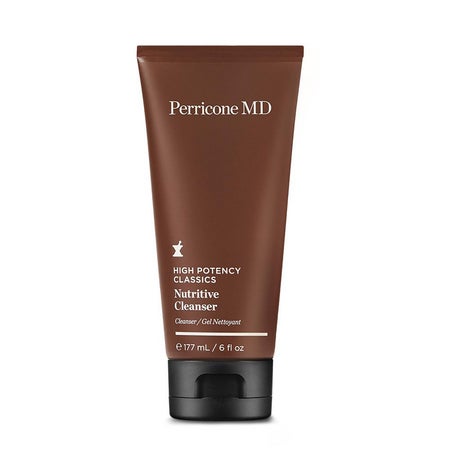

Perricone MD
High Potency Classics Nutritive Cleanser

High Potency Classics Nutritive Cleanser
Perricone MD
high-potency-classics-nutritive-cleanser
Cleanse
9643621843237
Morning or Evening?
How often will you use this product?
Notes


Highlights
WHAT IS IT?
Gel cleanser
FEATURES
Non-drying, skin softening and conditioning
BEST FOR
Normal to dry skin
CHECKS
Free from soy, gluten, fish, milk, phthalates, parabens, talc, and mineral oil
Who Is It For?
Adults (men And Women)What Does It Help With?
Removes Excess Oil Debris And Impurity BuildupBudget
Mid-rangeHow To Use
Which routine should it be used in?
Instructions:
Key Information


What Perricone MD Says
Product Description:
Gentle gel cleanser quickly and effectively removes excess oil, debris and impurity buildup without stripping the skin. Softens and conditions, leaving the skin looking and feeling refreshed, never dry or tight. Ideal for normal to dry skin.
About the Brand:
Ingredients Overview
Ingredients List
Water/Aqua/Eau, Sodium Laureth Sulfate, Cocamidopropyl Betaine, Lauryl Glucoside, PPG-2 Hydroxyethyl Coco/Isostearamide, Dimethyl MEA, Thioctic Acid, Fragrance/Parfum, Magnesium Aspartate, Zinc Gluconate, Ethylhexylglycerin, Copper Gluconate, Disodium EDTA, Sodium Chloride, Citric Acid, Phenoxyethanol
Key Ingredients
Alpha Lipoic Acid, Alpha Hydroxy Acids, Copper Complex
Ingredients Details
Cocamidopropyl Betaine
Common Name(s): Capb,cocoamidopropyl betaine,coconut betaine
CAS Number: 61789-40-0
DESCRIPTION
What It Does: Boosts foam, enhances mildness, and conditions skin and hair when combined with primary surfactants.
Why It's Used: The standard foam booster and mildness enhancer in virtually all shampoos, body washes, and facial cleansers – provides synergistic mildness improvement with anionic surfactants.
How It Works: Amphoteric (zwitterionic) character provides positive charge interaction with hair keratin for antistatic conditioning. reduces irritation of co-formulated anionic surfactants via ionic complex formation. foam stabilization via bilayer reinforcement in foam lamellae.
Typically Found In: Shampoos,body washes,facial cleansers,baby products
TECHNICAL DETAILS
Primary Category: Functional ingredient – amphoteric surfactant
Secondary Functions: Skin conditioning
Application Areas:

Facial Skincare
Body Care
Hair Care

Beard Care
Color Cosmetics (Makeup)
Dietary/Oral Supplements
Typical Concentration Range: 2%–15%
SOURCING & ETHICS
Vegan Status: Conditional - feedstock declaration required
Halal Status: Unverified - feedstock declaration required (plant, animal and petrochemical routes all exist)
Source Notes: Commercially produced for cosmetic use. verify vegan/halal status with supplier. [audit 2026-07-29 rev2: origin-dependent: the same inci exists in plant, animal and petrochemical versions and the name does not discriminate. determination requires shariah-panel sign-off.]
SKIN COMPATIBILITY
Irritancy Rating: 1/5 – very low
Comedogenicity Rating: 0/5 – non-comedogenic
Sensitivity Concerns: Well-tolerated by most skin types.
Safe for Sensitive Skin: Yes
SAFETY & COMPATIBILITY
Safety Profile: Good safety profile at recommended concentrations. ewg score: 1–2.
Works Well With: Standard skincare actives
Avoid Combining With: No known significant incompatibilities
SCIENTIFIC NOTE
Capb's mildness-enhancing synergy with sls has a molecular mechanism: capb's positive imidazoline head group forms an ion pair complex with sls's anionic sulfate group, reducing sls's free monomer concentration (the irritation-causing species) without significantly reducing micelle-forming capacity (the cleansing species).
Last Verified: 2026-03-12
Primary Sources: Cosing database,ananthapadmanabhan surfactant review,cir safety assessment
Dimethyl Mea
Common Name(s): Dmae,dimethylaminoethanol,membrane stabiliser anti-aging
CAS Number: N/a
DESCRIPTION
What It Does: Provides immediate skin firmness from the topical amine's interaction with skin surface proteins, reduces age-related lipofuscin accumulation in cell membranes through acetylcholine pathway enhancement, and conditions skin with mild surfactant activity.
Why It's Used: Dmae's dual immediate-effect (surface protein tightening) and long-term mechanism (membrane lipofuscin reduction) enables both instant and cumulative anti-aging claim support from one ingredient.
How It Works: Dmae as a membrane phospholipid precursor incorporates into cell membranes as dimethylethanolamine phospholipid, improving membrane fluidity and reducing cross-linked lipofuscin accumulation. at the skin surface, dmae's cationic amine group interacts with skin surface carboxylate groups creating mild surface contraction providing immediate firmness perception.
Typically Found In: Anti-aging firming,membrane health
TECHNICAL DETAILS
Primary Category: Active ingredient – antioxidant
Secondary Functions: Free radical scavenging,anti-aging
Application Areas:
Facial Skincare
Body Care
Hair Care
Beard Care
Color Cosmetics (Makeup)
Dietary/Oral Supplements
Typical Concentration Range: 0.5%–3%
SOURCING & ETHICS
Vegan Status: Conditional - supplier confirmation required
Halal Status: Unverified - supplier confirmation required
Source Notes: Plant-derived extract or synthetic. [audit 2026-07-29 rev2: status downgraded on audit. determination requires shariah-panel sign-off.]
SKIN COMPATIBILITY
Irritancy Rating: 1/5 – very low
Comedogenicity Rating: 0/5 – non-comedogenic
Sensitivity Concerns: Non-irritating; well-tolerated.
Safe for Sensitive Skin: Yes
SAFETY & COMPATIBILITY
Safety Profile: Excellent safety profile. ewg score: 1.
Works Well With: Vitamin c,vitamin e,ferulic acid,spf,other antioxidants
Avoid Combining With: No significant incompatibilities
SCIENTIFIC NOTE
Dmae penetration studies show significant transdermal absorption (significantly more than most cosmetic actives) — the cholinergic activity may have systemic implications at high concentrations. use at standard cosmetic concentrations (0.5–3%) is considered safe.
Last Verified: 2026-03-12
Primary Sources: Cosing database,dmae membrane stabiliser anti-aging review
Lauryl Glucoside
Common Name(s): C12 glucoside,dodecyl glucoside,apg surfactant
CAS Number: 110615-47-9
DESCRIPTION
What It Does: Provides mild, naturally-derived cleansing with excellent biodegradability from glucose and lauryl alcohol.
Why It's Used: The natural cleansing standard — lauryl glucoside's combination of renewability, biodegradability, mildness, and foaming makes it the benchmark natural surfactant for clean beauty facial cleansers.
How It Works: C12 alkyl chain provides cmc and foaming. glucose head group provides mild non-ionic/weakly anionic character from hydroxyl groups. very low irritation potential from polyol head group. excellent biodegradability >95% bod28 from glucoside hydrolysis. cosmos approved.
Typically Found In: Natural facial cleansers,baby shampoos,cosmos certified products
TECHNICAL DETAILS
Primary Category: Functional ingredient – alkyl glucoside surfactant
Secondary Functions: Skin conditioning
Application Areas:
Facial Skincare
Body Care
Hair Care
Beard Care
Color Cosmetics (Makeup)
Dietary/Oral Supplements
Typical Concentration Range: 2%–15%
SOURCING & ETHICS
Vegan Status: Conditional - supplier confirmation required
Halal Status: Unverified - supplier confirmation required
Source Notes: Commercially produced for cosmetic use. verify vegan/halal status with supplier. [audit 2026-07-29 rev2: the record's own source_notes does not assert a non-animal origin, or instructs the reader to verify with the supplier; "yes" asserts knowledge the record does not hold. determination requires shariah-panel sign-off.]
SKIN COMPATIBILITY
Irritancy Rating: 1/5 – very low
Comedogenicity Rating: 0/5 – non-comedogenic
Sensitivity Concerns: Well-tolerated by most skin types.
Safe for Sensitive Skin: Yes
SAFETY & COMPATIBILITY
Safety Profile: Good safety profile at recommended concentrations. ewg score: 1–2.
Works Well With: Standard skincare actives
Avoid Combining With: No known significant incompatibilities
SCIENTIFIC NOTE
Lauryl glucoside's mildness vs sls at equivalent foam performance is measurable by draize eye score: sls scores approximately 55 (mild irritant) while lauryl glucoside scores <15 (essentially non-irritant) in identical eye irritation testing. this quantitative mildness advantage explains why apg surfactants command premium pricing despite renewable/natural origin — actual performance superiority justifies the cost.
Last Verified: 2026-03-12
Primary Sources: Cosing database,cosmos standard,cir safety assessment
Magnesium Aspartate
Common Name(s): Mineral salt,ionic strength modifier,skin mineralising agent
CAS Number: N/a
DESCRIPTION
What It Does: Provides mineral ion delivery to skin, modulates formulation ionic strength for viscosity and stability optimisation, and supports skin enzyme activity through essential mineral cofactor supplementation.
Why It's Used: Mineral salts are essential formulation ph and ionic strength adjusters — magnesium sulfate specifically provides the mg²⁺ ions that activate transglutaminase crosslinking during sc cornification, supporting barrier formation.
How It Works: Ionic dissociation in aqueous formulation provides free ions that modulate polymer viscosity (ionic strength reduces charge-based thickener swelling), provide mineral nutrition to skin enzymes (ca²⁺ for transglutaminase, mg²⁺ for mgatp phosphotransferases), and adjust osmolality for skin-surface tonicity matching.
Typically Found In: All formulations,mineral skin care
TECHNICAL DETAILS
Primary Category: Active ingredient – mineral / metal active
Secondary Functions: Antimicrobial,sebum regulation,antioxidant enzyme cofactor
Application Areas:
Facial Skincare
Body Care
Hair Care
Beard Care
Color Cosmetics (Makeup)
Dietary/Oral Supplements
Typical Concentration Range: 0.01%–5%
SOURCING & ETHICS
Vegan Status: Yes – mineral
Halal Status: Yes
Source Notes: Mineral/inorganic compound. cosmetic or pharmaceutical grade.
SKIN COMPATIBILITY
Irritancy Rating: 1/5 – very low
Comedogenicity Rating: 0/5 – non-comedogenic
Sensitivity Concerns: Non-irritating at recommended concentrations.
Safe for Sensitive Skin: Yes at recommended concentrations
SAFETY & COMPATIBILITY
Safety Profile: Excellent safety profile at cosmetic concentrations. ewg score: 1–2.
Works Well With: Niacinamide,salicylic acid,other actives
Avoid Combining With: No significant incompatibilities at standard concentrations
SCIENTIFIC NOTE
Mg²⁺ and ca²⁺ are essential cofactors for the sc cornification process — ca²⁺ specifically drives the ca²⁺ gradient across the epidermis (high in outer sc, low in basal layer) that regulates keratinocyte differentiation through ca²⁺-calmodulin signalling.
Last Verified: 2026-03-12
Primary Sources: Cosing database,magnesium aspartate mineral salt formulation review