
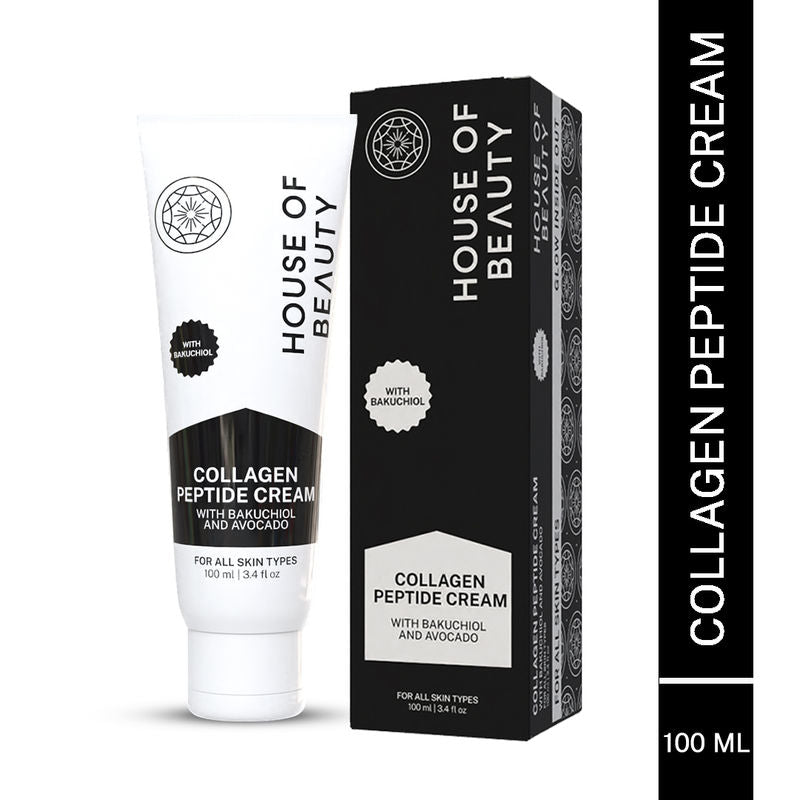

House Of Beauty
House Of Beauty Collagen Peptide Cream

House Of Beauty Collagen Peptide Cream
House Of Beauty
house-of-beauty-collagen-peptide-cream
Moisturize
10084957323557
Morning or Evening?
How often will you use this product?
Notes


Highlights
WHAT IS IT?
cream with 16 ingredients
FEATURES
Nourishing cream that reduces wrinkles and fine lines, contains collagen, bakuchiol, avocado oil, brilliant for anti-ageing and collagen boosting, keeps skin plumped and rejuvenated, cruelty-free
BEST FOR
combination
CHECKS
Who Is It For?
Ages 30 To 65 And Over All GendersWhat Does It Help With?
Wrinkles Fine Lines Pigmentation Melasma Signs Of Aging Nourishment Collagen Boosting Plumping RejuvenationBudget
Mid-range ($30-$75)How To Use
Which routine should it be used in?
Instructions:
Key Information


What House Of Beauty Says
Product Description:
A lightweight yet nourishing cream designed specifically for combination to dry skin. Ideal for individuals seeking minimal on-the-go skincare, aged 30 to 65 and over. Suitable for skin with wrinkles, pigmentation, melasma, or signs of aging. Formulated with 'bakuchiol,' a 100% natural, vegan-friendly, and non-irritating game-changer for anti-aging and nourishment. Enriched with avocado oil, rich in vitamin E, potassium, lecithin, and various nutrients that nourish and moisturize the skin. Features: Nourishing cream that reduces wrinkles and fine lines, infused with power ingredients like collagen, bakuchiol, and avocado. Brilliant for anti-ageing and collagen boosting. Keeps skin plumped and rejuvenated. Suitable for ages above 30 and all skin types. This product is cruelty-free.
About the Brand:
Ingredients Overview
Ingredients List
Collagen,Aloe-Vera-Extract,Hyaluronic-Acid,Rosehip-Oil,Avocado-Oil,Coconut-Oil,Cetyl-Alcohol,Vitamin-C,Green-Tea-Extract,Licorice-Extract,Chamomile-Extract,Lactic-Acid,Orange-Peel-Extract,Bakuchiol,Pomegranate-Oil,Vitamin-E
Key Ingredients
collagen,bakuchiol,avocado oil
Ingredients Details
Bakuchiol
Common Name(s): Bakuchiol,(s)-bakuchiol
CAS Number: 10309-37-2
DESCRIPTION
What It Does: Provides retinol-equivalent anti-aging gene expression from a natural plant compound without retinol's limitations.
Why It's Used: The natural retinol alternative — the first plant compound with rct evidence for equivalent anti-aging results to retinol with better safety and photostability.
How It Works: Bakuchiol activates rar beta and retinoid x receptors via allosteric binding mechanism. upregulates type i, iii, and iv collagen synthesis genes. downregulates mmp-1 and mmp-9. antioxidant via phenol radical scavenging. photostable — stable to uv exposure unlike retinol.
Typically Found In: Natural anti-aging serums,pregnancy-safe retinol alternative,photostable anti-aging
TECHNICAL DETAILS
Primary Category: Active ingredient – natural retinol alternative
Secondary Functions: Free radical scavenging,anti-aging
Application Areas:

Facial Skincare
Body Care

Hair Care
Beard Care
Color Cosmetics (Makeup)
Dietary/Oral Supplements
Typical Concentration Range: 0.5%–2%
SOURCING & ETHICS
Vegan Status: Yes – from psoralea corylifolia seeds
Halal Status: Yes
Source Notes: Plant-derived extract or synthetic.
SKIN COMPATIBILITY
Irritancy Rating: 1/5 – very low
Comedogenicity Rating: 0/5 – non-comedogenic
Sensitivity Concerns: Non-irritating; well-tolerated.
Safe for Sensitive Skin: Yes
SAFETY & COMPATIBILITY
Safety Profile: Excellent safety profile. ewg score: 1.
Works Well With: Vitamin c,vitamin e,ferulic acid,spf,other antioxidants
Avoid Combining With: No significant incompatibilities
SCIENTIFIC NOTE
The dhaliwal et al. (2019, british journal of dermatology) split-face rct directly compared 0.5% bakuchiol vs 0.5% retinol twice daily for 12 weeks — both groups showed equivalent reduction in fine lines and wrinkles, but bakuchiol showed significantly less scaling, stinging, and burning. this is the strongest evidence that bakuchiol provides retinol-equivalent anti-aging with better tolerability.
Last Verified: Cosing database,dhaliwal et al. bakuchiol vs retinol rct
Primary Sources: 2026-03-12
Collagen
Common Name(s): Collagen
DESCRIPTION
What It Does: Delivers targeted skin-conditioning or bioactive benefits through a specific mechanism of action suited to the formulation's intended purpose.
Why It's Used: Specialty actives address specific skin concerns through targeted molecular mechanisms, providing efficacy beyond what base formulation ingredients alone can achieve.
How It Works: The bioactive compound interacts with specific molecular targets in skin cells or the extracellular matrix — enzymes, receptors, structural proteins, or signaling molecules — triggering beneficial biological responses.
Typically Found In: Serums,treatments,moisturizers,specialty products
TECHNICAL DETAILS
Primary Category: Specialty actives
Secondary Functions: Skin-conditioning,anti-aging
Application Areas:
Facial Skincare
Body Care
Hair Care
Beard Care
Color Cosmetics (Makeup)
Dietary/Oral Supplements
Typical Concentration Range: 0.01–5%
SOURCING & ETHICS
Vegan Status: No
Halal Status: Conditional
Source Notes: Contains animal-derived components (collagen...); not suitable for vegan formulations.
SKIN COMPATIBILITY
Irritancy Rating: 1
Comedogenicity Rating: 0
Sensitivity Concerns: Low sensitization potential at recommended use concentrations.
Safe for Sensitive Skin: Conditional
SAFETY & COMPATIBILITY
Safety Profile: Well-characterized cosmetic ingredient with established safety profile. generally non-irritating at typical use concentrations. suitable for leave-on and rinse-off cosmetics.
Works Well With: Niacinamide,hyaluronic acid,vitamin c,peptides
Avoid Combining With: Incompatible with oxidizing agents; check ph stability
SCIENTIFIC NOTE
Specialty actives typically work through enzyme inhibition (e.g., tyrosinase inhibition for brightening, mmp inhibition for anti-aging), receptor activation (e.g., retinoid receptors, ppar-γ for barrier genes), or transcription factor modulation (e.g., nrf2 for antioxidant gene upregulation). structure-activity relationships determine potency and selectivity.
Last Verified: Cosing eu database; pcpc cosmetic ingredient safety reviews; ingredient-specific safety and efficacy literature
Primary Sources: 2025-01-15
