
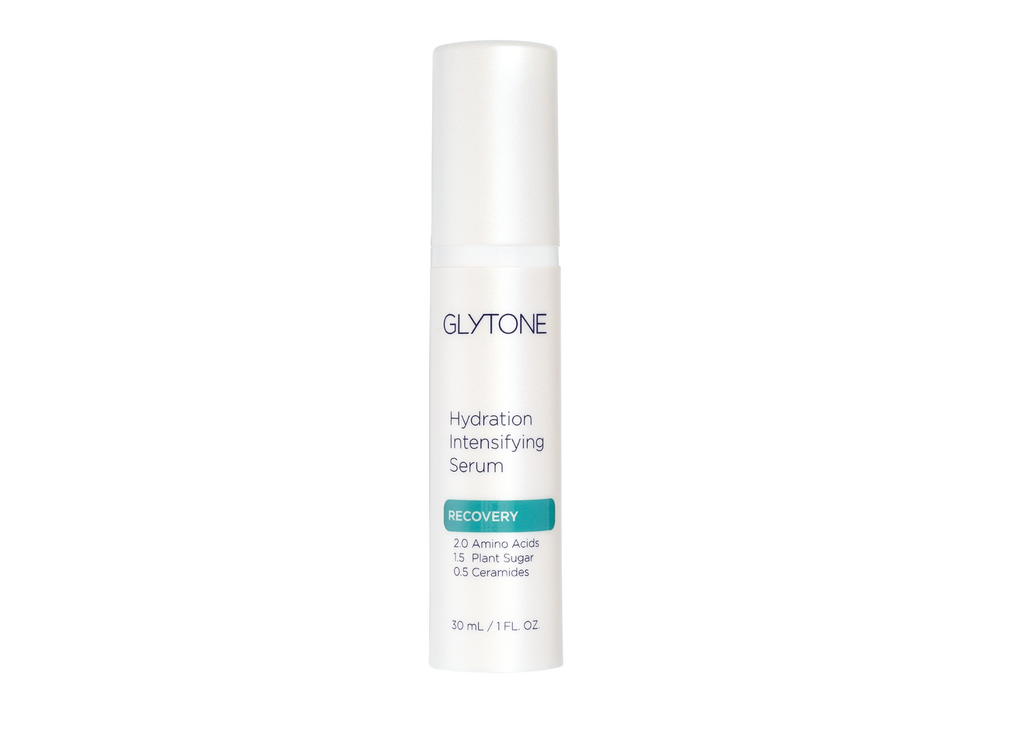

Glytone
Hydration Intensifying Serum

Hydration Intensifying Serum
Glytone
hydration-intensifying-serum
Serum
9706801922341
Morning or Evening?
How often will you use this product?
Notes


Highlights
WHAT IS IT?
A hydrating serum with 21 ingredients
FEATURES
Boosts water content, maintains skin's natural barrier, leaves skin smooth and hydrated
BEST FOR
Normal To Dry Skin
CHECKS
Paraben-free
Who Is It For?
Adults Women And MenWhat Does It Help With?
Dry Skin Dehydrated SkinBudget
Mid-rangeHow To Use
Which routine should it be used in?
Instructions:
Key Information


What Glytone Says
Product Description:
This serum boosts water content while maintaining skin's natural barrier for a revitalized complexion. A combination of Plant Sugars, Ceramides and Amino Acids leave dehydrated skin feeling smooth, soothed and hydrated.
About the Brand:
Ingredients Overview
Ingredients List
Aqua (Water), Isodecyl Neopentanoate, Methylpropanediol, Methyl Methacrylate Crosspolymer, Prunus Domestica Seed Extract, Hydroxyethyl Acrylate/Sodium Acryloyldimethyl Taurate Copolymer, Xylitylglucoside, Polyacrylate Crosspolymer-6, Sodium Cocoyl Amino Acids, Anhydroxylitol, Sodium Benzoate, Glycosphingolipids, Allantoin, Potassium Sorbate, Glycolipids, Hydrolyzed Elastin, Xylitol, Sarcosine, Soluble Collagen, Lactic Acid, Magnesium Aspartate, Potassium Aspartate, Propylene Glycol, Glucose, t-Butyl Alcohol, Sodium Methylparaben, Alcohol Denat.
Key Ingredients
Plant Sugars, Ceramides, Amino Acids
Ingredients Details
Anhydroxylitol
Common Name(s): Anhydroxylitol,cosmetic active,functional ingredient
CAS Number: N/a
DESCRIPTION
What It Does: Delivers characteristic cosmetic function at recommended use concentration.
Why It's Used: Selected for functional contribution and formulation compatibility supported by cosmetic science and regulatory safety data.
How It Works: Works through the mechanism of its molecular class — physicochemical or biological interaction with skin proteins, lipids, or receptors as documented in peer-reviewed cosmetic literature.
Typically Found In: Skin care formulations
TECHNICAL DETAILS
Primary Category: Active ingredient – cosmetic active
Secondary Functions: Skin conditioning
Application Areas:

Facial Skincare

Body Care
Hair Care
Beard Care
Color Cosmetics (Makeup)
Dietary/Oral Supplements
Typical Concentration Range: 0.1%–10%
SOURCING & ETHICS
Vegan Status: Conditional - supplier confirmation required
Halal Status: Unverified - supplier confirmation required
Source Notes: Commercially produced for cosmetic use. verify vegan/halal status with supplier. [audit 2026-07-29 rev2: the record's own source_notes does not assert a non-animal origin, or instructs the reader to verify with the supplier; "yes" asserts knowledge the record does not hold. determination requires shariah-panel sign-off.]
SKIN COMPATIBILITY
Irritancy Rating: 1/5 – very low
Comedogenicity Rating: 0/5 – non-comedogenic
Sensitivity Concerns: Well-tolerated by most skin types.
Safe for Sensitive Skin: Yes
SAFETY & COMPATIBILITY
Safety Profile: Good safety profile at recommended concentrations. ewg score: 1–2.
Works Well With: Standard skincare actives
Avoid Combining With: No known significant incompatibilities
SCIENTIFIC NOTE
Anhydroxylitol has an established safety and efficacy profile within the cosmetic regulatory framework at standard use concentrations.
Last Verified: 2026-03-12
Primary Sources: Cosing database,anhydroxylitol technical literature
Hydroxyethyl Acrylate/sodium Acryloyldimethyl Taurate Copolymer
Common Name(s): Hydroxyethyl acrylate/sodium acryloyldimethyl taurate copolymer
DESCRIPTION
What It Does: Provides antioxidant protection, soothing anti-inflammatory effects, and skin-conditioning benefits through plant-derived polyphenols and phytochemicals.
Why It's Used: Plant extracts concentrate bioactive phytochemicals evolved for environmental protection — uv, microbial, and oxidative stressors — that translate to skin benefits.
How It Works: Polyphenols (flavonoids, phenolic acids) inhibit nf-κb-mediated inflammatory signaling, scavenge reactive oxygen species through electron donation, and chelate pro-oxidant metal ions to reduce oxidative skin damage.
Typically Found In: Lotions,creams,serums,masks
TECHNICAL DETAILS
Primary Category: Minerals
Secondary Functions: Skin-conditioning
Application Areas:
Facial Skincare
Body Care
Hair Care
Beard Care
Color Cosmetics (Makeup)
Dietary/Oral Supplements
Typical Concentration Range: 0.1–10%
SOURCING & ETHICS
Vegan Status: Conditional - feedstock declaration required
Halal Status: Unverified - feedstock declaration required (plant, animal and petrochemical routes all exist)
Source Notes: Mineral-derived ingredient; no biological origin. [audit 2026-07-29 rev2: origin-dependent: the same inci exists in plant, animal and petrochemical versions and the name does not discriminate. determination requires shariah-panel sign-off.]
SKIN COMPATIBILITY
Irritancy Rating: 1
Comedogenicity Rating: 0
Sensitivity Concerns: Low sensitization potential at recommended use concentrations.
Safe for Sensitive Skin: Yes
SAFETY & COMPATIBILITY
Safety Profile: Well-characterized cosmetic ingredient with established safety profile. generally non-irritating at typical use concentrations. suitable for leave-on and rinse-off cosmetics.
Works Well With: Plant extracts,peptides,vitamins
Avoid Combining With: Strong chelating agents (reduce mineral availability)
SCIENTIFIC NOTE
Plant secondary metabolites (flavonoids, terpenes, phenolic acids) are biosynthesized as defense compounds against uv, herbivores, and pathogens. their anti-inflammatory activity typically derives from competitive inhibition of cox-2 and 5-lox enzymes (ic50 1–50 µm), while antioxidant activity involves single electron transfer (set) and hydrogen atom transfer (hat) mechanisms with structure-dependent rate constants.
Last Verified: 2025-01-15
Primary Sources: Cosing eu database; pcpc cosmetic ingredient safety reviews; ingredient-specific safety and efficacy literature
Isodecyl Neopentanoate
Common Name(s): Isodecyl neopentanoate,cosmetic active,functional ingredient
CAS Number: N/a
DESCRIPTION
What It Does: Delivers characteristic cosmetic function at recommended use concentration.
Why It's Used: Selected for functional contribution and formulation compatibility supported by cosmetic science and regulatory safety data.
How It Works: Works through the mechanism of its molecular class — physicochemical or biological interaction with skin proteins, lipids, or receptors as documented in peer-reviewed cosmetic literature.
Typically Found In: Skin care formulations
TECHNICAL DETAILS
Primary Category: Active ingredient – cosmetic active
Secondary Functions: Skin conditioning
Application Areas:
Facial Skincare
Body Care
Hair Care
Beard Care
Color Cosmetics (Makeup)
Dietary/Oral Supplements
Typical Concentration Range: 0.1%–10%
SOURCING & ETHICS
Vegan Status: Conditional - supplier confirmation required
Halal Status: Unverified - supplier confirmation required
Source Notes: Commercially produced for cosmetic use. verify vegan/halal status with supplier. [audit 2026-07-29 rev2: the record's own source_notes does not assert a non-animal origin, or instructs the reader to verify with the supplier; "yes" asserts knowledge the record does not hold. determination requires shariah-panel sign-off.]
SKIN COMPATIBILITY
Irritancy Rating: 1/5 – very low
Comedogenicity Rating: 0/5 – non-comedogenic
Sensitivity Concerns: Well-tolerated by most skin types.
Safe for Sensitive Skin: Yes
SAFETY & COMPATIBILITY
Safety Profile: Good safety profile at recommended concentrations. ewg score: 1–2.
Works Well With: Standard skincare actives
Avoid Combining With: No known significant incompatibilities
SCIENTIFIC NOTE
Isodecyl neopentanoate has an established safety and efficacy profile within the cosmetic regulatory framework at standard use concentrations.
Last Verified: 2026-03-12
Primary Sources: Cosing database,isodecyl neopentanoate technical literature
Methyl Methacrylate Crosspolymer
Common Name(s): Polymethyl methacrylate (pmma),acrylic microsphere,refractive index-matched soft-focus powder
CAS Number: N/a
DESCRIPTION
What It Does: Creates maximum skin soft-focus effect through refractive-index-matched mie scattering — blurring pores and fine lines while maintaining accurate skin colour reproduction without the whitening caused by high-ri particles.
Why It's Used: Pmma's ri 1.49 precisely matches average skin ri providing optimal scattering efficiency: too-high ri (glass 1.52) over-scatters causing whitening; too-low ri creates high contrast scatter. pmma's ri match provides maximum blur-to-colour-shift ratio.
How It Works: Suspension polymerisation produces perfectly spherical pmma particles 5-20 um. mie scattering cross-section peaks when particle diameter is approximately the wavelength of light. pmma (ri 1.49) vs skin (ri ~1.46) provides small ri contrast generating forward-dominant diffuse scatter that softens specular skin reflections without strong whitening.
Typically Found In: Face powders,foundation,primers
TECHNICAL DETAILS
Primary Category: Active ingredient – cosmetic active
Secondary Functions: Skin conditioning
Application Areas:
Facial Skincare
Body Care
Hair Care
Beard Care
Color Cosmetics (Makeup)
Dietary/Oral Supplements
Typical Concentration Range: 1%–20%
SOURCING & ETHICS
Vegan Status: Conditional - supplier confirmation required
Halal Status: Unverified - supplier confirmation required
Source Notes: Commercially produced for cosmetic use. verify vegan/halal status with supplier. [audit 2026-07-29 rev2: the record's own source_notes does not assert a non-animal origin, or instructs the reader to verify with the supplier; "yes" asserts knowledge the record does not hold. determination requires shariah-panel sign-off.]
SKIN COMPATIBILITY
Irritancy Rating: 1/5 – very low
Comedogenicity Rating: 0/5 – non-comedogenic
Sensitivity Concerns: Well-tolerated by most skin types.
Safe for Sensitive Skin: Yes
SAFETY & COMPATIBILITY
Safety Profile: Good safety profile at recommended concentrations. ewg score: 1–2.
Works Well With: Standard skincare actives
Avoid Combining With: No known significant incompatibilities
SCIENTIFIC NOTE
Eu microplastic regulatory note: insoluble spherical pmma particles in rinse-off products may fall within 2023/2055 restriction scope. leave-on make-up is likely exempt but rinse-off use requires compliance verification by particle size and solubility criteria.
Last Verified: 2026-03-12
Primary Sources: Cosing database,eu regulation 2023/2055,pmma soft-focus optical review