

INGLOT
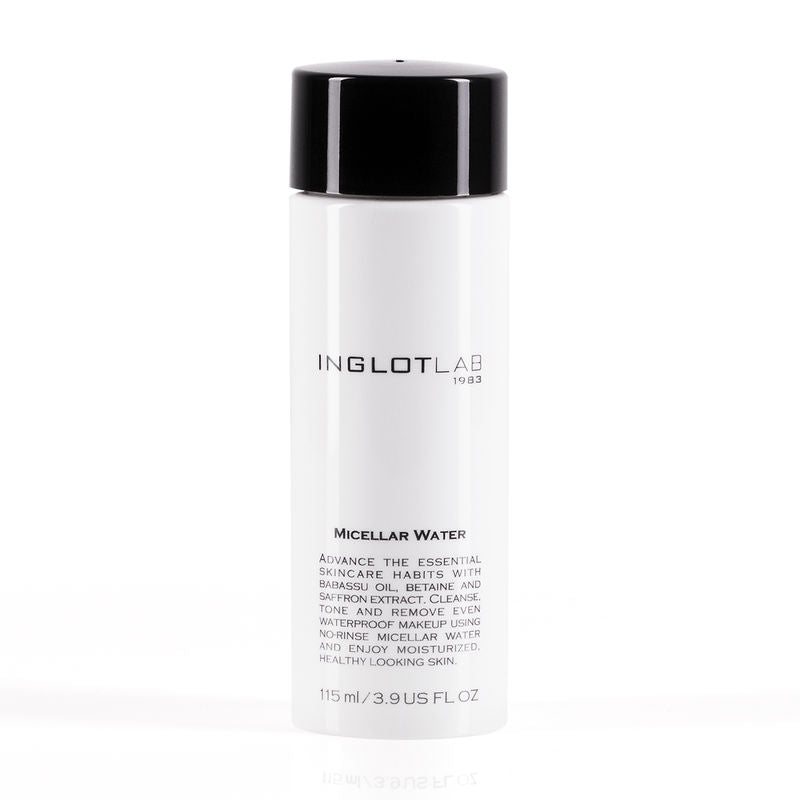
Inglot LAB Micellar Water

Inglot LAB Micellar Water
INGLOT
inglot-lab-micellar-water
Cleanse
10084956995877
Morning or Evening?
How often will you use this product?
Notes


Highlights
WHAT IS IT?
Micellar Water, contains babassu oil, betaine, saffron extract
FEATURES
Removes dirt, impurities and waterproof makeup, Lightweight texture does not leave sticky residue, Moisturises skin, improves elasticity, Suitable for all skin types
BEST FOR
sensitive
CHECKS
does not leave sticky residue
Who Is It For?
All Genders All AgesWhat Does It Help With?
Removing Dirt Impurities Waterproof Makeup Moisturizing Skin Improving Skin ElasticityBudget
Premium ($76-$150)How To Use
Which routine should it be used in?
Instructions:
Key Information


What INGLOT Says
Product Description:
As a skincare connoisseur or just the novice exploring the way to beautiful skin you already know how important is cleansing, toning and makeup removing. INGLOT Lab Micellar Water makes it easy turning these three activities into one single step. Owing to micellar molecules, which work like magnets to dirt - all impurities, trapped dirt and excess oil are removed without dry, dull skin afterward or leftover stickiness. The presence of babassu oil, betaine and saffron extract enrich the product with moisturizing properties.
Care for your precious skin while removing even waterproof makeup, forgetting about scrubbing or using running water. The formula itself is gentle enough for all skin types. While using Micellar Water your natural pH level is being restored, skin elasticity visually improves and you enjoy the feeling of soft and smooth skin.
You do not need to interrupt your routine while on the go as the product is available in small size too. Take a bottle of Micellar Water to the gym to prepare your skin for exhaustive exercises and let your skin ‘breathe free’. While traveling use it as a refresh or cleansing aid without risk of variable water hardness. If you are a fan of false lashes no need to worry about their condition as the product is gentle for them too. Treat the use of Micellar Water as a pleasant ritual not a chore.
Features:
- Removes dirt, impurities and waterproof makeup
- Lightweight texture does not leave any sticky residue
- Moisturises skin while improving the elasticity
- Suitable for all skin types
About the Brand:
Ingredients Overview
Ingredients List
WATER/AQUA, BABASSU OIL GLYCERETH-8 ESTERS, GLYCERIN, POLYGLYCERYL-3 CAPRATE/CAPRYLATE/SUCCINATE, BETAINE, PROPYLENE GLYCOL, PHENOXYETHANOL, CAPRYLYL GLYCOL, POTASSIUM SORBATE, SODIUM BENZOATE, CARAMEL, CROCUS SATIVUS STIGMA EXTRACT
Key Ingredients
babassu oil,betaine,saffron extract
Ingredients Details
Babassu Oil Glycereth-8 Esters
Common Name(s): Babassu glycereth-8 esters oil
DESCRIPTION
What It Does: Nourishes and softens skin through its balanced fatty acid profile, while antioxidant compounds protect against oxidative skin damage.
Why It's Used: Plant oils provide physiologically compatible lipid structures that integrate into the skin barrier and deliver fat-soluble antioxidants directly to skin cells.
How It Works: Fatty acids integrate into stratum corneum lipid lamellae, reinforcing the lipid barrier. antioxidants (tocopherols, carotenoids, polyphenols) neutralize ros through electron donation or singlet oxygen quenching.
Typically Found In: Face oils,serums,moisturizers,hair treatments,body oils
TECHNICAL DETAILS
Primary Category: Plant oils
Secondary Functions: Emollient,antioxidant
Application Areas:

Facial Skincare
Body Care
Hair Care

Beard Care
Color Cosmetics (Makeup)
Dietary/Oral Supplements
Typical Concentration Range: 0.5–30%
SOURCING & ETHICS
Vegan Status: Yes
Halal Status: Yes
Source Notes: Cold-pressed or solvent-extracted plant oil; no animal components.
SKIN COMPATIBILITY
Irritancy Rating: 1
Comedogenicity Rating: 2
Sensitivity Concerns: Low sensitization potential at recommended use concentrations.
Safe for Sensitive Skin: Yes
SAFETY & COMPATIBILITY
Safety Profile: Well-characterized cosmetic ingredient with established safety profile. generally non-irritating at typical use concentrations. suitable for leave-on and rinse-off cosmetics.
Works Well With: Vitamin e,ceramides,other plant oils,squalane
Avoid Combining With: Strong oxidizers (accelerate rancidity)
SCIENTIFIC NOTE
Vegetable oils are triglyceride matrices where the fatty acid composition determines skin compatibility, barrier function, and comedogenicity. oleic acid-rich oils (>60%) soften barrier lipids and enhance penetration; linoleic acid-rich oils reinforce ceramide-poor stratum corneum; saturated fatty acid-rich oils provide occlusion without skin penetration.
Last Verified: Cosing eu database; pcpc cosmetic ingredient safety reviews; aocs plant oil composition databases; fatty acid pharmacology reviews
Primary Sources: 2025-01-15
Betaine
Common Name(s): Trimethylglycine,tmg,natural betaine
CAS Number: 107-43-7
DESCRIPTION
What It Does: Provides osmoprotective humectant conditioning with anti-irritant and mild foam-boosting activity.
Why It's Used: Natural-origin multifunctional osmolyte from sugar beet providing hydration, anti-irritancy, and conditioning in virtually every cosmetic category.
How It Works: Quaternary ammonium betaine provides zwitterionic character for water binding via ionic hydration. osmoprotective function at 100–500mm as compatible solute protecting cells from osmotic stress. reduces surfactant irritation by competing with sls for protein binding sites. mild foam enhancement.
Typically Found In: Virtually all categories — moisturisers, shampoos, cleansers
TECHNICAL DETAILS
Primary Category: Functional ingredient – humectant
Secondary Functions: Tewl reduction,skin plumping
Application Areas:
Facial Skincare
Body Care
Hair Care
Beard Care
Color Cosmetics (Makeup)
Dietary/Oral Supplements
Typical Concentration Range: 0.5%–10%
SOURCING & ETHICS
Vegan Status: Yes – from beta vulgaris (sugar beet) molasses
Halal Status: Yes
Source Notes: Synthetic or naturally derived. excellent aqueous solubility.
SKIN COMPATIBILITY
Irritancy Rating: 1/5 – very low
Comedogenicity Rating: 0/5 – non-comedogenic
Sensitivity Concerns: Non-irritating; suitable for all skin types.
Safe for Sensitive Skin: Yes
SAFETY & COMPATIBILITY
Safety Profile: Excellent safety profile. ewg score: 1.
Works Well With: Ceramides,emollients,occlusives,glycerin,hyaluronic acid
Avoid Combining With: No significant incompatibilities
SCIENTIFIC NOTE
Betaine's anti-irritant mechanism for surfactant systems involves competitive protein protection: betaine at high concentrations preferentially interacts with skin proteins, occupying binding sites that would otherwise be occupied by surfactant molecules causing protein denaturation. this competition reduces available protein binding for irritating surfactants, explaining betaine's well-documented ability to reduce sls irritation when co-formulated.
Last Verified: Cosing database,craig betaine osmoprotective review,cir safety assessment
Primary Sources: 2026-03-12
Caprylyl Glycol
Common Name(s): 1,2-octanediol,octanediol,sensiva sc 50
CAS Number: 1117-86-8
DESCRIPTION
What It Does: Provides the most potent antimicrobial diol activity alongside skin feel enhancement.
Why It's Used: Premium antimicrobial diol — caprylyl glycol's c8 chain provides the strongest membrane-disrupting antimicrobial activity of common diol preservative boosters with unique skin-feel enhancement.
How It Works: C8 1,2-diol: c8 chain length provides strongest bacterial and fungal membrane disruption of common diols. emollient skin feel improvement from c8 chain length interaction with skin surface. active at lower concentrations than shorter-chain diols. synergistic with ethylhexylglycerin.
Typically Found In: Natural preservation systems,skin feel enhancement
TECHNICAL DETAILS
Primary Category: Functional ingredient – antimicrobial humectant
Secondary Functions: Skin conditioning
Application Areas:
Facial Skincare
Body Care
Hair Care
Beard Care
Color Cosmetics (Makeup)
Dietary/Oral Supplements
Typical Concentration Range: 0.1%–1%
SOURCING & ETHICS
Vegan Status: Yes – synthetic
Halal Status: Yes
Source Notes: Commercially produced for cosmetic use. verify vegan/halal status with supplier.
SKIN COMPATIBILITY
Irritancy Rating: 1/5 – very low
Comedogenicity Rating: 0/5 – non-comedogenic
Sensitivity Concerns: Well-tolerated by most skin types.
Safe for Sensitive Skin: Yes
SAFETY & COMPATIBILITY
Safety Profile: Good safety profile at recommended concentrations. ewg score: 1–2.
Works Well With: Standard skincare actives
Avoid Combining With: No known significant incompatibilities
SCIENTIFIC NOTE
Caprylyl glycol's antimicrobial potency follows the chain-length dependent membrane activity of fatty acids: c8 is the optimal chain length for membrane disruption (same as caprylic acid's antimicrobial optimum), providing maximum membrane integration without the skin sensitisation associated with longer chain lengths. this chain-length pharmacophore relationship is why c8 > c6 > c5 in diol antimicrobial potency despite identical head group chemistry.
Last Verified: Cosing database,schülke sensiva sc 50 technical data,cir safety assessment
Primary Sources: 2026-03-12
Caramel
Common Name(s): Caramel colour,natural brown,e150
CAS Number: 8028-89-5
DESCRIPTION
What It Does: Provides natural warm-brown colour from heat-treated sugar for natural cosmetics.
Why It's Used: Natural brown colorant with food-grade safety credentials for clean beauty formulations requiring warm brown or amber shades.
How It Works: Complex mixture of pyranose-ring condensation products from heat-treated sugars. 5-hmf and melanoidin polymers provide brown colour. ph-stable in acidic formulations. soluble in water and lower alcohols.
Typically Found In: Natural cosmetics,bronzers,hair products
TECHNICAL DETAILS
Primary Category: Colorant – natural brown dye
Secondary Functions: Skin conditioning
Application Areas:
Facial Skincare
Body Care
Hair Care
Beard Care
Color Cosmetics (Makeup)
Dietary/Oral Supplements
Typical Concentration Range: 0.01%–5%
SOURCING & ETHICS
Vegan Status: Yes – from sucrose, glucose (plant sugars)
Halal Status: Yes
Source Notes: Commercially produced for cosmetic use. verify vegan/halal status with supplier.
SKIN COMPATIBILITY
Irritancy Rating: 1/5 – very low
Comedogenicity Rating: 0/5 – non-comedogenic
Sensitivity Concerns: Well-tolerated by most skin types.
Safe for Sensitive Skin: Yes
SAFETY & COMPATIBILITY
Safety Profile: Good safety profile at recommended concentrations. ewg score: 1–2.
Works Well With: Standard skincare actives
Avoid Combining With: No known significant incompatibilities
SCIENTIFIC NOTE
Caramel's colour develops through the maillard reaction between reducing sugars and amino acids at elevated temperatures, creating a complex mixture of coloured polymer (melanoidin) and small molecule chromophores. unlike single-compound dyes with defined absorption spectra, caramel's broad-spectrum absorption from multiple chromophores provides a naturally warm, complex brown impossible to replicate with a single synthetic dye.
Last Verified: Cosing database,fda 21 cfr color additives
Primary Sources: 2026-03-12
