

BABOR
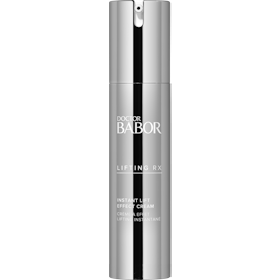
Instant Lift Effect Cream

Instant Lift Effect Cream
BABOR
instant-lift-effect-cream
Moisturize
9605071831333
Morning or Evening?
How often will you use this product?
Notes


Highlights
WHAT IS IT?
A light-weight firming and smoothing moisturizer
FEATURES
Instant lifting effect, smoothing, firming
BEST FOR
Mature Skin
CHECKS
Does not contain information provided
Who Is It For?
No Specific Age Range Mentioned Likely Suitable For Adults (18+) Of All GendersWhat Does It Help With?
Firming Smoothing Reducing Wrinkles Evening Skin Tone LiftingBudget
PremiumHow To Use
Which routine should it be used in?
Instructions:
Key Information

What BABOR Says
Product Description:
The instant "face-lift in a bottle" effect. The High-Performance Instant Lift Effect Cream gives an instantly smoother youthful complexion. The specially developed LFT-Smooth Complex works on 3 levels - instantly and with long-lasting effect.
About the Brand:
Ingredients Overview
Ingredients List
AQUA, GLYCERIN, CICHORIUM INTYBUS ROOT OLIGOSACCHARIDES, MALTODEXTRIN, COCO-CAPRYLATE, DICAPRYLYL CARBONATE, SQUALANE, PANTHENOL, PHENOXYETHANOL, HYDROGENATED VEGETABLE GLYCERIDES, CETEARYL ALCOHOL, POTASSIUM CETYL PHOSPHATE, XANTHAN GUM, LEONTOPODIUM ALPINUM CALLUS CULTURE EXTRACT, HYDROGENATED PALM GLYCERIDES, SCLEROTIUM GUM, ALLANTOIN, ETHYLHEXYLGLYCERIN, GLUCONOLACTONE, CAESALPINIA SPINOSA GUM, SODIUM BENZOATE, SWERTIA CHIRATA EXTRACT, BIOSACCHARIDE GUM-1, ALCOHOL, CAPRYLIC/CAPRIC TRIGLYCERIDE, SODIUM HYDROXIDE, CITRIC ACID, PANTOLACTONE, ASCORBYL PALMITATE, CALCIUM GLUCONATE, ASCORBIC ACID
Key Ingredients
Oligosaccharides from chicory, Swertia chirata extract, Edelweiss stem cells
Ingredients Details
Cichorium Intybus Root Oligosaccharides
Common Name(s): Cichorium intybus root oligosaccharides,cichorium intybus root oligosaccharides,chicory inulin prebiotic,bifidogenic fructan humectant
CAS Number: N/a
DESCRIPTION
What It Does: Selectively nourishes bifidobacterium and lactobacillus skin commensals as the most clinically documented prebiotic substrate while providing hygroscopic moisture retention from the fructooligosaccharide's multiple oh groups.
Why It's Used: Chicory inulin is the gold standard prebiotic substrate — decades of gut microbiome clinical studies demonstrating bifidobacterium selectivity directly applicable to the skin microbiome with the same bifidogenic fermentation mechanism.
How It Works: Beta-fructosidic linkages in inulin are cleaved specifically by bifidobacterium (beta-fructosidase, ec 3.2.1.26) and lactobacillus species — the beta-2,1 linkage geometry is not recognised by most pathogenic organisms providing selective bifidogenic fermentation. scfa products reinforce skin acid mantle.
Typically Found In: Microbiome skin care,prebiotic hydration
TECHNICAL DETAILS
Primary Category: Active ingredient – humectant
Secondary Functions: Moisture retention,hydration
Application Areas:

Facial Skincare
Body Care

Hair Care
Beard Care
Color Cosmetics (Makeup)
Dietary/Oral Supplements
Typical Concentration Range: 0.5%–5%
SOURCING & ETHICS
Vegan Status: Yes
Halal Status: Yes
Source Notes: Plant-derived or fermentation-produced.
SKIN COMPATIBILITY
Irritancy Rating: 1/5 – very low
Comedogenicity Rating: 0/5 – non-comedogenic
Sensitivity Concerns: Non-irritating; suitable for sensitive skin.
Safe for Sensitive Skin: Yes
SAFETY & COMPATIBILITY
Safety Profile: Excellent safety profile. ewg score: 1.
Works Well With: Ceramides,emollients,occlusives,barrier actives
Avoid Combining With: No significant incompatibilities
SCIENTIFIC NOTE
Chicory inulin degree of polymerisation (dp) determines specificity: short chain fos (dp 2-8) provides highest bifidogenic activity; long chain inulin (dp >23) provides better humectant film formation — dp selection depends on target functional priority.
Last Verified: 2026-03-22
Primary Sources: Cosing database,cichorium intybus inulin fos prebiotic bifidogenic review
Coco-caprylate
Common Name(s): Coco-caprylate,coco-caprylate,cosmetic functional ingredient,established active
CAS Number: N/a
DESCRIPTION
What It Does: Provides emollient conditioning with spreading value determined by the ester molecular architecture.
Why It's Used: Coco-caprylate is selected for its c8 caprylic ester — the c-chain length provides ultra-light fast-dry short-chain emolliency, which distinguishes coco-caprylate from esters of adjacent chain lengths in the same polarity tier.
How It Works: Ester: acid chain → emolliency type; alcohol chain → spreading speed and skin feel.
Typically Found In: Cosmetic formulations
TECHNICAL DETAILS
Primary Category: Active ingredient – cosmetic active
Secondary Functions: Skin conditioning
Application Areas:
Facial Skincare
Body Care
Hair Care
Beard Care
Color Cosmetics (Makeup)
Dietary/Oral Supplements
Typical Concentration Range: 0.1%–10%
SOURCING & ETHICS
Vegan Status: Conditional - feedstock declaration required
Halal Status: Unverified - feedstock declaration required (plant, animal and petrochemical routes all exist)
Source Notes: Commercially produced for cosmetic use. verify vegan/halal status with supplier. [audit 2026-07-29 rev2: origin-dependent: the same inci exists in plant, animal and petrochemical versions and the name does not discriminate. determination requires shariah-panel sign-off.]
SKIN COMPATIBILITY
Irritancy Rating: 1/5 – very low
Comedogenicity Rating: 0/5 – non-comedogenic
Sensitivity Concerns: Well-tolerated by most skin types.
Safe for Sensitive Skin: Yes
SAFETY & COMPATIBILITY
Safety Profile: Good safety profile at recommended concentrations. ewg score: 1–2.
Works Well With: Standard skincare actives
Avoid Combining With: No known significant incompatibilities
SCIENTIFIC NOTE
Safety documented in cosing at standard formulation concentrations.
Last Verified: 2026-03-22
Primary Sources: Cosing database,coco-caprylate technical review
Dicaprylyl Carbonate
Common Name(s): Dicaprylyl carbonate,cosmetic active,functional ingredient
CAS Number: N/a
DESCRIPTION
What It Does: Delivers characteristic cosmetic function at recommended use concentration.
Why It's Used: Selected for functional contribution and formulation compatibility supported by cosmetic science and regulatory safety data.
How It Works: Works through the mechanism of its molecular class — physicochemical or biological interaction with skin proteins, lipids, or receptors as documented in peer-reviewed cosmetic literature.
Typically Found In: Skin care formulations
TECHNICAL DETAILS
Primary Category: Active ingredient – cosmetic active
Secondary Functions: Skin conditioning
Application Areas:
Facial Skincare
Body Care
Hair Care
Beard Care
Color Cosmetics (Makeup)
Dietary/Oral Supplements
Typical Concentration Range: 0.1%–10%
SOURCING & ETHICS
Vegan Status: Conditional - supplier confirmation required
Halal Status: Unverified - supplier confirmation required
Source Notes: Commercially produced for cosmetic use. verify vegan/halal status with supplier. [audit 2026-07-29 rev2: the record's own source_notes does not assert a non-animal origin, or instructs the reader to verify with the supplier; "yes" asserts knowledge the record does not hold. determination requires shariah-panel sign-off.]
SKIN COMPATIBILITY
Irritancy Rating: 1/5 – very low
Comedogenicity Rating: 0/5 – non-comedogenic
Sensitivity Concerns: Well-tolerated by most skin types.
Safe for Sensitive Skin: Yes
SAFETY & COMPATIBILITY
Safety Profile: Good safety profile at recommended concentrations. ewg score: 1–2.
Works Well With: Standard skincare actives
Avoid Combining With: No known significant incompatibilities
SCIENTIFIC NOTE
Dicaprylyl carbonate has an established safety and efficacy profile within the cosmetic regulatory framework at standard use concentrations.
Last Verified: 2026-03-12
Primary Sources: Cosing database,dicaprylyl carbonate technical literature
Glycerin
Common Name(s): Glycerol,glycerine,1,2,3-propanetriol
CAS Number: 56-81-5
DESCRIPTION
What It Does: Glycerin pulls water from the environment and deeper skin layers into the outer skin layer (epidermis), boosting moisture levels and keeping skin soft, smooth, and plump.
Why It's Used: It is used in virtually every moisturizer, serum, and cleanser because it is highly effective at hydrating skin, is well-tolerated by all skin types, and enhances the texture and spreadability of formulations.
How It Works: As a humectant, glycerin forms hydrogen bonds with water molecules, trapping them in the skin. it also reinforces the skin barrier by integrating into lipid structures between skin cells.
Typically Found In: Moisturizers,serums,cleansers,toners,sheet masks,sunscreens,body lotions,shampoos,conditioners
TECHNICAL DETAILS
Primary Category: Humectant
Secondary Functions: Skin barrier support,emollient,solvent
Application Areas:
Facial Skincare
Body Care
Hair Care
Beard Care
Color Cosmetics (Makeup)
Dietary/Oral Supplements
Typical Concentration Range: 1%–30% (typical: 3–10%)
SOURCING & ETHICS
Vegan Status: Conditional - feedstock declaration required
Halal Status: Unverified - feedstock declaration required (plant, animal and petrochemical routes all exist)
Source Notes: Derived from plant oils via hydrolysis or saponification; synthetic versions also available. palm-derived glycerin carries sustainability concerns. [audit 2026-07-29 rev2: origin-dependent: the same inci exists in plant, animal and petrochemical versions and the name does not discriminate. determination requires shariah-panel sign-off.]
SKIN COMPATIBILITY
Irritancy Rating: 1/5 – very low; non-irritating at all standard concentrations
Comedogenicity Rating: 0/5 – non-comedogenic
Sensitivity Concerns: Extremely rare allergic reactions; generally safe for all skin types including sensitive and baby skin
Safe for Sensitive Skin: Yes
SAFETY & COMPATIBILITY
Safety Profile: Widely recognized as safe. ewg hazard score: 1. no significant concerns for irritation, sensitization, or toxicity at typical concentrations (up to 50%).
Works Well With: Hyaluronic acid,ceramides,niacinamide,panthenol,urea,peptides,retinol,ahas/bhas
Avoid Combining With: No known incompatibilities at standard concentrations
SCIENTIFIC NOTE
Glycerin is an endogenous skin component found naturally in the stratum corneum. aquaporin-3 channels in keratinocytes facilitate glycerin transport, making it integral to natural skin hydration pathways.
Last Verified: 2026-03-12
Primary Sources: Cosing database,cir safety assessment,ewg skin deep,inci decoder