

RéVive
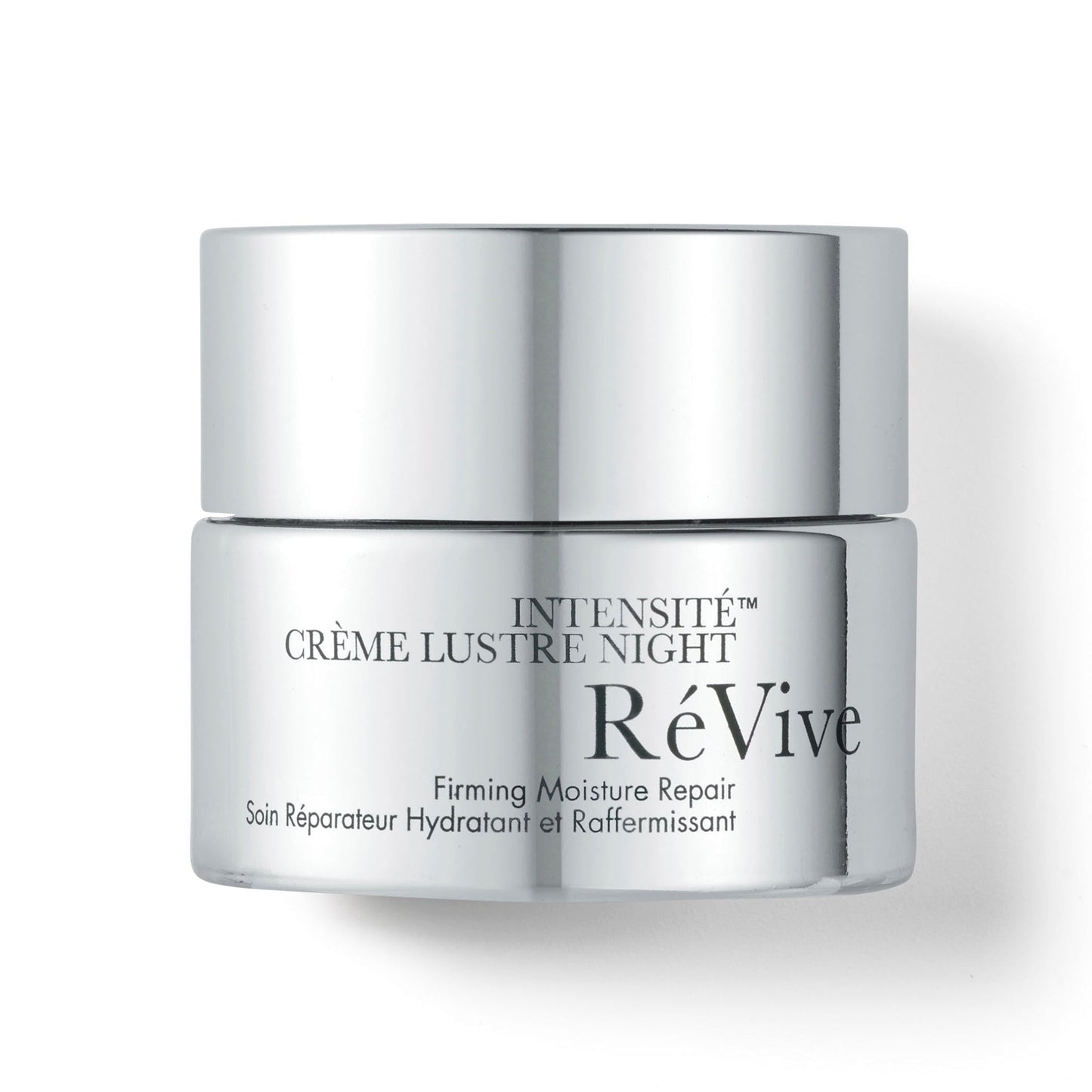
Intensité Crème Lustre Night / Firming Moisture Repair

Intensité Crème Lustre Night / Firming Moisture Repair
RéVive
intensite-creme-lustre-night-firming-moisture-repair
Moisturize
9643604181285
Morning or Evening?
How often will you use this product?
Notes


Highlights
WHAT IS IT?
Nighttime moisturizer with multiple ingredients
FEATURES
Deeply hydrates, rejuvenates, restores skin, visibly lifts and contours
BEST FOR
Dry to very dry skin with loss of elasticity
CHECKS
Free of Alcohol, Aluminum, Paraben, Phthalate, Preservative, Sulfate
Who Is It For?
No Specific Age Range Provided Default Above 18. For Both Women And Men.What Does It Help With?
Fine Lines Wrinkles Loss Of Elasticity DrynessBudget
ProfessionalHow To Use
Which routine should it be used in?
Instructions:
Key Information


What RéVive Says
Product Description:
An intensive firming nighttime moisturizer to deeply hydrate, rejuvenate, and restore the look of skin to unveil a brighter, more luminous, healthier-looking complexion. Developed for dry to very dry skin with loss of elasticity, this scientifically advanced formula visibly lifts and contours for a more youthful look and a reduced appearance of lines and wrinkles.
About the Brand:
Ingredients Overview
Ingredients List
Aqua (Water, Eau), Caprylic/Capric Triglyceride, Cyclopentasiloxane, Propanediol, Glyceryl Stearate, Squalane, Pentylene Glycol, Jojoba Esters, Di-C12-15 Alkyl Fumarate, Glycerin, PEG-100 Stearate, Cetyl Acetate, Cetyl Dimethicone, Candelilla/Jojoba/Rice Bran Polyglyceryl-3 Esters, Dimethicone Crosspolymer, Dimethicone, Cetyl Alcohol, Oligopeptide-24, Oligopeptide-20, Palmitoyl Tripeptide-1, Palmitoyl Tetrapeptide-7, Palmitoyl Hexapeptide-19, Tocopheryl Acetate, Pisum Sativum (Pea) Extract, Chlorella Vulgaris Extract, Leucojum Aestivum Bulb Extract, Tocopherol, Bambusa Vulgaris Leaf/Stem Extract, Glycine Soja (Soybean) Oil, Glucosamine HCL, Sodium Lactate, Sodium Stearoyl Lactylate, Cetearyl Alcohol, Acetylated Lanolin Alcohol, Caprylyl Glycol, Carbomer, Polysorbate 20, Fumaric Acid, Hydrogenated Phosphatidylcholine, Sodium Oleate, Hydrogenated Lecithin, Polymethyl Methacrylate, Butylene Glycol, Acrylates/C10-30 Alkyl Acrylate Crosspolymer, Xanthan Gum, Parfum (Fragrance), Phenoxyethanol, Mica, Chlorphenesin, Disodium EDTA, Sodium Hydroxide, Linalool, Citronellol, Limonene, Hexyl Cinnamal, CI 77891 (Titanium Dioxide).
Key Ingredients
Bio-Firming Peptide, Bio-Renewal Peptide, Restorative Firming Complex, Nourishing Jojoba Oil
Ingredients Details
Caprylic/capric Triglyceride
Common Name(s): Mct oil,fractionated coconut oil,c8/c10 triglyceride
CAS Number: 73398-61-5
DESCRIPTION
What It Does: Lightweight, stable emollient that solubilizes oil-soluble actives for excellent delivery without greasy feel.
Why It's Used: Universal lightweight emollient base and solubilizer for oil-soluble actives in serums and low-viscosity formulations where mineral oil or petrolatum would be too heavy.
How It Works: Medium-chain length provides ideal balance of spreading coefficient, penetration rate, and barrier-sealing properties. excellent solubilizer for vitamin e, retinoids, and other lipophilic actives.
Typically Found In: Serums,facial oils,sunscreens,anti-aging products,hair products
TECHNICAL DETAILS
Primary Category: Active ingredient – medium-chain triglyceride emollient
Secondary Functions: Active solubilizer,spreading agent
Application Areas:

Facial Skincare
Body Care
Hair Care

Beard Care
Color Cosmetics (Makeup)
Dietary/Oral Supplements
Typical Concentration Range: 1%–50%
SOURCING & ETHICS
Vegan Status: Conditional - feedstock declaration required
Halal Status: Unverified - feedstock declaration required (plant, animal and petrochemical routes all exist)
Source Notes: Fractionated by hydrolysis and re-esterification of coconut oil. only c8 and c10 fatty acids retained. [audit 2026-07-29 rev2: origin-dependent: the same inci exists in plant, animal and petrochemical versions and the name does not discriminate. determination requires shariah-panel sign-off.]
SKIN COMPATIBILITY
Irritancy Rating: 1/5 – very low
Comedogenicity Rating: 1/5 – very low; medium-chain length generally non-comedogenic
Sensitivity Concerns: Non-irritating.
Safe for Sensitive Skin: Yes
SAFETY & COMPATIBILITY
Safety Profile: Excellent safety profile. ewg score: 1.
Works Well With: Humectants,ceramides,actives as carrier
Avoid Combining With: No significant incompatibilities
SCIENTIFIC NOTE
Mct oil's medium-chain length (c8/c10) provides superior oxidative stability vs longer polyunsaturated chains and better skin aesthetics (lighter, less greasy) vs longer chain emollients (c16/c18). excellent solubilizer for retinoic acid, tocopheryl esters, and other lipophilic actives.
Last Verified: 2026-03-12
Primary Sources: Cosing database,cir safety assessment,ewg skin deep
Cyclopentasiloxane
Common Name(s): Cyclopentasiloxane,cyclic volatile silicone,dry-touch carrier solvent
CAS Number: N/a
DESCRIPTION
What It Does: Provides a dry, weightless application vehicle that evaporates cleanly leaving actives and non-volatile silicones deposited on skin — eliminating the residual heaviness of conventional liquid carrier solvents.
Why It's Used: Cyclosiloxanes are the unique volatile silicone solvents that dissolve non-volatile silicones (dimethicone, cyclomethicone), organic uv filters, and lipophilic actives, providing the sensory-superior dry-touch application experience in premium formulations.
How It Works: Cyclosiloxane vapour pressure (d5 cyclopentasiloxane ~0.3 mmhg at 25°c) provides clean evaporation at body temperature. the cyclic ring structure provides lower boiling point than equivalent linear dimethicone, enabling faster evaporation while the ring conformation maintains the silicone's low surface energy for smooth application.
Typically Found In: Primers,antiperspirants,sunscreens
TECHNICAL DETAILS
Primary Category: Functional ingredient – emollient
Secondary Functions: Barrier sealing,softening
Application Areas:
Facial Skincare
Body Care
Hair Care
Beard Care
Color Cosmetics (Makeup)
Dietary/Oral Supplements
Typical Concentration Range: 1%–50%
SOURCING & ETHICS
Vegan Status: Conditional - supplier confirmation required
Halal Status: Unverified - supplier confirmation required
Source Notes: Plant-derived, synthetic or animal-derived. verify source. [audit 2026-07-29 rev2: the record's own source_notes does not assert a non-animal origin, or instructs the reader to verify with the supplier; "yes" asserts knowledge the record does not hold. determination requires shariah-panel sign-off.]
SKIN COMPATIBILITY
Irritancy Rating: 1/5 – very low
Comedogenicity Rating: 1/5 – low; formulation-dependent
Sensitivity Concerns: Non-irritating.
Safe for Sensitive Skin: Yes
SAFETY & COMPATIBILITY
Safety Profile: Excellent safety profile. ewg score: 1.
Works Well With: Humectants,ceramides,actives as carrier
Avoid Combining With: No significant incompatibilities
SCIENTIFIC NOTE
Cyclopentasiloxane (d5) and cyclohexasiloxane (d6) are under eu regulatory review for potential environmental persistence (pbt assessment) — formulators should monitor eu regulation 2018/35 implementation for restrictions in wash-off products.
Last Verified: 2026-03-12
Primary Sources: Cosing database,eu cyclosiloxane regulatory review
Di-c12-15 Alkyl Fumarate
Common Name(s): Emollient wm,c12-15 alkyl fumarate
CAS Number: N/a
DESCRIPTION
What It Does: Provides silky non-tacky emolliency with excellent silicone and uv filter compatibility.
Why It's Used: Silicone-compatible ester emollient for premium gel and anhydrous formulations where silicone-like aesthetics are desired from a non-silicone ingredient.
How It Works: Fumarate diester provides silicone-like skin feel from low surface tension. excellent compatibility with cyclomethicone, dimethicone, and cyclopentasiloxane for hybrid silicone-ester formulations. non-tacky from low molecular weight. compatible with uv filters reducing white cast.
Typically Found In: Gel formulations,silicone-ester hybrid products,sunscreens
TECHNICAL DETAILS
Primary Category: Functional ingredient – fumarate ester emollient
Secondary Functions: Barrier sealing,softening
Application Areas:
Facial Skincare
Body Care
Hair Care
Beard Care
Color Cosmetics (Makeup)
Dietary/Oral Supplements
Typical Concentration Range: 1%–20%
SOURCING & ETHICS
Vegan Status: Conditional - supplier confirmation required
Halal Status: Unverified - supplier confirmation required
Source Notes: Plant-derived, synthetic or animal-derived. verify source. [audit 2026-07-29 rev2: the record's own source_notes does not assert a non-animal origin, or instructs the reader to verify with the supplier; "yes" asserts knowledge the record does not hold. determination requires shariah-panel sign-off.]
SKIN COMPATIBILITY
Irritancy Rating: 1/5 – very low
Comedogenicity Rating: 1/5 – low; formulation-dependent
Sensitivity Concerns: Non-irritating.
Safe for Sensitive Skin: Yes
SAFETY & COMPATIBILITY
Safety Profile: Excellent safety profile. ewg score: 1.
Works Well With: Humectants,ceramides,actives as carrier
Avoid Combining With: No significant incompatibilities
SCIENTIFIC NOTE
Di-c12-15 alkyl fumarate's silicone-like skin feel despite being a hydrocarbon ester arises from the trans-fumarate geometry: the rigid trans double bond in the fumarate backbone provides a specific molecular shape that interacts with skin surface proteins and lipids to reduce friction in a way similar to pdms's siloxane chain flexibility, providing the characteristic silky application feel without silicone chemistry.
Last Verified: 2026-03-12
Primary Sources: Cosing database,cir safety assessment
Glycerin
Common Name(s): Glycerol,glycerine,1,2,3-propanetriol
CAS Number: 56-81-5
DESCRIPTION
What It Does: Glycerin pulls water from the environment and deeper skin layers into the outer skin layer (epidermis), boosting moisture levels and keeping skin soft, smooth, and plump.
Why It's Used: It is used in virtually every moisturizer, serum, and cleanser because it is highly effective at hydrating skin, is well-tolerated by all skin types, and enhances the texture and spreadability of formulations.
How It Works: As a humectant, glycerin forms hydrogen bonds with water molecules, trapping them in the skin. it also reinforces the skin barrier by integrating into lipid structures between skin cells.
Typically Found In: Moisturizers,serums,cleansers,toners,sheet masks,sunscreens,body lotions,shampoos,conditioners
TECHNICAL DETAILS
Primary Category: Humectant
Secondary Functions: Skin barrier support,emollient,solvent
Application Areas:
Facial Skincare
Body Care
Hair Care
Beard Care
Color Cosmetics (Makeup)
Dietary/Oral Supplements
Typical Concentration Range: 1%–30% (typical: 3–10%)
SOURCING & ETHICS
Vegan Status: Conditional - feedstock declaration required
Halal Status: Unverified - feedstock declaration required (plant, animal and petrochemical routes all exist)
Source Notes: Derived from plant oils via hydrolysis or saponification; synthetic versions also available. palm-derived glycerin carries sustainability concerns. [audit 2026-07-29 rev2: origin-dependent: the same inci exists in plant, animal and petrochemical versions and the name does not discriminate. determination requires shariah-panel sign-off.]
SKIN COMPATIBILITY
Irritancy Rating: 1/5 – very low; non-irritating at all standard concentrations
Comedogenicity Rating: 0/5 – non-comedogenic
Sensitivity Concerns: Extremely rare allergic reactions; generally safe for all skin types including sensitive and baby skin
Safe for Sensitive Skin: Yes
SAFETY & COMPATIBILITY
Safety Profile: Widely recognized as safe. ewg hazard score: 1. no significant concerns for irritation, sensitization, or toxicity at typical concentrations (up to 50%).
Works Well With: Hyaluronic acid,ceramides,niacinamide,panthenol,urea,peptides,retinol,ahas/bhas
Avoid Combining With: No known incompatibilities at standard concentrations
SCIENTIFIC NOTE
Glycerin is an endogenous skin component found naturally in the stratum corneum. aquaporin-3 channels in keratinocytes facilitate glycerin transport, making it integral to natural skin hydration pathways.
Last Verified: 2026-03-12
Primary Sources: Cosing database,cir safety assessment,ewg skin deep,inci decoder