
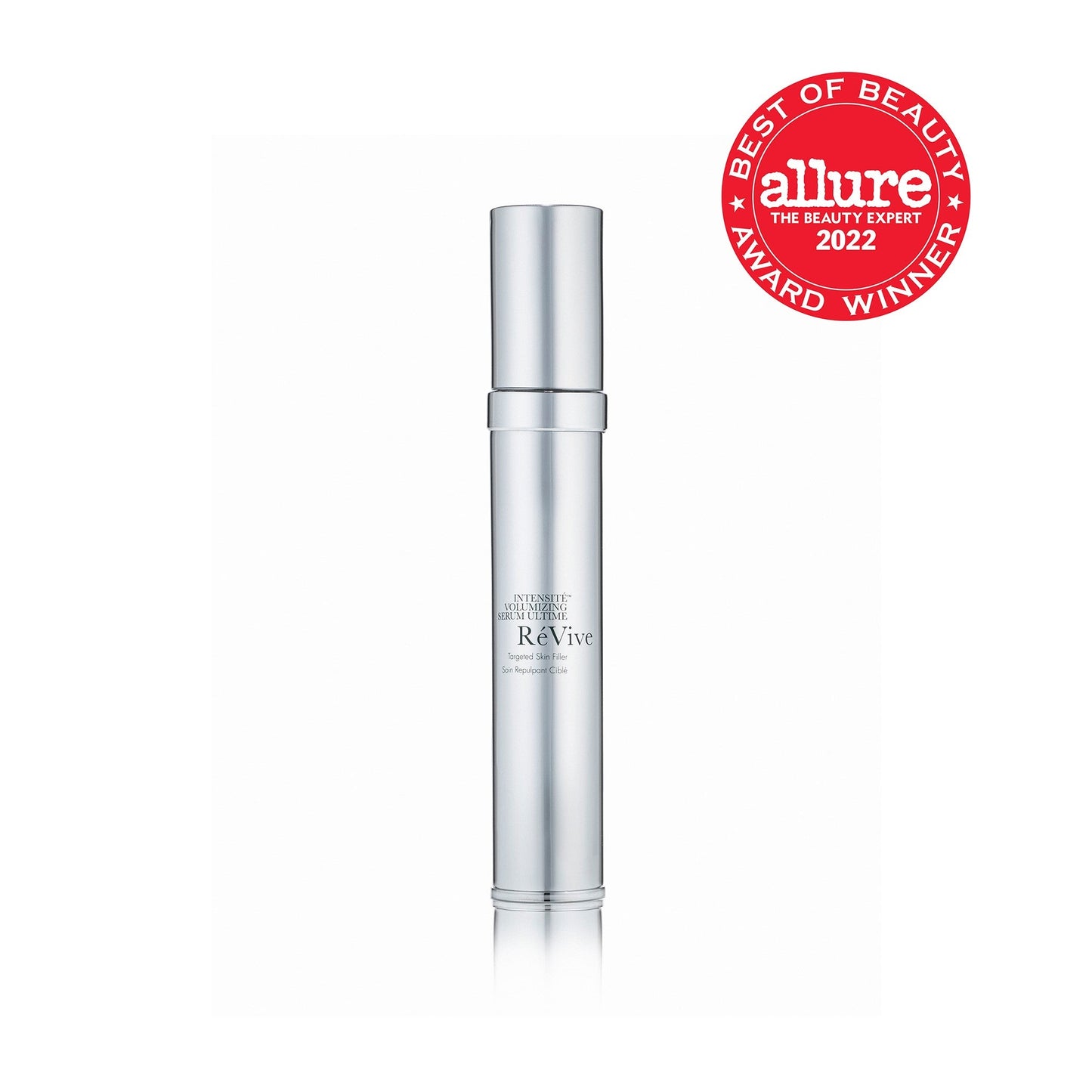

RéVive
Intensité Volumizing Serum Ultime / Targeted Skin Filler

Intensité Volumizing Serum Ultime / Targeted Skin Filler
RéVive
intensite-volumizing-serum-ultime-targeted-skin-filler
Serum
9643603853605
Morning or Evening?
How often will you use this product?
Notes


Highlights
WHAT IS IT?
A volumizing serum with 24 ingredients
FEATURES
Visibly plumps and firms skin, smooths expression lines, reduces crow's feet, nasolabial lines, and furrow lines
BEST FOR
Not specified, likely suitable for all skin types
CHECKS
Does not contain parabens (not mentioned in ingredients)
Who Is It For?
Adults (18+) Both Women And MenWhat Does It Help With?
Volume Loss Fine Lines And Wrinkles Facial ContouringBudget
ProfessionalHow To Use
Which routine should it be used in?
Instructions:
Key Information

What RéVive Says
Product Description:
The injection-less answer to restoring lost facial volume. With advancements in volumizing technology and our founder Dr. Brown's three-dimensional approach to volume loss, this powerful serum visibly plumps and firms from within, smoothing expression lines. Clinically proven to reduce crow's feet, nasolabial lines, and furrow lines (11 lines).
About the Brand:
Ingredients Overview
Ingredients List
Dimethicone, Dodecane, Isohexadecane, Dimethicone/Vinyl Dimethicone Crosspolymer, Dimethicone Crosspolymer, Polyglyceryl-4 Isostearate, Cetyl PEG/PPG-10/1 Dimethicone, Hexyl Laurate, C12-15 Alkyl Benzoate, Ceramide EOP, Oligopeptide-41, Palmitoyl Hexapeptide-12, Ceramide NG, Ceramide NP, Ceramide AP, Palmitoyl Isoleucine, Phytosphingosine, Cholesterol, Lactic Acid, Palmitic Acid, Caprylic/Capric Triglyceride, Pyrus Malus (Apple) Fruit Extract, Camellia Sinensis Leaf Extract, Tribehenin, Phenylethyl Resorcinol, Dimethyl Isosorbide, Sesamum Indicum (Sesame) Seed Extract, Tocopherol, Aqua (Water, Eau), Cyclotetrasiloxane, Sodium Lauroyl Lactylate, PEG-10 Phytosterol, Xanthan Gum, Carbomer, Ethylhexylglycerin, Phenoxyethanol, Silica.
Key Ingredients
Bio-Volumizing Peptide, Painless Plumping Actives, Ceramide Blend
Ingredients Details
C12-15 Alkyl Benzoate
Common Name(s): C12-15 alkyl benzoate,cosmetic active,functional ingredient
CAS Number: N/a
DESCRIPTION
What It Does: Delivers characteristic cosmetic function at recommended use concentration.
Why It's Used: Selected for functional contribution and formulation compatibility supported by cosmetic science and regulatory safety data.
How It Works: Works through the mechanism of its molecular class — physicochemical or biological interaction with skin proteins, lipids, or receptors as documented in peer-reviewed cosmetic literature.
Typically Found In: Skin care formulations
TECHNICAL DETAILS
Primary Category: Active ingredient – cosmetic active
Secondary Functions: Skin conditioning
Application Areas:

Facial Skincare

Body Care
Hair Care
Beard Care
Color Cosmetics (Makeup)
Dietary/Oral Supplements
Typical Concentration Range: 0.1%–10%
SOURCING & ETHICS
Vegan Status: Conditional - supplier confirmation required
Halal Status: Unverified - supplier confirmation required
Source Notes: Commercially produced for cosmetic use. verify vegan/halal status with supplier. [audit 2026-07-29 rev2: the record's own source_notes does not assert a non-animal origin, or instructs the reader to verify with the supplier; "yes" asserts knowledge the record does not hold. determination requires shariah-panel sign-off.]
SKIN COMPATIBILITY
Irritancy Rating: 1/5 – very low
Comedogenicity Rating: 0/5 – non-comedogenic
Sensitivity Concerns: Well-tolerated by most skin types.
Safe for Sensitive Skin: Yes
SAFETY & COMPATIBILITY
Safety Profile: Good safety profile at recommended concentrations. ewg score: 1–2.
Works Well With: Standard skincare actives
Avoid Combining With: No known significant incompatibilities
SCIENTIFIC NOTE
C12-15 alkyl benzoate has an established safety and efficacy profile within the cosmetic regulatory framework at standard use concentrations.
Last Verified:
Ceramide Eop
Common Name(s): Ceramide 1,omega-hydroxy ceramide linoleate,acylceramide
CAS Number: N/a
DESCRIPTION
What It Does: Provides the essential acylceramide scaffold for stratum corneum lamellar lipid organisation and barrier architecture.
Why It's Used: The architectural ceramide — ceramide eop's covalent corneocyte envelope binding is unique among ceramides and essential for organising the lamellar lipid matrix of the stratum corneum barrier.
How It Works: Omega-hydroxy ceramide esterified with linoleic acid at the omega-end. omega-hydroxyl group covalently bonds to involucrin/envoplakin proteins of corneocyte envelope via ester bond. this covalent anchor organises the lamellar lipid bilayers around each corneocyte. linoleate deficiency impairs this covalent anchoring — the biochemical basis of linoleic acid deficiency skin disease.
Typically Found In: Complete barrier repair systems,eczema treatment,omega-ceramide products
TECHNICAL DETAILS
Primary Category: Active ingredient – linoleate acylceramide
Secondary Functions: Skin conditioning
Application Areas:
Facial Skincare
Body Care
Hair Care
Beard Care
Color Cosmetics (Makeup)
Dietary/Oral Supplements
Typical Concentration Range: 0.001%–0.5%
SOURCING & ETHICS
Vegan Status: Conditional - feedstock declaration required
Halal Status: Unverified - feedstock declaration required (plant, animal and petrochemical routes all exist)
Source Notes: Commercially produced for cosmetic use. verify vegan/halal status with supplier. [audit 2026-07-29 rev2: origin-dependent: the same inci exists in plant, animal and petrochemical versions and the name does not discriminate. determination requires shariah-panel sign-off.]
SKIN COMPATIBILITY
Irritancy Rating: 1/5 – very low
Comedogenicity Rating: 0/5 – non-comedogenic
Sensitivity Concerns: Well-tolerated by most skin types.
Safe for Sensitive Skin: Yes
SAFETY & COMPATIBILITY
Safety Profile: Good safety profile at recommended concentrations. ewg score: 1–2.
Works Well With: Standard skincare actives
Avoid Combining With: No known significant incompatibilities
SCIENTIFIC NOTE
Ceramide eop's covalent corneocyte envelope binding is the only covalent interaction in the stratum corneum lipid structure — all other lamellar lipids interact via non-covalent van der waals and hydrogen bonds. this unique covalent anchoring of eop to the protein envelope provides the mechanical scaffold from which the entire lamellar lipid architecture is organised, making ceramide eop architecturally irreplaceable in barrier function.
Last Verified: 2026-03-12
Primary Sources: Cosing database,holleran et al. ceramide eop review
Cetyl Peg/ppg-10/1-dimethicone
Common Name(s): Cetyl peg/ppg-10/1-dimethicone
DESCRIPTION
What It Does: Smooths and softens skin by filling intercorneocyte spaces, reducing friction, and providing a pleasant aesthetic skin feel in formulations.
Why It's Used: Synthetic esters provide tailored aesthetic properties — spreadability, skin feel, volatility, refractive index — that natural oils alone cannot consistently deliver.
How It Works: The ester molecule fills microscopic surface irregularities between corneocytes, reducing coefficient of friction, reflecting light uniformly, and providing a lubrication layer that protects the skin surface.
Typically Found In: Moisturizers,sunscreens,color cosmetics,body lotions,lip products
TECHNICAL DETAILS
Primary Category: Synthetic emollients
Secondary Functions: Emollient
Application Areas:
Facial Skincare
Body Care
Hair Care
Beard Care
Color Cosmetics (Makeup)
Dietary/Oral Supplements
Typical Concentration Range: 1–20%
SOURCING & ETHICS
Vegan Status: Yes
Halal Status: Yes
Source Notes: Synthetically produced ester emollient; no animal components.
SKIN COMPATIBILITY
Irritancy Rating: 1
Comedogenicity Rating: 1
Sensitivity Concerns: Low sensitization potential at recommended use concentrations.
Safe for Sensitive Skin: Yes
SAFETY & COMPATIBILITY
Safety Profile: Well-characterized cosmetic ingredient with established safety profile. generally non-irritating at typical use concentrations. suitable for leave-on and rinse-off cosmetics.
Works Well With: Silicones,uv filters,other emollients
Avoid Combining With: Strongly alkaline conditions (risk of saponification of ester-type emollients)
SCIENTIFIC NOTE
The spreading coefficient of an emollient is governed by its surface tension, viscosity, and polarity. esters with branched alkyl chains (e.g., isopropyl, isostearyl) spread rapidly and leave a non-tacky film; linear long-chain esters provide more substantive moisturization. hlb value determines the preferred formulation system (w/o vs o/w emulsions).
Last Verified: 2025-01-15
Primary Sources: Cosing eu database; pcpc cosmetic ingredient safety reviews; ingredient-specific safety and efficacy literature
Dimethicone
Common Name(s): Pdms,polydimethylsiloxane,silicone fluid
CAS Number: 9006-65-9
DESCRIPTION
What It Does: Provides silicone-characteristic silky feel and skin protection with adjustable viscosity.
Why It's Used: The benchmark cosmetic silicone – sets the gold standard for silky application feel, spreadability, and skin protection in virtually all skin care categories.
How It Works: Polydimethylsiloxane chain flexibility provides extremely low surface tension and high spreadability. inert si-o backbone provides chemical stability and excellent skin tolerance. occlusive film formation reduces tewl. higher viscosity grades provide more intense conditioning.
Typically Found In: Moisturizers,foundations,primers,sunscreens – nearly universal
TECHNICAL DETAILS
Primary Category: Functional ingredient – polydimethylsiloxane
Secondary Functions: Barrier sealing,softening
Application Areas:
Facial Skincare
Body Care
Hair Care
Beard Care
Color Cosmetics (Makeup)
Dietary/Oral Supplements
Typical Concentration Range: 0.1%–30%
SOURCING & ETHICS
Vegan Status: Conditional - supplier confirmation required
Halal Status: Unverified - supplier confirmation required
Source Notes: Plant-derived, synthetic or animal-derived. verify source. [audit 2026-07-29 rev2: the record's own source_notes does not assert a non-animal origin, or instructs the reader to verify with the supplier; "yes" asserts knowledge the record does not hold. determination requires shariah-panel sign-off.]
SKIN COMPATIBILITY
Irritancy Rating: 1/5 – very low
Comedogenicity Rating: 1/5 – low; formulation-dependent
Sensitivity Concerns: Non-irritating.
Safe for Sensitive Skin: Yes
SAFETY & COMPATIBILITY
Safety Profile: Excellent safety profile. ewg score: 1.
Works Well With: Humectants,ceramides,actives as carrier
Avoid Combining With: No significant incompatibilities
SCIENTIFIC NOTE
Dimethicone's exceptional silky feel arises from its very low intermolecular attractive forces (weak van der waals forces due to non-polar methyl groups) that allow silicone chains to slide freely over skin. the coefficient of kinetic friction for pdms against skin (~0.04) is among the lowest of any cosmetic material – explaining why even small amounts transform product feel.
Last Verified: 2026-03-12
Primary Sources: Cosing database,cir safety assessment