

Jovees Herbal Pvt. Ltd.
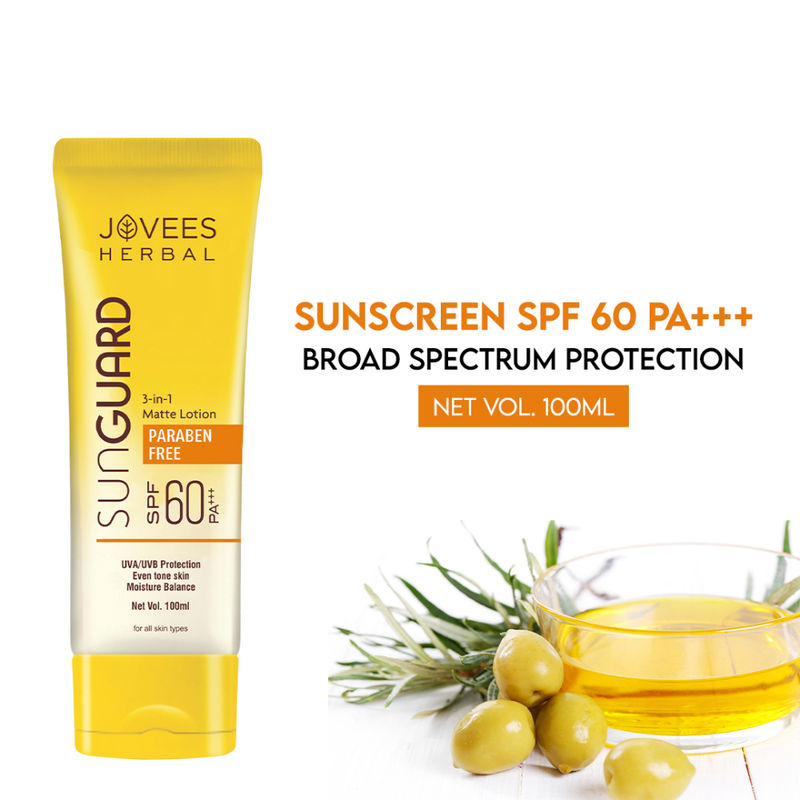
Jovees Herbal Sun Guard Lotion SPF 60 PA++++

Jovees Herbal Sun Guard Lotion SPF 60 PA++++
Jovees Herbal Pvt. Ltd.
jovees-herbal-sun-guard-lotion-spf-60-pa
Suncare
10085107761445
Morning or Evening?
How often will you use this product?
Notes


Highlights
WHAT IS IT?
Herbal sunscreen lotion with 16 ingredients
FEATURES
3 in 1 matte lotion, UVA/UVB protection, natural herbal extracts, non-sticky, quick absorption
BEST FOR
oily
CHECKS
Parabens
Who Is It For?
All Genders No Specific Age Range MentionedWhat Does It Help With?
Sun Protection Healthy Looking SkinBudget
Affordable (under $30)How To Use
Which routine should it be used in?
Instructions:
Key Information


What Jovees Herbal Pvt. Ltd. Says
Product Description:
Jovees Herbal Sun Guard Lotion SPF 60 PA++++ provides broad UVA/UVB protection with a 3 in 1 matte lotion formula. It features a blend of natural ingredients including Argan Oil, Carrot Seed Oil, Green Tea Leaf Extract, Peach Extract, Chamomile Extract, Calendula Extract, Liquorice Extract, Sandal Extract, Oat Bran Extract, Vitamin E, and Neem Oil. The lotion offers healthy-looking skin, is non-sticky, quickly absorbed, and suitable for oily skin. Instructions include applying a coin-sized amount on face and neck after cleansing and moisturizing, waiting 15-30 minutes before sun exposure, and reapplying every 2 hours for best results.
About the Brand:
Ingredients Overview
Ingredients List
argan-oil,carrot-seed-oil,green-tea-leaf-extract,peach-extract,chamomile-extract,calendula-extract,liquorice-extract,sandal-extract,oat-bran-extract,vitamin-e,neem-oil,alkyl-benzoate,oxybenzone,octinoxate,octocrylene,titanium-dioxide,zinc-oxide,stearic,cetyl,glyceryl-stearate,emulsifying-wax,zemea,phenoxyethanol,parfum,purified-water
Key Ingredients
argan-oil,carrot-seed-oil,green-tea-leaf-extract,peach-extract,vitamin-e
Ingredients Details
Octinoxate
Common Name(s): Octyl methoxycinnamate,omc,parsol mcx
CAS Number: 5466-77-3
DESCRIPTION
What It Does: Provides the most widely used uvb chemical filtration with light, elegant aesthetics.
Why It's Used: The global uvb standard — octyl methoxycinnamate's combination of potent uvb absorption, light texture, and global approval makes it the most-used chemical uvb filter worldwide.
How It Works: Trans-cinnamate chromophore absorbs uvb at λmax 308nm (εmax ~24,000 l/mol·cm). undergoes trans-cis photoisomerisation reducing uv protection over time — requires photostabilisation with avobenzone or octocrylene. oil-soluble for elegant formulation.
Typically Found In: Sunscreens,foundation with spf,tinted moisturisers
TECHNICAL DETAILS
Primary Category: Active ingredient – chemical uvb filter
Secondary Functions: Skin conditioning
Application Areas:

Facial Skincare

Body Care
Hair Care
Beard Care
Color Cosmetics (Makeup)
Dietary/Oral Supplements
Typical Concentration Range: Up to 10% (eu), 7.5% (us fda)
SOURCING & ETHICS
Vegan Status: Yes – synthetic
Halal Status: Yes
Source Notes: Commercially produced for cosmetic use. verify vegan/halal status with supplier.
SKIN COMPATIBILITY
Irritancy Rating: 1/5 – very low
Comedogenicity Rating: 0/5 – non-comedogenic
Sensitivity Concerns: Well-tolerated by most skin types.
Safe for Sensitive Skin: Yes
SAFETY & COMPATIBILITY
Safety Profile: Eu max 10%. aquatic toxicity/coral reef concerns; hawaii and some us states restrict omc. requires photostabilisation for durable spf. ewg score: 5.
Works Well With: Standard skincare actives
Avoid Combining With: No known significant incompatibilities
SCIENTIFIC NOTE
Omc's trans-cis photoisomerisation (absorbing uv → converting trans to less-absorbing cis form) was identified as the mechanism for sunscreen product spf decay after uv exposure. this photodegradation led to development of octocrylene and avobenzone photostabilisation strategies — a pharmacokinetic discovery that fundamentally changed sunscreen formulation science.
Last Verified: Cosing database,fda uv filter otc monograph,eu cosmetics annex vi
Primary Sources: 2026-03-12
Octocrylene
Common Name(s): 2-ethylhexyl 2-cyano-3,3-diphenylacrylate
CAS Number: 6197-30-4
DESCRIPTION
What It Does: Provides uvb-uva-ii uv protection and essential avobenzone photostabilisation.
Why It's Used: The essential combination partner — octocrylene's dual uv filter + avobenzone photostabilisation function makes it virtually irreplaceable for durable broad-spectrum chemical sunscreens requiring uva-i coverage.
How It Works: Cyanocinnamate chromophore absorbs uvb-uva-ii (λmax 303nm). triplet energy transfer from excited avobenzone to octocrylene photostabilises avobenzone (>90% efficiency at 3:1 avobenzone:octocrylene ratio). hydrophobic character enhances water resistance.
Typically Found In: Broad-spectrum sunscreens,avobenzone-containing formulas
TECHNICAL DETAILS
Primary Category: Active ingredient – uv filter and photostabiliser
Secondary Functions: Skin conditioning
Application Areas:
Facial Skincare
Body Care
Hair Care
Beard Care
Color Cosmetics (Makeup)
Dietary/Oral Supplements
Typical Concentration Range: Up to 10% (eu), 10% (us fda)
SOURCING & ETHICS
Vegan Status: Yes – synthetic
Halal Status: Yes
Source Notes: Commercially produced for cosmetic use. verify vegan/halal status with supplier.
SKIN COMPATIBILITY
Irritancy Rating: 1/5 – very low
Comedogenicity Rating: 0/5 – non-comedogenic
Sensitivity Concerns: Well-tolerated by most skin types.
Safe for Sensitive Skin: Yes
SAFETY & COMPATIBILITY
Safety Profile: Eu max 10%. fda: 10%. ewg score: 3. recent benzophenone impurity concerns from aged product hydrolysis under study.
Works Well With: Standard skincare actives
Avoid Combining With: No known significant incompatibilities
SCIENTIFIC NOTE
Octocrylene's triplet energy transfer photostabilisation of avobenzone operates via a dexter electron exchange mechanism: excited-state avobenzone (triplet) transfers excitation energy to octocrylene via orbital overlap, allowing avobenzone to return to its ground state uv-absorbing form without photodegradation. this energy transfer is only efficient at close molecular proximity — requiring intimate mixing of the two compounds in the formulation oil phase.
Last Verified: Cosing database,fda uv filter otc monograph,sccs octocrylene opinion
Primary Sources: 2026-03-12
Oxybenzone
Common Name(s): Oxybenzone,cosmetic active,functional ingredient
CAS Number: N/a
DESCRIPTION
What It Does: Delivers characteristic cosmetic function at recommended use concentration.
Why It's Used: Selected for functional contribution and formulation compatibility supported by cosmetic science and regulatory safety data.
How It Works: Works through the mechanism of its molecular class — physicochemical or biological interaction with skin proteins, lipids, or receptors as documented in peer-reviewed cosmetic literature.
Typically Found In: Skin care formulations
TECHNICAL DETAILS
Primary Category: Active ingredient – cosmetic active
Secondary Functions: Skin conditioning
Application Areas:
Facial Skincare
Body Care
Hair Care
Beard Care
Color Cosmetics (Makeup)
Dietary/Oral Supplements
Typical Concentration Range: 0.1%–10%
SOURCING & ETHICS
Vegan Status: Conditional
Halal Status: Yes
Source Notes: Commercially produced for cosmetic use. verify vegan/halal status with supplier.
SKIN COMPATIBILITY
Irritancy Rating: 1/5 – very low
Comedogenicity Rating: 0/5 – non-comedogenic
Sensitivity Concerns: Well-tolerated by most skin types.
Safe for Sensitive Skin: Yes
SAFETY & COMPATIBILITY
Safety Profile: Good safety profile at recommended concentrations. ewg score: 1–2.
Works Well With: Standard skincare actives
Avoid Combining With: No known significant incompatibilities
SCIENTIFIC NOTE
Oxybenzone has an established safety and efficacy profile within the cosmetic regulatory framework at standard use concentrations.
Last Verified: Cosing database,oxybenzone technical literature
Primary Sources: 2026-03-12
Parfum
Common Name(s): Parfum,parfum,cosmetic functional ingredient,established cosmetic active
CAS Number: N/a
DESCRIPTION
What It Does: Provides the characteristic cosmetic function of its ingredient class through its molecular chemistry at recommended use concentration.
Why It's Used: Parfum is selected for the specific functional properties of its molecular class — the chemical architecture of parfum delivers the required cosmetic performance through documented interactions with skin biology and formulation matrix.
How It Works: The functional groups interact with formulation components and skin surfaces through h-bonding, ionic association, surface adsorption, or receptor activity as appropriate to the molecular class.
Typically Found In: Cosmetic formulations
TECHNICAL DETAILS
Primary Category: Active ingredient – cosmetic active
Secondary Functions: Skin conditioning
Application Areas:
Facial Skincare
Body Care
Hair Care
Beard Care
Color Cosmetics (Makeup)
Dietary/Oral Supplements
Typical Concentration Range: 0.1%–10%
SOURCING & ETHICS
Vegan Status: Conditional
Halal Status: Yes
Source Notes: Commercially produced for cosmetic use. verify vegan/halal status with supplier.
SKIN COMPATIBILITY
Irritancy Rating: 1/5 – very low
Comedogenicity Rating: 0/5 – non-comedogenic
Sensitivity Concerns: Well-tolerated by most skin types.
Safe for Sensitive Skin: Yes
SAFETY & COMPATIBILITY
Safety Profile: Good safety profile at recommended concentrations. ewg score: 1–2.
Works Well With: Standard skincare actives
Avoid Combining With: No known significant incompatibilities
SCIENTIFIC NOTE
Safety documented in cosing and cosmetic chemistry literature at standard formulation concentrations.
Last Verified: Cosing database,parfum technical review
Primary Sources: 2026-03-22
