

Just Herbs
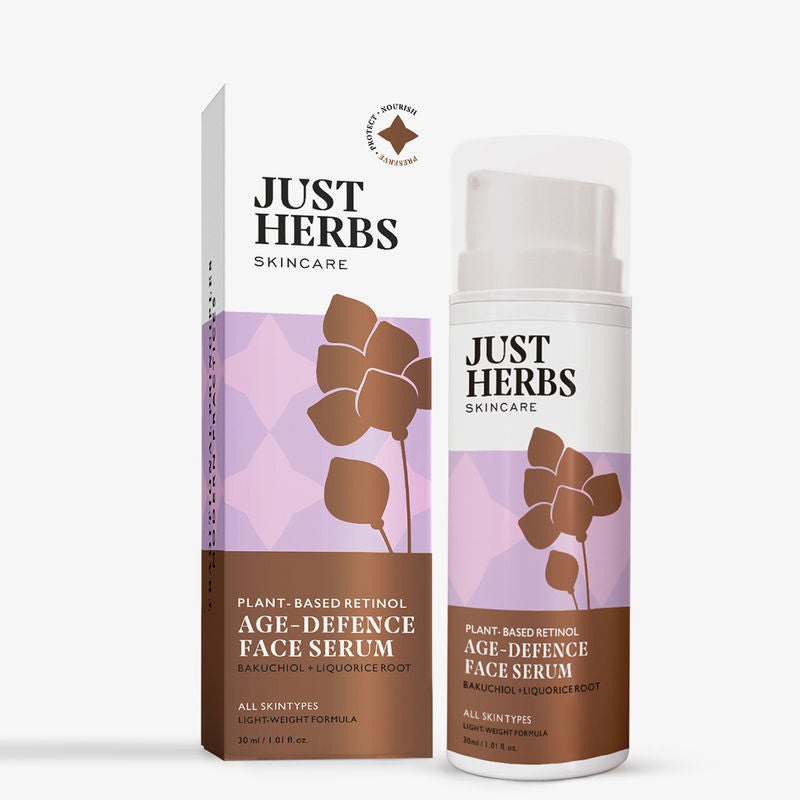
Just Herbs Plant-Based Retinol Age-Defence Face Serum for Fine Lines Wrinkles & Pigmentation

Just Herbs Plant-Based Retinol Age-Defence Face Serum for Fine Lines Wrinkles & Pigmentation
Just Herbs
just-herbs-plant-based-retinol-age-defence-face-serum-for-fine-lines-wrinkles-pigmentation
Serum
10085042946341
Morning or Evening?
How often will you use this product?
Notes


Highlights
WHAT IS IT?
Face Serum with 12 ingredients
FEATURES
Plant-Based Retinol, reduces fine lines, wrinkles & pigmentation, lightweight, does not irritate skin, organic formula
BEST FOR
sensitive
CHECKS
harsh chemicals
Who Is It For?
All Genders General Adult AgeWhat Does It Help With?
Fine Lines Wrinkles Pigmentation Skin GlowBudget
Mid-range ($30-$75)How To Use
Which routine should it be used in?
Instructions:
Key Information


What Just Herbs Says
Product Description:
Explore the entire range of Serums & Essence available on Nykaa. Shop more Just Herbs products here. You can browse through the complete world of Just Herbs Serums & Essence.
About the Brand:
Ingredients Overview
Ingredients List
Bakuchi-psoralea-corylifolia-seed-ext,liquorice-glycyrrhiza-glabra-ext,manjishtha-rubia-cordifolia-ext,priangu-callicarpa-macrophylla-ext,sweta-chandan-santalum-album-ext,neelkamal-nymphaea-nucifera-ext,purified-water-aqua,cold-pressed-jojoba-simmondsia-chinensis-oil,aloe-vera-aloe-barbadensis-leaf-juice,cetearyl-olivate,vegetable-glycerine,octyldodecanol,sorbitan-olivate,shea-butyrospermum-parkii-butter,rice-starch-phosphate-soy-lecithin,acacia-senegal-gum-xanthan-gum,caprylyl-glycol,potassium-sorbate,gluconolactone,sodium-gluconate,ethylhexylglycerin,natural-mixed-tocopherols-non-gmo
Key Ingredients
Bakuchi (Psoralea Corylifolia) Seed Ext., Liquorice (Glycyrrhiza Glabra) Ext., Manjishtha (Rubia Cordifolia) Ext.
Ingredients Details
Ethylhexylglycerin
Common Name(s): Octylglycerin,2-ethylhexyl glycerol ether,sensiva sc 10
CAS Number: 70445-33-9
DESCRIPTION
What It Does: Provides antimicrobial skin conditioning with deodorant activity and preservation system enhancement.
Why It's Used: Multifunctional clean beauty preservation active — ethylhexylglycerin provides antimicrobial, deodorant, and skin conditioning in a single ingredient accepted in most natural cosmetic certification schemes.
How It Works: Glycerol ether provides antimicrobial via bacterial membrane phospholipid disruption. deodorant activity via reduction of underarm lipase enzyme activity (similar mechanism to triethyl citrate). skin conditioning from glycerol humectant component. synergistic with phenoxyethanol and diols.
Typically Found In: Natural preservation systems,deodorants,skin conditioning products
TECHNICAL DETAILS
Primary Category: Functional ingredient – antimicrobial glycerol ether
Secondary Functions: Skin conditioning
Application Areas:

Facial Skincare

Body Care
Hair Care
Beard Care
Color Cosmetics (Makeup)
Dietary/Oral Supplements
Typical Concentration Range: 0.1%–0.5%
SOURCING & ETHICS
Vegan Status: Yes – synthetic
Halal Status: Yes
Source Notes: Commercially produced for cosmetic use. verify vegan/halal status with supplier.
SKIN COMPATIBILITY
Irritancy Rating: 1/5 – very low
Comedogenicity Rating: 0/5 – non-comedogenic
Sensitivity Concerns: Well-tolerated by most skin types.
Safe for Sensitive Skin: Yes
SAFETY & COMPATIBILITY
Safety Profile: Good safety profile at recommended concentrations. ewg score: 1–2.
Works Well With: Standard skincare actives
Avoid Combining With: No known significant incompatibilities
SCIENTIFIC NOTE
Ethylhexylglycerin's deodorant mechanism is pharmacologically identical to triethyl citrate: both inhibit skin surface microbial lipase enzymes that convert odourless triglycerides to odorous free fatty acids. the glycerol ether structure of ethylhexylglycerin, combined with the 2-ethylhexyl chain, provides lipase inhibition similar to ester-based lipase inhibitors from a different chemical class.
Last Verified: Cosing database,schülke sensiva sc 10 technical data,cir safety assessment
Primary Sources: 2026-03-12
Gluconolactone
Common Name(s): D-gluconolactone,delta-gluconolactone
CAS Number: 90-80-2
DESCRIPTION
What It Does: Provides the gentlest chemical exfoliation with simultaneous antioxidant, moisture retention, and barrier support.
Why It's Used: Preferred exfoliant for rosacea, eczema, sensitive skin, and post-procedure recovery where standard ahas cause unacceptable irritation.
How It Works: Hydrolyzes slowly on skin surface to gluconic acid providing gentle exfoliation. multiple hydroxyl groups enable water binding (humectant) and metal chelation (antioxidant).
Typically Found In: Sensitive skin exfoliants,rosacea treatments,eczema care,post-procedure recovery
TECHNICAL DETAILS
Primary Category: Active ingredient – polyhydroxy acid (pha)
Secondary Functions: Gentle exfoliation,antioxidant,humectant
Application Areas:
Facial Skincare
Body Care
Hair Care
Beard Care
Color Cosmetics (Makeup)
Dietary/Oral Supplements
Typical Concentration Range: 5%–15%
SOURCING & ETHICS
Vegan Status: Yes – fermentation or synthetic
Halal Status: Yes
Source Notes: Fermentation-derived from glucose or synthetic. among the safest chemical exfoliants available.
SKIN COMPATIBILITY
Irritancy Rating: 1/5 – very low
Comedogenicity Rating: 0/5 – non-comedogenic
Sensitivity Concerns: No photosensitization; no stinging; suitable for very sensitive skin.
Safe for Sensitive Skin: Yes – ideal for sensitive, reactive, rosacea, and eczema-prone skin; no photosensitization
SAFETY & COMPATIBILITY
Safety Profile: Exceptional safety profile. no photosensitization. ewg score: 1.
Works Well With: Ceramides,niacinamide,hyaluronic acid,soothing actives
Avoid Combining With: No significant incompatibilities
SCIENTIFIC NOTE
Phas have molecular weights 2–3× larger than ahas, limiting penetration to superficial layers. combined humectant and antioxidant properties make them uniquely well-tolerated while providing meaningful exfoliation.
Last Verified: Cosing database,green & yu (2003) pha review,cir safety assessment
Primary Sources: 2026-03-12
Octyldodecanol
Common Name(s): 2-octyldodecanol,eutanol g,c20 branched alcohol
CAS Number: 5333-42-6
DESCRIPTION
What It Does: Provides elegant dry-touch emolliency with excellent solubilisation for active ingredients.
Why It's Used: Premium emollient solvent — octyldodecanol's branched c20 structure provides a uniquely dry, elegant emollient character with exceptional compatibility for challenging actives.
How It Works: Branched c20 fatty alcohol provides dry, non-greasy emolliency. excellent solvent for fat-soluble vitamins, retinoids, uv filters, and flavour compounds. lower viscosity than longer-chain fatty alcohols for elegant application. very good spreading coefficient for uniform application.
Typically Found In: Premium skincare,sunscreens,vitamin delivery systems
TECHNICAL DETAILS
Primary Category: Functional ingredient – emollient
Secondary Functions: Barrier sealing,softening
Application Areas:
Facial Skincare
Body Care
Hair Care
Beard Care
Color Cosmetics (Makeup)
Dietary/Oral Supplements
Typical Concentration Range: 1%–20%
SOURCING & ETHICS
Vegan Status: Yes – from c10 alcohols via guerbet reaction (plant-derived)
Halal Status: Yes
Source Notes: Plant-derived, synthetic or animal-derived. verify source.
SKIN COMPATIBILITY
Irritancy Rating: 1/5 – very low
Comedogenicity Rating: 1/5 – low; formulation-dependent
Sensitivity Concerns: Non-irritating.
Safe for Sensitive Skin: Yes
SAFETY & COMPATIBILITY
Safety Profile: Excellent safety profile. ewg score: 1.
Works Well With: Humectants,ceramides,actives as carrier
Avoid Combining With: No significant incompatibilities
SCIENTIFIC NOTE
Octyldodecanol is produced via the guerbet reaction — a base-catalysed self-condensation of two c10 alcohol molecules (decanol) yielding the branched c20 2-octyldodecanol. this reaction produces a highly branched structure that prevents crystallisation (liquid at room temperature), providing liquid-state emolliency with a completely different tactile profile than the waxy feel of linear c20 fatty alcohols.
Last Verified: Cosing database,cir safety assessment
Primary Sources: 2026-03-12
