
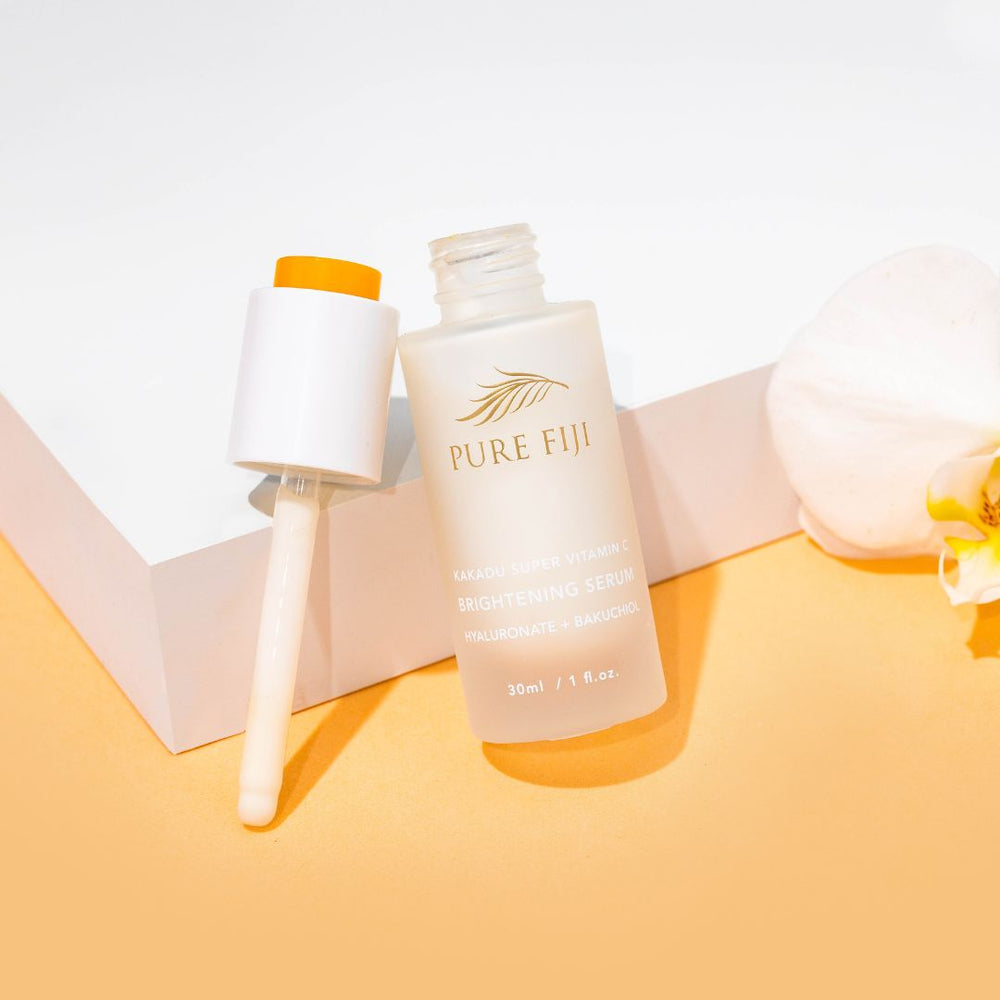

Pure Fiji
Kakadu Super Vitamin C Brightening Serum with Hyaluronate + Bakuchiol

Kakadu Super Vitamin C Brightening Serum with Hyaluronate + Bakuchiol
Pure Fiji
kakadu-super-vitamin-c-brightening-serum-with-hyaluronate-bakuchiol
Serum
9706861297957
Morning or Evening?
How often will you use this product?
Notes


Highlights
WHAT IS IT?
A Vitamin C brightening serum
FEATURES
Contains Kakadu plum, Bakuchiol, and Hyaluronate
BEST FOR
All skin types and those suffering from hyperpigmentation, dullness and the signs of ageing.
CHECKS
Free of parabens, phthalates, phenoxyethanol, sulfates, artifical colors, synthetics, PEGs, GMOs
Who Is It For?
Above 18 And Both Women And MenWhat Does It Help With?
Improves Radiance Luminosity Hydration Fine Lines Wrinkles And HyperpigmentationBudget
PremiumHow To Use
Which routine should it be used in?
Instructions:
Key Information


What Pure Fiji Says
Product Description:
Infuse your skin with this potent Vitamin C serum, supercharged with Kakadu plum, Bakuchiol and Hyaluronate. This powerful blend will dramatically improve radiance and luminosity while delivering an instant moisture surge and visibly reducing the appearance of fine lines, wrinkles and hyperpigmentation – rapid results for glowing skin.
About the Brand:
Ingredients Overview
Ingredients List
Water (Aqua), Ascorbyl Tetraisopalmitate, Terminalia Ferdinandiana (Kakaduplum) Oil, Aleurites Moluccana (Sikeci) Seed Oil, Glycerine, Macadamia Integrifolia (Macadamia) Seed Oil, Cocos Nucifera (Coconut) Oil, Xanthum Gum, Lecithin, Sclerotium Gum, Pullulan, Tocopherol, Bakuchiol (Vitamin A), Calophyllum Inophyllum (Dilo) Seed Oil, Terminalia Ferdinandiana (Kakadu plum) Fruit Extract, Passiflora Incarnata Flower Extract, Frangrance, Phenoxyethanol, Chlorphenesin, Caprylyl Glycol
Key Ingredients
Terminalia Ferdinandiana (Kakadu Plum) Oil and extract, Bakuchiol (Vitamin A), Ascorbyl Tetraisopalmitate (Vitamin C), Sodium Hyaluronate, Pullulan, Botanical Oil Blend, Passionflower extract, Vitamins A, B, C & E, Omegas 3, 6, 7 & 9
Ingredients Details
Ascorbyl Tetraisopalmitate
Common Name(s): Atip,vc-ip,vitamin c tetraisopalmitate
CAS Number: 183476-82-6
DESCRIPTION
What It Does: Delivers potent, stable vitamin c deep into skin for antioxidant protection, brightening, and collagen stimulation.
Why It's Used: Premium anti-aging where deep vitamin c penetration and exceptional stability are both required.
How It Works: Four isopalmitate chains facilitate passive diffusion through stratum corneum lipid bilayers. esterases progressively cleave chains releasing ascorbic acid in deeper skin layers.
Typically Found In: Premium serums,oil-based vitamin c,anti-aging oils
TECHNICAL DETAILS
Primary Category: Active ingredient – vitamin c derivative
Secondary Functions: Superior penetration,stable vitamin c
Application Areas:

Facial Skincare

Body Care
Hair Care
Beard Care
Color Cosmetics (Makeup)
Dietary/Oral Supplements
Typical Concentration Range: 0.5%–3%
SOURCING & ETHICS
Vegan Status: Yes – synthetic
Halal Status: Yes
Source Notes: Fully synthetic. produced by esterification of ascorbic acid with isopalmitic acid derivatives.
SKIN COMPATIBILITY
Irritancy Rating: 1/5 – very low
Comedogenicity Rating: 0/5 – non-comedogenic
Sensitivity Concerns: Non-irritating; suitable for all skin types.
Safe for Sensitive Skin: Yes
SAFETY & COMPATIBILITY
Safety Profile: Excellent safety profile. ewg score: 1.
Works Well With: Tocopherol,ferulic acid,niacinamide,spf
Avoid Combining With: No significant incompatibilities
SCIENTIFIC NOTE
Ex vivo penetration studies confirm significantly higher skin penetration depth vs l-ascorbic acid. the four isopalmitate chains facilitate partitioning into the lipid-continuous stratum corneum phase.
Last Verified: Cosing database,pinnell vitamin c derivatives review
Primary Sources: 2026-03-12
Cocos Nucifera (coconut) Oil
Common Name(s): Cocos nucifera (coconut) oil,cosmetic active,functional ingredient
CAS Number: N/a
DESCRIPTION
What It Does: Delivers characteristic cosmetic function — skin conditioning, protection, preservation, or active biological benefit — at recommended use concentration.
Why It's Used: Selected for its functional contribution and formulation compatibility — supported by cosmetic science literature and regulatory safety assessment.
How It Works: Works through the mechanism of its molecular class — physicochemical interaction with the formulation or biological interaction with skin proteins, lipids, or receptors as documented in peer-reviewed literature.
Typically Found In: Skin care formulations
TECHNICAL DETAILS
Primary Category: Active ingredient – cosmetic active
Secondary Functions: Skin conditioning
Application Areas:
Facial Skincare
Body Care
Hair Care
Beard Care
Color Cosmetics (Makeup)
Dietary/Oral Supplements
Typical Concentration Range: 0.1%–10%
SOURCING & ETHICS
Vegan Status: Conditional
Halal Status: Yes
Source Notes: Commercially produced for cosmetic use. verify vegan/halal status with supplier.
SKIN COMPATIBILITY
Irritancy Rating: 1/5 – very low
Comedogenicity Rating: 0/5 – non-comedogenic
Sensitivity Concerns: Well-tolerated by most skin types.
Safe for Sensitive Skin: Yes
SAFETY & COMPATIBILITY
Safety Profile: Good safety profile at recommended concentrations. ewg score: 1–2.
Works Well With: Standard skincare actives
Avoid Combining With: No known significant incompatibilities
SCIENTIFIC NOTE
Cocos nucifera (coconut) oil delivers documented functional benefit with an established safety profile within the cosmetic regulatory framework (cosing eu, cir usa).
Last Verified: Cosing database,cocos nucifera (coconut) oil technical literature
Primary Sources: 2026-03-12
Glycerine
Common Name(s): Glycerin,universal humectant,water-binding skin conditioning
CAS Number: N/a
DESCRIPTION
What It Does: Attracts and retains moisture in the sc, improves skin barrier function at low concentrations, provides gentle keratolytic softening, and acts as a co-solvent for water-soluble actives.
Why It's Used: The reference humectant — lowest cost, best safety profile, universal formulation compatibility, and present naturally in the sc via lipase-mediated glycerolipid hydrolysis makes glycerin the industry standard against which all humectants are benchmarked.
How It Works: Three hydroxyl groups form 6 h-bonds with water molecules per glycerol unit — the highest oh-group density per carbon of any commercial humectant. glycerin also down-regulates epidermal serine proteases that overactivate in dry sc, improving desquamation and barrier integrity.
Typically Found In: All cosmetics,universal
TECHNICAL DETAILS
Primary Category: Functional ingredient – humectant
Secondary Functions: Tewl reduction,skin plumping
Application Areas:
Facial Skincare
Body Care
Hair Care
Beard Care
Color Cosmetics (Makeup)
Dietary/Oral Supplements
Typical Concentration Range: 1%–40%
SOURCING & ETHICS
Vegan Status: Yes
Halal Status: Yes
Source Notes: Synthetic or naturally derived. excellent aqueous solubility.
SKIN COMPATIBILITY
Irritancy Rating: 1/5 – very low
Comedogenicity Rating: 0/5 – non-comedogenic
Sensitivity Concerns: Non-irritating; suitable for all skin types.
Safe for Sensitive Skin: Yes
SAFETY & COMPATIBILITY
Safety Profile: Excellent safety profile. ewg score: 1.
Works Well With: Ceramides,emollients,occlusives,glycerin,hyaluronic acid
Avoid Combining With: No significant incompatibilities
SCIENTIFIC NOTE
Epidermal lipases hydrolyse sc glycerophospholipids during cornification, releasing glycerol that contributes to the natural nmf — topical glycerin directly supplements this endogenous sc humectant pool.
Last Verified: Cosing database,glycerin universal humectant review
Primary Sources: 2026-03-12
Lecithin
Common Name(s): Soy lecithin,sunflower lecithin,phosphatidylcholine complex
CAS Number: 8002-43-5
DESCRIPTION
What It Does: Provides natural phospholipid emulsification with barrier-compatible delivery and liposome-forming properties.
Why It's Used: The most biologically authentic emulsifier – identical to cell membrane composition providing barrier-compatible delivery and liposome formation unavailable from synthetic emulsifiers.
How It Works: Phosphatidylcholine (pc), phosphatidylethanolamine (pe), phosphatidylinositol (pi) mixture provides hlb 7-12 for o/w emulsification. forms liposomal bilayers for active encapsulation. pc/pe/pi composition mirrors cell membrane for barrier-compatible delivery.
Typically Found In: Natural cosmetics,liposomal products,barrier repair,penetration-enhanced formulas
TECHNICAL DETAILS
Primary Category: Functional ingredient – natural phospholipid emulsifier
Secondary Functions: Skin conditioning
Application Areas:
Facial Skincare
Body Care
Hair Care
Beard Care
Color Cosmetics (Makeup)
Dietary/Oral Supplements
Typical Concentration Range: 0.5%–10%
SOURCING & ETHICS
Vegan Status: Conditional – soy lecithin (vegan); egg lecithin (not vegan)
Halal Status: Conditional – soy (halal); egg (verify)
Source Notes: Commercially produced for cosmetic use. verify vegan/halal status with supplier.
SKIN COMPATIBILITY
Irritancy Rating: 1/5 – very low
Comedogenicity Rating: 0/5 – non-comedogenic
Sensitivity Concerns: Well-tolerated by most skin types.
Safe for Sensitive Skin: Yes
SAFETY & COMPATIBILITY
Safety Profile: Good safety profile at recommended concentrations. ewg score: 1–2.
Works Well With: Standard skincare actives
Avoid Combining With: No known significant incompatibilities
SCIENTIFIC NOTE
Lecithin's phospholipid composition mirrors the composition of the stratum corneum's own lamellar bodies that deliver barrier lipids to the skin surface. this structural mimicry allows lecithin-based delivery systems to integrate seamlessly with the barrier lipid structure, exploiting the same transport pathway the skin uses for its own lipid secretion.
Last Verified: Cosing database,cir safety assessment
Primary Sources: 2026-03-12
