

La Shield
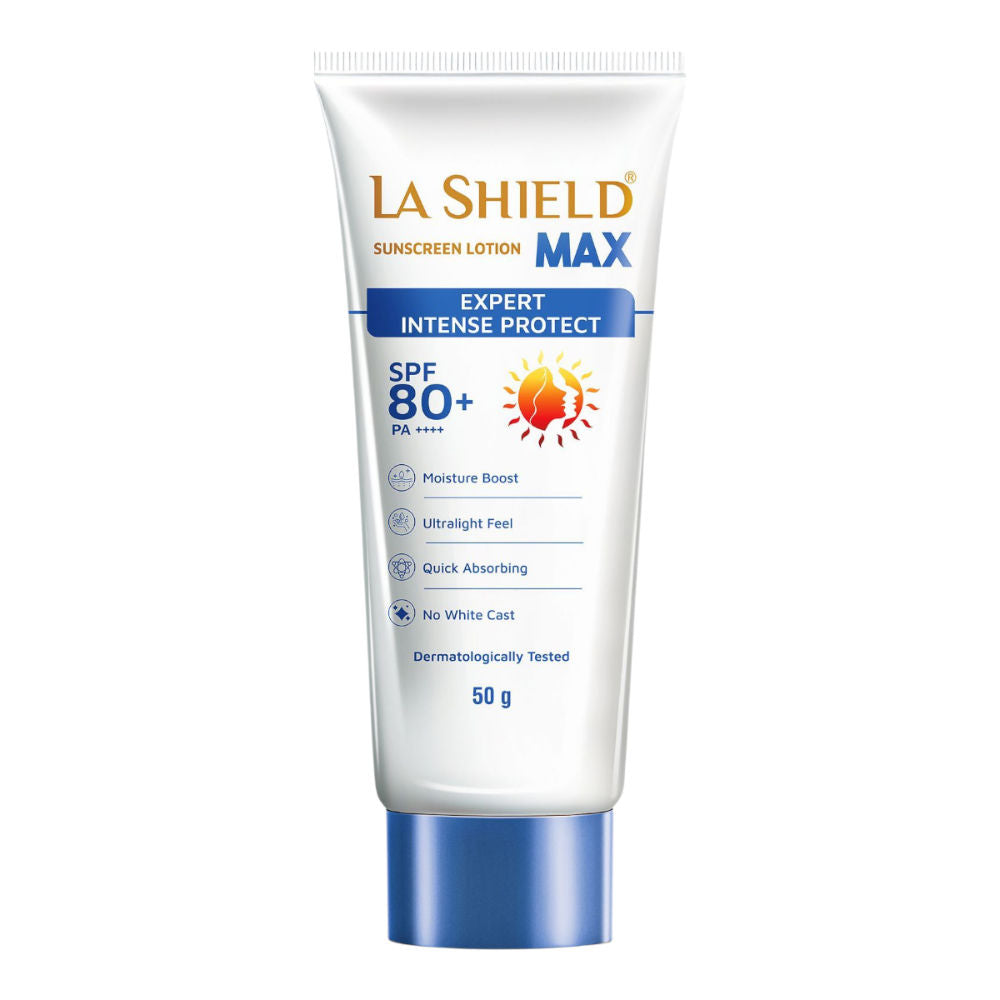
La Shield Max SPF 80+ PA++++ Intense Sun Protection Sunscreen Lotion

La Shield Max SPF 80+ PA++++ Intense Sun Protection Sunscreen Lotion
La Shield
la-shield-max-spf-80-pa-intense-sun-protection-sunscreen-lotion
Suncare
10085111464229
Morning or Evening?
How often will you use this product?
Notes


Highlights
WHAT IS IT?
Broad-spectrum sunscreen with SPF 80+ PA++++, Hydrosella extract enriched
FEATURES
Nourishing sunscreen with SPF 80+ PA++++; Infused with hydrosella extract for moisturization; Lightweight and transparent; Smooth matte finish; Dermatologically tested; Non-comedogenic
BEST FOR
sensitive
CHECKS
Who Is It For?
What Does It Help With?
Protection From Sun Damage Hydration Suitable For Skin Undergoing Procedural Treatment For Hyperpigmentation And AcneBudget
Mid-range ($30-$75)How To Use
Which routine should it be used in?
Instructions:
Key Information


What La Shield Says
Product Description:
La Shield Max Sunscreen with SPF 80+ PA++++ is specially formulated for protection of ultra-sensitive skin from sun damage. It is a broad-spectrum sunscreen with SPF 80+ and PA++++. It is a hydrating sunscreen enriched with hydrosella, which ensures optimal hydration of the skin. It is specially suited for skin undergoing procedural treatment for hyperpigmentation and acne. Superior sun protection begins with the La Shield sun care range. Features: Nourishing sunscreen with SPF 80+ PA++++ provides intense sun protection for highly sensitive skin; Infused with hydrosella extract, which ensures moisturization along with protection; It is lightweight and transparent with a smooth matte finish; Dermatologically tested and non-comedogenic.
About the Brand:
Ingredients Overview
Ingredients List
Purified-Water,Methylene-Bis-benzotriazolyl-Tetramethylbutylphenol,Decyl-Glucoside,Propylene-Glycol,Xanthan-Gum,Diethylamino-Hydroxybenzoyl-Hexyl-Benzoate,Ethylhexyl-Triazone,Butylene-Glycol,Peg-100-Stearate,Zinc-Oxide,Titanium-Dioxide,Phospholipid,Phenoxyethanol
Key Ingredients
Methylene Bis-benzotriazolyl Tetramethylbutylphenol, Hydrosella extract, Zinc Oxide, Titanium Dioxide
Ingredients Details
Phenoxyethanol
Common Name(s): 2-phenoxyethanol,rose ether,ethylene glycol monophenyl ether
CAS Number: 122-99-6
DESCRIPTION
What It Does: Prevents microbial contamination and spoilage in cosmetic formulations.
Why It's Used: The benchmark cosmetic preservative – eu-permitted up to 1%, effective against virtually all cosmetically relevant microorganisms, and excellent tolerability.
How It Works: Phenol ring provides broad antimicrobial activity via disruption of bacterial and fungal cell membranes and inhibition of enzymatic activity. effective against gram-positive and gram-negative bacteria, yeasts (candida), and molds (aspergillus). activity ph range: 3-9.
Typically Found In: All cosmetic formulations as primary preservative
TECHNICAL DETAILS
Primary Category: Functional ingredient – broad-spectrum preservative
Secondary Functions: Skin conditioning
Application Areas:

Facial Skincare

Body Care
Hair Care
Beard Care
Color Cosmetics (Makeup)
Dietary/Oral Supplements
Typical Concentration Range: 0.1%–1% (eu max 1%)
SOURCING & ETHICS
Vegan Status: Yes – synthetic
Halal Status: Yes
Source Notes: Commercially produced for cosmetic use. verify vegan/halal status with supplier.
SKIN COMPATIBILITY
Irritancy Rating: 1/5 – very low
Comedogenicity Rating: 0/5 – non-comedogenic
Sensitivity Concerns: Well-tolerated by most skin types.
Safe for Sensitive Skin: Yes
SAFETY & COMPATIBILITY
Safety Profile: Eu cosmetics regulation max 1%. sccs assessed as safe at ≤1%. avoid use around eyes in baby products per some country regulations. ewg score: 4.
Works Well With: Standard skincare actives
Avoid Combining With: No known significant incompatibilities
SCIENTIFIC NOTE
Phenoxyethanol's widespread adoption as the primary cosmetic preservative followed the phaseout of parabens from many formulations in the 2000s-2010s. despite having a comparable or better safety profile to parabens, it is often cited in 'free-from' formulations – a consumer perception issue rather than a scientific safety concern.
Last Verified: Cosing database,sccs opinion on phenoxyethanol,cir safety assessment
Primary Sources: 2026-03-12
Phospholipid
Common Name(s): Lecithin/phospholipid,cell membrane lipid,emulsifier barrier repair
CAS Number: N/a
DESCRIPTION
What It Does: Stabilises o/w and w/o emulsions through biomimetic phospholipid bilayer formation, supplements sc barrier lipids for barrier repair, and forms liposomes and lamellar delivery vehicles for encapsulated active delivery.
Why It's Used: Phospholipids are uniquely bifunctional: they provide conventional emulsification and form genuine liposomal bilayer vesicles for encapsulated active delivery — a dual function unavailable from synthetic emulsifiers.
How It Works: The phosphocholine head group provides strong h-bonding hydrophilicity while the dual fatty acid tails provide lipophilic anchoring — this wedge-shaped geometry spontaneously forms closed bilayer vesicles (liposomes) that encapsulate actives for sustained release and enhanced sc penetration.
Typically Found In: Emulsions,liposomal delivery,barrier repair
TECHNICAL DETAILS
Primary Category: Functional ingredient – emollient
Secondary Functions: Barrier sealing,softening
Application Areas:
Facial Skincare
Body Care
Hair Care
Beard Care
Color Cosmetics (Makeup)
Dietary/Oral Supplements
Typical Concentration Range: 1%–15%
SOURCING & ETHICS
Vegan Status: Conditional
Halal Status: Yes
Source Notes: Plant-derived, synthetic or animal-derived. verify source.
SKIN COMPATIBILITY
Irritancy Rating: 1/5 – very low
Comedogenicity Rating: 1/5 – low; formulation-dependent
Sensitivity Concerns: Non-irritating.
Safe for Sensitive Skin: Yes
SAFETY & COMPATIBILITY
Safety Profile: Excellent safety profile. ewg score: 1.
Works Well With: Humectants,ceramides,actives as carrier
Avoid Combining With: No significant incompatibilities
SCIENTIFIC NOTE
Phospholipid's wedge-shaped geometry (large head relative to two acyl tails) preferentially forms spherical bilayer vesicles (liposomes) rather than flat lamellar phases — this curvature preference enables self-assembly of drug delivery liposomes simply by hydration of the phospholipid film.
Last Verified: Cosing database,lecithin phospholipid liposomal delivery review
Primary Sources: 2026-03-12
