

Nykaa E retail limited
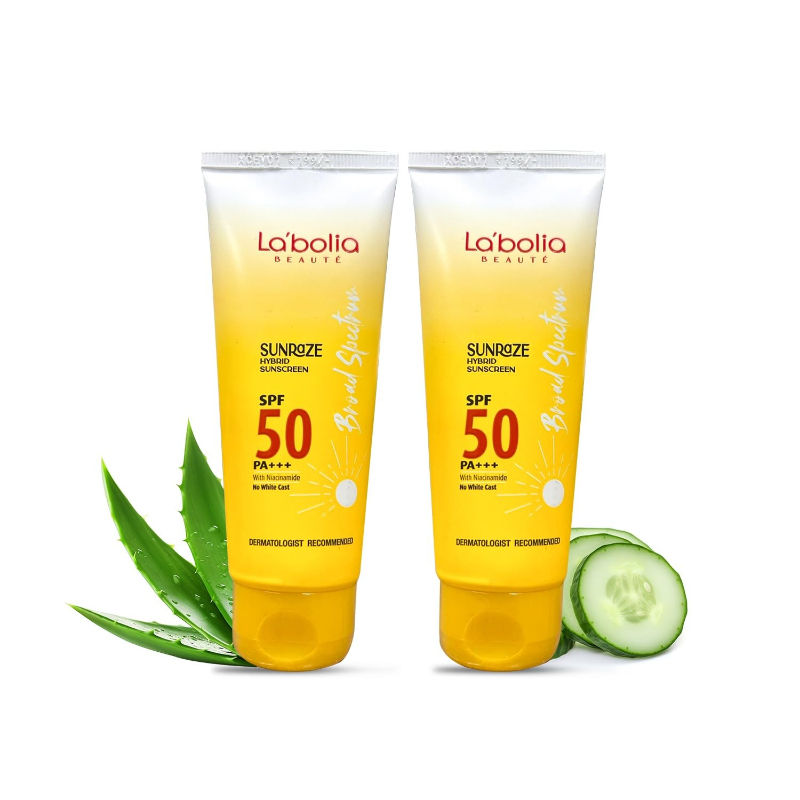
Labolia Beaute Sunraze Spf 50 Pa+++ For Glowing Skin, No White Cast - Pack Of 2

Labolia Beaute Sunraze Spf 50 Pa+++ For Glowing Skin, No White Cast - Pack Of 2
Nykaa E retail limited
labolia-beaute-sunraze-spf-50-pa-for-glowing-skin-no-white-cast-pack-of-2
Suncare
10084961321253
Morning or Evening?
How often will you use this product?
Notes


Highlights
WHAT IS IT?
Hybrid sunscreen, 20 ingredients
FEATURES
Broad-spectrum UVA and UVB protection, no white cast, moisturizing with niacinamide, enriched with turmeric, saffron, vitamin E, chickpea juice, vitamin B5, cruelty-free, dermatologist recommended
BEST FOR
sensitive
CHECKS
Does not contain parabens (only methylparaben and propylparaben sodium present), fragrance present, no sulfates or silicones explicitly stated
Who Is It For?
All Genders Adult Age Range ImpliedWhat Does It Help With?
Sun Protection Pigmentation Reduction Hydration Skin Nourishment Brightening Anti-aging (fine Lines And Wrinkles) Skin RepairBudget
Affordable (under $30)How To Use
Which routine should it be used in?
Instructions:
Key Information


What Nykaa E retail limited Says
Product Description:
Labolia Beaute Sunraze SPF 50 PA+++ is a dermatologist-recommended hybrid sunscreen that offers broad-spectrum protection against UVA and UVB rays. Formulated for glowing skin with zero white cast, it features niacinamide to lock in moisture and prevent dryness and dehydration. Safe for daily use, it keeps your skin protected, hydrated, and radiant. Features include gentle tan removal, turmeric for pigmentation reduction, saffron for brightening, vitamin E for moisture, chickpea juice for nourishment, and vitamin B5 for moisture retention and skin repair. Cruelty-free and dermatologist recommended.
About the Brand:
Ingredients Overview
Ingredients List
Light-liquid-paraffin,Octyl-salicylate,Zinc-oxide,Stearic-acid,Octyl-methoxycinnamate,Titanium-dioxide,Glycerin,Glyceryl-monostearate,Cetomacrogol-1000,Aloe-vera-liquid-extract,Cucumber-liquid-extract,Benzophenone-3,Butyl-methoxydibenzoylmethane,Cetyl-alcohol,Perfume,Niacinamide,Triethanolamine,Phenoxyethanol,Beeswax,Methylparaben-sodium,Propylparaben-sodium,Carbopol-940,Purified-water
Key Ingredients
Niacinamide,Turmeric,Saffron,Vitamin E,Chickpea juice,Vitamin B5
Ingredients Details
Beeswax
Common Name(s): Cera alba (white),cera flava (yellow),apis mellifera wax
CAS Number: 8012-89-3
DESCRIPTION
What It Does: Provides natural wax structure and emolliency for cosmetic texture and lip balm applications.
Why It's Used: The original cosmetic wax – provides natural, hard-texture structure for lip balms, sticks, and creams with emollient skin conditioning.
How It Works: Complex mixture of esters (wax esters), hydrocarbons (hentriacontane), and fatty acids provides semi-crystalline structure. melting point 62-65°c enables stable solid products. emulsifying capacity from free cerotic acid content.
Typically Found In: Lip balms,cosmetic sticks,creams,natural cosmetics
TECHNICAL DETAILS
Primary Category: Functional ingredient – natural wax
Secondary Functions: Natural wax structure,occlusive conditioning
Application Areas:

Facial Skincare

Body Care
Hair Care
Beard Care
Color Cosmetics (Makeup)
Dietary/Oral Supplements
Typical Concentration Range: 2%–30%
SOURCING & ETHICS
Vegan Status: No - animal-derived
Halal Status: Conditional - bee-derived; widely held permissible, confirm certifier stance
Source Notes: Plant-derived, synthetic or animal-derived. verify source. [audit 2026-07-29 rev2: bee-derived; permissibility widely accepted but fatwa varies by jurisdiction. determination requires shariah-panel sign-off.]
SKIN COMPATIBILITY
Irritancy Rating: 1/5 – very low
Comedogenicity Rating: 1/5 – low; formulation-dependent
Sensitivity Concerns: Non-irritating.
Safe for Sensitive Skin: Yes
SAFETY & COMPATIBILITY
Safety Profile: Excellent safety profile. ewg score: 1.
Works Well With: Humectants,ceramides,actives as carrier
Avoid Combining With: No significant incompatibilities
SCIENTIFIC NOTE
Beeswax's multi-component wax ester composition (myricyl palmitate as primary component) provides a unique crystalline structure that gives lip balms and cosmetic sticks their characteristic 'dragée' glide – different from synthetic wax esters that lack this crystalline lattice diversity.
Last Verified: 2026-03-12
Primary Sources: Cosing database,cir safety assessment
Benzophenone-3
Common Name(s): Oxybenzone,2-hydroxy-4-methoxybenzophenone,uva+uvb filter
CAS Number: 131-57-7
DESCRIPTION
What It Does: Provides combined uva and uvb filtration in a single chemical uv filter molecule.
Why It's Used: Combined uva+uvb filter historically used for broad-spectrum coverage in a single ingredient, now increasingly restricted.
How It Works: Benzophenone chromophore absorbs uvb (305nm) and uva-ii (326nm) via two separate n→π* transitions. water-soluble allows aqueous phase formulation. single filter providing partial broad-spectrum coverage.
Typically Found In: Sunscreens (being phased out in many markets)
TECHNICAL DETAILS
Primary Category: Active ingredient – chemical uva/uvb filter
Secondary Functions: Skin conditioning
Application Areas:
Facial Skincare
Body Care
Hair Care
Beard Care
Color Cosmetics (Makeup)
Dietary/Oral Supplements
Typical Concentration Range: Up to 6% (eu), 6% (us fda)
SOURCING & ETHICS
Vegan Status: Conditional - supplier confirmation required
Halal Status: Unverified - supplier confirmation required
Source Notes: Commercially produced for cosmetic use. verify vegan/halal status with supplier. [audit 2026-07-29 rev2: the record's own source_notes does not assert a non-animal origin, or instructs the reader to verify with the supplier; "yes" asserts knowledge the record does not hold. determination requires shariah-panel sign-off.]
SKIN COMPATIBILITY
Irritancy Rating: 1/5 – very low
Comedogenicity Rating: 0/5 – non-comedogenic
Sensitivity Concerns: Well-tolerated by most skin types.
Safe for Sensitive Skin: Yes
SAFETY & COMPATIBILITY
Safety Profile: Eu max 6%. coral reef/aquatic toxicity — banned hawaii, palau, some us states. potential endocrine activity at high systemic exposure. ewg score: 7. use declining due to regulatory pressure.
Works Well With: Standard skincare actives
Avoid Combining With: No known significant incompatibilities
SCIENTIFIC NOTE
Benzophenone-3's declining use reflects evolving understanding of environmental and endocrine impacts: discovered in coral bleaching studies, its restriction in hawaii (2018) sparked a global trend in marine-safe sunscreen formulations that is reshaping the industry away from bp-3 toward mineral filters and marine-safer organic alternatives.
Last Verified: 2026-03-12
Primary Sources: Cosing database,fda uv filter otc monograph,hawaii bp-3 restriction law
Glycerin
Common Name(s): Glycerol,glycerine,1,2,3-propanetriol
CAS Number: 56-81-5
DESCRIPTION
What It Does: Glycerin pulls water from the environment and deeper skin layers into the outer skin layer (epidermis), boosting moisture levels and keeping skin soft, smooth, and plump.
Why It's Used: It is used in virtually every moisturizer, serum, and cleanser because it is highly effective at hydrating skin, is well-tolerated by all skin types, and enhances the texture and spreadability of formulations.
How It Works: As a humectant, glycerin forms hydrogen bonds with water molecules, trapping them in the skin. it also reinforces the skin barrier by integrating into lipid structures between skin cells.
Typically Found In: Moisturizers,serums,cleansers,toners,sheet masks,sunscreens,body lotions,shampoos,conditioners
TECHNICAL DETAILS
Primary Category: Humectant
Secondary Functions: Skin barrier support,emollient,solvent
Application Areas:
Facial Skincare
Body Care
Hair Care
Beard Care
Color Cosmetics (Makeup)
Dietary/Oral Supplements
Typical Concentration Range: 1%–30% (typical: 3–10%)
SOURCING & ETHICS
Vegan Status: Conditional - feedstock declaration required
Halal Status: Unverified - feedstock declaration required (plant, animal and petrochemical routes all exist)
Source Notes: Derived from plant oils via hydrolysis or saponification; synthetic versions also available. palm-derived glycerin carries sustainability concerns. [audit 2026-07-29 rev2: origin-dependent: the same inci exists in plant, animal and petrochemical versions and the name does not discriminate. determination requires shariah-panel sign-off.]
SKIN COMPATIBILITY
Irritancy Rating: 1/5 – very low; non-irritating at all standard concentrations
Comedogenicity Rating: 0/5 – non-comedogenic
Sensitivity Concerns: Extremely rare allergic reactions; generally safe for all skin types including sensitive and baby skin
Safe for Sensitive Skin: Yes
SAFETY & COMPATIBILITY
Safety Profile: Widely recognized as safe. ewg hazard score: 1. no significant concerns for irritation, sensitization, or toxicity at typical concentrations (up to 50%).
Works Well With: Hyaluronic acid,ceramides,niacinamide,panthenol,urea,peptides,retinol,ahas/bhas
Avoid Combining With: No known incompatibilities at standard concentrations
SCIENTIFIC NOTE
Glycerin is an endogenous skin component found naturally in the stratum corneum. aquaporin-3 channels in keratinocytes facilitate glycerin transport, making it integral to natural skin hydration pathways.
Last Verified: 2026-03-12
Primary Sources: Cosing database,cir safety assessment,ewg skin deep,inci decoder
Niacinamide
Common Name(s): Vitamin b3,nicotinamide,pyridine-3-carboxamide
CAS Number: 98-92-0
DESCRIPTION
What It Does: Niacinamide strengthens the skin barrier, reduces visible pore size, regulates sebum production, fades dark spots, and improves skin texture and tone.
Why It's Used: It is used because it addresses multiple skin concerns at once without irritation, making it suitable for all skin types. it is stable in formulations and pairs well with most other actives.
How It Works: Niacinamide inhibits the transfer of melanosomes (pigment packets) to skin cells, reducing hyperpigmentation. it also stimulates ceramide synthesis to strengthen the skin barrier and reduces inflammation by modulating cytokine activity.
Typically Found In: Serums,moisturizers,toners,cleansers,eye creams,sunscreens,primers
TECHNICAL DETAILS
Primary Category: Active ingredient – vitamin
Secondary Functions: Barrier repair,brightening,anti-inflammatory
Application Areas:
Facial Skincare
Body Care
Hair Care
Beard Care
Color Cosmetics (Makeup)
Dietary/Oral Supplements
Typical Concentration Range: 2%–10% (typical: 5%; higher concentrations may cause flushing in some individuals)
SOURCING & ETHICS
Vegan Status: Yes – synthetically produced
Halal Status: Yes – synthetic origin
Source Notes: Commercially produced via synthesis from nicotinic acid or 3-cyanopyridine. no animal-derived sources used in cosmetic-grade niacinamide.
SKIN COMPATIBILITY
Irritancy Rating: 1/5 – very low; concentrations above 10% may cause temporary flushing in sensitive individuals
Comedogenicity Rating: 0/5 – non-comedogenic
Sensitivity Concerns: At concentrations >10%, some users experience niacin flush (transient redness/tingling). generally very well-tolerated.
Safe for Sensitive Skin: Yes – one of the best-tolerated actives for sensitive skin
SAFETY & COMPATIBILITY
Safety Profile: Extensively studied and considered very safe. ewg hazard score: 1. no significant systemic toxicity concerns at topical concentrations.
Works Well With: Retinol,peptides,ahas/bhas,hyaluronic acid,ceramides,zinc,vitamin c,spf
Avoid Combining With: High concentrations of vitamin c (ascorbic acid) may theoretically convert to niacin – use at different times if using pure l-ascorbic acid above 15%
SCIENTIFIC NOTE
Niacinamide is a precursor to nad+ and nadp+, coenzymes vital to cellular energy metabolism. its benefits for dna repair and mitochondrial function make it a key ingredient in anti-aging strategies.
Last Verified: 2026-03-12
Primary Sources: Cosing database,cir safety assessment,ewg skin deep,pubmed clinical studies