

Lakme
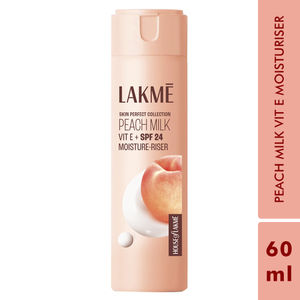
Lakme Peach Milk Moisturizer SPF 24 PA Sunscreen Lotion 60 ml

Lakme Peach Milk Moisturizer SPF 24 PA Sunscreen Lotion 60 ml
Lakme
lakme-peach-milk-moisturizer-spf-24-pa-sunscreen-lotion-60-ml
Moisturize
10084865638693
Morning or Evening?
How often will you use this product?
Notes


Highlights
WHAT IS IT?
Moisturizer SPF 24, 1 type
FEATURES
Blend of peaches and milk, nourishes deeply without oily feel, SPF 24 protection, soothing fragrance, locks moisture for 12 hours, soft smooth glowing skin
BEST FOR
normal
CHECKS
Avoid contact with eyes
Who Is It For?
Unspecified Age And GenderWhat Does It Help With?
Moisturizing Nourishment Sun Protection Soft And Glowing SkinBudget
Affordable (under $30)How To Use
Which routine should it be used in?
Instructions:
Key Information


What Lakme Says
Product Description:
Is your skin loosing moisture as the day goes by? Lakme brings to you a moisturizer which is a blend of wholesome peaches and milk which nourishes the skin deeply without making it appear oily. This light moisturizer dozed with SPF 24 has a soothing fragrance which will make you fall in love with it instantly. This lotion easily absorbs into the skin to lock moisture for 12 hours to give you soft smooth and glowing skin. Choose the right Peach Milk Moisturizer for light nourishment pick this classic lotion. For intense nourishment try the Peach Milk Winter lotion. For nourishment with sun protection try the Peach Milk SPF lotion. For best results use everyday for nourished skin that glows. About Lakme Lakme is Indias No.1 Color Cosmetics brand offering a wide range of highend worldclass color cosmetic and skincare products. Lakme has a vast product range specially crafted by experts for the Indian skin. The brand has also been redefining fashion in India for over 15 years with Lakme Fashion Week Indias premier fashion event. Allergies In the unlikely event of skin irritation stop using and consult a doctor immediately. Warning Avoid contact with eyes. Wash your eyes thoroughly with clean water in case of contact
About the Brand:
Ingredients Overview
Ingredients List
Alpha hydroxy acid, Octyl salicilate, Avobenzone
Key Ingredients
Peach, Milk, SPF 24
Ingredients Details
Alpha Hydroxy Acid
Common Name(s): Alpha hydroxy acid,alpha-hydroxy acid exfoliant,keratolytic active
CAS Number: N/a
DESCRIPTION
What It Does: Exfoliates dead skin cells by disrupting desmosomal adhesion bonds, brightens skin tone, stimulates collagen production, and improves product active penetration through the exfoliated sc.
Why It's Used: Aha exfoliation is the most evidence-backed chemical exfoliation mechanism with 30+ years of clinical use data; different acid sizes allow formulators to select penetration depth and intensity for specific skin types.
How It Works: Aha carboxylic groups donate h⁺ disrupting ca²⁺ coordination of desmoglein desmosomal proteins at formulation ph 3–4, weakening corneocyte cohesion. smaller ahas (glycolic, mw 76) penetrate fastest; larger (mandelic, mw 152) penetrate slower for gentler exfoliation.
Typically Found In: Exfoliating toners,aha serums,anti-aging
TECHNICAL DETAILS
Primary Category: Active ingredient – alpha hydroxy acid (aha)
Secondary Functions: Brightening,collagen stimulation
Application Areas:

Facial Skincare
Body Care

Hair Care
Beard Care
Color Cosmetics (Makeup)
Dietary/Oral Supplements
Typical Concentration Range: 1%–15%
SOURCING & ETHICS
Vegan Status: Yes
Halal Status: Yes
Source Notes: Fermentation-derived or synthetic. ph must be ≤4.0 for aha activity.
SKIN COMPATIBILITY
Irritancy Rating: 2/5 – low to moderate
Comedogenicity Rating: 0/5 – non-comedogenic
Sensitivity Concerns: Photosensitizing – mandatory spf use. start at low frequency.
Safe for Sensitive Skin: Use with caution – spf required
SAFETY & COMPATIBILITY
Safety Profile: Safe at otc concentrations. eu: ≤10% leave-on at ph ≥3.5. mandatory spf advisory.
Works Well With: Niacinamide,ceramides,hyaluronic acid,spf
Avoid Combining With: Retinol in same step; multiple exfoliants simultaneously
SCIENTIFIC NOTE
Glycolic acid is the most clinically studied aha; mandelic and lactic are preferred for sensitive or darker skin types from their larger molecular weight and slower penetration kinetics.
Last Verified: Cosing database,alpha hydroxy acid aha exfoliant review
Primary Sources: 2026-03-12
Avobenzone
Common Name(s): Parsol 1789,avobenzone
DESCRIPTION
What It Does: Provides uva-i protection (340-400nm) critical for photoaging prevention — the only widely available chemical uva-i filter.
Why It's Used: The essential uva-i filter — avobenzone is the only commonly approved chemical filter providing protection in the photoaging-critical 340-400nm range essential for broad-spectrum sunscreen claims.
How It Works: Dibenzoylmethane chromophore absorbs uva-i (λmax 357nm, εmax ~36,000). photodegrades via photoisomerisation requiring photostabilisation (octocrylene, bemotrizinol) for durability.
Typically Found In: Broad-spectrum sunscreens,anti-aging spf products
TECHNICAL DETAILS
Primary Category: Active ingredient – chemical uva-i filter
Secondary Functions: Skin conditioning
Application Areas:
Facial Skincare
Body Care
Hair Care
Beard Care
Color Cosmetics (Makeup)
Dietary/Oral Supplements
Typical Concentration Range: Up to 5% (eu), 3% (us fda)
SOURCING & ETHICS
Vegan Status: Yes – synthetic
Halal Status: Yes
Source Notes: Commercially produced for cosmetic use. verify vegan/halal status with supplier.
SKIN COMPATIBILITY
Irritancy Rating: 1/5 – very low
Comedogenicity Rating: 0/5 – non-comedogenic
Sensitivity Concerns: Well-tolerated by most skin types.
Safe for Sensitive Skin: Yes
SAFETY & COMPATIBILITY
Safety Profile: Eu max 5%. fda: 3%. ewg score: 2. requires photostabilisation. photoallergy risk in some individuals.
Works Well With: Standard skincare actives
Avoid Combining With: No known significant incompatibilities
SCIENTIFIC NOTE
Avobenzone's photodegradation discovery drove development of photostabilisation technology — the period from avobenzone's 1978 introduction to development of effective photostabilisers in the 1990s was marked by sunscreens with inadequate uva durability. bemotrizinol (tinosorb s) development provided the most elegant solution by providing a photostable molecule with equivalent uva coverage.
Last Verified: Cosing database,fda uv filter otc monograph,shaath sunscreen photostabilisation review
Primary Sources: 2026-03-12
